FMCG stands for Fast-Moving Consumer Goods. These are products that are purchased frequently, sold relatively quickly and generally have a comparatively short sales cycle.
IBEF estimates that the Indian FMCG market generated about US$289.1 billion in 2025 and projects it to reach about US$642.9 billion by 2030, although market-size estimates vary by research methodology. E-commerce and quick-commerce are also becoming increasingly important FMCG distribution channels.
Quick Answer
To start an FMCG business:
Decide what product you want to sell.
Determine its regulatory category.
Choose manufacturing, third-party manufacturing, distribution or retail.
Register the business.
Obtain product-specific licences.
Arrange GST registration where applicable.
Protect the brand through trademark registration.
Check Legal Metrology requirements for packaged goods.
Check plastic-packaging EPR obligations.
Develop packaging and labels.
Establish manufacturing or select a contract manufacturer.
Build distribution, e-commerce and retail channels.
Maintain inventory, quality and complaint systems.
The most important rule is:
Do not ask “Which licence is required for FMCG?” Ask “Which licence is required for this particular product?”
Is There Any FMCG Licence in India?
No single licence called an “FMCG licence” covers all fast-moving consumer goods.
A biscuit manufacturer and a shampoo manufacturer are both in FMCG, but their main product licences are completely different.
For example:
Product
Main Regulatory Route
Biscuits, beverages, snacks
FSSAI
Protein/health supplement
FSSAI, depending on classification
Face wash, shampoo, cream
Cosmetics Rules
Ayurvedic medicine
AYUSH/ASU drug licence
Pharmaceutical medicine
Drug manufacturing licence
Mosquito-repellent insecticide
Insecticides regulatory framework
Packaged household cleaner
Product-specific consumer/chemical requirements
Electronic item
BIS/QCO/E-waste requirements where applicable
General stationery
Usually general business compliance, plus product-specific rules if notified
Therefore, product classification should come before business registration or machinery purchase.
Four Ways to Start an FMCG Business
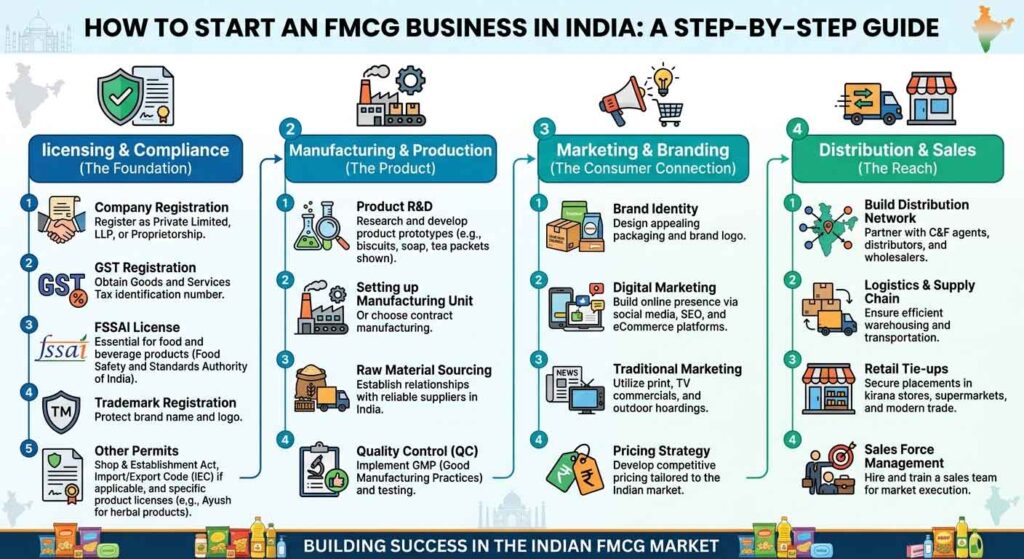
1. Start Your Own Manufacturing Unit
You establish your own factory and manufacture the products yourself.
You may need:
Industrial premises
Product manufacturing licence
Machinery
Production staff
Quality-control arrangements
Pollution-control approvals
Labour and occupational-safety compliance
Fire approval
Packaging systems
Working capital
This provides maximum control but normally requires the highest investment.
2. Start Through Third-Party Manufacturing
An existing licensed manufacturer makes products under your brand.
You focus on:
Brand development
Packaging
Marketing
Distribution
Online sales
Customer acquisition
For a new FMCG entrepreneur, this is often the easiest way to test the market before constructing a factory.
3. Start as a Distributor or Wholesaler
You purchase established brands and supply:
Retail shops
Supermarkets
Pharmacies
Wholesalers
Institutions
Online sellers
Product-specific distribution licences may still be required—for example, FSSAI licensing for food businesses.
4. Start as a D2C or Online FMCG Brand
You manufacture through a third party and sell through:
Your website
Amazon
Flipkart
Quick-commerce platforms
Social media
Marketplaces
Online businesses must also comply with the applicable Consumer Protection (E-Commerce) Rules and product-specific regulations.
Step 1: Select the Product Category
Do not begin by registering a company first and deciding the product later.
Prepare a list of the exact products you want to launch.
Then determine the correct legal category for each product.
Food and Beverage FMCG Business
Food and beverages include products such as:
Packaged foods
Bakery products
Dairy products
Confectionery
Juices
Tea
Coffee
Chocolates
Biscuits
Namkeen
Bottled water
Health beverages
Nutritional foods
Every Food Business Operator must obtain the appropriate FSSAI registration or licence according to its activity and eligibility. Applications are handled through FoSCoS. The portal specifically covers activities including manufacturing, wholesaling, distribution, retail, transport and storage. FSSAI amended its licensing and registration framework again in 2026, so old turnover thresholds from older articles should not be copied without checking the current FoSCoS eligibility tool.
A food company may require an FSSAI licence as:
Manufacturer
Marketer
Distributor
Wholesaler
Retailer
Storage operator
E-commerce operator
Importer
depending on its operations.
Examples
If you manufacture biscuits yourself, you need the appropriate manufacturing licence.
If another factory manufactures biscuits under your brand, the manufacturer and marketer/business operator must each ensure their respective FSSAI requirements are fulfilled.
Health Supplements and Nutraceuticals
Health supplements, protein powders, nutritional supplements and nutraceuticals normally fall under the food regulatory framework when legally classified as food products.
They should not automatically be treated as pharmaceutical drugs just because they are sold in:
Capsules
Tablets
Sachets
Syrups
Powders
FSSAI licensing applies according to the exact product and activity. FoSCoS also identifies qualified-person requirements for certain food-manufacturing activities.
Claims require special care.
A food supplement should not be marketed as though it is an approved medicine for curing a disease unless it actually falls under the applicable drug framework.
Cosmetics and Personal-Care Products
Cosmetics include products intended to cleanse, beautify, improve attractiveness or alter appearance.
Examples may include:
Face wash
Shampoo
Cosmetic cream
Lotion
Moisturiser
Serum
Lipstick
Nail polish
Hair colour
Perfume
Deodorant
Cosmetic gel
Manufacturing cosmetics in India is regulated under the Cosmetics Rules, 2020, and domestic manufacturing licences are granted through the respective State Licensing Authorities.
A cosmetic must also meet applicable standards, and false or misleading cosmetic claims are prohibited.
Important Correction: “Ayurvedic Cosmetic”
Do not assume that adding herbal ingredients automatically allows a product to be manufactured under an Ayurvedic medicine licence.
A herbal shampoo can still legally be a cosmetic.
Classification depends on:
Composition
Intended use
Claims
Product presentation
Applicable legal definition
The correct licence must be established before launch.
Toiletries and Household Cleaning Products
Products such as:
Laundry detergent
Dishwashing liquid
Floor cleaner
Toilet cleaner
Furniture polish
Shoe polish
Air freshener
are not automatically cosmetics.
They may fall primarily under general consumer-product, chemical, environmental, Legal Metrology, BIS or other product-specific requirements.
Products that legally qualify as insecticides can require registration under the Insecticides Act and related licensing. The Insecticides Act requires registration of insecticides intended for manufacture or import.
Therefore, a mosquito-control claim can materially change the regulatory position.
Pharmaceutical and Consumer Healthcare Products
Products such as:
Medicinal balms
Medicated ointments
Medicinal cough preparations
Analgesic preparations
Pharmaceutical tablets or syrups
may fall under the Drugs and Cosmetics framework.
Do not assume that because a medicine can be purchased without a prescription it becomes an ordinary FMCG product.
If the product is legally a drug, manufacturing must comply with the appropriate drug-licensing requirements.
This is different from:
Food supplements
Cosmetics
Ayurvedic medicines
even if consumers perceive all of them as “healthcare FMCG.”
Ayurvedic FMCG Products
Ayurvedic businesses may deal with:
Classical medicines
Patent/proprietary Ayurvedic medicines
Herbal syrups
Tablets
Capsules
Oils
Churna
These are regulated under the Ayurvedic, Siddha and Unani provisions of the Drugs Rules when legally classified as medicines.
However, not every “herbal” product is an Ayurvedic medicine.
A herbal:
Food
Supplement
Cosmetic
may belong under a different regulatory regime.
Always classify first.
Electronics and Household Consumer Goods
Some fast-moving electronics and household products include:
LED products
Chargers
Headphones
Small appliances
Batteries
Consumer electronics
These products may need:
BIS registration/certification
Quality Control Order compliance
Electrical safety compliance
E-waste EPR
Battery EPR
depending on the product.
There is no single licence applicable to every electronic FMCG item.
Stationery Products
Products may include:
Pens
Pencils
Notebooks
Markers
Colour products
Staplers
Boxes
Many ordinary stationery products do not require a sector-specific manufacturing licence, but businesses still need applicable:
Business registration
Tax compliance
Legal Metrology compliance
BIS/QCO compliance where a product is specifically notified
Labour/environmental permissions for manufacturing
Do not write that stationery products are universally “licence-free.”
Sanitary and Hygiene Products
This category may include:
Sanitary napkins
Baby diapers
Adult diapers
Tissues
Cotton products
Wipes
Other personal-hygiene articles
Regulation depends on the exact intended use, claims, standards and construction.
For example, a general hygiene item and a product making a wound-care or medical-device claim may follow very different rules.
Common Registrations for an FMCG Business
The following registrations may apply in addition to the main product licence.
1. Business Registration
You can operate as:
Proprietorship
Partnership
LLP
Private Limited Company
Choose the structure according to:
Owners
Investment
Liability
Funding plans
Scale
2. GST Registration
GST registration depends on:
Turnover
State
Type of supply
Interstate transactions
E-commerce activity
Exempt/taxable goods
Applicable notifications
A ₹40-lakh threshold exemption exists for certain persons exclusively supplying goods, subject to the applicable conditions and jurisdiction. Special rules also allow certain eligible small sellers to supply goods through e-commerce operators without mandatory GST registration, subject to conditions under Notification 34/2023.
For an FMCG company planning pan-India distribution, marketplaces and input-tax-credit claims, GST registration is often commercially practical even where a specific exemption may technically be available.
3. Udyam Registration
Udyog Aadhaar is obsolete.
The current MSME system is Udyam Registration.
Udyam registration is:
Online
Paperless
Based largely on self-declaration
Free on the official government portal
Current MSME classification from April 2025 uses revised investment and turnover thresholds.
4. Trademark Registration
Before finalising your FMCG brand, search and consider protecting:
Company name
Brand name
Logo
Product sub-brand
FMCG packaging can become expensive very quickly, so trademark checking should ideally happen before printing thousands of labels, cartons or pouches.
5. Legal Metrology
Most pre-packaged FMCG products must also be examined under the Legal Metrology (Packaged Commodities) Rules, 2011.
Rule 27 provides for registration of applicable:
Manufacturers
Packers
Importers
of packaged commodities.
Depending on the product, labels may need declarations such as:
Manufacturer/packer/importer details
Net quantity
MRP
Consumer-care information
Month/year details
Other prescribed declarations
Product-specific regulations such as FSSAI or Cosmetics Rules apply in addition to Legal Metrology requirements where relevant.
6. Plastic Packaging EPR
If your brand introduces plastic packaging into the market, you may fall within the Producer, Importer or Brand Owner (PIBO) framework under the Plastic Waste Management Rules.
CPCB requires applicable producers, importers and brand owners to register and manage their Extended Producer Responsibility obligations. In June 2026, CPCB migrated EPR operations to its new Common EPR Portal.
This may affect businesses using:
Plastic bottles
Pouches
Wrappers
Sachets
Plastic jars
Laminated packaging
Do not treat packaging compliance as only the manufacturer’s responsibility when you are the brand owner.
7. Factory, Labour and Occupational-Safety Compliance
India implemented its four labour codes on November 21, 2025, including the Occupational Safety, Health and Working Conditions Code, 2020, with Central Rules issued in 2026. Applicable registration, licensing and workplace requirements now need to be checked under the current labour-code/state framework according to worker numbers and the nature of the establishment.
A manufacturing project may also need:
State pollution-control consent
Fire approval
Local building/use permission
Industrial electricity approval
Labour registrations
Occupational-safety compliance
depending on the premises and process.
Step-by-Step Procedure to Start an FMCG Company
Step 1: Identify the Customer
Decide whether your buyer is:
Mass consumer
Premium consumer
Rural customer
Urban customer
Pharmacy customer
Online shopper
Institutional buyer
Step 2: Select One Focused Category
A new startup should avoid launching:
Shampoo
Protein powder
Floor cleaner
Biscuits
Diapers
all together.
Each need different:
Suppliers
Licences
Marketing
Distribution
Customer behaviour
A focused portfolio is easier to manage.
Step 3: Study Competitors
Compare:
MRP
Net quantity
Ingredients
Packaging
Retailer margin
Distributor margin
Marketplace price
Reviews
Claims
Positioning
Step 4: Select the Business Model
Choose:
Own manufacturing
Contract manufacturing
Private label
Distribution
Importing
D2C
Step 5: Confirm Regulatory Classification
Do this before finalising the formulation or packaging.
Step 6: Register the Business
Complete applicable:
Entity registration
PAN
Bank account
GST
Udyam
Trademark
Step 7: Obtain Product-Specific Licence
For example:
FSSAI
Cosmetic licence
Drug licence
AYUSH manufacturing licence
Insecticide registration/licence
BIS/QCO requirements
Step 8: Develop the Product
Confirm:
Formula
Specifications
Raw materials
Shelf life
Testing
Packaging compatibility
Step 9: Develop Packaging
Packaging should be:
Protective
Compliant
Transport-friendly
Shelf-friendly
Cost-effective
Easy to identify
Step 10: Approve the Label
Check:
Ingredients
Net quantity
MRP
Batch
Manufacturing date
Expiry/best before
Manufacturer
Marketer
Consumer care
Product-specific declarations
Step 11: Manufacture a Controlled First Batch
Do not manufacture excessive inventory simply to obtain a lower rate.
A cheap unit price can become expensive if stock expires or does not move.
Step 12: Build Distribution
Possible channels include:
Distributor
Super-stockist
Retailer
Modern trade
Supermarkets
E-commerce
Quick commerce
Own website
Direct selling
Step 13: Monitor Secondary Sales
Do not judge success only by stock sent to distributors.
Track:
Retail movement
Repeat order
Stock days
Returns
Customer feedback
Expiry
Marketplace conversion
How Much Investment Is Required?
There is no fixed investment.
A business using third-party manufacturing can start with significantly less capital than a business building its own manufacturing facility.
Major cost heads include:
Company registration
Licensing
Trademark
Product development
Testing
MOQ
Packaging
Design
Warehouse
Marketing
Sales staff
Distributor credit
Freight
E-commerce fees
Working capital
A practical formula is:
Initial investment = setup/compliance + product development + first inventory + packaging + marketing + distribution + working-capital reserve
Do not invest all your available money in stock.
Own Manufacturing vs Third-Party Manufacturing
Factor
Own Manufacturing
Third-Party Manufacturing
Initial investment
High
Lower
Licensing burden
High
Lower for brand owner
Production control
Maximum
Moderate
Speed to launch
Slower
Faster
Technical staff
Required
Manufacturer handles
Machinery
Required
Not required
Suitable for beginner
Less suitable
Often more suitable
For a startup that has not yet proved demand, private-label or third-party manufacturing can be a sensible first stage.
Common Mistakes to Avoid
Avoid:
Treating FMCG as a licence category
Launching too many unrelated products
Purchasing machinery before confirming regulation
Calling every herbal product Ayurvedic
Calling every supplement an OTC medicine
Using outdated Udyog Aadhaar information
Applying an old fixed GST threshold to every situation
Ignoring Legal Metrology
Ignoring plastic EPR
Printing packaging before trademark search
Making unsupported health claims
Ordering excessive stock
Ignoring distributor credit
Copying competitor labels
Depending on a single sales channel
Frequently Asked Questions
1. What is FMCG?
FMCG means Fast-Moving Consumer Goods—products that generally sell frequently and move rapidly through retail channels.
2. Is there a separate FMCG licence?
No. Licensing depends on the specific product.
3. Can I start an FMCG company without a factory?
Yes. You may use contract or third-party manufacturing.
4. Is FSSAI required for every FMCG product?
No. FSSAI applies to food businesses, not to every FMCG category. Every Food Business Operator must obtain the appropriate FSSAI registration/licence.
5. Is Udyog Aadhaar still valid for new registration?
New MSME registration is through Udyam Registration.
6. Does every cosmetic need an Ayurvedic licence?
No. Ordinary cosmetics are regulated under the Cosmetics Rules, 2020.
7. Is GST compulsory above ₹40 lakh?
Not as a universal rule. Thresholds and compulsory-registration provisions depend on the business, jurisdiction and nature of supplies.
8. Can I sell FMCG products online?
Yes, subject to applicable product, GST, marketplace and e-commerce consumer-protection requirements.
9. Is trademark compulsory?
Trademark registration is not a universal product licence, but protecting the brand before major packaging and advertising investment is strongly recommended.
10. Is Legal Metrology applicable?
Many pre-packaged FMCG goods fall under the Packaged Commodities Rules, including manufacturer/packer/importer registration requirements where applicable.
11. Does a brand owner have responsibility for plastic packaging?
Applicable Producers, Importers and Brand Owners have EPR obligations under the Plastic Waste Management framework.
12. Which FMCG category is easiest for a startup?
There is no universally easiest category. A simple, shelf-stable product available through an experienced third-party manufacturer can reduce operational complexity, but the best option depends on your market and regulatory expertise.
Final Thoughts
The correct way to start an FMCG business is:
Product selection → regulatory classification → market research → business model → licences → product development → packaging → manufacturing → distribution → repeat sales
Do not start with:
Company registration → machinery purchase → then ask which licence applies.
For a new entrepreneur, a focused range of two to five products manufactured through an experienced contract manufacturer is often a more manageable starting point than immediately establishing a multi-category factory.
Looking for Ayurvedic Franchise or Distribution Opportunities?
Looking to start an Ayurvedic franchise, become a distributor, or launch your own herbal product range?
Elzac Herbal India offers:
Ayurvedic & Herbal Product Range
Franchise & Distribution Opportunities
Third-Party Manufacturing
Product Development Support
Marketing Guidance
PAN India Business Opportunities
Whether you are an entrepreneur, retailer, distributor, or healthcare professional, our team can help you explore the right business opportunity in the growing Ayurvedic sector.
Ajay Kamboj is an entrepreneur and business owners associated with many Ayurvedic and Pharmaceutical start-ups. With years of experience in Ayurvedic product marketing, pharmaceutical distribution, franchise development, and client relationship management, he regularly shares practical business insights based on real-world experiences. His articles focus on business growth, entrepreneurship, customer management, and lessons learned from the healthcare and wellness industry.



Leave a Reply
You must be logged in to post a comment.