Yes, you can commercialize a home-developed Ayurvedic formulation in India, but you cannot legally sell it as a medicine just because it worked in personal use. You first need to decide the correct regulatory category, protect your formula appropriately, manufacture through a licensed and compliant setup, build evidence for safety and effectiveness, and avoid unsupported medical claims. If you are not formally qualified in Ayurveda, that does not automatically stop you from becoming the founder or brand owner; the law focuses on licensed manufacturing and competent technical supervision, which many founders satisfy through qualified staff or licensed third-party/loan-license arrangements. That said, the more aggressive your claims, the stronger your evidence and legal diligence must be.
How to Commercialize Homemade Ayurvedic Products
Many entrepreneurs in India come from families with deep traditional knowledge. A grandmother’s digestive formulation, a family oil for hair and scalp care, or a classical rejuvenation recipe from old Sanskrit texts may work extremely well in practice. The challenge begins when you try to convert that family formulation from a household remedy into a commercial product.
The first thing to understand is that your encouraging observations should be treated as anecdotal, not as market-ready proof. If a person reports better skin, lower hair fall, more exercise stamina, or reduced soreness, that may justify further investigation, but it is still not enough to market the product as a cure, an anti-aging breakthrough, or a therapy for serious conditions such as Alzheimer’s disease. Once you step into commercialization, regulators care about category, safety, consistency, evidence, labeling, and claims. India also regulates health-product advertising through laws including the Drugs and Magic Remedies framework, so unsupported therapeutic claims can create risk.
Regulatory Requirements
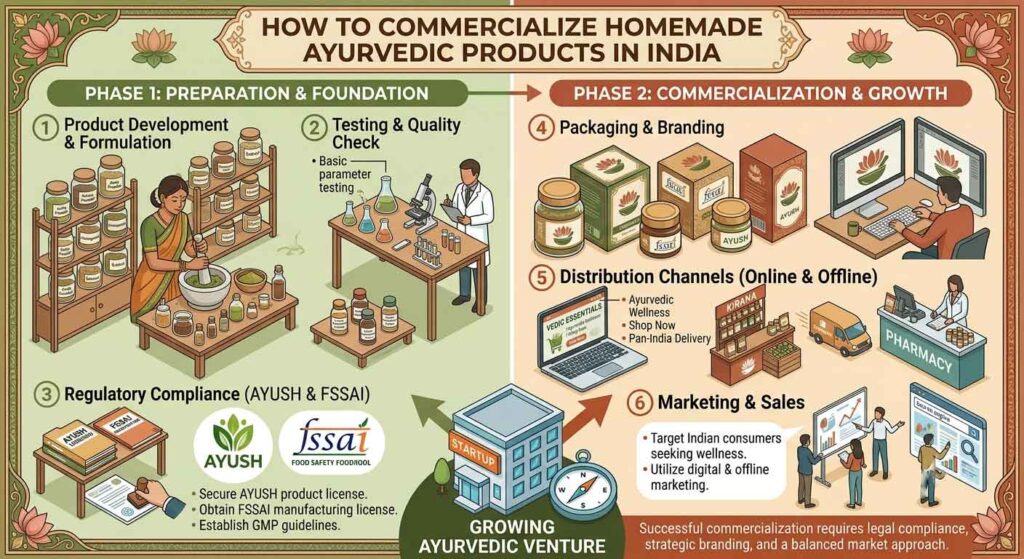
The most important decision is to choose the right regulatory path. If your product is an Ayurvedic medicine, you need to work within the ASU drug regime. Rule 158B separates classical products manufactured exactly according to the authoritative books from patent or proprietary products containing ingredients drawn from the authoritative books but formulated in a new way not appearing as a classical formula. The same rule also recognizes categories such as preventive health promoter formulations and oral/skin/hair/body care formulations, but they still sit within a rule-based licensing framework when positioned as ASU products. If, instead, you want to position a product as a food supplement or nutraceutical, that falls under FSSAI, not the ASU drug route. FSSAI’s current guidance also makes clear that “Ayurveda Aahara” excludes Ayurvedic drugs and proprietary Ayurvedic medicines. In practical terms, that means you should decide the category before you invest in packaging, brand strategy, or claims.
If you choose the Ayurvedic medicineroute, you have two broad commercialization models. The first is to set up your own manufacturing unit. Under the Drugs Rules, an application to manufacture Ayurvedic, Siddha, or Unani drugs for sale is made in Form 24D, and the manufacturing licence is issued in Form 25D. The premises must satisfy Schedule T GMP requirements, and the licensing framework now runs through the e-AUSHADHI portal. The second route is often more practical for first-time founders: a loan licence or third-party-style arrangement. Rule 153A/154A contemplates a loan licence in Forms 24E/25E for applicants who do not have their own manufacturing arrangements and instead use the facilities of a Form 25D licensee. For a non-technical founder, this is usually the most realistic way to enter the market with lower capital risk.
Can Non Ayurvedic Person start Business?
A related concern from the original query was: “How to take it forward without being qualified on paper?” The rules do not say that the founder must personally hold an Ayurveda degree. What they do require is that manufacturing be conducted under the supervision of competent technical staff. Rule 157 states that manufacture must be under at least one whole-time qualified person, and then lists acceptable qualifications such as a degree in Ayurveda/Ayurvedic Pharmacy or certain other relevant qualifications and experience. So, as a practical reading of the rules, a non-BAMS founder can still commercialize a product by building the business entity, hiring or partnering with the required qualified professionals, and using licensed manufacturing infrastructure. That distinction is crucial and should be explained clearly in the article.
Document your Formula
Before talking to investors, manufacturers, or brand partners, you need to document your formula properly. Maintain contemporaneous records showing ingredient identity, source, batch notes, method of preparation, expected yield, storage conditions, observations, and any preliminary user feedback. Also document what comes from classical texts and what is genuinely your own formulation logic or preparation innovation. This does two things: it improves technology transfer when you move to scale, and it helps you understand whether any real intellectual property is available.
Intellectual Property
On IP, the correct advice is not “always file a patent.” India’s patent guidance for AYUSH inventions is explicit that traditional knowledge, or duplication/aggregation of known properties of traditionally known components, is excluded under Section 3(p). Section 3(e) also bars a mere admixture unless you can show a synergistic effect beyond the sum of the parts. At the same time, the AYUSH patent examination guidance notes that patentability can still arise where a process or composition shows novelty, inventive step, or a demonstrable unexpected/synergistic effect. For many Ayurvedic founders, a trade secret + NDA + strong trademark strategy is more practical than assuming a patent will be granted. India’s TKDL exists precisely because patent offices use it to screen traditional medicine prior art.
Trademark protection, by contrast, is often extremely useful. Your formula may be hard to patent, but your brand can still become valuable. The Trade Marks Registry provides the standard filing workflow, public search tools, and official fee schedules. For example, the official fee page shows concessional filing fees for individuals, startups, and small enterprises. Even if you are still validating the formulation, you should shortlist a distinctive brand name early and search availability before designing packaging.
Scientific Evaluation of Formula
The next stage is scientific validation, and this is where many traditional innovators either over-promise or give up too early. Validation does not have to begin with a large multicentric trial. Start with what regulators and serious partners will respect: authenticated raw materials, repeatable manufacturing SOPs, pilot batches, stability work, and a realistic evidence dossier. Rule 160 requires raw materials used in ASU preparation to be identified and tested where tests are available, and Rule 161B requires shelf-life or expiry information to be supported by scientific data based on real-time stability studies in accordance with applicable pharmacopoeial guidance. For proprietary ASU medicines, Rule 158B already anticipates textual rationale, relevance of ingredients, and in certain cases pilot studies or stronger effectiveness evidence.
If you want to approach clinical trials, do it in the right order. First, define one narrow research question. Do not begin with “this may cure Alzheimer’s.” Begin with something testable and ethically proportionate, such as tolerability, quality-of-life support, exercise recovery, or a dermatology/wellness endpoint that matches the intended category and available evidence. Second, work with a qualified investigator and an institution that has ethics-review capability. Third, prepare a protocol aligned with AYUSH GCP and ICMR ethics norms. Fourth, obtain ethics approval and register the study prospectively in CTRI before enrolling the first participant. CTRI states clearly that trials involving human participants, including those in the purview of AYUSH, are expected to be registered before enrollment, and submission of ethics approval is essential for registration.
Investment and Funding
Funding becomes much easier once you have this structure. Investors typically do not fund “a secret family remedy” at attractive terms; they fund a dossier. A credible dossier has a defined product category, documented formula, manufacturing pathway, preliminary quality data, claims discipline, and a clear commercialization model. For early-stage support, Startup India’s Seed Fund Scheme is explicitly meant for proof of concept, prototype development, product trials, market entry, and commercialization. Startup India also operates Investor Connect and a mentorship ecosystem. In the biotech and life-sciences space, BIRAC continues to offer incubation, early-stage financing, and commercialization-oriented programs such as BIG, BioNEST, equity funding tracks, and product commercialization funds. On the AYUSH research side, CCRAS describes collaborative research activity and has long positioned extramural and collaborative research as part of evidence development for Ayurveda.
Labelling and claims
Once you are ready to launch, remember that labeling and claims are part of commercialization, not an afterthought. Rule 161 requires the label to display the true list of ingredients, including botanical names of plant-based ingredients and plant parts/forms, along with other mandatory particulars such as the manufacturer’s name and address, manufacturing licence number, batch number, manufacturing date, and whether the product is an Ayurvedic medicine. If the product contains Schedule E ingredients and is for internal use, the caution statement about medical supervision applies. This means packaging design should happen only after the regulatory lane, formula, and final label copy are settled.
Key takeaways:
A homemade Ayurvedic formula can absolutely become a real business, but not by jumping directly from anecdote to advertising. The practical sequence is: classify the product correctly, secure the formula and brand, choose licensed manufacturing, build a quality dossier, validate claims in a staged way, and only then scale sales.
FAQs
Can I commercialize an Ayurvedic product if I am not a BAMS doctor? Yes, potentially. The law focuses on licensed manufacturing and competent technical supervision. In practice, non-AYUSH founders usually commercialize by hiring qualified technical staff or using licensed third-party/loan-license manufacturing setups.
Do I need my own manufacturing plant? No. You can apply for your own manufacturing setup under Form 24D/25D, but the rules also provide for a loan licence under Form 24E/25E if you intend to use the facilities of an existing licensed manufacturer.
Should I patent my family formulation? Not automatically. If the formula is essentially traditional knowledge or a mere admixture of known ingredients, patentability may fail under Sections 3(p) and 3(e). You should get a proper IP opinion before spending on patent filing.
What is safer for most first-time founders: own plant or tie-up? For most beginners, a tie-up with a licensed manufacturer or a loan-licence model is safer because it reduces capital burden and lets you focus first on validation, branding, and market development. This is a practical business inference based on how the licensing framework is structured.
How do I start clinical validation? Start with a narrow protocol, partner with a qualified investigator and ethics-enabled institution, obtain ethics approval, and register the trial in CTRI before enrolling participants. Human studies should align with AYUSH GCP and ICMR ethical guidelines.
Can I market my product as an anti-aging or Alzheimer’s cure based on personal testimonies? You should not do that without adequate scientific evidence and legal review. The more disease-specific and high-stakes the claim, the more evidence, ethics, and regulatory scrutiny you need.
Partner with Elzac Herbal India
Looking to start an Ayurvedic franchise, become a distributor, or launch your own herbal product range?
Elzac Herbal India offers:
Ayurvedic & Herbal Product Range
Franchise & Distribution Opportunities
Third-Party Manufacturing Services
Product Development Support
Marketing Guidance
PAN India Business Opportunities
Whether you are an entrepreneur, retailer, distributor, or healthcare professional, our team can help you explore the right business opportunity in the growing Ayurvedic sector.
Ajay Kamboj is an entrepreneur and business owners associated with many Ayurvedic and Pharmaceutical start-ups. With years of experience in Ayurvedic product marketing, pharmaceutical distribution, franchise development, and client relationship management, he regularly shares practical business insights based on real-world experiences. His articles focus on business growth, entrepreneurship, customer management, and lessons learned from the healthcare and wellness industry.






Leave a Reply Cancel reply
You must be logged in to post a comment.