Starting a pharmaceutical manufacturing company is a major business decision that requires careful planning, regulatory compliance, and a long-term vision.
A common question asked by entrepreneurs planning to invest in a manufacturing facility is:
“Should I manufacture high-end generics or focus on low-cost, high-volume generic medicines?”
There is no one-size-fits-all answer.
The right strategy depends on your investment, manufacturing capabilities, target market, competition, and long-term business objectives.
In this guide, we’ll compare both approaches and discuss the factors you should evaluate before investing in a pharmaceutical manufacturing plant.
Is ₹1 Crore Enough to Start a Pharma Manufacturing Plant?
An investment of around ₹1 crore can be a starting point for certain pharmaceutical manufacturing projects, but the total capital requirement depends on several factors, including:
Product categories
Manufacturing capacity
Land and building costs
Machinery
Cleanroom requirements
Quality control laboratory
Regulatory compliance
Working capital
The actual investment may vary significantly depending on the scope of the project and local costs. Before making any investment, prepare a detailed business plan and consult qualified technical, regulatory, and financial professionals.
What Products Can a Pharma Manufacturing Plant Produce?
Depending on the infrastructure and regulatory approvals, a manufacturing unit may specialize in one or more dosage forms, such as:
Tablets
Capsules
Oral liquids and syrups
Dry syrups
Powders
Ointments, creams, and gels
Eye and ear drops
Soft gelatin capsules
Injections
Sprays and inhalation products
Many entrepreneurs begin with one or two dosage forms and expand as their business grows.
Understanding High-End and Low-End Generic Medicines
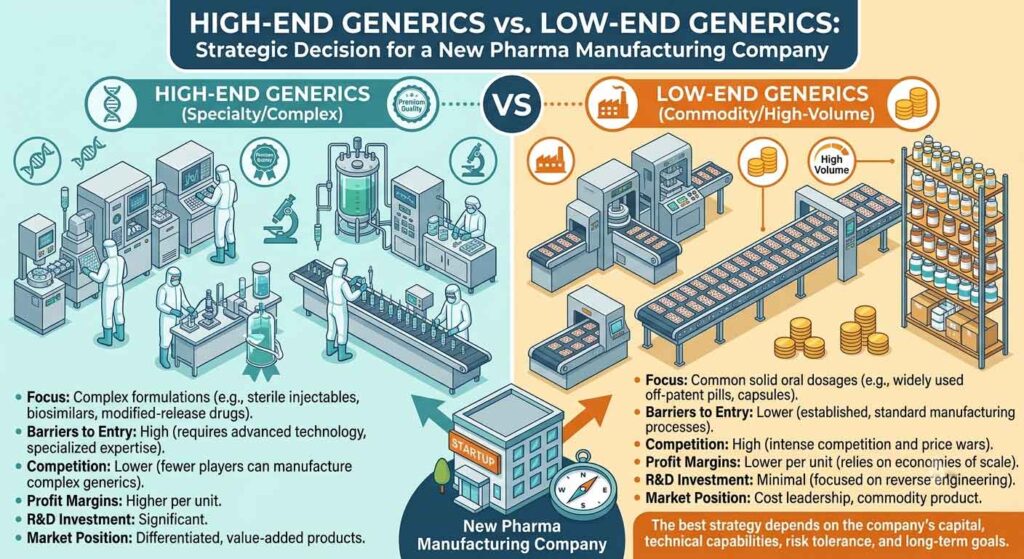
High-End Generic Strategy
High-end generics generally focus on:
Specialty therapies
Value-added formulations
Complex dosage forms
Lower competition
Better differentiation
Advantages
Potentially higher profit margins
Less price competition
Stronger brand positioning
Opportunity to build expertise in niche therapeutic areas
Challenges
Higher development costs
Greater technical complexity
More demanding marketing efforts
Slower market acceptance in some segments
Low-End Generic Strategy
Low-end generics usually focus on widely prescribed medicines with established demand.
Advantages
Large market size
Consistent demand
Easier product acceptance
Faster inventory movement
Challenges
Intense price competition
Lower profit margins
Numerous competitors
High dependence on efficient operations
Which Strategy Is Better?
Rather than choosing only one approach, many successful pharmaceutical companies adopt a balanced portfolio.
For example, they may include:
High-volume essential medicines to maintain steady sales.
Selected specialty or differentiated products to improve profitability and stand out in the market.
The ideal mix depends on your manufacturing capabilities, customer base, and long-term business goals.
Manufacturing Alone Is Not Enough
One of the biggest misconceptions among new entrepreneurs is that building a manufacturing plant automatically leads to business success.
In reality, manufacturing is only one part of the equation.
You also need a strong strategy for:
Branding
Sales
Marketing
Distribution
Regulatory compliance
Customer service
Inventory management
Without an effective sales and distribution network, even high-quality products may struggle to achieve commercial success.
Additional Revenue Opportunities
Many manufacturing companies supplement their own product sales by offering:
Third-party manufacturing
Contract manufacturing
Loan licence manufacturing
Private label manufacturing
These services can help improve production capacity utilization and generate additional revenue while your own brands continue to grow.
Questions to Answer Before Investing
Before setting up a pharmaceutical manufacturing plant, ask yourself:
Who will buy my products?
Which therapeutic segments will I focus on?
How will I build my distribution network?
What makes my company different from competitors?
Do I have a marketing strategy?
How much working capital will I need?
Can I maintain consistent product quality?
What are my long-term expansion plans?
Having clear answers to these questions will strengthen your business foundation.
Common Mistakes to Avoid
Many new manufacturers face challenges because they:
Invest heavily in infrastructure but neglect marketing.
Launch too many products without adequate market research.
Underestimate working capital requirements.
Focus only on manufacturing costs rather than total business costs.
Compete solely on price.
Ignore inventory planning and customer support.
Building a successful pharmaceutical company requires both technical excellence and sound business management.
Final Thoughts
Choosing between high-end generics and low-end generics should not be viewed as an either-or decision.
Instead, build a product portfolio that aligns with your technical capabilities, market opportunities, and long-term vision.
A successful pharmaceutical manufacturing business combines quality production, regulatory compliance, efficient operations, effective marketing, and strong customer relationships.
The companies that consistently deliver quality products and reliable service are the ones most likely to achieve sustainable growth.
Frequently Asked Questions (FAQs)
Which is more profitable: high-end or low-end generic medicines?
Profitability depends on market demand, competition, manufacturing efficiency, and marketing strategy. High-end generics may offer better margins, while low-end generics often provide larger sales volumes.
Is ₹1 crore sufficient to establish a pharma manufacturing unit?
It can be a starting point for certain manufacturing projects, but the total investment depends on the dosage forms, production capacity, infrastructure, equipment, regulatory requirements, and working capital.
Should I start with one product category or multiple categories?
Many entrepreneurs begin with one or two dosage forms and gradually expand after gaining operational experience and market acceptance.
Is manufacturing more profitable than third-party manufacturing?
Each model has its advantages. Manufacturing offers greater control over production, while third-party manufacturing allows companies to focus on branding and marketing with lower infrastructure investment.
What is the most important factor in building a successful pharma manufacturing business?
Success depends on a combination of quality products, regulatory compliance, efficient operations, effective marketing, strong distribution, and excellent customer service.
Partner with Elzac Herbal India
Looking to start an Ayurvedic franchise, become a distributor, or launch your own herbal product range?
Elzac Herbal India offers:
Ayurvedic & Herbal Product Range
Franchise & Distribution Opportunities
Third-Party Manufacturing Services
Product Development Support
Marketing Guidance
PAN India Business Opportunities
Whether you are an entrepreneur, retailer, distributor, or healthcare professional, our team can help you explore the right business opportunity in the growing Ayurvedic sector.
Ajay Kamboj is an entrepreneur and business owners associated with many Ayurvedic and Pharmaceutical start-ups. With years of experience in Ayurvedic product marketing, pharmaceutical distribution, franchise development, and client relationship management, he regularly shares practical business insights based on real-world experiences. His articles focus on business growth, entrepreneurship, customer management, and lessons learned from the healthcare and wellness industry.





Leave a Reply Cancel reply
You must be logged in to post a comment.