Students who complete Class 12 through the National Institute of Open Schooling, commonly known as NIOS, often have questions about their eligibility for pharmacy education.
Common questions include:
Can an NIOS student take admission in D.Pharm?
Are open-school students eligible for B.Pharm or Pharm.D?
Can an NIOS student register as a pharmacist?
Will the State Pharmacy Council accept an open-school certificate?
Were open-school qualifications previously rejected by PCI?
The confusion exists because the Pharmacy Council of India issued older circulars in 2007 and 2009 stating that National Open School qualifications were not approved at that time. PCI later changed and clarified its position through circulars issued in 2015.
A further clarification issued by PCI on January 12, 2026 has now made the position clearer.
Quick Answer
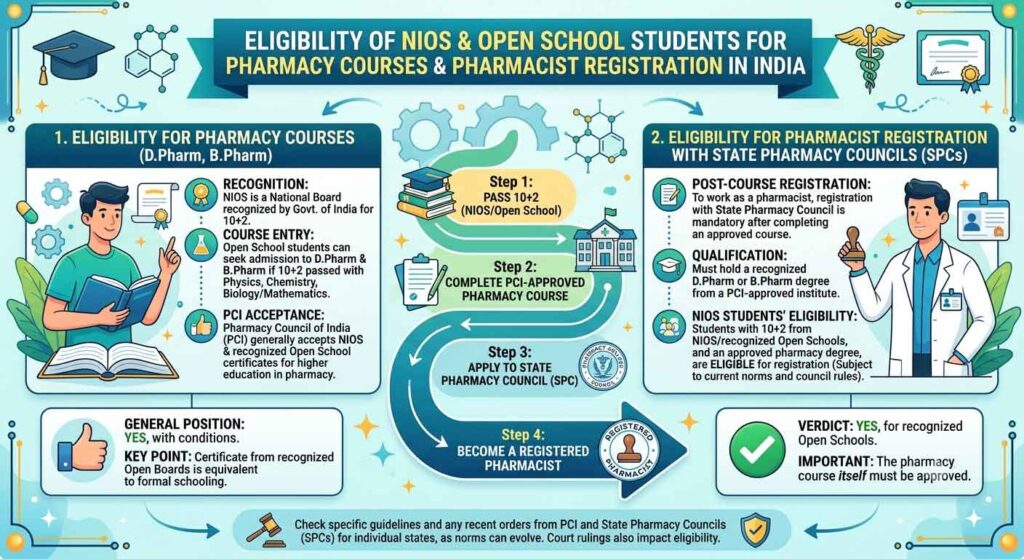
Students who have passed through an open-school education system operated by the Central Government or a State Government can be eligible for admission to:
Diploma in Pharmacy
Bachelor of Pharmacy
Doctor of Pharmacy
They may also be eligible for registration as pharmacists after completing an approved pharmacy course, provided they fulfil all other requirements under the Pharmacy Act, applicable Education Regulations and State Pharmacy Council procedures.
An open-school certificate alone does not create automatic eligibility. The student must also have the required subjects, complete the course from a PCI-approved institution and satisfy the applicable registration conditions.
What Was the Earlier PCI Position?
In 2007 and 2009, PCI issued circulars stating that National Open School qualifications were not approved for admission to pharmacy courses for the purpose of pharmacist registration.
Because of those circulars, many students, colleges and State Pharmacy Councils believed that students from NIOS or other open-school systems were not eligible.
This created difficulties for students who had:
Completed Class 12 through open schooling
Taken admission in D.Pharm or B.Pharm
Completed their pharmacy qualification
Applied for registration with a State Pharmacy Council
However, PCI reconsidered the matter in later years.
What Changed in 2015?
PCI issued circulars dated July 30, 2015 and September 7, 2015 regarding the eligibility of students from open-school education systems operated by Central and State Government institutions.
These circulars recognised eligible open-school students for admission to pharmacy courses for the purpose of registration as pharmacists.
The 2015 position effectively replaced the uncertainty created by the older 2007 and 2009 circulars.
What Did PCI Clarify in January 2026?
PCI issued another clarification on January 12, 2026.
According to the clarification, students who have passed through open-school education systems operated by Central or State Government institutions may be admitted to:
D.Pharm
B.Pharm
Pharm.D
Admission must still comply with the Education Regulations applicable to the particular course.
PCI also clarified that students from such open schools who have already completed or are currently pursuing a pharmacy course should be treated as eligible for pharmacist registration, subject to fulfilment of the other conditions prescribed under the Pharmacy Act, 1948.
This means that open-school education itself should not be the sole reason for rejecting an otherwise eligible candidate.
Is an NIOS Student Eligible for D.Pharm?
Yes, an NIOS student may be eligible for admission to D.Pharm, provided the student fulfils the applicable admission conditions.
These generally include:
Passing the required 10+2 or equivalent examination
Having the prescribed science subjects
Meeting the requirements of the Education Regulations
Taking admission in an institution approved by PCI
Following the admission rules of the examining authority, university or state
For pharmacy-course admission, students should normally have Physics and Chemistry along with Biology or Mathematics, according to the requirements applicable to the course.
The student should verify that all required subjects were passed individually and that the admission is accepted by the college, examining authority and relevant state authorities.
Is an NIOS Student Eligible for B.Pharm?
Yes, an eligible open-school student can be admitted to B.Pharm, subject to the applicable admission regulations.
The student must generally have:
Passed 10+2 or an equivalent examination
Studied English
Studied Physics and Chemistry
Studied either Mathematics or Biology
Met the applicable minimum marks or entrance requirements
Secured admission in a PCI-approved institution
University, state-counselling and entrance-examination requirements may also apply.
Therefore, PCI eligibility does not automatically guarantee admission to every college. The candidate must satisfy all applicable academic and admission conditions.
Is an Open-School Student Eligible for Pharm.D?
Yes. PCI’s January 2026 clarification also covers Pharm.D courses.
However, the candidate must satisfy the admission requirements prescribed under the Pharm.D Regulations, including the required 10+2 subjects or another permitted qualifying route.
Can an NIOS Student Register as a Pharmacist?
An NIOS or eligible government open-school student can be considered for registration as a pharmacist after completing an approved pharmacy qualification.
However, pharmacist registration is not granted merely because the student has passed Class 12 or obtained admission to a pharmacy college.
The candidate must normally:
Complete an approved pharmacy course.
Study at an institution approved by PCI for the relevant academic session.
Pass the approved examination.
Complete practical training wherever required.
Satisfy the conditions under the Pharmacy Act.
Meet any applicable exit-examination requirements.
Apply to the appropriate State Pharmacy Council.
Submit the prescribed documents and fee.
Registration is carried out by State Pharmacy Councils, not directly by PCI.
Which Pharmacy Qualifications Are Accepted for Registration?
The principal qualifications approved for pharmacist registration include:
D.Pharm
B.Pharm
Pharm.D
The course and institution must be approved in accordance with the Pharmacy Act.
A degree or diploma containing the word “pharmacy” is not automatically sufficient. Students should verify the approval status of both the course and institution.
Why Is PCI Approval of the College Important?
A student may satisfy the Class 12 eligibility requirement but still face registration problems if the pharmacy institution or admitted intake was not properly approved.
Before taking admission, students should verify:
Whether the college is approved by PCI
Whether the course is approved
Whether approval covers the relevant academic year
Whether the approved admission intake has been followed
Whether the examining authority or university is recognised
Whether the admission was made according to the prescribed qualification
Students should not rely only on verbal assurances from an admission agent or college representative.
Does Every Open-School Board Qualify?
PCI’s clarification refers to open-school education systems of Central Government and State Government institutions.
Therefore, students should not assume that every private or similarly named open-school board is automatically accepted.
Before admission, verify:
Who established or operates the board
Whether it is a Central or State Government open-school institution
Whether its Class 12 qualification is recognised
Whether the examining authority accepts it
Whether the pharmacy college accepts it under PCI regulations
Whether the State Pharmacy Council has issued any document-related instructions
NIOS is a Central Government open-school institution. For other boards, students should obtain written confirmation where eligibility is uncertain.
What Subjects Are Required?
An open-school student must have the same prescribed subjects as other students.
For most entry-level pharmacy courses, the qualifying examination requires science subjects such as:
Physics
Chemistry
Biology or Mathematics
Depending on the course, English and other conditions may also apply.
Open schooling does not allow a candidate to bypass the prescribed subject combination.
For example, a student who passed Class 12 through open schooling without the required science subjects may still be ineligible for a pharmacy course.
What About Students Who Took Additional Science Subjects Later?
This area can involve separate rules of the university, examining authority, counselling authority and State Pharmacy Council.
A student who originally completed Class 12 without the required subjects and later added Physics, Chemistry, Biology or Mathematics should obtain written confirmation before admission.
Do not rely only on a college’s verbal statement.
Ask the college or admission authority to confirm:
Whether additional-subject marksheets are accepted
Whether subjects from different examination sessions can be combined
Whether practical examinations were completed
Whether the university considers the qualification valid
Whether the State Pharmacy Council is likely to accept the documents during registration
Is Regular Schooling Compulsory?
The January 2026 PCI clarification recognises eligible students from government open-school systems. Therefore, regular classroom schooling should not be treated as the only permitted route merely because the pharmacy course follows a professional curriculum.
However, the pharmacy course itself must be completed according to PCI requirements. A regular D.Pharm, B.Pharm or Pharm.D course cannot be replaced with an unapproved distance or online pharmacy qualification.
Can Pharmacy Be Studied Through Distance Education?
Students should distinguish between:
Completing Class 12 through an eligible open-school system; and
Trying to complete the professional pharmacy course through distance education.
These are not the same.
An eligible open-school Class 12 qualification may be accepted for admission. However, D.Pharm, B.Pharm and Pharm.D must be studied through an approved institution and in the prescribed mode.
An unapproved online, correspondence or distance pharmacy qualification may not make the candidate eligible for pharmacist registration.
Is the D.Pharm Exit Examination Required?
PCI’s current FAQ states that the Diploma in Pharmacy Exit Examination applies from the 2022–23 D.Pharm batch.
After passing the applicable exit examination, the candidate may become entitled to registration, subject to the other requirements under the Pharmacy Act.
Therefore, an open-school student completing D.Pharm must satisfy the same exit-examination requirements as other D.Pharm students when those requirements apply to the candidate’s batch.
Who Grants Pharmacist Registration?
Pharmacist registration is granted by the respective State Pharmacy Council.
PCI regulates pharmacy education and approves courses and institutions, but students normally submit their registration applications to the State Pharmacy Council where they reside or practise.
The State Council may check:
Date of birth
Residence
Class 10 and 12 certificates
Subject combination
Pharmacy qualification
PCI approval of the institution
Practical-training certificate
Exit-examination result, where applicable
University or board verification
Identity and address documents
What Should a Student Do Before Taking Admission?
An open-school student should take the following precautions.
1. Check the Open-School Board
Confirm that the qualification was issued by an eligible Central or State Government open-school institution.
2. Check the Subject Combination
Verify that the marksheet contains the subjects required for the intended pharmacy course.
3. Check the College’s PCI Approval
Confirm approval for the course and academic year.
4. Ask for Written Confirmation
Request the institution or counselling authority to confirm the eligibility in writing or through official admission documentation.
5. Preserve All Documents
Keep:
Original marksheets
Passing certificate
Migration certificate
Transfer certificate
Subject practical records
Admission letter
Fee receipts
PCI approval details
College prospectus
Relevant PCI circulars
6. Contact the State Pharmacy Council
Where doubt remains, send a written query to the State Pharmacy Council before paying a large non-refundable admission fee.
What Should a Student Do If Registration Is Rejected?
If registration is refused only because Class 12 was completed through an eligible government open-school system, the student should:
Ask for the rejection reason in writing.
Obtain a copy of the applicable State Council rules.
Submit the relevant PCI open-school circulars.
Submit the January 12, 2026 PCI clarification.
Provide proof that the pharmacy institution and course were approved.
Show compliance with the required subjects and training.
File a formal representation before the State Pharmacy Council.
Seek professional legal advice where necessary.
The student should first determine whether the rejection relates to open schooling or to another issue, such as missing subjects, an unapproved institution, invalid admission or incomplete practical training.
Answer to the Original Query
A student who completed Class 12 through NIOS with Physics, Chemistry and Mathematics may be eligible to take or continue admission in D.Pharm, provided:
The NIOS qualification is valid.
The required subjects were passed.
The admission complies with D.Pharm Education Regulations.
The college and course are approved by PCI.
The examining authority accepts the admission.
Practical training and other course conditions are completed.
The applicable D.Pharm exit examination is passed.
The State Pharmacy Council’s registration requirements are fulfilled.
The student should not leave the course solely because of the outdated 2007 or 2009 circulars. The later PCI circulars and the January 2026 clarification recognise eligible Central and State Government open-school students.
Frequently Asked Questions
1. Can an NIOS student take admission in D.Pharm?
Yes, provided the candidate has the prescribed subjects and satisfies the applicable D.Pharm admission regulations.
2. Can an NIOS student become a registered pharmacist?
Yes, after completing an approved pharmacy qualification and satisfying all applicable registration requirements.
3. Did PCI previously reject NIOS qualifications?
PCI issued restrictive circulars in 2007 and 2009. It later reconsidered the matter through its 2015 circulars and clarified the eligibility of government open-school students again in January 2026.
4. Is every open-school student eligible?
No. The open-school institution, subject combination, pharmacy course, college approval and other statutory requirements must all be valid.
5. Is an NIOS certificate equal to regular Class 12 for pharmacy admission?
It can be accepted for pharmacy-course eligibility when the candidate satisfies PCI’s applicable requirements. Course-specific, university and counselling conditions must also be fulfilled.
6. Can an arts or commerce open-school student join D.Pharm?
Generally, no. The student must possess the prescribed science subjects required for admission.
7. Can I study D.Pharm through distance education?
An open-school Class 12 qualification and a distance-mode professional pharmacy course are different matters. The professional course must be completed from a PCI-approved institution in the prescribed mode.
8. Who decides pharmacist registration: PCI or State Pharmacy Council?
The State Pharmacy Council processes and grants pharmacist registration. PCI regulates pharmacy education and approval of courses and institutions.
9. Is the D.Pharm exit examination compulsory?
PCI states that the exit-examination requirement applies from the 2022–23 D.Pharm batch. Candidates should check the latest PCI and State Council instructions applicable to their batch.
10. What is the safest step before admission?
Obtain written confirmation from the college or counselling authority and verify the institution’s current PCI approval. Where uncertainty remains, contact the relevant State Pharmacy Council.
Important Disclaimer
This article provides general educational information based on PCI circulars and publicly available regulations. Admission and registration decisions depend on the candidate’s documents, subjects, institution, academic year and applicable State Pharmacy Council procedure.
Students should obtain written confirmation from the concerned admission authority or State Pharmacy Council before taking a final decision.
Looking for Ayurvedic Franchise or Distribution Opportunities?
Looking to start an Ayurvedic franchise, become a distributor, or launch your own herbal product range?
Elzac Herbal India offers:
Ayurvedic & Herbal Product Range
Franchise & Distribution Opportunities
Third-Party Manufacturing
Product Development Support
Marketing Guidance
PAN India Business Opportunities
Whether you are an entrepreneur, retailer, distributor, or healthcare professional, our team can help you explore the right business opportunity in the growing Ayurvedic sector.
Ajay Kamboj is an entrepreneur and business owners associated with many Ayurvedic and Pharmaceutical start-ups. With years of experience in Ayurvedic product marketing, pharmaceutical distribution, franchise development, and client relationship management, he regularly shares practical business insights based on real-world experiences. His articles focus on business growth, entrepreneurship, customer management, and lessons learned from the healthcare and wellness industry.
2 responses to “Are NIOS and Open-School Students Eligible for Pharmacy Courses and Pharmacist Registration?”
Sir, same situation at me but But Sir I am doing B Pharma Sir, I want to ask that Can I get a degree and license, sir?



Sir, same situation at me but But Sir I am doing B Pharma Sir, I want to ask that Can I get a degree and license, sir?
I have done my 12th from Assam state open school PCB, can I take admission into D. Pharmacy?
Please let me know.