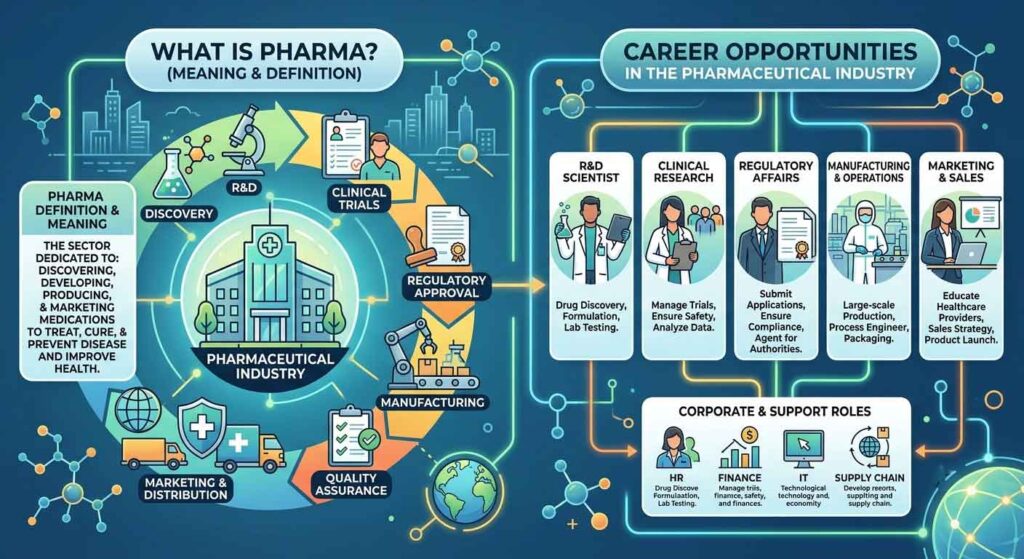
Pharma is the short form of Pharmaceuticals, a broad industry involved in the discovery, development, manufacturing, distribution, marketing, and sale of medicines and healthcare products.
In simple words:
Pharma is the industry responsible for developing and delivering medicines that help prevent, diagnose, and treat diseases.
If an interviewer asks, “What is Pharma?”, a professional answer would be:
“Pharma refers to the pharmaceutical industry, which includes all activities related to medicines and healthcare products, from research and development to manufacturing, quality control, marketing, distribution, and patient care.”
Query
My query is about an interview. If an interviewer asks me, “What is Pharma?” then what should I reply? Also, what types of work are available in the pharma sector?
This is a common interview question for pharmacy students, freshers, medical representatives, and job seekers entering the healthcare industry.
Let’s understand it in a simple way.
What Does Pharma Mean?
The word Pharma is derived from Pharmaceutical.
The pharmaceutical industry deals with:
Medicines
Drugs
Vaccines
Healthcare products
Medical research
Drug manufacturing
Distribution and supply of medicines
The primary goal of the pharmaceutical industry is to improve human health by developing safe and effective healthcare solutions.
What Does the Pharmaceutical Industry Do?
The pharmaceutical sector covers the complete journey of a medicine.
From Idea to Patient
The process may include:
Drug discovery
Research and development
Clinical studies
Manufacturing
Quality testing
Packaging
Distribution
Marketing
Retail sale
Patient use
Every stage is considered part of the pharmaceutical industry.
Types of Work in the Pharma Sector
One of the biggest advantages of the pharmaceutical industry is the wide variety of career opportunities available.
1. Research and Development (R&D)
R&D professionals work on:
New drug discovery
Formulation development
Product improvement
Stability studies
Suitable For
M.Pharm graduates
PhD professionals
Researchers
Scientists
2. Manufacturing and Production
Production teams ensure medicines are manufactured according to approved procedures and quality standards.
Typical Roles
Production Chemist
Manufacturing Executive
Plant Manager
Production Supervisor
3. Quality Control (QC)
Quality Control professionals test:
Raw materials
In-process materials
Finished products
Their role is to ensure products meet required specifications.
4. Quality Assurance (QA)
Quality Assurance focuses on:
Documentation
Compliance
Audits
Process validation
GMP implementation
QA helps maintain product quality systems.
5. Regulatory Affairs
Regulatory teams manage:
Product registrations
Regulatory submissions
Compliance documentation
Government approvals
This field is growing rapidly as regulations become more stringent.
6. Sales and Marketing
Sales and marketing professionals promote pharmaceutical products and develop business opportunities.
Typical Roles
Medical Representative (MR)
Area Sales Manager
Regional Manager
Product Manager
Marketing Executive
This is one of the largest employment sectors within pharma.
7. Distribution and Supply Chain
These professionals ensure medicines reach the market efficiently.
Responsibilities
Inventory management
Warehousing
Logistics
Distribution planning
8. Pharma Franchise and PCD Business
Many entrepreneurs enter the pharmaceutical industry through:
PCD Pharma Franchise
Distribution
Stockistship
Marketing companies
This sector provides excellent opportunities for self-employment and business ownership.
This segment continues to grow due to increasing consumer interest in natural healthcare solutions.
Pharma Industry Segments
The pharmaceutical industry can be broadly divided into:
Pharmaceutical Manufacturing
Production of medicines and healthcare products.
Pharmaceutical Marketing
Promotion and sale of medicines.
Pharmaceutical Distribution
Supply chain and logistics.
Pharmaceutical Research
Drug discovery and development.
Pharmaceutical Services
Regulatory, testing, and consulting activities.
Sample Interview Answer
If an interviewer asks:
“What Is Pharma?”
You can answer:
“Pharma is the short form of Pharmaceutical Industry. It includes all activities related to medicines and healthcare products, such as research, development, manufacturing, quality control, marketing, distribution, and sale of medicines. The primary objective of the pharma industry is to improve health by providing safe and effective treatment solutions.”
This answer is simple, professional, and interview-friendly.
Why Is the Pharma Industry Important?
The pharmaceutical industry contributes to:
Disease prevention
Better treatment outcomes
Improved quality of life
Public health advancement
Medical innovation
Without the pharmaceutical industry, modern healthcare would not be possible.
Final Thoughts
Pharma is much more than medicine manufacturing.
It is a diverse industry that includes research, production, quality systems, marketing, distribution, healthcare services, and entrepreneurship.
Whether you want to work as a scientist, pharmacist, medical representative, entrepreneur, or healthcare professional, the pharmaceutical industry offers a wide range of opportunities for growth and development.
Frequently Asked Questions
What is the full form of Pharma?
Pharma is the short form of Pharmaceutical or Pharmaceutical Industry.
What does the pharmaceutical industry do?
The pharmaceutical industry researches, develops, manufactures, markets, and distributes medicines and healthcare products.
What are the major departments in a pharma company?
Common departments include R&D, Production, Quality Control, Quality Assurance, Regulatory Affairs, Marketing, Sales, and Supply Chain.
Is pharma a good career option?
Yes. The pharmaceutical industry offers diverse career opportunities in scientific, technical, marketing, and business roles.
Can I start my own business in the pharma sector?
Yes. Options include PCD pharma franchise, distribution, third-party manufacturing, marketing companies, and Ayurvedic healthcare businesses.
Partner with Elzac Herbal India
Looking to start an Ayurvedic franchise, become a distributor, or launch your own herbal product range?
Elzac Herbal India offers:
Ayurvedic & Herbal Product Range
Franchise & Distribution Opportunities
Third-Party Manufacturing Services
Product Development Support
Marketing Guidance
PAN India Business Opportunities
Whether you are an entrepreneur, retailer, distributor, or healthcare professional, our team can help you explore the right business opportunity in the growing Ayurvedic sector.
Ajay Kamboj is an entrepreneur and business owners associated with many Ayurvedic and Pharmaceutical start-ups. With years of experience in Ayurvedic product marketing, pharmaceutical distribution, franchise development, and client relationship management, he regularly shares practical business insights based on real-world experiences. His articles focus on business growth, entrepreneurship, customer management, and lessons learned from the healthcare and wellness industry.





Leave a Reply
You must be logged in to post a comment.