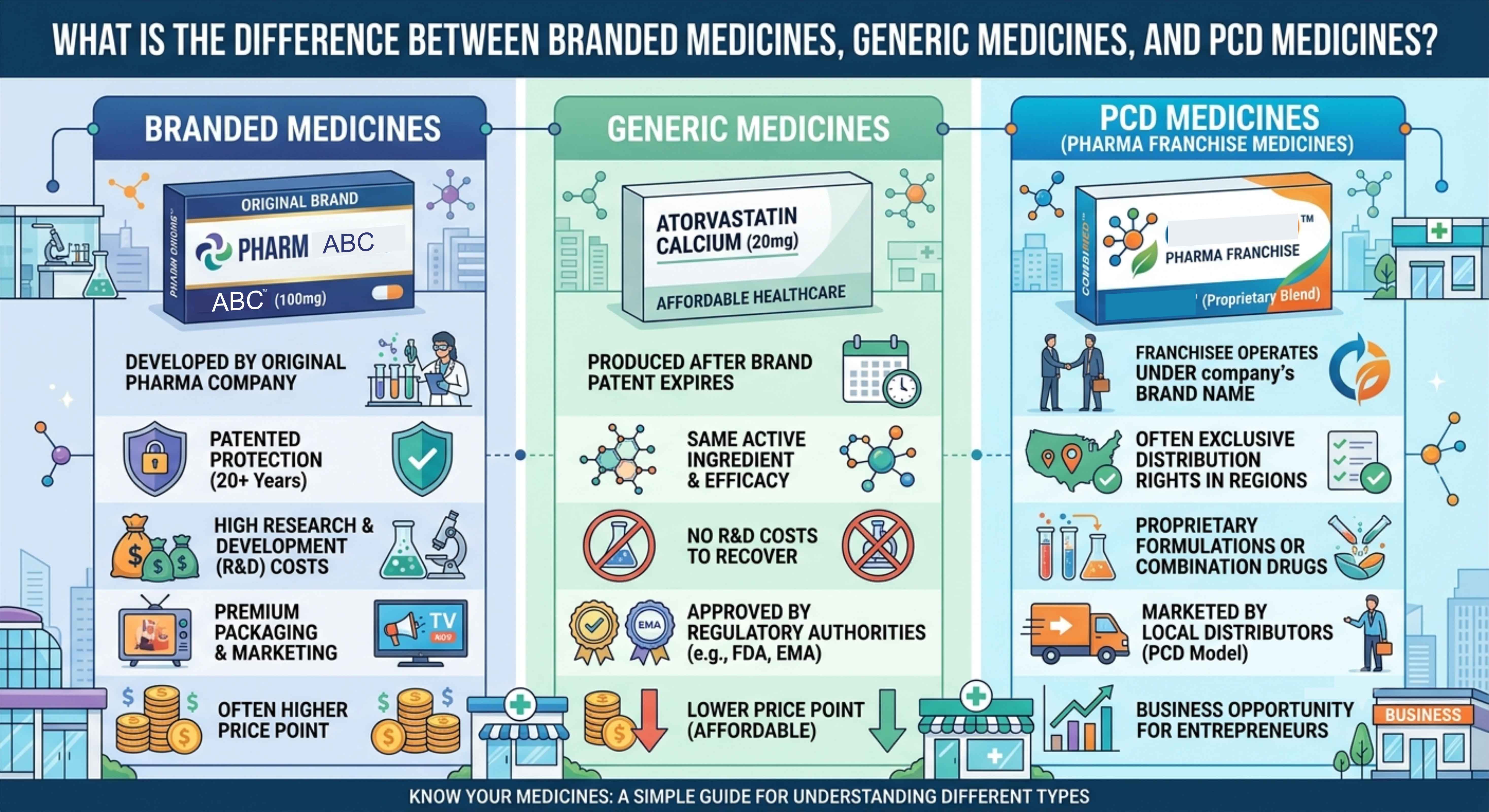
The biggest misconception in the pharmaceutical industry is that branded medicines, generic medicines, and PCD medicines are three different types of medicines.
In reality, the active medicine itself may be exactly the same. The primary differences usually lie in:
Marketing strategy
Distribution channel
Branding
Pricing structure
Promotional expenses
A medicine does not become stronger or weaker simply because it is sold as a branded, generic, or PCD product.
Why Is This Question So Common?
Many healthcare professionals, distributors, entrepreneurs, and even patients often ask:
“What is the difference between branded medicines, generic medicines, and PCD medicines?”
The confusion exists because people often associate different prices with different quality.
However, pharmaceutical marketing is much more complex than that.
Let’s understand each category individually.
What Is a Medicine?
A medicine is a product used for:
Prevention of disease
Diagnosis of disease
Treatment of disease
Management of health conditions
This basic definition remains the same regardless of whether the product is marketed as:
A branded medicine
A generic medicine
A PCD franchise medicine
The medicine itself does not automatically change because of the marketing model.
What Are Branded Medicines?
Branded medicines are marketed under a specific brand name and are typically promoted through a company’s own sales and marketing team.
How They Are Sold
A pharmaceutical company:
Appoints Medical Representatives (MRs)
Promotes products to doctors
Builds prescription demand
Supplies products through distributors and retailers
Example
A company launches a medicine under a brand name and invests heavily in:
Doctor promotion
Scientific meetings
Medical representative visits
Marketing campaigns
These promotional expenses become part of the overall business model.
Characteristics
✓ Strong brand recognition
✓ Doctor-focused promotion
✓ Company-managed marketing
✓ Extensive field force
What Are Generic Medicines?
Generic medicines contain the same active pharmaceutical ingredients as the reference product and are intended to provide comparable therapeutic effects when manufactured according to applicable standards.
How They Are Sold
Generic medicines are usually marketed with minimal promotional expenditure.
Distribution is often driven by:
Wholesalers
Retailers
Generic medicine outlets
Direct supply networks
Characteristics
✓ Lower marketing costs
✓ Competitive pricing
✓ Retail-driven sales
✓ Wider affordability
Important Note
A generic medicine is not automatically inferior.
Quality depends on:
Manufacturing standards
Regulatory compliance
Quality control systems
Raw material quality
Not simply on whether it is called “generic” or “branded.”
What Are PCD Medicines?
PCD stands for Propaganda Cum Distribution.
A PCD medicine is not a different type of medicine.
It is a medicine marketed through a franchise or distribution partner rather than directly by the pharmaceutical company.
How They Are Sold
The pharmaceutical company:
Manufactures or sources the products
Provides promotional materials
Supplies products to franchise partners
The franchise partner:
Promotes the products locally
Meets doctors
Builds prescriptions
Develops the market
Characteristics
✓ Entrepreneur-driven model
✓ Territory-based marketing
✓ Local promotion
✓ Shared business responsibility
Important Point
The medicine itself may be identical to products sold under other marketing models.
The difference lies in who performs the marketing activities.
Understanding Through a Simple Example
Imagine a company manufactures a batch of 500,000 Cefixime 200 mg tablets.
The manufacturing process remains the same.
The company then launches the same formulation under three different business models.
Brand A – Branded Medicine
The company:
Appoints Medical Representatives
Promotes directly to doctors
Invests in marketing
Brand B – Generic Medicine
The company:
Sells primarily through distributors and retailers
Minimizes promotional expenses
Brand C – PCD Medicine
The company:
Supplies products to franchise partners
Relies on distributors to promote the products
The formulation may remain similar, but the route to market changes.
Why Do Prices Differ?
One of the biggest reasons for price variation is the difference in commercial models.
Factors that influence pricing include:
Marketing Expenses
Medical representatives
Promotional campaigns
Scientific meetings
Distribution Margins
Distributor commissions
Retailer margins
Franchise incentives
Branding Costs
Packaging
Brand development
Market positioning
Business Strategy
Different companies may choose different pricing approaches based on their target market.
Which Medicine Is Better?
This is perhaps the most important question.
Branded, generic, and PCD medicines cannot be judged solely by their category.
The more relevant questions are:
Was the product manufactured in a compliant facility?
Does the manufacturer maintain quality standards?
Are regulatory requirements being followed?
Is the product sourced from a reputable company?
Quality is determined by manufacturing and quality systems—not by the marketing model alone.
Key Differences at a Glance
Feature
Branded Medicine
Generic Medicine
PCD Medicine
Marketing
Company-driven
Minimal promotion
Franchise-driven
Doctor Coverage
Direct company team
Limited
Franchise partner
Branding
Strong emphasis
Usually limited
Moderate to strong
Distribution
Traditional channel
Retail-focused
Franchise network
Promotional Cost
High
Low
Shared with distributor
Medicine Type
Pharmaceutical product
Pharmaceutical product
Pharmaceutical product
Final Thoughts
Branded medicines, generic medicines, and PCD medicines are often misunderstood as completely different categories of products.
In reality:
The major difference is usually the marketing and distribution model, not necessarily the medicine itself.
A high-quality medicine can be sold through any of these channels.
For healthcare professionals, distributors, and entrepreneurs, understanding these distinctions helps in making better business and purchasing decisions.
The focus should always remain on quality, compliance, reliability, and patient outcomes rather than marketing labels alone.
Frequently Asked Questions
Are generic medicines less effective than branded medicines?
Not necessarily. Effectiveness depends on manufacturing quality, regulatory compliance, and formulation standards.
Is a PCD medicine different from a branded medicine?
Usually, the key difference is the marketing and distribution model rather than the medicine itself.
Why are some medicines priced differently despite having the same ingredient?
Pricing can be influenced by branding, marketing expenses, distribution costs, and business strategy.
Can the same manufacturer produce branded, generic, and PCD medicines?
Yes. Many manufacturers supply products under multiple business models.
Which category is best for starting a pharma business?
The answer depends on your investment capacity, marketing experience, and business objectives.
Partner with Elzac Herbal India
Looking to start an Ayurvedic franchise, become a distributor, or launch your own herbal product range?
Elzac Herbal India offers:
Ayurvedic & Herbal Product Range
Franchise & Distribution Opportunities
Third-Party Manufacturing Services
Product Development Support
Marketing Guidance
PAN India Business Opportunities
Whether you are an entrepreneur, retailer, distributor, or healthcare professional, our team can help you explore the right business opportunity in the growing Ayurvedic sector.
Ajay Kamboj is an entrepreneur and business owners associated with many Ayurvedic and Pharmaceutical start-ups. With years of experience in Ayurvedic product marketing, pharmaceutical distribution, franchise development, and client relationship management, he regularly shares practical business insights based on real-world experiences. His articles focus on business growth, entrepreneurship, customer management, and lessons learned from the healthcare and wellness industry.



Leave a Reply
You must be logged in to post a comment.