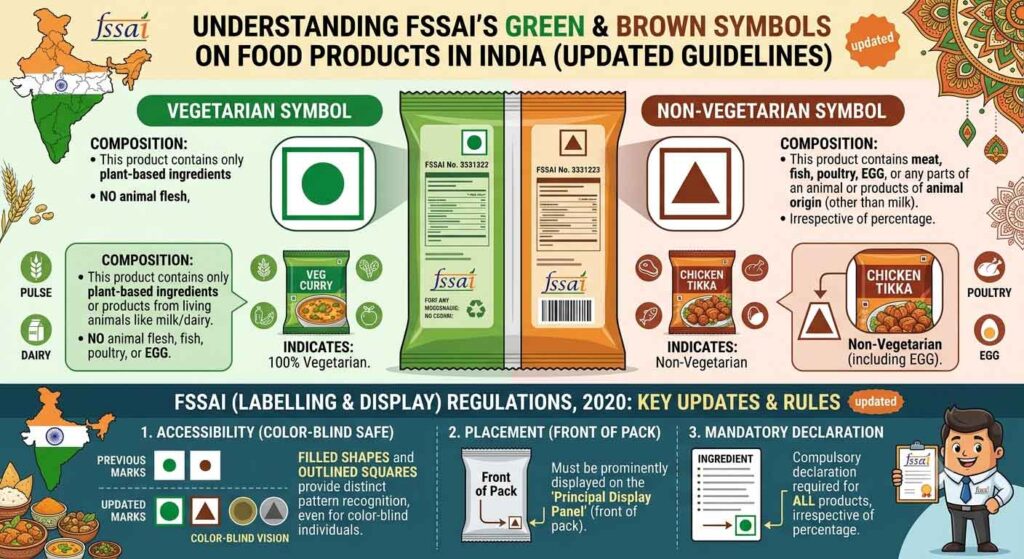
As per the latest FSSAI (Food Safety and Standards Authority of India) regulations, the traditional green dot and brown dot symbols have been updated for food products.
🟢 Green Filled Dot inside a Green Square = Vegetarian product
⚠️ Important: These symbols apply only to food products regulated by FSSAI, not to medicines or cosmetics.
Why Were the Symbols Updated?
India has a large vegetarian population, and clear labeling is essential for informed consumer choices.
To improve visibility and standardization, FSSAI replaced the earlier dot system with triangle-based symbols, making them easier to identify on packaging.
What Does the Green Dot Symbol Mean?
🟢 A green filled Dot inside a green square indicates that the product is vegetarian.
This means the ingredients are derived from:
Plants
Herbs
Fruits
Vegetables
Minerals
Other vegetarian sources
Examples
Herbal supplements
Plant-based protein powders
Vegetarian packaged foods
Ayurvedic food supplements
Consumers who follow vegetarian diets should look for this updated symbol.
What Does the Brown/Red Triangle Symbol Mean?
🔺 A brown or red filled triangle inside a square indicates that the product contains non-vegetarian ingredients.
This includes ingredients derived from:
Animals
Animal by-products
Marine sources
Even a small amount of non-vegetarian ingredient requires this symbol.
Examples
Fish oil capsules
Omega-3 supplements
Gelatin-based food products
Foods containing egg or meat derivatives
Do These Symbols Apply to Medicines or Cosmetics?
No.
These symbols are specifically mandated for food products under FSSAI regulations.
They do not indicate whether a product is a medicine, cosmetic, or supplement regulated under drug laws.
For medicines and cosmetics, labeling rules are governed by different authorities such as:
CDSCO (for drugs)
State Drug Authorities
BIS or other regulatory bodies
Why Do Some Capsules Still Show Old Symbols?
Some products may still display the old green or brown dot symbols, especially:
Older stock
Non-food regulated products
Imported or transitional packaging
However, for new food product packaging, the triangle symbols are now the correct standard.
What About Dietary Supplements and Nutraceuticals?
Dietary supplements and nutraceuticals regulated under FSSAI must follow the updated Dot and triangle symbol system.
Examples include:
Multivitamins
Protein powders
Herbal supplements
Health supplements
Consumers should rely on the triangle symbols for accurate identification.
What About Cosmetics and Personal Care Products?
Cosmetics are not required to follow FSSAI food labeling rules.
Some cosmetic brands may voluntarily use vegetarian/non-vegetarian indicators, but these are not standardized under FSSAI.
Always check:
Ingredient list
Certifications (e.g., vegan, cruelty-free)
How Can Consumers Identify Product Type?
To understand whether a product is food, supplement, or medicine, check:
“The green symbol means the product is Ayurvedic.”
❌ Incorrect It only indicates vegetarian ingredients.
Myth 2
“The brown/red symbol means the product is a medicine.”
❌ Incorrect It only indicates non-vegetarian ingredients.
Myth 3
“The green symbol means the product is healthier.”
❌ Incorrect It only reflects ingredient origin, not nutritional value.
Final Thoughts
The updated FSSAI labeling system uses triangle symbols instead of dots to clearly indicate ingredient origin.
Remember:
🟢 Green Dot = Vegetarian 🔺 Brown/Red Triangle = Non-Vegetarian
These symbols help consumers make informed dietary choices but do not define whether a product is a medicine, supplement, or cosmetic.
Always read the full label, ingredient list, and regulatory details before purchasing.
Frequently Asked Questions
What is the new symbol for vegetarian food in India?
A green filled Dot inside a green square.
What is the new symbol for non-vegetarian food?
A brown or red filled triangle inside a square.
Are green and brown dots still valid?
They are being phased out for food products and replaced by Green Dot for vegetarian and Brown/Red triangle symbols for Non-vegetarian under FSSAI guidelines.
Do these symbols apply to medicines?
No. They apply only to food products regulated by FSSAI.
How can I identify a food supplement?
Check for FSSAI license number and labeling such as “Health Supplement” or “Nutraceutical.”
Partner with Elzac Herbal India
Looking to start an Ayurvedic franchise, become a distributor, or launch your own herbal product range?
Elzac Herbal India offers:
Ayurvedic & Herbal Product Range
Franchise & Distribution Opportunities
Third-Party Manufacturing Services
Product Development Support
Marketing Guidance
PAN India Business Opportunities
Whether you are an entrepreneur, retailer, distributor, or healthcare professional, our team can help you explore the right business opportunity in the growing Ayurvedic sector.
Ajay Kamboj is an entrepreneur and business owners associated with many Ayurvedic and Pharmaceutical start-ups. With years of experience in Ayurvedic product marketing, pharmaceutical distribution, franchise development, and client relationship management, he regularly shares practical business insights based on real-world experiences. His articles focus on business growth, entrepreneurship, customer management, and lessons learned from the healthcare and wellness industry.
One response to “What Do the Green and Brown Symbols Mean on Food Products in India? (Updated as per Latest FSSAI Guidelines)”







Would like to know about green dot and brown dot