Yes, it is possible to start your own herbal or Ayurvedic pharma company without owning a manufacturing facility.
Many successful herbal brands operate through a third-party manufacturing model, where:
The product formulation may be developed by you or sourced through the manufacturer.
Manufacturing is carried out by a licensed Ayurvedic manufacturer.
Quality testing and packaging are handled by the manufacturer.
The products are marketed under your own brand name.
Sales and marketing activities are managed by your company.
This business model allows entrepreneurs to focus on branding, marketing, and distribution without investing in a manufacturing plant.
Disclaimer: Regulatory requirements may vary depending on the product category, formulation type, and applicable laws. Always consult a qualified regulatory consultant or legal professional before launching healthcare products.
Query
I want to start a herbal pharma company where the formulation will be my own, but manufacturing, testing, and packaging will be done by a licensed manufacturer. The brand name will be mine, and I will handle marketing. Is this possible? What are the steps involved?
The answer is Yes.
This is one of the most common business models used in the Ayurvedic, herbal, nutraceutical, and wellness industries today.
Let’s understand the process step by step.
What Is an Herbal Pharma Marketing Company?
An herbal marketing company is a business that owns and promotes products under its own brand name while outsourcing manufacturing to a licensed third-party manufacturer.
Instead of investing heavily in land, machinery, and factory operations, the company focuses on:
Product development
Branding
Marketing
Distribution
Customer acquisition
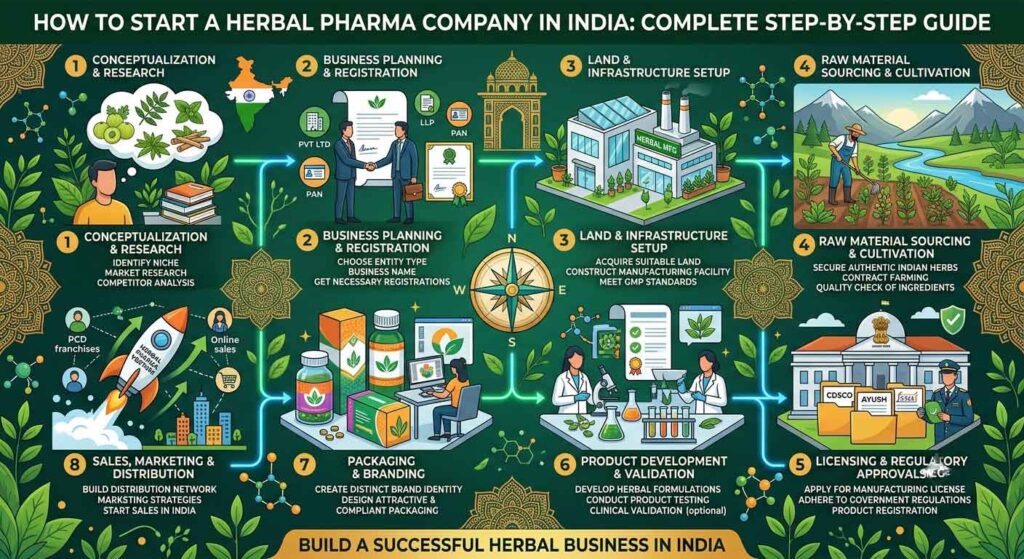
Step 1: Finalize Your Business Model
Before starting, decide whether your products will be marketed as:
Ayurvedic Medicines
Regulated under the AYUSH framework and manufactured by licensed Ayurvedic manufacturers.
Nutraceuticals or Food Supplements
Regulated under applicable food regulations and marketed as dietary supplements.
This decision affects product approvals, claims, labeling, and manufacturing requirements.
Step 2: Register Your Business
Choose an appropriate business structure.
Common options include:
Proprietorship
Partnership Firm
LLP (Limited Liability Partnership)
Private Limited Company
The choice depends on your investment plans and long-term business goals.
Step 3: Obtain GST Registration
GST registration is generally required for:
Raising invoices
Purchasing products
Conducting business transactions
This is usually one of the first operational registrations obtained by a new company.
Step 4: Prepare Your Product Portfolio
Create a list of products you want to launch.
Examples may include:
Herbal syrups
Ayurvedic tablets
Capsules
Churnas
Oils
Nutraceutical products
Wellness supplements
Start with a manageable range rather than launching too many products at once.
Step 5: Choose Your Company Name and Brand Names
Brand building is one of the most valuable assets in the herbal industry.
Select:
Company name
Product names
Logo concepts
Brand positioning
Choose names that are:
✓ Easy to pronounce
✓ Easy to remember
✓ Distinctive
✓ Relevant to the product category
Step 6: Apply for Trademark Protection
Trademark registration helps protect:
Company name
Product brands
Logos
Marketing identity
Early trademark filing can help avoid future disputes and strengthen your brand value.
Step 7: Decide Whether to Use Your Own Formulation
You have two options.
Option 1: Use Existing Approved Formulations
Many manufacturers already possess approved Ayurvedic formulations.
Advantages:
Faster launch
Lower development costs
Simpler documentation
Option 2: Develop Your Own Formulation
If you have created a unique herbal formulation:
Discuss feasibility with the manufacturer
Evaluate regulatory requirements
Assess intellectual property considerations
Custom formulations often require additional documentation and approvals before commercialization.
Step 8: Select a Third-Party Manufacturer
This is one of the most important decisions.
Evaluate manufacturers based on:
Regulatory Compliance
AYUSH licence (for Ayurvedic products)
GMP certification
Quality systems
Manufacturing Capabilities
Product categories offered
Production capacity
Packaging options
Reputation
Industry experience,
Existing client feedback,
Service standards.
Step 9: Finalize the Manufacturing Agreement
The agreement should clearly define:
Product specifications
Pricing
Minimum order quantities
Delivery timelines
Confidentiality obligations
Packaging responsibilities
Clear agreements reduce future misunderstandings.
Step 10: Product Approval and Manufacturing
For Ayurvedic products, the manufacturer may need to obtain applicable approvals before commercial production.
Requirements depend on:
Product category
Formulation type
Claims
Applicable regulations
Once approvals are complete, manufacturing can begin under your brand name.
Step 11: Design Packaging and Labels
Your packaging should:
Reflect your brand identity
Comply with labeling requirements
Communicate product information clearly
Professional packaging often influences customer perception as much as the product itself.
Step 12: Build Your Marketing and Distribution Network
Since manufacturing is outsourced, your primary responsibility becomes business development.
Common channels include:
PCD Franchise Network
Appoint franchise partners across different regions.
Distribution Network
Supply products through wholesalers and distributors.
Direct-to-Consumer Sales
Use digital platforms and e-commerce where appropriate.
Healthcare Professionals
Develop relationships with practitioners and healthcare businesses.
What Are the Advantages of Third-Party Manufacturing?
Lower Investment
No need to establish a manufacturing plant.
Faster Market Entry
Products can often be launched more quickly.
Reduced Regulatory Burden
Many manufacturing-related compliance responsibilities remain with the licensed manufacturer.
Focus on Growth
You can focus on:
Brand building,
Marketing,
Distribution,
Customer relationships.
Common Mistakes to Avoid
❌ Launching too many products initially.
❌ Choosing a manufacturer based only on price.
❌ Ignoring trademark protection.
❌ Not verifying regulatory compliance.
❌ Underestimating marketing expenses.
❌ Neglecting distribution planning.
Final Thoughts
Starting an herbal pharma company through third-party manufacturing is one of the most practical ways to enter the healthcare industry.
You do not need your own factory to build a successful herbal brand.
By selecting the right manufacturer, protecting your brand, focusing on quality, and building strong distribution channels, you can create a scalable and sustainable business in the growing Ayurvedic and herbal products market.
Success comes not from owning machinery, but from building trust, quality, and market presence.
Frequently Asked Questions
Can I start an herbal pharma company without a manufacturing facility?
Yes. Third-party manufacturing is a widely used model in the Ayurvedic and herbal industry.
Can I use my own formulation?
Yes, subject to regulatory requirements, manufacturing feasibility, and applicable approvals.
Is trademark registration necessary?
While not always mandatory before launch, trademark protection is strongly recommended for long-term brand security.
Do I need a drug licence for a marketing company?
Requirements depend on the business model and product category. Consult a regulatory expert for guidance.
How much investment is required?
Investment varies based on product range, branding, packaging, inventory, and marketing plans.
What is the biggest factor in success?
Product quality, brand trust, distribution strength, and consistent marketing efforts.
Partner with Elzac Herbal India
Looking to start an Ayurvedic franchise, become a distributor, or launch your own herbal product range?
Elzac Herbal India offers:
Ayurvedic & Herbal Product Range
Franchise & Distribution Opportunities
Third-Party Manufacturing Services
Product Development Support
Marketing Guidance
PAN India Business Opportunities
Whether you are an entrepreneur, retailer, distributor, or healthcare professional, our team can help you explore the right business opportunity in the growing Ayurvedic sector.
Ajay Kamboj is an entrepreneur and business owners associated with many Ayurvedic and Pharmaceutical start-ups. With years of experience in Ayurvedic product marketing, pharmaceutical distribution, franchise development, and client relationship management, he regularly shares practical business insights based on real-world experiences. His articles focus on business growth, entrepreneurship, customer management, and lessons learned from the healthcare and wellness industry.







Leave a Reply Cancel reply
You must be logged in to post a comment.