A company can launch dietary supplements or nutraceutical products in India without establishing its own manufacturing facility.
The products may be manufactured by an FSSAI-licensed third-party manufacturer and marketed under the brand owner’s name.
However, the process is not simply:
Select ingredients → Give a brand name → Manufacturer obtains approval
Both the manufacturer and brand owner must operate through the appropriate FSSAI licensing structure, and the complete formulation must comply with applicable standards.
A common query is:
“We want to launch a dietary supplement but do not have our own manufacturing facility. How can we obtain FSSAI approval for the product in our name? Is there a list of FSSAI-approved products, ingredients and third-party manufacturers in Delhi/NCR?”
The practical answer is:
FSSAI generally regulates nutraceuticals through permitted product categories, ingredient schedules, daily usage conditions, additives, claims and labelling requirements rather than approving every ordinary formulation individually.
When the formulation contains only permitted ingredients in compliant forms and quantities, it may be manufactured and licensed through the ordinary FoSCoS process.
When the formulation contains a non-specified, novel or otherwise unlisted ingredient, prior product or ingredient approval may be required.
Is There a List of FSSAI-Approved Nutraceutical Products?
There is no single permanent list containing ready-made approved products such as:
Calcium tablets
Multivitamin capsules
Protein powder
Liver-support syrup
Immunity gummies
Joint-support sachets
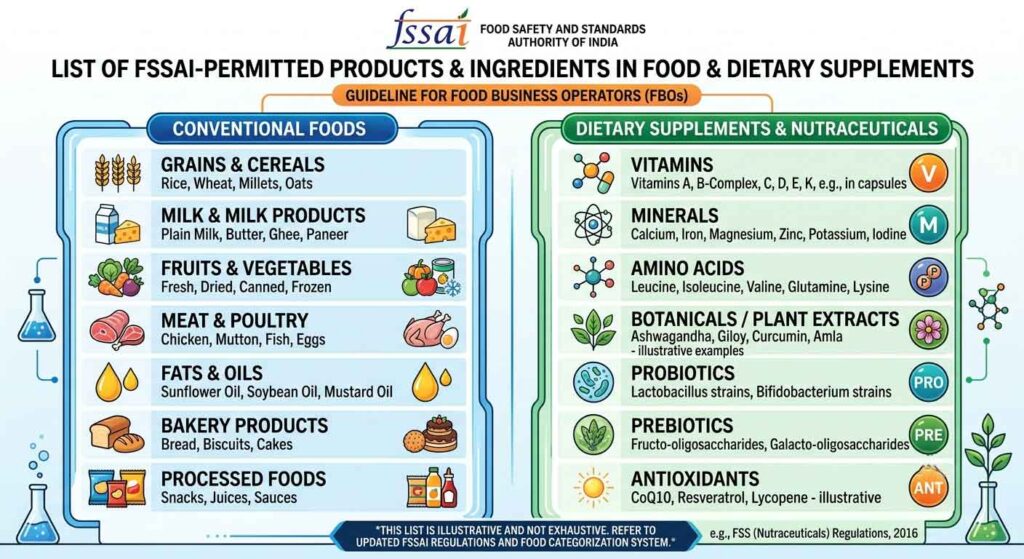
FSSAI primarily provides:
Product categories
Permitted nutrients
Permitted vitamins and minerals
Permitted amino acids
Permitted botanicals
Permitted isolates and molecules
Permitted probiotics and prebiotics
Conditions of use
Maximum or daily usage levels
Additive permissions
Labelling requirements
Claim restrictions
A company develops a formulation within these regulatory conditions.
Main Categories Covered Under Nutraceutical Regulations
The principal categories include:
1. Health Supplements
Health supplements are intended to supplement the normal diet.
They may provide:
Vitamins
Minerals
Amino acids
Enzymes
Other permitted nutrients
Botanical ingredients
Permitted substances with nutritional or physiological effects
Examples may include:
Multivitamin tablets
Calcium and Vitamin D3 supplements
Iron and folic acid supplements
Amino-acid supplements
General nutrition capsules
A health supplement should not be presented as a substitute for a normal diet unless specifically permitted.
2. Nutraceuticals
Nutraceuticals generally contain permitted food-derived substances with nutritional or physiological benefits.
Examples may include compliant formulations containing:
Curcumin
Lycopene
Lutein
Coenzyme Q10
Permitted botanical extracts
Permitted isolates
Omega fatty acids
The exact ingredient, source, extract, strength and daily intake must be checked.
3. Food for Special Dietary Use
These foods are specially processed or formulated for particular dietary requirements.
Possible uses may relate to:
Sports nutrition
Weight-management programmes
Special physiological conditions
Controlled nutrient intake
The product must meet the specific category requirements rather than merely using the words “special diet.”
4. Food for Special Medical Purpose
Food for Special Medical Purpose, or FSMP, is specially formulated for the dietary management of patients.
These products are not ordinary consumer supplements.
They require particular care concerning:
Intended patient group
Medical or dietetic supervision
Nutritional rationale
Scientific support
Labelling
Directions for use
A normal protein powder should not be presented as an FSMP without meeting the applicable requirements.
5. Specialty Food Containing Plant or Botanical Ingredients
These products contain permitted plants or botanicals in specified forms.
Examples may include products containing permitted:
Herbs
Roots
Leaves
Seeds
Fruits
Bark
Botanical extracts
The manufacturer must verify:
Botanical name
Common name
Plant part
Extractive ratio
Solvent used
Daily usage level
Applicable cautions
The same plant may not be permitted in every part or every extract form.
The product should specify relevant information such as:
Genus
Species
Strain
Viable count
Shelf-life count
Storage condition
Recommended usage
A general statement such as “contains probiotics” is not enough without strain and viability controls.
7. Foods Containing Prebiotics
Prebiotic formulations contain permitted substances intended to support beneficial intestinal microorganisms.
The exact ingredient and usage level must be checked against current standards.
8. Novel Foods
Novel foods may include foods or ingredients without an established history of human consumption in India or those produced through novel technology.
These products may need prior approval before commercial licensing and sale.
Main FSSAI Ingredient Schedules
The nutraceutical framework broadly organizes ingredients into schedules.
Schedule I: Nutrients
This may include permitted:
Vitamins
Minerals
Amino acids
Other nutrients
Examples of commonly used nutrients include:
Vitamins
Vitamin A
Vitamin B1
Vitamin B2
Vitamin B3
Vitamin B5
Vitamin B6
Biotin
Folic acid
Vitamin B12
Vitamin C
Vitamin D
Vitamin E
Vitamin K
The permitted chemical forms should be checked.
For example, it is not sufficient to state only:
“Vitamin D”
The manufacturer must check the permitted source and form, such as the applicable form of cholecalciferol or ergocalciferol.
Minerals
Common examples may include:
Calcium
Iron
Magnesium
Zinc
Copper
Selenium
Chromium
Manganese
Iodine
Potassium
Phosphorus
The permitted mineral salt is important.
For example, the regulations may distinguish between forms such as:
Calcium carbonate
Calcium citrate
Ferrous fumarate
Ferrous bisglycinate
Zinc sulphate
Zinc citrate
An unlisted mineral compound should not be used merely because it supplies the same elemental mineral.
Amino Acids
Depending on the applicable list and product category, permitted amino acids may include substances such as:
L-arginine
L-glutamine
L-leucine
L-isoleucine
L-valine
L-lysine
L-carnitine
Taurine
The current schedule, purity and daily intake must be verified product-wise.
Schedule II: Plants and Botanicals
This schedule covers permitted plant and botanical ingredients.
The schedule may specify:
Botanical name
Common name
Permitted plant part
Daily usage value
Additional conditions
Examples of botanical ingredients commonly encountered in supplement development may include permitted forms of:
Ashwagandha
Amla
Tulsi
Curcuma
Fenugreek
Garlic
Green tea
Ginger
Ginseng
Grape seed
Flaxseed
Aloe vera
This does not mean that every extract of every listed plant is automatically permitted.
Confirm:
Correct species
Plant part
Extraction method
Extract ratio
Marker compounds
Residual solvents
Usage level
Schedule III: Molecules, Isolates and Extracts
This category may include specified food-derived:
Molecules
Isolates
Concentrates
Standardized extracts
Possible examples include permitted forms of:
Curcuminoids
Lycopene
Lutein
Zeaxanthin
Coenzyme Q10
Plant sterols
Certain fatty acids
Other identified substances
The exact regulatory description should be matched rather than relying only on a commercial ingredient name.
Schedule IV: Probiotics and Prebiotics
This schedule covers permitted:
Probiotic strains
Prebiotic substances
For probiotics, compliance should be strain-specific.
Two strains belonging to the same species may not have identical stability or evidence.
Does FSSAI Specify Lower and Upper Limits?
FSSAI may specify:
Daily usage value
Recommended dietary allowance relationship
Maximum usage limits
Minimum functional quantity
Category-specific conditions
Ingredient-specific warnings
The product should be evaluated on the basis of its complete recommended daily consumption.
Example:
Suppose one capsule contains 250 mg of an ingredient and the recommended dosage is two capsules twice daily.
The daily exposure is:
250 mg × 4 capsules = 1,000 mg per day
The compliance assessment should be based on 1,000 mg—not merely 250 mg per capsule.
RDA and Daily Usage Levels
Vitamin and mineral formulations commonly require comparison with the applicable Recommended Dietary Allowance.
The product developer should confirm:
Target consumer group
Recommended daily serving
Nutrient quantity per serving
Percentage of RDA
Upper safe level
Required warnings
Requirements can differ for:
Adults
Children
Pregnant women
Lactating women
Athletes
Elderly persons
Do not use a single adult RDA calculation for every population.
Is Separate Product Approval Required?
There are two main situations.
Situation 1: Standard or Permitted Formulation
Separate prior product approval may generally not be necessary when:
Every ingredient is permitted.
Every ingredient form is permitted.
Quantities comply with applicable limits.
Additives are permitted.
The delivery format is permitted.
Claims are compliant.
Labelling meets the regulations.
The manufacturer and brand owner hold the appropriate licences.
The product still needs to be correctly selected or endorsed under the relevant FoSCoS licensing structure.
Situation 2: Non-Specified or Novel Product
Prior approval may be required when:
An ingredient is not listed or standardized.
A novel ingredient is proposed.
The ingredient has no established use in the relevant food category.
A nano-derived ingredient is used.
A modified drug-delivery format is proposed.
A new microbial strain is used.
The product does not fit an existing standard.
A novel manufacturing process materially changes the ingredient.
Such applications are evaluated under the Non-Specified Food and Food Ingredients approval framework.
What Does “Approval in Our Name” Mean?
A startup often asks:
“How can we obtain FSSAI product approval in our company name?”
For an ordinary compliant nutraceutical formulation, the process generally involves licensing and product endorsement rather than issuance of a separate product-approval certificate for every brand.
The two main parties are:
Third-Party Manufacturer
The manufacturer physically produces and packs the product.
It should have:
Applicable Central FSSAI licence
Manufacturer Kind of Business
Relevant nutraceutical or health-supplement product category
Suitable processing facilities
Qualified technical staff
Food-safety management system
Testing arrangements
Brand Owner or Marketing Company
When products are manufactured by another FBO under the brand owner’s name, the brand owner should apply under:
Relabeller Kind of Business
The relabeller generally:
Owns or controls the brand
Selects the product formulation
Approves artwork
Markets the product
Arranges distribution
Handles consumer complaints
Coordinates recalls
Maintains the relationship with the manufacturer
The exact Central or State licence eligibility for the relabeller should be determined through FoSCoS based on the business, premises and current eligibility criteria.
Online NOC From Manufacturer
FoSCoS provides a process for linking relabellers with their third-party manufacturers.
The manufacturer may provide an online NOC confirming that:
It agrees to manufacture for the relabeller.
It holds the required licence.
The relevant food category is endorsed.
The manufacturing relationship is genuine.
The manufacturer’s consent does not remove the brand owner’s compliance responsibility.
Typical Third-Party Manufacturing Structure
A label may show:
Manufactured by: Name and address of licensed manufacturer Manufacturer’s FSSAI licence number
Marketed by: Name and address of brand owner or relabeller Brand owner’s FSSAI licence number
The exact declaration should follow the current Labelling and Display Regulations.
Documents Required from the Brand Owner
A third-party manufacturer may ask for:
Proprietorship, partnership, LLP or company documents
PAN
GST registration
Address proof
FSSAI licence under Relabeller Kind of Business
Trademark or brand authorization
Proposed product name
Complete composition
Pack size
Artwork
Purchase order
Manufacturing agreement
Quality agreement
Online NOC request
Documents to Collect from the Manufacturer
Before placing an order, collect and verify:
1. FSSAI Licence
Check:
Licence number
Legal entity name
Manufacturing address
Active status
Kind of Business
Product categories
Validity
2. Product Category Endorsement
Confirm that the licence covers:
Health supplements
Nutraceuticals
Probiotics
Prebiotics
FSMP
FSDU
Botanical products
as applicable to your proposed product.
A licence for bakery products or beverages does not automatically authorize nutraceutical capsule manufacturing.
3. Manufacturing Capability
Verify whether the facility can manufacture the required format:
Tablets
Capsules
Softgels
Syrups
Powders
Sachets
Gummies
Drops
Bars
4. Technical Staff
Check whether the facility has qualified personnel for:
Production
Quality control
Food safety
Microbiology
Formulation development
5. Food-Safety Management Documents
Ask for:
GMP or hygiene procedures
HACCP plan
Cleaning procedures
Pest-control records
Allergen controls
Traceability
Recall procedure
Complaint procedure
6. Batch-Wise Certificate of Analysis
The COA should match:
Product
Batch number
Manufacturing date
Specifications
Test results
Authorized release
7. Ingredient COAs
For important ingredients, review:
Identity
Assay
Microbial limits
Heavy metals
Pesticide residues
Residual solvents
Marker compound
Allergen information
8. Stability Data
The claimed shelf life should be supported by stability data in the proposed packaging.
9. Six-Monthly Testing Compliance
Verify that the manufacturer follows the applicable FoSCoS testing and reporting requirements.
10. Existing Client References
Speak with genuine clients regarding:
Quality
Delivery
Documentation
Complaint response
Product development
Packaging
Replacement
How to Prepare a Compliant Nutraceutical Formula
Step 1: Decide the Product Category
Choose whether the product is:
Health supplement
Nutraceutical
Probiotic food
Prebiotic food
Botanical specialty food
FSDU
FSMP
Novel food
Do not use several categories simultaneously merely for marketing.
Step 2: Prepare the Complete Formula
Include:
Ingredient name
Regulatory name
Chemical or botanical form
Quantity per serving
Recommended daily servings
Total daily exposure
Functional purpose
Step 3: Check Every Ingredient
Verify each ingredient against:
Applicable FSSAI schedule
Permitted form
Source
Plant part
Extract ratio
Daily usage level
Purity
Warning conditions
Step 4: Check Additives
Review:
Colours
Flavours
Sweeteners
Preservatives
Anti-caking agents
Stabilizers
Coating agents
Capsule shell
Processing aids
An active formula may be compliant while its colour or sweetener is not.
Step 5: Check Delivery Format
Confirm that the proposed format is permitted.
Examples include:
Tablet
Capsule
Powder
Granule
Liquid
Drop
Gummy
Jelly
Bar
Mouth-dissolving strip
Unusual or modified delivery systems may need additional approval.
Step 6: Review Claims
Claims should be:
Truthful
Supportable
Relevant
Not misleading
Consistent with food regulation
Step 7: Prepare Product Specifications
Specifications may include:
Appearance
Identity
Nutrient assay
Marker compound
Moisture
Microbial limits
Heavy metals
Contaminants
Disintegration
Fill weight
Stability parameters
Step 8: Approve Packaging
Select packaging based on:
Moisture sensitivity
Oxygen sensitivity
Light sensitivity
Probiotic viability
Product format
Shelf life
Step 9: Complete Licence and NOC Process
Ensure that both:
Manufacturer
Relabeller or brand owner
have the applicable licensing and FoSCoS linkage.
Step 10: Manufacture a Controlled First Batch
Do not begin with a very large batch before confirming:
Taste
Stability
Packaging
Consumer acceptance
Market demand
Label compliance
Claims That Should Be Avoided
Food supplements and nutraceuticals should not claim to:
Cure diabetes
Treat arthritis
Reverse fatty liver
Cure infertility
Treat thyroid disease
Prevent heart attacks
Replace prescribed medicine
Cure cancer
Permanently remove obesity
Guarantee immunity
Produce no side effects
Such claims can cause the product to be treated as misleading or medicinally presented.
Safer food-support language may include:
Supports normal energy metabolism
Helps meet daily calcium requirements
Supports normal immune function
Supports nutritional requirements
Provides antioxidants
Supports normal bone health
Every claim still requires regulatory and scientific review.
Labelling Requirements
Depending on the product, the label may need:
Name of food
Product category
Ingredient list
Nutritional information
Quantity of nutrients per serving
Percentage RDA
Recommended usage
Warning not to exceed recommended daily usage
Statement that the product is not a substitute for a varied diet
Is Trademark Registration the Same as FSSAI Approval?
No.
Trademark Registration
Protects:
Brand name
Logo
Commercial identity
FSSAI Licence
Authorizes the food-business activity at the licensed premises and for the endorsed product categories.
Non-Specified Food Approval
Addresses an unstandardized or novel food or ingredient where applicable.
All three serve different purposes.
Is There an FSSAI-Approved Manufacturer List?
FSSAI does not provide a commercial recommendation list of “trusted” or “approved” third-party manufacturers.
It provides a public database of:
Licensed Food Business Operators
Licence status
Business name
Address
Kind of Business
Product categories
An active FSSAI licence means that the FBO holds a licence for the listed activities.
It does not mean that FSSAI commercially recommends the manufacturer or guarantees:
Product quality
Delivery time
Pricing
Customer service
Minimum order
Formulation ability
Financial reliability
How to Search Third-Party Manufacturers in Delhi/NCR
Use the official FoSCoS Advanced FBO Search.
Search separately across relevant states because Delhi/NCR includes multiple jurisdictions.
Delhi
Search districts within the National Capital Territory of Delhi.
Uttar Pradesh NCR
Consider locations such as:
Noida
Greater Noida
Ghaziabad
Haryana NCR
Consider locations such as:
Gurugram
Faridabad
Sonipat
Karnal
Bahadurgarh
FoSCoS Search Steps
Open the Advanced FBO Search.
Select Licence rather than only Registration.
Select the state.
Select the district.
Select Manufacturer as the Kind of Business.
Select the relevant product category.
Search for Food or Health Supplements and Nutraceuticals.
Review the company’s licence details.
Confirm that the licence is active.
Check the approved product categories and manufacturing address.
The presence of a company in search results should be treated as the beginning of due diligence—not the final selection.
How to Shortlist a Delhi/NCR Manufacturer
Ask shortlisted manufacturers:
Do you have a Central FSSAI manufacturing licence for nutraceuticals?
Is the proposed product category endorsed?
Can you manufacture the required dosage form?
What is your minimum batch size?
What is your printed packaging MOQ?
Do you support Relabeller NOC linking?
Do you provide formulation review?
Do you provide a batch-wise COA?
Do you have stability data?
Can you conduct microbiological and heavy-metal testing?
Who owns the formula?
What is the delivery timeline?
What is your complaint and recall process?
Can we audit or visit the facility?
Can you provide customer references?
Common Third-Party Manufacturing Models
Manufacturer’s Existing Formula
The manufacturer already has a compliant formulation.
You provide:
Brand name
Pack size
Packaging
Required quantity
Advantages:
Faster launch
Lower development cost
Established raw-material sourcing
Existing stability support
Limitations:
Formula may not be exclusive.
Similar formulation may be supplied to other brands.
Differentiation may be limited.
Custom Formula
You provide a target formula or work with the manufacturer’s R&D team.
Advantages:
Better differentiation
Control over serving size
Custom flavour or format
Potential exclusivity
Limitations:
Development cost
Longer lead time
Stability work
Higher MOQ
Regulatory review
Who Is Responsible for Product Compliance?
Responsibility is shared.
Manufacturer
Responsible for:
Raw-material procurement
Manufacturing
Hygiene
Batch records
Testing
Product release
Manufacturing licence
Traceability
Recall support
Brand Owner or Relabeller
Responsible for areas including:
Product selection
Formula approval
Brand name
Artwork
Claims
Marketing
Distribution
Consumer complaints
Recall coordination
Maintaining its FSSAI licence
A brand owner should not respond to a complaint by saying:
“We only market the product; contact the manufacturer.”
Quality Agreement
The parties should sign a quality agreement covering:
Approved formula
Ingredient specifications
Supplier qualification
Testing
COA
Stability
Packaging
Change control
Complaint handling
Recall
Retention samples
Labelling approval
Defective-product replacement
Regulatory inspection
A purchase order alone is not sufficient.
Common Mistakes to Avoid
Avoid:
Asking only for an “FSSAI-approved formula”
Assuming every vitamin form is permitted
Ignoring total daily intake
Using an unlisted botanical extract
Using the wrong plant part
Launching a novel ingredient without approval
Obtaining only the manufacturer’s licence
Not taking a Relabeller licence
Printing only one FSSAI number without review
Making disease-treatment claims
Copying another company’s formula and label
Not checking additives
Ignoring stability
Choosing a manufacturer only by low price
Treating an active licence as a quality guarantee
Not obtaining an online NOC
Launching before artwork review
Practical Answer to the Query
To launch your own dietary supplement through third-party manufacturing:
Register your business entity.
Finalize the proposed product category.
Prepare the complete composition and daily dosage.
Check every ingredient against current FSSAI schedules.
Determine whether non-specified food approval is required.
Apply through FoSCoS under the appropriate Relabeller Kind of Business.
Select an active Central FSSAI-licensed nutraceutical manufacturer.
Obtain the manufacturer’s online NOC.
Sign manufacturing and quality agreements.
Prepare compliant artwork.
Obtain batch specifications and COA.
Manufacture a controlled first batch.
Market only with permitted food and nutrition claims.
Both your business and the actual manufacturer require appropriate FSSAI licensing and product-category endorsement.
Frequently Asked Questions
1. Is there a list of FSSAI-approved nutraceutical products?
FSSAI generally provides permitted product categories, ingredient schedules and usage conditions rather than approving every ordinary product by brand name.
2. Does every dietary supplement require product approval?
A compliant product using permitted ingredients may generally proceed through the licensing and endorsement route. Non-specified or novel products may need prior approval.
3. Who should obtain the FSSAI licence—the manufacturer or brand owner?
Both may require licences. The manufacturer needs the applicable manufacturing licence, and the brand owner using a third-party manufacturer should generally apply as a Relabeller.
4. Does the manufacturer’s licence cover the marketer?
No. A manufacturer’s licence does not automatically become the brand owner’s licence.
5. Can a product carry two FSSAI licence numbers?
Where manufacturer and brand owner are different, the applicable licence numbers and names should be declared according to current labelling regulations.
6. Is every herbal ingredient permitted in nutraceuticals?
No. Check the exact species, plant part, extract form and daily usage value.
7. Can a nutraceutical claim to treat a disease?
Ordinary nutraceuticals and health supplements should not make medicinal disease-treatment or cure claims.
8. How can I verify a Delhi/NCR manufacturer?
Use the official FoSCoS Advanced FBO Search and verify its active licence, manufacturing address, Kind of Business and product categories.
9. Does an active FSSAI licence guarantee product quality?
No. It confirms licensing status but does not replace factory audit, testing, documentation review and commercial due diligence.
10. Can I launch a novel ingredient through an ordinary manufacturer?
Not automatically. Prior approval may be required before licensing and commercial manufacture.
Final Thoughts
The correct process is not:
Find a manufacturer → Give a brand name → Obtain an FSSAI approval certificate
The correct process is:
Classify the product → Check every ingredient → Calculate daily intake → Determine whether prior approval is required → Obtain manufacturer and relabeller licences → Link the parties through NOC → Approve the label and claims → Manufacture and test the batch
A compliant nutraceutical business requires active involvement from both the manufacturer and brand owner.
Looking for Ayurvedic Franchise or Distribution Opportunities?
Looking to start an Ayurvedic franchise, become a distributor, or launch your own herbal product range?
Elzac Herbal India offers:
Ayurvedic & Herbal Product Range
Franchise & Distribution Opportunities
Third-Party Manufacturing Services
Product Development Support
Marketing Guidance
PAN India Business Opportunities
Whether you are an entrepreneur, retailer, distributor, or healthcare professional, our team can help you explore the right business opportunity in the growing Ayurvedic sector.
Ajay Kamboj is an entrepreneur and business owners associated with many Ayurvedic and Pharmaceutical start-ups. With years of experience in Ayurvedic product marketing, pharmaceutical distribution, franchise development, and client relationship management, he regularly shares practical business insights based on real-world experiences. His articles focus on business growth, entrepreneurship, customer management, and lessons learned from the healthcare and wellness industry.
2 responses to “List of FSSAI-Permitted Products and Ingredients in Food and Dietary Supplements”
AM GENERIC MEDICINE DISTRIBUTOR I WANT FSSAI LICINECE







AM GENERIC MEDICINE DISTRIBUTOR I WANT FSSAI LICINECE
Is stevia approved in bakery products? If so, what is the permitted levels?