The nutraceutical and health-supplement industry in India includes products such as vitamin and mineral supplements, protein preparations, botanical formulations, probiotics, prebiotics and other products intended to provide nutritional or physiological benefits.
However, nutraceuticals are legally food products—not pharmaceutical drugs.
Therefore, starting a nutraceutical manufacturing company requires an FSSAI manufacturing licence rather than a pharmaceutical drug-manufacturing licence, provided the products genuinely fall within the food/nutraceutical regulatory framework.
The first and most important step is therefore not purchasing machinery. It is correctly deciding what your product legally is.
Quick Answer
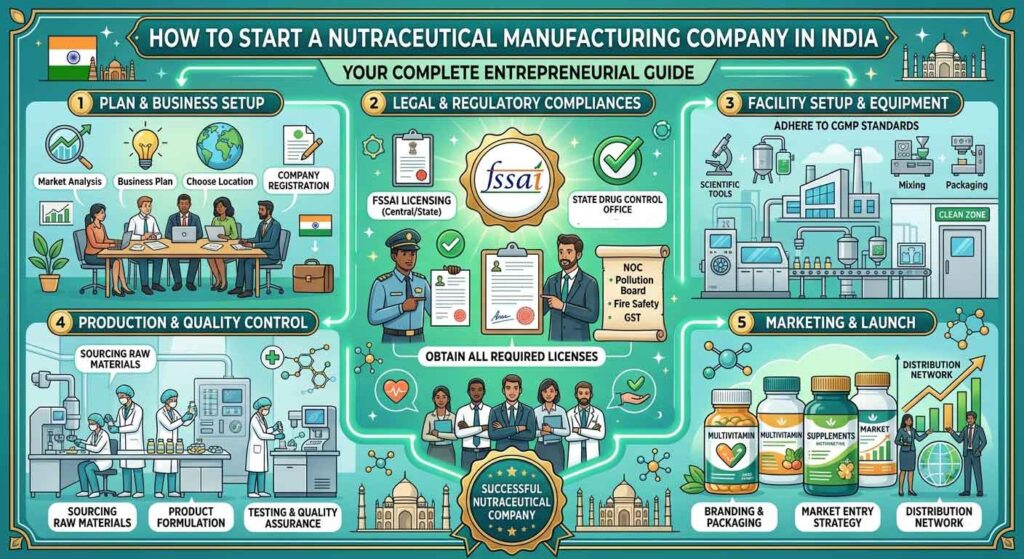
As of August 2026, an entrepreneur planning to manufacture health supplements or nutraceuticals in India should normally establish a suitable food-manufacturing premises, develop compliant formulations, appoint a technically qualified production person, implement an FSMS/GMP/GHP system and apply through FoSCoS for a Central FSSAI Licence.
FSSAI’s current FoSCoS eligibility document, updated April 1, 2026, classifies manufacturers of “Food or Health Supplements and Nutraceuticals etc.” under Central Licensing with no turnover threshold and an annual licence fee of ₹7,500.
The normal startup sequence is:
Decide the product category and formulations.
Check every ingredient and its permitted usage level.
Decide whether any ingredient requires prior FSSAI approval.
Register the business entity.
Select suitable manufacturing premises.
Prepare the plant layout according to Schedule 4 hygiene requirements.
Purchase machinery according to the product formats.
Appoint qualified technical and food-safety personnel.
Establish quality-control, sanitation, traceability and recall systems.
Apply for Central FSSAI Licence through FoSCoS.
Complete inspection and resolve any observations.
Add only approved/endorsed products to the licence.
Manufacture, test, label and release products under controlled procedures.
File annual returns and maintain ongoing FSSAI compliance.
Which Law Regulates Nutraceuticals in India?
The main law is the Food Safety and Standards Act, 2006.
FSSAI is the statutory authority responsible for setting science-based food standards and regulating food manufacture, storage, distribution, sale and import.
FSSAI’s current Health Supplements page continues to identify the Food Safety and Standards (Health Supplements, Nutraceuticals, Food for Special Dietary Use, Food for Special Medical Purpose, Functional Food and Novel Food) Regulations, 2016 as the principal standards framework and lists the relevant categories. FSSAI has also issued amendments and operationalisation directions, including the 2022 nutraceutical framework. Therefore, businesses should check the current FSSAI regulations and FoSCoS/FPIVS classification at the time each formulation is developed.
What Products Come Under the Nutraceutical Framework?
Depending on their formulation and intended use, the regulatory framework covers categories including health supplements, nutraceuticals, foods for special dietary use, foods for special medical purpose, probiotic foods, prebiotic foods and other applicable specialized food categories. The exact category matters because permitted ingredients, quantities, labels and claims differ.
Products may be presented in formats such as tablets, capsules, powders and liquids where permitted under the applicable category. FSSAI’s official nutraceutical FAQ specifically recognizes tablet, capsule and syrup formats under the framework.
Nutraceutical vs Health Supplement
These terms should not automatically be treated as identical.
A health supplement generally supplements the normal diet through concentrated nutrients or other substances having nutritional or physiological effects.
A nutraceutical is intended to provide physiological benefit and help maintain good health through permitted nutraceutical ingredients.
The product category determines which ingredient schedules, usage limits and labelling conditions apply.
Do not select “Nutraceutical” simply because the name sounds more marketable.
Nutraceutical vs Ayurvedic Medicine
This distinction is extremely important.
A product containing herbs is not automatically an Ayurvedic medicine, and a herbal product is not automatically a nutraceutical.
An Ayurvedic drug is regulated under the Drugs and Cosmetics framework and requires manufacturing through an appropriately licensed AYUSH drug manufacturer.
A nutraceutical is regulated as food under FSSAI.
FoSCoS’s April 2026 eligibility document also separately identifies Ayurveda Aahara and specifically distinguishes it from Ayurvedic drugs and proprietary Ayurvedic medicines.
For example, the same botanical name may potentially appear in very different regulatory contexts depending on its form, concentration, combination, intended use and claims.
Therefore, classify the product before deciding which licence to obtain.
Nutraceutical vs Pharmaceutical Drug
A nutraceutical should not become a disguised pharmaceutical medicine.
FSSAI’s current product-identity system requires applicants to declare, among other things, that the product is not a drug under the Drugs and Cosmetics Act and does not contain hormones, steroids or psychotropic ingredients. It also requires confirmation that disease-prevention, treatment or cure claims are not being made.
For example, statements such as:
“Supports normal joint health”
may potentially be considered under the applicable claims framework when properly substantiated.
But statements such as:
“Cures arthritis permanently”
would create a major regulatory problem for a nutraceutical.
Is Central FSSAI Licence Compulsory?
Yes, for manufacturers covered under the nutraceutical/health-supplement manufacturing category.
This is an important change from the older system.
Earlier, State or Central licensing could depend on production capacity. FSSAI subsequently moved nutraceutical manufacturers exclusively under the Central Licensing Authority.
The current FoSCoS criteria updated April 1, 2026 confirm:
Particular
Current position
Kind of Business
Food or Health Supplements and Nutraceuticals etc.
Turnover restriction
No restriction
Licence
Central FSSAI Licence
Government fee
₹7,500 per year
How Long Is the FSSAI Licence Valid?
FoSCoS currently permits a licence to be obtained for up to five years, with the applicable licence fee payable according to the period selected. The current Central Licence fee shown by FoSCoS is ₹7,500 per year.
A longer licence period can reduce repeated renewal work, although the FBO must continue meeting all licence conditions throughout that period.
Where to Apply?
Applications are made electronically through the Food Safety Compliance System (FoSCoS).
The online application process includes premises details, product selection, communication details, supporting documents and payment.
Physical filing should not be treated as the normal application procedure.
First Step: Finalize the Product Category
Do this before preparing labels or purchasing raw materials.
For each proposed product, determine its:
Requirement
Example
Category
Health Supplement/Nutraceutical
Format
Tablet/Capsule/Powder/Liquid
Target group
Adults, women, elderly etc.
Serving size
As scientifically justified
Daily servings
Defined quantity
Ingredients
Permitted ingredients
Usage level
Within applicable limits
Claims
Compliant and substantiated
Warnings
Category-specific
FSSAI provides its Food Product Identity Verification System to help FBOs evaluate products and generate a Statement of Ingredients and Additives that may support the Central Licence application. FSSAI expressly cautions that the generated statement itself is not a licence and that the actual regulations remain controlling.
What If an Ingredient Is Not Permitted?
Do not assume that a new imported ingredient, botanical extract or novel substance can be used merely because it is sold abroad.
Where a food or food ingredient is not standardized under the applicable regulations, prior approval may be required under the Food Safety and Standards (Approval for Non-Specified Food and Food Ingredients) Regulations, 2017.
FSSAI states that applications for non-specified food or ingredients undergo risk analysis by its Scientific Panels.
FoSCoS’s current eligibility criteria also state that non-specified food/food ingredients requiring approval should obtain that approval separately before applying for the relevant licence.
This ingredient check should occur during product development—not after the factory is ready.
Selection of Business Structure
A nutraceutical manufacturing business may operate through proprietorship, partnership, LLP or private limited company.
The best structure depends on ownership, investment, number of founders, future funding, liability and expansion plans.
For a substantial manufacturing project, LLP or private limited company structures are often considered because ownership and investment arrangements can be documented more clearly, but FSSAI does not require every manufacturer to be incorporated as a private limited company.
Premises and Factory Requirements
A nutraceutical facility is a food-processing facility and should comply with the applicable hygiene and sanitary requirements under Schedule 4.
FSSAI states that licensed food businesses must maintain a documented Food Safety Management System and comply with Schedule 4. For manufacturing/processing/packaging/storage businesses, Schedule 4 addresses GMP and Good Hygiene Practices.
The factory should be designed to prevent contamination and mix-ups while allowing logical movement of raw materials, employees, processing materials and finished products.
A typical nutraceutical facility may include receiving and quarantine, approved raw-material storage, rejected-material storage, dispensing, manufacturing rooms, packaging areas, finished-goods quarantine, released-goods storage, washing and sanitation areas, quality-control facilities, personnel change rooms and administrative areas.
The exact layout should depend on the actual dosage forms and processes rather than being copied from another factory.
Food Safety Management System
FSSAI expects licensed food manufacturers to establish a documented FSMS appropriate to their operations.
The system should cover matters such as incoming-material control, supplier qualification, hygiene, allergen management where relevant, equipment cleaning, pest control, traceability, batch identification, product testing, complaint handling, recall, rejected material and corrective action.
FSSAI’s current inspection framework evaluates general manufacturers under areas including design and facilities, control of operations, maintenance and sanitation, and personal hygiene.
Technical Person Required
A nutraceutical plant does not require a registered pharmacist merely because it manufactures products in tablets or capsules.
FoSCoS currently states that a person supervising production should possess an appropriate scientific or food-related qualification. Its listed examples include a degree in Science with Chemistry, Biochemistry, Food and Nutrition or Microbiology, or an applicable degree/diploma in food technology or another discipline related to the specific business.
The person’s qualification should be checked against the current FoSCoS requirement before appointment.
Food Safety Supervisor
In addition to technically competent production staff, FSSAI’s FoSTaC framework requires licensed food businesses to have trained Food Safety Supervisors.
FSSAI currently states that Central- or State-licensed food businesses should have at least one trained and certified Food Safety Supervisor for every 25 food handlers or part thereof at each premises.
The supervisor should also support periodic training of food handlers in hygiene and food-safety practices.
Machinery Required for Nutraceutical Manufacturing
Machinery depends entirely on the product format.
Product format
Typical machinery
Tablets
Sifter, blender, granulator where required, dryer, tablet compression machine, deduster, metal detector, coating equipment
Sifter, pulverizer where required, ribbon blender/V-blender, powder filling or sachet machine
Protein powders
Blender, sifter, powder transfer system, jar/pouch filling line
Liquids
Manufacturing vessel, homogenizer where required, filter, holding tank, liquid filling and capping line
Gummies/chewables
Specialized cooking, mixing, depositing, cooling and coating equipment where the product category permits the format
Sachets
Form-fill-seal or sachet packing machine
Bottles/jars
Filling, capping, induction sealing, labelling and coding machines
Machinery should be food-grade and suited to the actual formulation.
A startup planning only capsules should not invest in tablet compression, liquid manufacturing and gummy lines merely to appear like a larger factory.
Stainless-Steel Equipment
Product-contact equipment should use food-compatible materials appropriate to the process.
For many nutraceutical operations, suitable stainless steel is commonly used for manufacturing and material-contact equipment because it provides good cleanability and corrosion resistance.
The suitability of each material should nevertheless be assessed based on the product, processing conditions and cleaning chemicals.
Water Requirements
Where water is used as an ingredient, the application document package includes an appropriate chemical and bacteriological water-analysis report.
Water used in manufacturing should be of suitable quality for its intended food use and the water system should be maintained so that microbiological contamination is controlled.
If groundwater is extracted, check the current applicability of groundwater permissions and local requirements before commissioning the plant.
Raw Material Control
Raw materials should not be purchased simply because a supplier says that they are “nutraceutical grade.”
For each material, maintain appropriate specifications covering identity, purity and relevant safety parameters.
Depending on the ingredient, testing or supplier documentation may address microbiological quality, heavy metals, pesticides, aflatoxins, solvents, active marker compounds, nutrient assay and adulteration.
Each material should be traceable to its supplier and batch.
Supplier Qualification
Develop a supplier-approval system before commercial production.
A supplier file may contain the supplier’s FSSAI licence where applicable, company details, material specification, Certificate of Analysis, test history, audits or questionnaires, complaint history and change-notification commitment.
A low-priced ingredient without reliable traceability may become very expensive if a finished batch fails.
Manufacturing Documentation
A professional unit should prepare controlled documentation for its products and processes.
Important documents include master manufacturing instructions, batch manufacturing records, batch packing records, raw-material specifications, packaging specifications, finished-product specifications, cleaning procedures, equipment logs, calibration records, pest-control records, testing records, deviations, corrective and preventive actions, complaints, recalls, supplier approvals and product-release records.
Records should allow the manufacturer to trace every batch from incoming raw materials to customers.
Product Testing
Testing should be based on the product, ingredients, category and applicable specification.
Typical tests may include identity, assay of nutrients or active nutraceutical ingredients, moisture, microbial limits, heavy metals, contaminants, disintegration or other physical quality parameters for tablets/capsules, net quantity and stability-related parameters.
Not every manufacturer is required to reproduce a pharmaceutical QC laboratory merely because products are supplied as tablets or capsules. Laboratory capability should match the actual products, while required testing may also involve appropriately recognized external laboratories.
Stability and Shelf Life
A manufacturer should not assign a 24- or 36-month shelf life simply because competitors use the same period.
Shelf life should be scientifically supported through stability data for the actual formulation in its proposed packaging.
The study should consider relevant parameters such as nutrient or marker stability, microbiological quality, moisture, physical appearance, flavour, odour, disintegration and packaging protection.
This is particularly important for vitamins, probiotics, botanical extracts, oils and moisture-sensitive formulations.
Packaging Requirements
Packaging should be suitable for food use and protect the product throughout its shelf life.
Selection may depend on sensitivity to moisture, oxygen, light, temperature and handling.
For example, a moisture-sensitive capsule product may need significantly stronger barrier protection than a stable powder product.
FSSAI also treats food-grade packaging-material compliance as an important food-safety inspection issue.
Nutraceutical Labelling Requirements
Nutraceutical labels have requirements beyond ordinary food labels.
Depending on the applicable category, important declarations may include the regulatory category, recommended usage, applicable nutrient amounts, warnings, precautions and the statement “NOT FOR MEDICINAL USE.”
FSSAI’s operationalized nutraceutical framework also provides for warnings concerning recommended daily usage, excessive consumption, precautions, relevant interactions and storage away from children.
In addition, the package must comply with applicable general FSSAI labelling and display requirements.
Can a Nutraceutical Claim to Cure Disease?
No, not as an ordinary nutraceutical.
FSSAI states that nutraceutical labelling, presentation and advertising should not claim that the product prevents, treats or cures a human disease.
A nutraceutical company should therefore avoid claims such as “cures diabetes,” “treats fatty liver,” “removes ovarian cysts,” “cures arthritis,” or “reverses thyroid disease.”
Claims relating to nutrition, physiological functions or general well-being must be truthful, compliant and supported by appropriate scientific evidence.
Can Vitamins and Minerals Be Added in Any Quantity?
No.
The permitted quantity depends on the category, ingredient, current FSSAI requirements and applicable recommended dietary allowance.
FSSAI’s product-verification system specifically requires a declaration that nutrients used in a product comply with the applicable RDA framework.
Do not formulate a high-dose vitamin or mineral product merely by copying a foreign supplement.
Documents Required for Central FSSAI Manufacturing Licence
The exact FoSCoS checklist should always be generated for the selected Kind of Business, but commonly relevant documentation includes Form B, the plant layout with dimensions and operation-wise areas, details of directors/partners/proprietor, machinery and installed capacity, proof of premises, product/category details and other supporting documents generated by FoSCoS.
For nutraceutical manufacturing, additional practical documents commonly include the water-analysis report where water is used, recall plan, product specifications and ingredient/purity information. These requirements were also correctly captured in the uploaded source article.
It is advisable to prepare the complete technical product file before submitting the application instead of waiting for a query from the Licensing Authority.
FoSCoS Application Procedure
Begin by selecting the location of the manufacturing premises and the correct manufacturing Kind of Business. Then select the appropriate products/categories, complete Form B, enter premises and technical-person details, upload the required documents and submit the government fee electronically.
FoSCoS currently processes the application under separate stages for premises details, product selection, communication details, document upload and payment.
After submission, the Licensing Authority may scrutinize documents, raise queries or arrange inspection before granting the licence.
Inspection of Nutraceutical Manufacturing Unit
The Food Safety Officer or concerned authority may inspect the premises against the applicable FSSAI inspection checklist.
FSSAI states that its manufacturer inspection checklists are based on Schedule 4 hygiene requirements.
Inspection may therefore assess factory design, receiving and storage, pest control, sanitation, employee hygiene, water, equipment maintenance, raw-material control, packaging, testing, traceability and documentation.
The factory should be inspection-ready before the licence application is finalized.
Product Endorsement on FSSAI Licence
Obtaining a manufacturing licence does not mean that a manufacturer may automatically produce every food product it wishes.
Only products appropriately covered/endorsed under the licence should be manufactured.
FSSAI’s licensing FAQ specifically states that FBOs should manufacture/process food products only after getting them endorsed on the FSSAI licence.
Therefore, when launching a new product category or making a regulatory change, check whether licence modification or product addition is required before manufacturing.
Annual Return
Licensed manufacturers, including relevant repackers and relabellers, have annual-return obligations.
FSSAI’s April 2024 advisory states that manufacturers, repackers, relabellers, importers and manufacturer-exporters required to file annual returns should submit them online through FoSCoS by 31 May for the previous financial year. The advisory provides for a delay penalty of ₹100 per day, subject to the stated maximum.
Annual-return compliance should therefore be added to the company’s regulatory calendar.
Third-Party Nutraceutical Manufacturing
Building a factory is not compulsory if your main objective is to launch a nutraceutical brand.
You can get products manufactured through an existing licensed nutraceutical manufacturer.
However, the marketing company itself may require the appropriate FSSAI licence for its role.
FoSCoS currently states that its old “Supplier/Marketer” Kind of Business is disabled for new applications and that an FBO getting food products manufactured through a third-party manufacturer should apply under the Relabeller Kind of Business.
This is an important update for nutraceutical marketing companies.
Own Manufacturing vs Third-Party Manufacturing
Own manufacturing
Third-party manufacturing
High initial investment
Lower initial investment
Full production control
Manufacturer controls production
Own employees and machinery
No production plant required
Central manufacturing licence
Appropriate Relabeller/other FSSAI licence
Greater fixed overhead
Mainly variable product cost
Suitable for high volumes
Suitable for startups
Can accept contract orders
Primarily focuses on own brand
Long setup period
Faster market entry
A new entrepreneur should calculate expected annual sales before deciding to build a factory.
If volumes are initially small, third-party manufacturing can often provide a more practical entry route.
Investment Required
There is no fixed amount for starting a nutraceutical plant.
Investment varies dramatically depending on whether the unit manufactures only powders, tablets and capsules, liquids, gummies, probiotics or multiple formats.
Major cost heads include premises, civil work, food-grade interiors, HVAC or environmental controls where needed, machinery, laboratory equipment, water systems, utilities, packaging equipment, FSSAI and professional expenses, salaries, raw materials, packaging materials and working capital.
A single-format powder or capsule unit is considerably simpler than an integrated plant manufacturing tablets, capsules, protein powders, syrups, gummies and probiotics.
Best Startup Model
For a new manufacturing entrepreneur, a focused plant is usually easier to control.
For example, one could begin with powder and capsule manufacturing, establish stable customers and processes, and add tablet or liquid sections later.
This reduces machinery cost, validation work, employee requirements, product complexity and working-capital pressure.
The plant should be designed so that expansion is possible without destroying existing material and personnel flows.
Common Mistakes
The most common errors are choosing an FSSAI category only after the formula has already been developed; confusing Ayurvedic medicine with nutraceuticals; using unapproved botanicals or extracts; assuming every foreign supplement formula is legal in India; applying for a State Licence instead of the current Central Licence; assigning disease-treatment claims; using doses above permitted levels without approval; purchasing machinery before the product range is finalized; ignoring Schedule 4 hygiene requirements; operating without a qualified technical person or trained Food Safety Supervisor; manufacturing products not endorsed on the licence; and neglecting annual returns.
These mistakes are usually more expensive to correct after production begins.
Practical Business Strategy
Start by selecting a small number of commercially viable products and checking their classification through current FSSAI regulations and FPIVS.
Complete ingredient and claim compliance before finalizing artwork.
Then design the plant around the actual manufacturing processes, appoint technically qualified staff and establish a documented FSMS.
Apply for the Central FSSAI Licence only when the premises and records are ready for inspection.
Commercial production should begin only after the licence and relevant product endorsements are in place.
Final Answer
To start a nutraceutical manufacturing company in India, you primarily require a Central FSSAI Manufacturing Licence rather than a pharmaceutical drug-manufacturing licence.
As of April 1, 2026, FoSCoS lists manufacturers of Food/Health Supplements and Nutraceuticals under Central Licensing regardless of turnover, with a government licence fee of ₹7,500 per year.
The success of the application depends on much more than Form B. The proposed manufacturer should have a properly designed premises, compliant product formulations, permitted ingredients, a technically qualified production supervisor, trained Food Safety Supervisors, machinery appropriate to the selected products, a documented Food Safety Management System, product testing and traceability, compliant labels and a recall system.
Most importantly, determine whether the proposed product is actually a nutraceutical before investing. A product may instead fall under health supplement, FSDU, FSMP, proprietary food, non-specified food, Ayurveda Aahara, Ayurvedic medicine or another regulatory category.
Correct classification at the beginning can prevent major licensing, formulation and labelling problems later.
Frequently Asked Questions
1. Which licence is required to manufacture nutraceuticals in India?
A Central FSSAI Licence is currently required for manufacturers covered under the Food/Health Supplements and Nutraceuticals category, irrespective of turnover.
2. What is the government fee for the Central FSSAI Licence?
FoSCoS’s current eligibility criteria show ₹7,500 per year for this manufacturing category.
3. Can I obtain a State FSSAI Licence for a small nutraceutical plant?
The current nutraceutical-manufacturing category is under Central Licensing irrespective of turnover or capacity.
4. Do I need a drug manufacturing licence?
Not for a genuine FSSAI-regulated nutraceutical. A drug licence becomes relevant if the product is legally a drug rather than food.
5. Is a pharmacist compulsory?
Not merely because the nutraceutical is supplied as tablets or capsules. FoSCoS requires an appropriately technically qualified person supervising production.
6. Can nutraceuticals be manufactured in tablet and capsule form?
Yes, subject to the applicable product category, formulation and FSSAI requirements. FSSAI’s official guidance recognizes tablet, capsule and syrup formats.
7. Can a nutraceutical claim to cure disease?
No. Ordinary nutraceuticals cannot claim to prevent, treat or cure a human disease.
8. What happens if my ingredient is not covered by FSSAI standards?
Prior approval under the non-specified food and food-ingredient framework may be required before licensing or commercial use.
9. Is FoSTaC required?
FSSAI states that licensed food businesses should have at least one trained Food Safety Supervisor for every 25 food handlers or part thereof at each premises.
10. Can I start a nutraceutical company without my own factory?
Yes. Products can be manufactured through a licensed third-party manufacturer. The brand owner should obtain the appropriate FSSAI licence for its activity; FoSCoS currently directs third-party-manufactured food businesses toward the Relabeller Kind of Business.
11. Is annual return compulsory?
Applicable manufacturers and relabellers must submit the prescribed annual return through FoSCoS, normally by May 31 for the previous financial year.
12. Can Ayurvedic herbs be used in nutraceuticals?
Only when the ingredient and its form, extract, usage level and intended product category are permitted under the applicable FSSAI framework. The fact that an ingredient is used in Ayurveda does not automatically make it permissible in a nutraceutical.
13. Can I manufacture a foreign supplement formula in India?
Only after confirming that every ingredient, quantity, additive and claim complies with Indian FSSAI regulations. Foreign market approval does not automatically establish Indian legality.
14. How long can an FSSAI licence be obtained for?
FoSCoS permits licences to be applied for for up to five years, subject to payment of the applicable annual fee.
15. Which is better for a beginner—own plant or third-party manufacturing?
For a new brand with uncertain sales volume, third-party manufacturing generally reduces fixed investment and regulatory setup. An own manufacturing unit becomes more attractive when there is sufficient volume, contract-manufacturing demand and long-term production capability.
Looking for Ayurvedic Franchise or Distribution Opportunities?
Elzac Herbal India offers opportunities for entrepreneurs interested in Ayurvedic and herbal product distribution, franchise marketing and third-party manufacturing.
Elzac Herbal India offers:
Ayurvedic & Herbal Product Range
Franchise & Distribution Opportunities
Third-Party Manufacturing
Product Development Support
Marketing Guidance
PAN India Business Opportunities
Whether you are an entrepreneur, retailer, distributor, or healthcare professional, our team can help you explore the right business opportunity in the growing Ayurvedic sector.
Ajay Kamboj is an entrepreneur and business owners associated with many Ayurvedic and Pharmaceutical start-ups. With years of experience in Ayurvedic product marketing, pharmaceutical distribution, franchise development, and client relationship management, he regularly shares practical business insights based on real-world experiences. His articles focus on business growth, entrepreneurship, customer management, and lessons learned from the healthcare and wellness industry.