One of the most common questions asked by pharmaceutical entrepreneurs, distributors, and marketing professionals is:
“How can I know whether a product is covered under DPCO, and how do I identify its schedule?”
Understanding DPCO and drug schedules is extremely important before launching products, calculating pricing, or starting a pharmaceutical business in India.
This guide explains everything you need to know.
What Is DPCO?
DPCO stands for Drugs (Prices Control) Order.
It is a government mechanism that regulates the prices of certain essential medicines in India to ensure that they remain affordable and accessible to the public.
Under DPCO, the government fixes a ceiling price for specified medicines, and pharmaceutical companies cannot sell these scheduled medicines above the prescribed limits.
Over the years, DPCO has evolved through various policies. The currently applicable framework operates under the provisions issued pursuant to the National Pharmaceutical Pricing Policy (NPPP).
Over the years, various versions of DPCO have been implemented:
DPCO 1963
DPCO 1966
DPCO 1970
DPCO 1979
DPCO 1987
DPCO 1995
DPCO 2013 (currently in force, with amendments from time to time)
What Is NPPA?
NPPA stands for the National Pharmaceutical Pricing Authority. The National Pharmaceutical Pricing Authority (NPPA) is the government body responsible for implementing DPCO.
It is the government body responsible for:
Fixing and revising prices of scheduled medicines.
Monitoring the prices of pharmaceutical formulations.
Ensuring the availability of essential medicines.
Enforcing the provisions related to drug price control.
Issuing notifications regarding price revisions and ceiling prices.
For pharmaceutical companies, regular monitoring of NPPA notifications is essential.
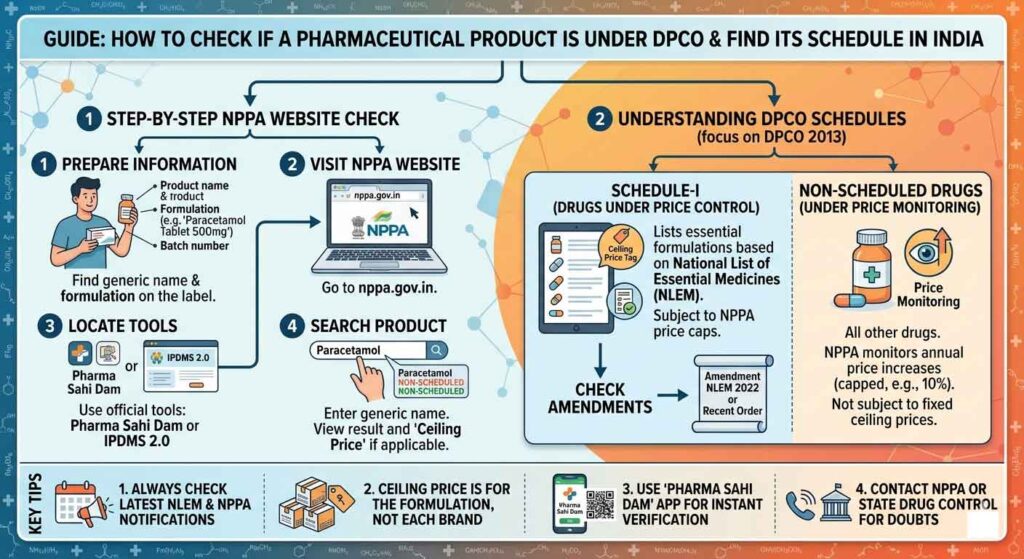
How Can You Check Whether a Product Is Under DPCO?
The easiest way is to verify the latest notifications and ceiling price lists issued by NPPA.
Prescription medicines that can only be sold on a registered medical practitioner’s prescription.
Schedule H1
Certain antibiotics and specified medicines requiring stricter record maintenance.
Schedule X
Habit-forming and narcotic medicines requiring additional controls.
Schedule G
Medicines carrying caution regarding medical supervision.
Schedule C & C1
Biological and special products.
The complete Drugs Rules and schedules are available on CDSCO’s official portal.
How to Check the Latest DPCO Amendments
Many entrepreneurs mistakenly rely on old DPCO lists.
Instead:
Visit the NPPA website regularly.
Check the “Circulars/Orders” section.
Review newly issued notifications.
Monitor annual WPI-based revisions.
NPPA publishes all revised ceiling prices and retail price notifications on its website.
How to Find Top-Selling Molecules in India?
There is no single publicly available government list of the top-selling molecules in India.
However, pharmaceutical companies often rely on market intelligence sources such as:
Industry market research reports
Prescription audit data
Sales analytics reports
Distributor feedback
Doctor prescribing trends
Trade publications
Internal sales performance data
Studying market demand before launching products can help improve product selection and business growth.
Why Is This Important for Pharma Companies?
Before launching any product, every pharmaceutical entrepreneur should understand:
Whether the product falls under DPCO.
Applicable price restrictions.
The relevant drug schedule.
Regulatory compliance requirements.
Market demand for the molecule.
Ignoring these factors can lead to pricing errors, compliance issues, and operational challenges.
Final Thoughts
Knowledge of DPCO, NPPA notifications, and drug schedules is an essential part of running a pharmaceutical business in India.
Whether you are starting a pharma marketing company, selecting products for a franchise business, or launching new formulations, regularly reviewing regulatory updates can help you make informed decisions and remain compliant.
The pharmaceutical industry evolves continuously, and staying updated is one of the best investments you can make for long-term success.
Frequently Asked Questions (FAQs)
1. How do I know if a medicine is covered under DPCO?
Check the latest NPPA notifications and ceiling price lists. Search using the product’s molecule name, dosage form, strength, and pack size.
2. What happens if a product is under DPCO?
Its maximum selling price is regulated, and companies cannot exceed the notified ceiling price, subject to applicable rules.
3. What is the difference between scheduled and non-scheduled medicines?
Scheduled medicines are covered under notified price controls, whereas non-scheduled medicines are generally not subject to DPCO ceiling prices, although other pricing provisions may still apply.
4. Who regulates medicine prices in India?
The National Pharmaceutical Pricing Authority (NPPA) is responsible for implementing and enforcing drug pricing regulations.
5. How often are DPCO prices revised?
Price revisions and notifications are issued periodically by NPPA. Companies should regularly monitor official announcements.
6. How can I identify whether a medicine falls under Schedule H, H1, or X?
Review the latest Drugs and Cosmetics Rules and verify whether the active ingredient appears in the respective schedules.
7. Can a pharmaceutical company launch a product without checking DPCO status?
It is strongly advisable to verify DPCO applicability before product launch to avoid pricing and compliance issues.
Partner with Elzac Herbal India
Looking to start an Ayurvedic franchise, become a distributor, or launch your own herbal product range?
Elzac Herbal India offers:
✔ Ayurvedic & Herbal Product Range ✔ Franchise & Distribution Opportunities ✔ Third-Party Manufacturing Services ✔ Product Development Support ✔ Marketing Guidance ✔ PAN India Business Opportunities
Whether you are an entrepreneur, retailer, distributor, or healthcare professional, our team can help you explore the right business opportunity in the growing Ayurvedic sector.
Ajay Kamboj is an entrepreneur and business owners associated with many Ayurvedic and Pharmaceutical start-ups. With years of experience in Ayurvedic product marketing, pharmaceutical distribution, franchise development, and client relationship management, he regularly shares practical business insights based on real-world experiences. His articles focus on business growth, entrepreneurship, customer management, and lessons learned from the healthcare and wellness industry.




Leave a Reply
You must be logged in to post a comment.