A third-party pharmaceutical manufacturer is a company that manufactures medicines on behalf of other pharmaceutical marketing companies, PCD franchise companies, exporters, hospitals, or healthcare brands.
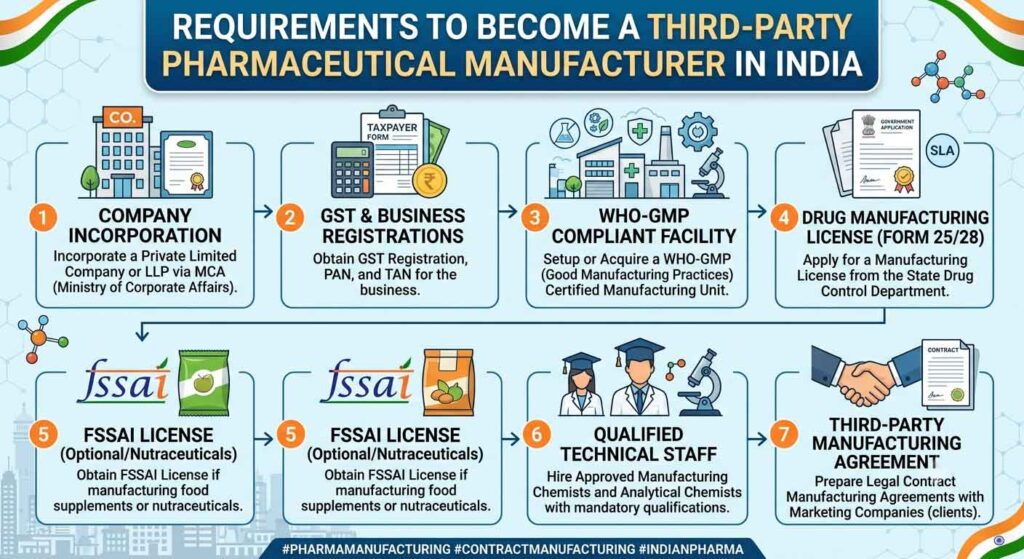
To become a third-party manufacturer in India, you generally need:
Pharmaceutical manufacturing licence
GMP-compliant manufacturing facility
Qualified technical staff
Production and quality control infrastructure
Adequate working capital
Consistent manufacturing orders
The requirements are largely the same whether you manufacture products for your own marketing company or for third-party clients.
Query 1
I am a Diploma in Pharmacy holder from Karnataka and want to start a small-scale pharmaceutical manufacturing unit. I am interested in third-party manufacturing rather than starting my own marketing company. What are the requirements, investment, manpower needs, and profitability of this business?
Query 2
I am a pharmacist with one year of pharmaceutical industry experience. I want to start my own business with an investment of around ₹50 lakh. I am confused between marketing and third-party manufacturing. Which option is more profitable?
These are common questions among pharmacy professionals planning to enter pharmaceutical entrepreneurship.
Let’s understand the practical realities of third-party manufacturing.
What Is Third-Party Pharmaceutical Manufacturing?
Third-party manufacturing is a business model where a manufacturing company produces medicines for another company under that company’s brand name.
The manufacturer focuses on production, while the client focuses on sales and marketing.
Basic Requirements to Start a Third-Party Manufacturing Unit
The regulatory requirements are generally similar to those for any pharmaceutical manufacturing facility.
1. Manufacturing Facility
You need a manufacturing premises that complies with applicable pharmaceutical manufacturing regulations.
The facility may be:
Owned
Leased
Rented
The building should support:
Production activities
Quality control operations
Material storage
Finished goods storage
Documentation systems
2. Manufacturing Licence
A valid manufacturing licence must be obtained from the appropriate regulatory authority before commercial production begins.
Approval requirements depend on:
Product category
Dosage forms
Manufacturing activities
3. Qualified Technical Staff
Qualified personnel are essential.
Typical requirements may include:
Manufacturing Department
Manufacturing Chemist
Production Personnel
Quality Department
Analytical Chemist
Quality Control Staff
Quality Assurance Staff
The exact requirements depend on the type and scale of manufacturing operations.
4. Machinery and Equipment
Machinery requirements vary depending on dosage forms.
Tablet Manufacturing
Granulator
Fluid Bed Dryer
Tablet Compression Machine
Coating Equipment
Capsule Manufacturing
Capsule Filling Machine
Capsule Polishing Machine
Liquid Manufacturing
Manufacturing Vessels
Storage Tanks
Filling Machines
Packaging
Blister Packing Machines
Alu-Alu Packing Machines
Labeling Equipment
5. Quality Control Laboratory
Every manufacturing facility must maintain appropriate quality systems.
Testing may involve:
Raw materials
Packaging materials
In-process products
Finished products
Reliable quality systems are critical for attracting and retaining clients.
How Much Investment Is Required?
Investment varies significantly based on:
Product categories
Dosage forms
Production capacity
Location
Infrastructure
A facility manufacturing tablets and capsules requires substantially different investment compared to an injectable plant.
Major Cost Components
Land and building
Machinery
Utilities
Licences and approvals
Laboratory setup
Working capital
Staff salaries
A detailed project report should always be prepared before investment.
How Many Employees Are Needed?
Manpower depends on:
Product range
Number of shifts
Production volume
Automation level
A small manufacturing unit may require:
Technical Team
Manufacturing Chemist
Analytical Chemist
QA Personnel
Operational Team
Machine Operators
Helpers
Warehouse Staff
Administrative Personnel
As production grows, manpower requirements increase accordingly.
Is Third-Party Manufacturing Profitable?
The answer depends on one important factor:
Do you have enough clients placing regular manufacturing orders?
Many entrepreneurs focus on setting up a factory but underestimate the importance of customer acquisition.
A pharmaceutical manufacturing plant has ongoing expenses such as:
Staff salaries
Maintenance
Utilities
Regulatory compliance
Quality systems
Without adequate production volumes, profitability becomes difficult.
The Biggest Challenge: Capacity Utilization
A manufacturing plant becomes profitable when machinery and manpower are utilized efficiently.
For success, you need:
✓ Regular orders
✓ Long-term customers
✓ Multiple marketing companies
✓ Consistent production schedules
✓ Strong quality reputation
A facility operating near capacity generally performs much better financially than one running intermittently.
Third-Party Manufacturing vs Pharma Marketing Company
Many entrepreneurs ask:
Should I start a manufacturing company or a marketing company?
The answer depends on your experience and strengths.
Manufacturing Is Better If You Have
Production experience
Technical expertise
Regulatory understanding
Strong capital resources
Marketing Is Better If You Have
Sales experience
Distribution contacts
Market knowledge
Doctor and distributor networks
Both models can be profitable when executed correctly.
Advice for New Entrepreneurs
If you have limited industry exposure:
Consider Gaining Additional Experience
The pharmaceutical industry is highly specialized.
Before investing significant capital:
Learn market dynamics
Understand distribution channels
Study manufacturing operations
Build industry relationships
Practical experience often saves entrepreneurs from expensive mistakes.
As we often say:
The pharmaceutical industry is profitable for those who understand how to create value, build relationships, and manage risk effectively.
Common Mistakes to Avoid
❌ Starting manufacturing without customers.
❌ Underestimating working capital requirements.
❌ Ignoring quality systems.
❌ Investing heavily before understanding market demand.
❌ Depending on a single client.
❌ Choosing products without proper market research.
Final Thoughts
Third-party pharmaceutical manufacturing can be a rewarding and scalable business opportunity.
However, success depends on much more than obtaining a manufacturing licence.
The most successful manufacturers combine:
Strong quality systems,
Reliable production,
Competitive pricing,
Regulatory compliance,
Long-term customer relationships.
Before investing, focus on understanding both manufacturing and market realities.
A well-planned facility with steady orders can become a valuable long-term business asset.
Frequently Asked Questions
What is third-party pharmaceutical manufacturing?
It is the manufacturing of medicines for another company under that company’s brand name.
Do I need a manufacturing licence?
Yes. Appropriate regulatory approvals are required before manufacturing pharmaceutical products.
Is ₹50 lakh enough to start a pharmaceutical business?
Depending on the business model, ₹50 lakh may be sufficient for certain pharmaceutical ventures. A detailed project assessment should be conducted before investment.
Is manufacturing more profitable than marketing?
Both can be profitable. Success depends on expertise, execution, market access, and business strategy.
What is the biggest challenge in third-party manufacturing?
Maintaining a steady flow of manufacturing orders and utilizing production capacity effectively.
Should I gain experience before investing?
In most cases, additional industry experience can significantly improve the chances of long-term success.
Partner with Elzac Herbal India
Looking to start an Ayurvedic franchise, become a distributor, or launch your own herbal product range?
Elzac Herbal India offers:
Ayurvedic & Herbal Product Range
Franchise & Distribution Opportunities
Third-Party Manufacturing Services
Product Development Support
Marketing Guidance
PAN India Business Opportunities
Whether you are an entrepreneur, retailer, distributor, or healthcare professional, our team can help you explore the right business opportunity in the growing Ayurvedic sector.
Ajay Kamboj is an entrepreneur and business owners associated with many Ayurvedic and Pharmaceutical start-ups. With years of experience in Ayurvedic product marketing, pharmaceutical distribution, franchise development, and client relationship management, he regularly shares practical business insights based on real-world experiences. His articles focus on business growth, entrepreneurship, customer management, and lessons learned from the healthcare and wellness industry.




Leave a Reply
You must be logged in to post a comment.