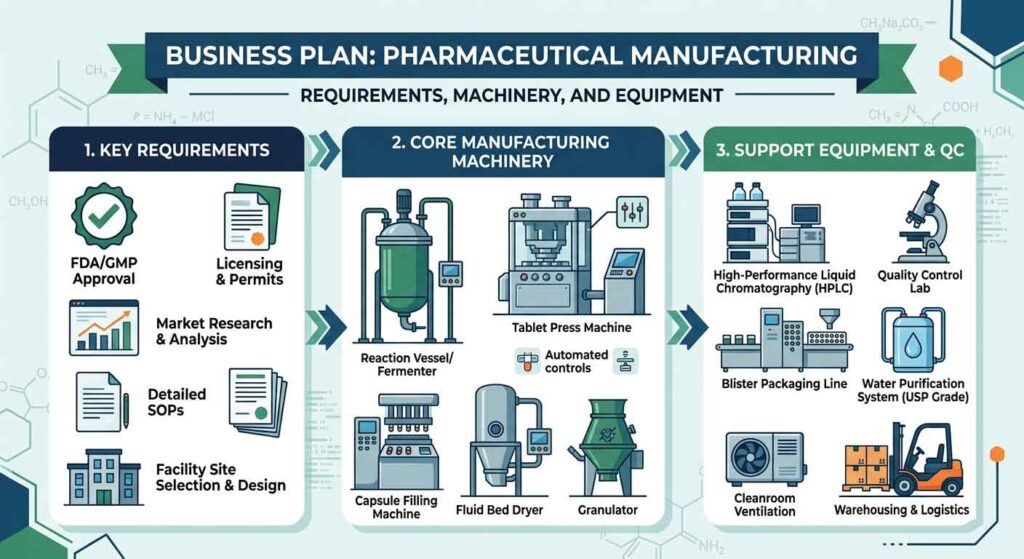
A modern pharmaceutical manufacturing plant must comply not only with manufacturing-licence conditions but also with the revised Schedule M requirements for Good Manufacturing Practices, premises, plant and equipment.
India’s revised Schedule M was notified through G.S.R. 922(E) dated December 28, 2023. It requires manufacturers to establish a Pharmaceutical Quality System incorporating GMP and Quality Risk Management and to provide suitable personnel, premises, equipment and facilities throughout the product lifecycle.
Quick Answer
To start a pharmaceutical manufacturing unit, you generally need:
Appropriate business entity
Industrial premises
Approved pharmaceutical plant layout
Applicable drug manufacturing licence
Revised Schedule M-compliant facility
Production machinery
HVAC and utility systems
Pharmaceutical water system
Quality Control laboratory
Quality Assurance department
Qualified technical staff
Equipment qualification
Process and cleaning validation
Product permissions
Raw-material and packaging suppliers
Working capital
Marketing or contract-manufacturing customers
The machinery and area required depend entirely on the dosage forms you intend to manufacture.
Which Pharmaceutical Sections Can You Start?
A pharmaceutical manufacturing plant may contain one or more sections such as:
External preparations
Oral liquids
Tablets
Capsules
Powders
Dry syrups
Ophthalmic preparations
Parenteral preparations
Inhalers
Suppositories and pessaries
Surgical dressings
Drug repacking
A first-time entrepreneur should not automatically start every section.
Every additional dosage form increase:
Civil work
HVAC
Machinery
Validation
Staff
Laboratory requirements
Documentation
Working capital
Inspection complexity
For many new manufacturers, beginning with selected non-sterile dosage forms is more manageable than immediately starting injectables or sterile ophthalmics.
Business Models for a Pharmaceutical Factory
Before selecting machinery, decide where your sales will come from.
1. Own Brand Manufacturing
You manufacture and market your own brands through:
Medical representatives
PCD franchise
Stockists
Distributors
Hospitals
This requires a separate marketing and distribution budget.
2. Third-Party Manufacturing
You manufacture products for other pharmaceutical marketing companies.
Revenue depends on:
Manufacturing rate
Batch size
Machine utilisation
Packaging
Customer credit
Product development
Testing
This can be particularly useful for improving plant utilisation.
3. Contract Manufacturing
Large pharma companies may outsource products under:
Quality agreement
Technical agreement
Approved specifications
Manufacturing agreement
Revised Schedule M requires outsourced activities to be appropriately defined and controlled within the pharmaceutical quality system.
4. Export Manufacturing
An export-oriented unit may manufacture for:
Overseas distributors
Contract customers
Tender markets
Registered foreign products
This may eventually require:
WHO-GMP certification
CoPP
Country-specific GMP audits
Dossier support
Export NOCs where applicable
Step 1: Decide Your Dosage Forms
This is the most important investment decision.
For example, if you select:
Tablets + Capsules
you may share certain upstream equipment such as:
Sifter
Blender
Material handling
but the final manufacturing operations remain different.
If you select:
Liquids + External Preparations
some utility systems may be common, but production areas and processing requirements need appropriate separation.
Machinery should never be shared simply to save money where doing so creates an unacceptable cross-contamination risk.
Revised Schedule M requires equipment and facility design to minimise contamination and cross-contamination and specifies dedicated/self-contained facilities for certain highly sensitising and high-risk products.
Can One Machine Be Used for More Than One Product?
Possibly, but only where:
Equipment is technically suitable.
Cross-contamination risk is acceptable.
Cleaning procedures are validated.
Product changeover is controlled.
Batch records identify equipment used.
No regulatory requirement requires dedicated equipment.
For certain high-risk products, separate facilities may be necessary.
Schedule M specifically identifies products such as certain:
Penicillins
Cytotoxics
Sex hormones
Live vaccines
Biological preparations
for dedicated/self-contained or specially controlled manufacturing arrangements.
Step 2: Select Location
The plant should preferably be in an approved industrial location.
Consider:
Land cost
Building cost
Water
Electricity
Road connectivity
Transport
Skilled manpower
Raw-material suppliers
Packaging suppliers
Pollution-control requirements
Fire access
Drainage
Future expansion
A cheap remote location may eventually become expensive if qualified chemists, engineers and machine operators are difficult to recruit.
Worker and Factory Regulation
Worker health and factory safety also need to be included in the project.
The Occupational Safety, Health and Working Conditions Code, 2020 came into force on November 21, 2025 and now provides the central framework covering occupational safety, working conditions, welfare and factory-related requirements, subject to applicable rules and transition provisions.
Therefore, a 2026 project should not rely only on old references to the Factories Act, 1948.
Step 3: Plant Layout
The layout should follow logical material and personnel flow.
A basic material flow can be:
Material Receipt
↓
Quarantine
↓
Sampling
↓
QC Approval
↓
Approved Raw-Material Store
↓
Dispensing
↓
Manufacturing
↓
Primary Packaging
↓
Secondary Packaging
↓
Finished-Goods Quarantine
↓
QA Release
↓
Finished-Goods Store
↓
Dispatch
Schedule M requires production areas to be logically arranged to minimise confusion, errors and cross-contamination. QC laboratories must also be separated from production areas.
Major Areas Required
A complete plant normally needs significantly more space than the manufacturing-room areas listed in Schedule M.
You may need:
Raw-material receiving
Quarantine
Sampling
Approved raw-material storage
Rejected-material area
Dispensing
Manufacturing
Primary packing
Secondary packing
Packaging-material store
Printed packaging store
Finished-goods quarantine
Released finished goods
Returned-goods area
Recalled-goods area
QC laboratory
Microbiology laboratory
Stability section
QA office
Documentation/archive
Engineering
Utilities
Change rooms
Wash areas
Corridors
Airlocks
Therefore, the Schedule M area stated for a manufacturing section should not be interpreted as total factory area.
Recommended Areas Under Revised Schedule M
Schedule M Part XIII uses the word recommended for the following basic installation areas.
Section
Basic Installation
Ancillary
External preparations
30 m²
10 m²
Oral liquids
30 m²
10 m²
Uncoated tablets
60 m²
20 m²
Tablet coating
Additional 30 m²
10 m²
Powders
30 m²
Additional blending room where required
Capsules
25 m²
10 m²
Surgical dressing
30 m²
Additional 30 m² for medicated dressing
Ophthalmics
25 m²
10 m²
Suppositories/Pessaries
20 m²
—
Inhalers/Vitrallae
20 m²
—
Drug repacking
30 m²
—
SVP injections
150 m²
100 m²
LVP in glass containers
150 m²
150 m²
Large-volume parenterals produced through Form-Fill-Seal technology in plastic containers have separate requirements; revised Schedule M recommends 250 m² basic installation plus 150 m² ancillary area.
These figures should be treated as section-specific planning guidance. A GMP architect should calculate the complete built-up area after adding all support functions.
1. External Preparation Section
This section can manufacture products such as:
Ointments
Creams
Lotions
Pastes
Topical solutions
Emulsions
Dusting powders
Schedule M recommends the following equipment where applicable:
Mixing and storage tanks
Jacketed kettle
Electrically operated mixer
Planetary mixer
Colloid mill or emulsifier
Triple roller mill or ointment mill
Liquid filling machine
Jar or tube filling machine
The recommended basic installation area is 30 m² plus 10 m² ancillary area.
Additional Modern Requirements
Budget should also consider:
HVAC
Local exhaust
SS product-transfer system
Homogenizer
Vacuum emulsifier, where required
Tube crimping/sealing
Coding
In-process weighing
Cleaning facilities
Revised Schedule M specifically requires filtered, air-conditioned air/HVAC and suitable exhaust in topical manufacturing areas.
2. Oral Liquid/Syrup Section
Products may include:
Syrups
Oral solutions
Suspensions
Emulsions
Elixirs
Recommended equipment includes:
Stainless-steel mixing/storage tanks
Jacketed kettle
Portable stirrer
Colloid mill or emulsifier
Filtration equipment
Bottle filling machine
Pilfer-proof cap sealing equipment
Water-processing equipment
Clarity inspection units
Schedule M recommends 30 m² for basic installation plus 10 m² ancillary area.
Pharmaceutical Water
Revised Schedule M requires the chemical and microbiological quality of Purified Water to be specified and routinely monitored and requires written procedures for operation and maintenance of the Purified Water system.
A modern water system may include, according to source water and design:
Pretreatment
Softener
RO
EDI where used
UV
Storage
Recirculating loop
Sanitization system
3. Tablet Manufacturing Section
Tablet manufacturing should be divided into:
Mixing/granulation/drying
Compression
Packaging
Coating, where applicable
Schedule M requires dust-control arrangements and recommends isolation of tablet compression machines into cubicles connected to suitable dust extraction.
Granulation and Drying Machinery
Recommended equipment includes:
Disintegrator
Sifter
Powder mixer
Mass mixer
Planetary mixer or Rapid Mixer Granulator
Granulator
Hot air oven or Fluid Bed Dryer
Weighing machines
Modern plants commonly select the RMG + FBD route for wet granulation where appropriate.
Compression Equipment
Tablet compression machine
Punch and die cabinets
Tablet deduster
Tablet inspection unit/belt
In-process balance
Hardness tester
Friability tester
Disintegration apparatus
Dissolution apparatus, where applicable
Environmental controls
Schedule M lists these in its recommended tablet equipment.
Packing Equipment
Blister packing machine
Strip packing machine
Leak-test apparatus
Tablet counter
Batch coding
Cartoning
Checkweigher, where appropriate
Area
Uncoated tablets:
60 m² basic + 20 m² ancillary
Coating:
Additional 30 m² basic + 10 m² ancillary.
Tablet Coating Machinery
Where coated tablets are manufactured, equipment may include:
Jacketed kettle for coating solution
Coating pan
Automatic perforated coating machine
Polishing pan where needed
Exhaust system
Dust collector
Air-conditioning
Dehumidification
An automatic coating system may be commercially preferable to conventional coating pans for larger operations, but the final choice depends on batch size.
4. Capsule Manufacturing Section
Hard-capsule manufacturing should be carried out in a separate enclosed, suitably air-conditioned and dehumidified area with airlock arrangements.
Recommended machinery includes:
Mixing and blending equipment
Capsule filling machine
Capsule counters
Weighing machine
Disintegration apparatus
Capsule polishing machine
Modern projects may also use:
Capsule deduster/polisher
Metal detector
Empty capsule loader
Automatic capsule inspection
Blister packing
Area
Schedule M recommends:
25 m² basic installation + 10 m² ancillary area.
5. Powder Section
Products may include applicable:
Oral powders
Sachet powders
Medicated powders
Recommended machinery:
Disintegrator
Mixer
Sifter
Stainless-steel containers
Scoops
Filling machine
Weighing machine
A dust extraction system is required where fine floating powder is generated.
The recommended area is:
30 m² for basic installation, with an additional room where actual blending is conducted.
6. Surgical Dressing Section
For applicable surgical dressings other than absorbent cotton wool, recommended equipment includes:
Rolling machine
Trimming machine
Cutting equipment
Gauze folding/pressing machine
Processing tanks for medicated dressing
Hot-air oven
Steam/dry-heat sterilizer where applicable
Work tables
Schedule M recommends:
30 m² basic installation
and where medicated dressings are produced:
an additional 30 m² room.
7. Ophthalmic Manufacturing Section
Ophthalmic manufacturing should not be treated as an ordinary liquid section.
It is a sterile manufacturing operation requiring appropriate aseptic controls.
Schedule M recommends machinery such as:
Hot-air oven
Jacketed kettle
SS mixing and storage tanks
Planetary mixer
Colloid/ointment mill
Tube filling and crimping
Tube cleaning
Vial washing
Vial drying oven
Rubber closure washing
Cartridge/membrane filtration
Liquid filling
Autoclave
Air-conditioning/dehumidification
Laminar airflow units
The Part XIII recommended basic area is:
25 m² + 10 m² ancillary.
However, that figure alone does not describe the complete sterile facility.
Sterile ophthalmic manufacture must also comply with the specific sterile-product requirements in Part II of revised Schedule M.
8. Suppositories and Pessaries
Recommended machinery includes:
Mixing equipment
Pouring equipment
Moulding equipment
Weighing equipment
Recommended basic installation area:
20 m².
Where pessaries are produced through granulation and compression, applicable tablet-manufacturing requirements also become relevant.
9. Inhaler Section
Schedule M Part XIII recommends:
Mixing equipment
Graduated delivery equipment for measurement during filling
Sealing equipment
Recommended basic installation area:
20 m².
However, a modern metered-dose inhaler project can be significantly more complex than this short equipment list suggests because it may involve:
Propellants
Pressure filling
Explosion/fire controls
Specialized HVAC
Leak testing
Dose-delivery testing
Therefore, detailed engineering should be based on the specific inhaler technology.
10. Drug Repacking Section
For repacking drugs and pharmaceutical chemicals, revised Schedule M recommends:
Powder disintegrator
Powder sifter
Stainless-steel scoops/vessels
Weighing and measuring equipment
Filling machine
Electric sealing machine
The current recommended basic installation area is 30 m².
11. Parenteral/Injection Manufacturing Section
Parenteral manufacturing requires significantly higher investment and technical expertise.
Schedule M separates the operation into areas including:
Water management
Container/closure preparation
Solution preparation
Filling/capping/sealing
Sterilisation
Quarantine
Visual inspection
Packaging
Water Management Equipment
Recommended equipment includes:
RO or EDI treatment unit
Multi-column distillation
Controlled water-storage tank
Transfer pumps
Continuously circulating piping
For the parenteral water system described in Schedule M Part XIII, the storage tank and circulating pipeline material is specified as SS-316L.
Container Preparation
Ampoule/vial/bottle washing machine
Closure washing
Dryer/sterilizer
Dustproof storage
Stainless-steel benches
Solution Preparation
SS preparation tanks
Stirrer
Cartridge/membrane filters
Transfer pumps
Filling
Automatic ampoule/vial filling and sealing
Laminar airflow
Gas lines where required
Sterilization
Steam sterilizer
Hot-air sterilizer
Leak-test equipment
Visual Inspection
Illuminated inspection unit
Conveyor system
Packaging
Batch coder
Labeling machine
Packing line
Recommended Areas
Small-Volume Injectables
150 m² basic + 100 m² ancillary
Large-Volume Parenterals in Glass
150 m² basic + 150 m² ancillary
Sterile projects also require extensive:
Classified cleanrooms
HVAC
WFI
Environmental monitoring
Sterility assurance
Media fills
Sterilization validation
Microbiology
For a first-time small entrepreneur, injectables should normally be treated as a separate high-investment project rather than as one extra room added to a tablet plant.
Quality Control Laboratory
Manufacturing machinery is only half of the project.
A pharmaceutical factory must have adequate quality-control capability.
Revised Schedule M states that QC laboratories should be separated from production and designed with enough space to avoid mix-ups and cross-contamination.
The exact instruments depend on the products.
A non-sterile formulation laboratory may need equipment such as:
HPLC
UV-visible spectrophotometer
Analytical balances
pH meter
Dissolution tester
Disintegration tester
Friability tester
Hardness tester
Karl Fischer apparatus where required
Viscometer
Refractometer
Stability chambers
Hot-air oven
Muffle furnace
Water-testing equipment
Microbiology Laboratory
Where microbiological testing is required, suitable separate facilities may include:
Laminar airflow cabinet
Incubators
Autoclave
Colony counter
Refrigerator
Microscope
Sterility-testing arrangement, where applicable
Microbial-limit-testing facilities
The scope depends strongly on whether the factory produces:
Non-sterile products
Sterile products
Antibiotics
Biologicals
Quality Assurance Department
Do not budget only for Production and QC.
Modern Schedule M compliance requires a functioning Pharmaceutical Quality System.
QA responsibilities normally include:
Document control
Batch-record review
Line clearance
Deviations
CAPA
Change control
Validation
Qualification
Product Quality Review
Supplier qualification
Training
Self-inspection
Batch release
Complaints
Recall
Revised Schedule M specifically places senior-management responsibility on ensuring that the Pharmaceutical Quality System is adequately resourced.
HVAC System
HVAC is a major investment head.
A pharmaceutical HVAC system may control:
Temperature
Relative humidity
Pressure differentials
Dust
Air filtration
Airflow
Cross-contamination
Schedule M requires HVAC systems to be appropriately designed, installed and maintained to protect products, personnel and the environment.
Do not calculate HVAC cost simply as the cost of ordinary split air conditioners.
Dust Extraction
Particularly important in:
Dispensing
Tablet compression
Powder processing
Granulation
Capsule filling
Systems may include:
Dust collectors
Local exhaust
Vacuum transfer
Appropriate pressure control
The plant design should prevent dust from moving into adjoining production areas.
Pharmaceutical Water System
The system depends on dosage forms.
Possible grades include:
Potable water
Purified Water
Water for Injection
For oral liquids, revised Schedule M specifically requires defined and routinely monitored Purified Water quality.
For sterile manufacturing, WFI production, storage and distribution require a significantly more sophisticated system.
Other Utilities
A project may need:
Air compressor
Clean compressed air
Boiler
Pure steam/clean steam where applicable
Chiller
Cooling tower
DG generator
UPS
Transformer
Vacuum system
Nitrogen
ETP
STP
Fire-safety systems
Do not purchase production machinery before calculating its complete utility requirements.
Warehouse Equipment
Warehouse investment may include:
Pallet racks
Storage racks
Pallets
Material handling
Temperature data loggers
Cold storage/refrigerator
Quarantine partitions
Barcode systems
Sampling booth
Dispensing booth
Maintain clear status segregation:
Quarantine / Approved / Rejected / Returned / Recalled
Packaging Equipment
Common packaging machinery may include:
Blister machine
Strip machine
Bottle filler
Capper
Induction sealer
Tube filler
Labeling machine
Cartoning machine
Batch coder
Checkweigher
Shrink wrapper
Leak tester
Packing machinery should be selected according to intended commercial pack size and speed.
Technical Manpower
A practical organisation may include:
Production
Production Head
Manufacturing chemist
Production executives
Supervisors
Machine operators
Helpers
Quality Control
QC Head
Analytical chemists
Microbiologists
Laboratory assistants
Quality Assurance
QA Head
IPQA
Validation personnel
Documentation staff
Supporting Staff
Warehouse
Engineering
Maintenance
Regulatory affairs
Purchase
HR
Accounts
Dispatch
EHS/Safety
Technical qualifications and experience must satisfy the applicable Drugs Rules and concerned Licensing Authority.
Qualification and Validation
Buying a machine does not make it ready for pharmaceutical production.
Major equipment and systems may require:
Qualification
Design Qualification
Installation Qualification
Operational Qualification
Performance Qualification
Validation
Manufacturing-process validation
Cleaning validation
Analytical-method validation
Water-system validation/qualification
HVAC qualification
Hold-time studies
Computer-system validation where applicable
Sterilization validation for sterile facilities
Schedule M requires equipment to be appropriately located, designed, installed and maintained and requires cleaning procedures to be validated where relevant to contamination and carry-over risk.
Documents Required Before Commercial Production
A compliant plant may require documents including:
Site Master File
Quality Manual
Validation Master Plan
SOPs
Master Formula Records
Batch Manufacturing Records
Batch Packing Records
Specifications
Standard testing procedures
Cleaning procedures
Equipment logbooks
Calibration schedule
Preventive-maintenance schedule
Training records
Supplier qualification
Deviation procedure
CAPA procedure
Change control
OOS procedure
Product Quality Review
Recall procedure
Manufacturing Licence
The appropriate drug manufacturing licence depends on:
Product category
Dosage form
Schedule classification
Sterile/non-sterile status
New-drug status
Biological status
CDSCO maintains the Drugs Rules and current amendments, while manufacture and sale licences for ordinary drug formulations are principally administered through State Licensing Authorities, with central involvement for specified categories and new drugs.
Do not finalize machinery until the product list has been reviewed against the correct licensing route.
Product Permission
Obtaining a manufacturing licence does not automatically permit production of every formulation.
Each commercial product must be appropriately covered by:
Manufacturing permission
Approved composition
Dosage form
Strength
Applicable regulatory approvals
New drugs and certain new FDCs may also require approval under the New Drugs and Clinical Trials Rules, 2019.
Capital Investment
There is no reliable universal statement such as:
“A tablet plant costs ₹20 lakh.”
The complete investment depends on:
Land
Built-up area
Product types
Capacity
Automation
HVAC
Water
Laboratory
Packaging
Utilities
Validation
Working capital
A more practical capital-budget structure is:
Investment Head
Typical Planning Importance
Land/building
High
GMP civil work
High
HVAC
High
Production machinery
Very high
Packing machinery
High
QC laboratory
High
Water/utilities
High
Warehouse
Medium
IT/software
Medium
Qualification/validation
Medium-high
Pre-operative expenses
Medium
The actual budget should be prepared from current vendor quotations, not old internet machinery prices.
Obtain Multiple Quotations
For major equipment, obtain at least several comparable quotations covering:
Capacity
Material of construction
Automation
GMP design
Utilities
Electrical load
Installation
FAT
Documentation
Qualification support
Warranty
Spare parts
Service
The lowest quotation is not automatically the cheapest machine over its operating life.
Working Capital
Working capital may be as important as machinery investment.
Never purchase machinery based only on the manufacturer’s advertised maximum output.
Calculate:
Required Annual Output
then consider:
Batch size
Changeover
Cleaning
Maintenance
Rejection
Downtime
Working shifts
For example, a machine theoretically producing 100,000 tablets per hour will not deliver that output continuously for every working hour of the year.
Capacity Utilisation
For financial planning, use conservative utilisation assumptions during the early years.
An illustrative model might be:
Year
Planning Utilisation
Year 1
25–40%
Year 2
40–55%
Year 3
55–70%
These are business-planning assumptions only, not regulatory standards.
Actual projections should be supported by:
Existing company sales
Third-party enquiries
Letters of intent
Distributor network
Export customers
Production Cost
Calculate product cost as:
Raw Material + Packing Material + Direct Labour + Utilities + Testing + Manufacturing Overhead + QA/QC + Depreciation Allocation + Rejection Provision
Then compare against:
Third-party manufacturing rates
Market price
Selling price
Batch size
A small batch may be technically possible but commercially unprofitable.
Break-Even
Suppose:
Monthly fixed expenses = ₹20 lakh
Contribution margin = 30%
Then:
Break-Even Monthly Sales = ₹20 lakh ÷ 30%
= approximately ₹66.7 lakh
This means machinery should not be justified only by its production capacity.
The project must have enough demand to cover fixed costs.
Major Fixed Expenses
These may include:
Technical salaries
QA/QC staff
Engineering
Administration
HVAC
Maintenance
Rent
Interest
Depreciation
Security
Regulatory compliance
Even a factory with no production continues to incur many of these expenses.
Safety Requirements
Production may involve:
Dust
Solvents
Heat
Pressure
Chemicals
Potent APIs
Moving machinery
Controls should include:
PPE
Machine guarding
Dust extraction
Chemical storage
Fire systems
Emergency exits
First aid
Spill response
Safety training
The applicable occupational-safety framework should be integrated into factory design from the beginning.
Suggested Startup Models
Model A: Tablet + Capsule Unit
Suitable where:
Market demand is mainly oral solids.
Third-party manufacturing customers are available.
Capital is moderate to high.
Major investment:
RMG
FBD
Compression
Capsule filling
Blister
HVAC
QC
Model B: Liquid + External Preparation Unit
Suitable for:
Syrups
Suspensions
Creams
Ointments
Major investment:
Water system
SS vessels
Homogenization
Filling
Tube filling
HVAC
Model C: Powder/Capsule Focus
Can offer a more focused starting model where the product portfolio supports it.
Model D: Sterile Injectable Unit
Suitable only with:
Significantly higher capital
Sterile-manufacturing expertise
Strong QA/microbiology
Confirmed customers
It should be developed as a dedicated project.
Project Implementation Sequence
A practical sequence is:
Phase 1 — Feasibility
Decide products.
Estimate market.
Decide business model.
Prepare DPR.
Arrange financing.
Phase 2 — Site
Select industrial premises.
Conduct regulatory review.
Prepare concept layout.
Phase 3 — Engineering
Finalize GMP layout.
HVAC design.
Utility design.
Water design.
Electrical design.
Phase 4 — Procurement
Production machines
Packing machines
QC equipment
Utilities
Phase 5 — Installation
Civil work
HVAC
Water
Machinery
Laboratories
Phase 6 — Quality System
SOPs
Documentation
Recruitment
Training
Qualification
Phase 7 — Regulatory
Licence application
Inspection
Observation closure
Product permissions
Phase 8 — Validation
Process validation
Cleaning validation
Analytical validation
Utility qualification
Phase 9 — Commercial Launch
Production
QA release
Distribution
Third-party orders
Own marketing
Common Mistakes
Avoid:
Purchasing machines before finalizing dosage forms
Designing from old Schedule M plans
Treating recommended production-room area as total factory area
Ignoring HVAC
Installing only a basic deionizer for pharmaceutical liquids
Underestimating QC
Ignoring QA
Sharing equipment without cleaning validation
Mixing high-risk products in common facilities
Starting sterile manufacturing without specialist expertise
Underestimating working capital
Assuming machine capacity equals sales
Buying too much automation before demand exists
Using outdated equipment prices
Copying another plant’s layout
Starting construction without regulatory review
Practical Checklist Before Investment
Product categories selected
Dosage forms selected
Manufacturing licence route checked
New-drug/FDC status checked
Market survey completed
Expected capacity calculated
Site selected
GMP layout prepared
Material flow reviewed
Personnel flow reviewed
HVAC designed
Water system designed
Utility load calculated
Machinery list prepared
Vendor quotations obtained
QC equipment selected
Microbiology requirements assessed
Technical staff planned
Validation budget included
Working capital calculated
Five-year financial projection prepared
Break-even calculated
Regulatory consultant/legal review completed where necessary
Final Answer
A pharmaceutical manufacturing project should be planned around the products and GMP system, not merely around machinery.
Revised Schedule M continues to provide recommended machinery and basic installation areas for conventional dosage forms, including tablets, capsules, liquids, external preparations, ophthalmics, powders, inhalers, surgical dressings and parenterals.
However, a modern 2026 factory also requires substantial investment in:
HVAC
Pharmaceutical water
Quality Control
Quality Assurance
Validation
Documentation
Utilities
Warehouse controls
Skilled manpower
Therefore, never estimate total project cost simply by adding the price of a tablet machine, capsule filler and blister machine.
For a new entrepreneur, the safest approach is usually to select one or two commercially strong non-sterile dosage-form sections, build them fully to current GMP requirements and expand after achieving stable quality, sales and capacity utilisation.
Frequently Asked Questions
1. What is the minimum area required for a tablet section?
Revised Schedule M recommends 60 m² for basic installation plus 20 m² ancillary area for uncoated tablets.
2. What is the area for tablet coating?
An additional 30 m² basic plus 10 m² ancillary area is recommended.
3. What is the area for oral liquids?
30 m² basic plus 10 m² ancillary area is recommended.
4. What area is required for capsules?
25 m² basic plus 10 m² ancillary area is recommended.
5. What is the area for external preparations?
30 m² basic plus 10 m² ancillary area is recommended.
6. What is the current basic area recommended for drug repacking?
30 m² under revised Schedule M.
7. How much area is required for injections?
For Small Volume Injectables, Schedule M recommends 150 m² basic plus 100 m² ancillary. For Large Volume Parenterals in the conventional glass-container arrangement, 150 m² basic plus 150 m² ancillary is recommended.
8. Is a QC laboratory compulsory?
A pharmaceutical manufacturing facility requires proper quality-control arrangements. Revised Schedule M requires QC laboratories to be separated from production areas and designed for their testing operations.
9. Can the same machinery be used for different products?
Possibly, where risk assessment supports it and cleaning/changeover controls are validated. Certain high-risk products require dedicated/self-contained arrangements.
10. Is HVAC compulsory?
Environmental control requirements depend on product and process, but revised Schedule M places extensive requirements on appropriate ventilation/HVAC and contamination control.
11. Can I use only DM water for syrup manufacturing?
The liquid-production system should provide and routinely monitor Purified Water meeting applicable requirements.
12. Which is cheaper to start—tablets or injections?
A non-sterile tablet operation is generally simpler than a sterile injectable plant because injectable manufacturing additionally requires classified sterile areas, specialized HVAC, WFI, sterilization, microbiological controls and aseptic-process validation.
13. Should I buy automatic or semi-automatic machinery?
The choice should be based on expected batch size, market demand, manpower cost, product mix and changeover frequency rather than prestige.
14. Can I manufacture tablets, capsules and liquids in one factory?
Yes, subject to appropriate separate sections, layout, HVAC, equipment, licences and contamination-control arrangements.
15. What is the first step before buying machinery?
Finalize the intended products, dosage forms, capacity and regulatory route, then prepare a GMP layout and utility design.
Looking for Ayurvedic Franchise or Distribution Opportunities?
Looking to start an Ayurvedic franchise, become a distributor, or launch your own herbal product range?
Elzac Herbal India offers:
Ayurvedic & Herbal Product Range
Franchise & Distribution Opportunities
Third-Party Manufacturing
Product Development Support
Marketing Guidance
PAN India Business Opportunities
Whether you are an entrepreneur, retailer, distributor, or healthcare professional, our team can help you explore the right business opportunity in the growing Ayurvedic sector.
Ajay Kamboj is an entrepreneur and business owners associated with many Ayurvedic and Pharmaceutical start-ups. With years of experience in Ayurvedic product marketing, pharmaceutical distribution, franchise development, and client relationship management, he regularly shares practical business insights based on real-world experiences. His articles focus on business growth, entrepreneurship, customer management, and lessons learned from the healthcare and wellness industry.
3 responses to “Business Plan for Pharmaceutical Manufacturing: Requirements, Machinery and Equipment”
A very usefui input for a beginer.Thanx.Hope to receive all information and guidence in stat\rting a Pharneutical Manufacturing Venture.
Dear Sir/Ma’am,
We are in need of :
– Acetaminophen/Paracetamol powder pure white BP EP USP 500 Kg
– Hydroxychloroquine sulfate 99.0% 175 Kg
Could you please help me source that? Thank you
Hi Ajay, I am looking to set up a comprehensive Pharma manufacturing plant in Chennai and I need to have an approximate idea of the costs that will be required for creating the infrastructure in terms of land and building, machinery, fixtures and fitting and ongoing working capital for 2 years. Also, I need to understand from your experience the sectors that will show strong growth. I look forward to hearing from you. Thanks Jagan



A very usefui input for a beginer.Thanx.Hope to receive all information and guidence in stat\rting a Pharneutical Manufacturing Venture.
Dear Sir/Ma’am,
We are in need of :
– Acetaminophen/Paracetamol powder pure white BP EP USP 500 Kg
– Hydroxychloroquine sulfate 99.0% 175 Kg
Could you please help me source that? Thank you
Hi Ajay, I am looking to set up a comprehensive Pharma manufacturing plant in Chennai and I need to have an approximate idea of the costs that will be required for creating the infrastructure in terms of land and building, machinery, fixtures and fitting and ongoing working capital for 2 years. Also, I need to understand from your experience the sectors that will show strong growth. I look forward to hearing from you. Thanks Jagan