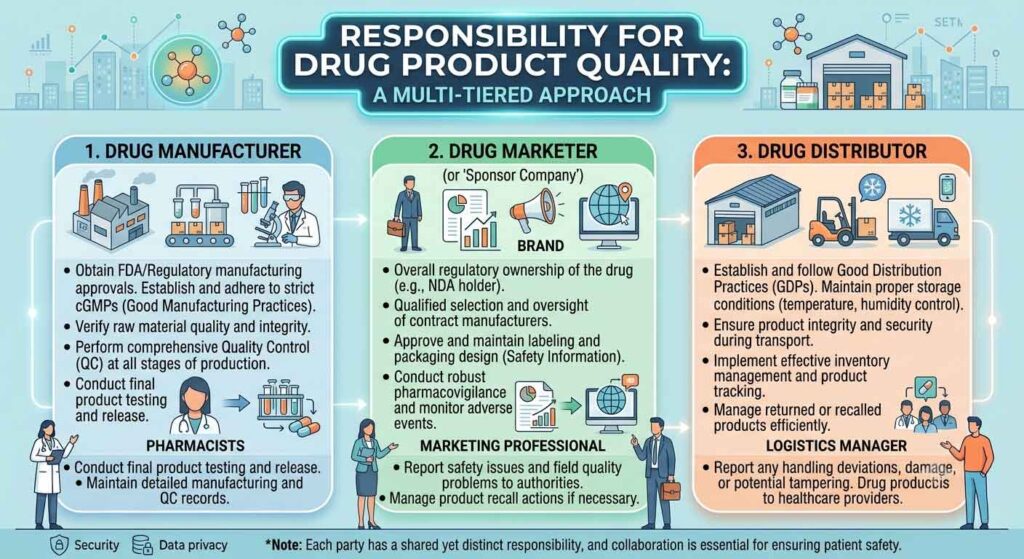
Drug quality is not the responsibility of only one person or company.
Different participants are responsible for different stages of the pharmaceutical supply chain:
Manufacturer
Marketing company
PCD franchise company
Franchisee
C&F agent
Distributor or stockist
Transporter
Retail pharmacy
The party responsible for a particular quality problem depends on:
Where the defect originated
Who owned or controlled the product
How the product was manufactured
How it was stored and transported
Who approved the label and claims
Whether proper records were maintained
Whether complaints were reported and investigated
A common query is:
“We are planning to enter the pharmaceutical business as a PCD franchisee in Odisha. Who will be responsible if there is a quality issue—the manufacturer, marketer or distributor? What documents should we collect, and how can we find a reliable company?”
The practical answer is:
The manufacturer and marketer carry major responsibility for product quality, while every person in the distribution chain is responsible for preserving that quality and following applicable storage, sale, documentation and recall requirements.
Quality Responsibility at a Glance
Manufacturer
Primarily responsible for:
Manufacturing under valid licence
Following GMP
Using approved raw materials
Correct formulation and strength
In-process quality control
Finished-product testing
Batch release
Stability and shelf life
Correct packaging
Manufacturing records
Investigation of manufacturing defects
Marketing Company
Responsible along with the manufacturer for:
Product quality
Regulatory compliance
Correct marketed-by information
Selecting a compliant manufacturer
Approved product composition
Label and promotional claims
Complaint handling
Recall coordination
Pharmacovigilance support
Maintaining agreements and records
Franchisee, Distributor or Stockist
Responsible for:
Purchasing through a licensed source
Proper storage
Required temperature control
Protection from moisture and sunlight
Batch and invoice traceability
Expiry management
Prevention of tampering
Selling only through lawful channels
Cooperating in complaints and recalls
Retailer
Responsible for:
Purchasing from licensed suppliers
Proper storage
Prescription compliance
Not selling expired products
Maintaining applicable records
Proper dispensing
Supporting product recall
Manufacturer’s Responsibility for Drug Quality
The manufacturer has the most direct control over how a medicine is produced.
Its responsibilities generally include:
Raw-Material Control
The manufacturer should:
Purchase materials from qualified suppliers
Check identity and quality
Verify specifications
Maintain Certificates of Analysis
Test materials as required
Reject unsuitable materials
The manufacturer should not rely blindly on the raw-material supplier’s COA.
Manufacturing Process
The manufacturer must follow approved:
Master Formula Records
Batch Manufacturing Records
Standard operating procedures
In-process specifications
Cleaning procedures
Equipment controls
A wrong quantity, incorrect mixing time, contamination or process deviation can directly affect product quality.
Finished-Product Testing
Before batch release, the product may require testing for parameters such as:
Identification
Assay
Dissolution
Disintegration
Content uniformity
Microbial limits
Related substances
pH
Viscosity
Fill volume
Physical appearance
Testing depends on the dosage form and approved specification.
Batch Release
Only an authorized batch should be released for sale.
The manufacturer should review:
Manufacturing records
Packing records
Test results
Deviations
Reconciliation
Investigation reports
Stability and Shelf Life
The manufacturer should have adequate technical support for the stated shelf life.
The product should remain within specification when stored under the labelled conditions throughout its shelf life.
Packaging Quality
The manufacturer is also responsible for ensuring that packaging:
Protects the product
Is compatible with the formulation
Carries correct batch details
Is properly sealed
Prevents contamination and leakage
Uses approved label matter
Is the Marketing Company Also Responsible?
Yes.
A marketing company cannot completely avoid responsibility by saying:
“We did not manufacture it; contact the factory.”
When a company places its name on the product as “Marketed by,” selects the manufacturer and commercializes the product, it has significant responsibility.
The marketer should conduct proper due diligence before placing products in the market.
Marketer’s Responsibilities
These may include:
Selecting a licensed manufacturer
Verifying product permission
Checking manufacturing capability
Approving legally compliant artwork
Receiving batch-wise COA
Maintaining a quality agreement
Monitoring complaints
Coordinating recalls
Ensuring truthful promotion
Keeping traceability records
Reporting safety concerns through the appropriate process
Marketer Cannot Transfer Everything Through an Agreement
A commercial agreement may divide responsibilities between the manufacturer and marketing company.
However, an agreement cannot necessarily remove statutory responsibility toward regulators, distributors or patients.
The agreement helps determine:
Who performs testing
Who releases the batch
Who handles complaints
Who bears replacement cost
Who investigates defects
Who conducts recall
Who retains samples
But both parties must still meet applicable legal obligations.
Is the PCD Franchisee Responsible?
A PCD franchisee normally does not manufacture the product.
However, the franchisee may still be responsible for activities under its control.
These include:
Buying only from an authorized source
Checking invoice and batch details
Storing products properly
Preventing sale of expired stock
Maintaining temperature conditions
Not altering labels
Not repacking products without authorization
Avoiding misleading promotional claims
Reporting quality complaints immediately
Supporting recall activity
A franchisee should not continue selling a suspected batch merely because the company has not yet responded.
When Can a Distributor Be Responsible?
A distributor may be responsible when the product was originally manufactured correctly but became defective because of poor distribution practices.
Examples include:
Insulin stored without required refrigeration
Syrup bottles kept in excessive heat
Products exposed to rain or moisture
Tablets stored in direct sunlight
Damaged cartons supplied to retailers
Batch numbers or labels altered
Expired stock sold
Products purchased from an unauthorized source
Counterfeit products introduced into the supply chain
In such cases, the manufacturer may not be the only responsible party.
Transporter’s Responsibility
Transportation can affect medicine quality.
Transport-related problems may include:
Excessive temperature
Water damage
Rough handling
Glass breakage
Leakage
Theft
Package tampering
Delivery delays
Responsibility depends on the transport agreement, packaging, shipment conditions and evidence of where damage occurred.
For temperature-sensitive products, transport conditions should be clearly defined and monitored.
Quality Problem vs Adverse Drug Reaction
An adverse reaction is not always a quality defect.
Quality Defect
Examples:
Tablet has insufficient active ingredient
Syrup is contaminated
Pack has wrong label
Capsule is leaking
Product fails dissolution
Bottle contains foreign particles
Adverse Drug Reaction
An adverse drug reaction may occur even when the product meets all quality specifications and is used correctly.
Examples may include:
Allergy
Nausea
Drowsiness
Known drug-related reaction
Both situations require investigation, but they are not automatically the same.
Examples of Responsibility
Example 1: Product Fails Assay
If laboratory testing confirms that a tablet contains less active ingredient than required, the manufacturer and marketer may face responsibility.
Example 2: Product Damaged by Heat
If a distributor stores temperature-sensitive medicine in excessive heat against labelled conditions, the distributor may be responsible for the deterioration.
Example 3: Wrong Composition Printed
If the marketer approved incorrect artwork and the manufacturer printed it without detecting the mistake, responsibility may involve both parties.
Example 4: Expired Product Sold
If a retailer knowingly sells an expired product, the retailer may be directly responsible, although the supply chain and return policy may also be investigated.
Example 5: Counterfeit Product
Responsibility may fall on the person who manufactured, introduced, stocked or sold the counterfeit product, depending on the investigation.
Example 6: Unapproved Promotional Claim
If the product is manufactured correctly but the marketing company or franchisee promotes it for an unapproved indication, the marketing party may be responsible for the promotional violation.
Documents a Franchisee Should Ask from the Company
A franchisee should collect documents from both:
The PCD or marketing company
The actual manufacturer
Do not rely only on a product catalogue and price list.
Documents Related to the Manufacturer
1. Manufacturing Licence
Check:
Name of manufacturer
Factory address
Licence number
Validity or retention status
Approved dosage forms
Relevant manufacturing sections
The address on the licence should match the “Manufactured by” address on the product.
2. Product Permission
Ask for evidence that the manufacturer is permitted to manufacture the exact product.
Check:
Composition
Strength
Dosage form
Product category
Manufacturing site
A general manufacturing licence alone does not prove that every product offered is permitted.
3. GMP Certificate
Ask for the current applicable GMP certificate or evidence of compliance.
Confirm:
Issuing authority
Manufacturing-site address
Dosage-form coverage
Validity
An ISO certificate does not replace a drug manufacturing licence or GMP compliance.
4. Batch-Wise Certificate of Analysis
Collect a COA for every supplied batch, particularly for important products.
The COA should normally mention:
Product name
Batch number
Manufacturing date
Expiry date
Specifications
Test results
Conclusion
Authorized approval
A general sample COA is not enough for all future batches.
5. Batch Release Document
A batch-release certificate or suitable release confirmation shows that the batch was reviewed and approved before dispatch.
6. Approved Artwork
The final artwork should match:
Approved composition
Product permission
Batch details
Manufacturer details
Marketing-company details
Schedule warning
Storage condition
MRP
Dosage form
7. Manufacturer–Marketer Agreement
This should confirm that the manufacturer is authorized to manufacture products for the marketing company.
8. Quality Agreement
A quality agreement should define:
Batch testing
Release responsibilities
Documentation
Stability
Complaints
Defects
Product returns
Recall
Retention samples
Change control
This is different from a basic commercial manufacturing agreement.
9. GST and Company Documents
Collect:
GST certificate
PAN or business details
Company constitution documents, where relevant
10. Testing-Laboratory Details
Check whether testing is:
Conducted in-house
Outsourced to an approved laboratory
Supported by valid reports
Documents Related to the PCD or Marketing Company
1. Wholesale Drug Licence
If the company is stocking, billing or distributing allopathic medicines, check its applicable wholesale drug licence.
2. GST Registration
The legal name on GST, invoice, agreement and licence should be consistent.
3. Company Registration Documents
Depending on constitution:
Proprietorship proof
Partnership deed
LLP registration
Certificate of incorporation
4. Authorization Letter
Ask for an authorization confirming that you are permitted to promote or distribute products in the agreed territory.
5. Monopoly or Territory Agreement
This should clearly mention:
Territory
Product range
Minimum purchase
Payment terms
Duration
Sales expectations
Conditions for cancellation
Conflict handling
A monopoly letter is a commercial document. It is not a quality certificate.
6. Trademark or Brand Authorization
Check whether the marketing company owns or is authorized to use the product brands.
7. Price List
The price list should clearly show:
Net rate
MRP
GST
Pack size
Scheme
Transport terms
8. Expiry and Replacement Policy
Obtain written terms for:
Near-expiry stock
Expired stock
Breakage
Leakage
Transit damage
Product recall
Defective batches
9. Complaint Contact
The company should provide a clear quality-complaint contact with:
Responsible person
Email
Phone number
Reporting process
Documents the Franchisee Itself May Need
If you will purchase, stock, sell or distribute allopathic medicines, your own business structure may require:
Wholesale drug licence
GST registration
Firm registration
Licensed premises
Approved competent person
Purchase and sale records
Proper storage facilities
If you work through a licensed distributor, the billing, stocking and supply arrangement should be documented clearly.
Check the exact requirements with the Drugs Control Administration before beginning operations.
Why COA Alone Is Not Enough
A COA is important, but it is not a complete guarantee.
A COA:
Applies to a particular batch
Is prepared from tested samples
Does not prove that storage remained proper after release
Does not replace supplier qualification
Does not replace product permission
Does not replace complaint investigation
For important or high-risk products, the marketer or franchisee may consider periodic independent testing through a suitable laboratory.
Can a Franchisee Independently Test Products?
A franchisee or marketing company may obtain samples tested from a competent laboratory, subject to proper sampling and documentation.
Independent testing can help verify:
Assay
Dissolution
Microbial quality
Physical parameters
Packaging or label concerns
However, the sample should be representative and properly handled.
An informal test of an incorrectly stored or unsealed sample may not give a reliable conclusion.
How to Find a Trusted and Reliable Manufacturer
Step 1: Do Not Select Only Through Google Ranking
A good website or advertisement does not prove manufacturing quality.
Use online research only for initial shortlisting.
Step 2: Verify the Manufacturing Licence
Check the original or digitally verifiable licence.
Confirm it directly through:
Issuing State Drug Licensing Authority
Official regulatory portal, where available
Written verification, when required
Do not depend on a cropped WhatsApp image.
Step 3: Verify Product Permissions
Ask for product-wise permission for the formulations you intend to purchase.
Step 4: Visit the Manufacturing Unit
Where commercially practical, inspect:
Production areas
Quality-control laboratory
Raw-material warehouse
Finished-goods warehouse
Packaging area
Hygiene
Documentation system
Retention-sample room
Complaint system
A factory visit can reveal much more than a brochure.
Step 5: Evaluate Quality Documentation
Ask for:
Sample COAs
GMP certificate
Quality policy
Product-permission documents
Complaint and recall process
Quality agreement
Step 6: Check Regulatory History
Review available official information relating to:
Not-of-standard-quality reports
Product recalls
Regulatory alerts
Licence suspension
Warning or enforcement action
One isolated complaint does not always prove that an entire company is unreliable, but repeated unresolved problems are a serious warning.
Step 7: Ask Existing Clients
Speak with two or three genuine customers.
Ask about:
Product quality
Delivery time
Stock availability
Replacement
Complaint response
Documentation
Payment disputes
Do not rely only on references selected by a salesperson without verification.
Step 8: Start With a Controlled Order
Begin with:
Limited products
Moderate quantity
Fast-moving formulations
Products with adequate shelf life
Review performance before increasing investment.
Step 9: Test Selected Batches
Periodic independent testing can provide additional confidence, particularly for:
New manufacturers
High-risk products
Costly products
Products with previous complaints
Step 10: Sign a Written Agreement
The agreement should cover both commercial and quality responsibilities.
What Should a Quality Agreement Include?
A practical quality agreement may cover:
Approved product composition
Manufacturing site
Raw-material control
Packaging specifications
Batch testing
COA
Batch release
Stability
Change control
Deviations
Out-of-specification results
Complaints
Adverse-event communication
Recall
Retention samples
Regulatory inspection
Defective-product replacement
Document retention
Audit rights
Do not depend only on a purchase order.
How to Handle a Quality Complaint
When a complaint is received:
1. Record Complete Details
Collect:
Product name
Batch number
Manufacturing date
Expiry date
Invoice
Complaint description
Photographs
Storage details
Quantity affected
Source of product
2. Isolate the Suspected Stock
Do not mix it with saleable stock.
3. Inform the Company Immediately
Send a written complaint rather than only making a telephone call.
4. Stop Sale if Necessary
Where the complaint may create safety or serious quality concerns, stop further sale of the suspected batch pending assessment.
5. Preserve Samples
Keep:
Unopened market sample
Affected sample
Packaging
Invoice
Transport records
6. Investigate
The investigation may review:
Retention sample
Manufacturing records
Test results
Distribution history
Storage temperature
Similar complaints
Packaging integrity
7. Take Corrective Action
Action may include:
Replacement
Product recall
Laboratory testing
Regulatory communication
Corrective and preventive action
Product Recall Responsibilities
Recall should be a coordinated process.
Manufacturer and Marketer
Usually lead:
Investigation
Risk assessment
Recall decision
Regulatory coordination
Communication
Reconciliation
C&F and Distributors
Should:
Stop dispatch
Identify customers
Segregate stock
Return products
Maintain records
Franchisees and Retailers
Should:
Stop sale
Inform customers or channel partners as instructed
Isolate stock
Return affected batches
provide reconciliation
A franchise agreement should explain recall cooperation.
Red Flags While Selecting a Company
Avoid or investigate carefully when a company:
Refuses to share manufacturing licence
Cannot provide product permission
Offers only a generic sample COA
Gives an inactive factory address
Promises every product at an unusually low price
Frequently changes manufacturers without notice
Has no written replacement policy
Avoids written quality agreement
Supplies products with very short expiry
Uses misleading approval claims
Refuses a factory visit
Does not investigate complaints
Asks for large advance without documentation
ISO, GMP and WHO-GMP: Understand the Difference
GMP
GMP is directly relevant to pharmaceutical manufacturing quality.
WHO-GMP or COPP
These documents may be relevant for certain manufacturing and export purposes, but should be verified for:
Issuing authority
Site
Products or dosage forms
Validity
ISO
ISO certification may indicate a management-system certification.
However, ISO does not replace:
Manufacturing licence
Product permission
GMP compliance
Batch testing
Do not select a manufacturer only because it displays several logos.
Practical Responsibility Matrix
Manufacturing Defect
Likely responsibility:
Manufacturer
Marketer may share regulatory responsibility
Incorrect Approved Label
Likely responsibility:
Manufacturer
Marketer
Party that prepared or approved the artwork
Poor Storage
Likely responsibility:
Warehouse
C&F
Distributor
Franchisee
Retailer, depending on where it occurred
Transit Damage
Likely responsibility:
Transporter
Dispatching party
Receiving party, depending on evidence and contract
Expired Product Sale
Likely responsibility:
Seller
Distributor or retailer involved
Other parties may be examined if stock was improperly pushed or recalled
Misleading Promotion
Likely responsibility:
Marketer
Franchise company
Franchisee or sales team involved
Counterfeit Product
Likely responsibility:
Person or entity introducing, stocking, distributing or selling it
Investigation may involve the full supply chain
Practical Answer for a New Franchisee
Before placing the first order:
Take or arrange the required wholesale drug-licence structure.
Verify the PCD company’s legal identity and wholesale licence.
Verify the manufacturer’s manufacturing licence.
Check product-wise permissions.
Collect current GMP evidence.
Obtain batch-wise COAs.
Sign an authorization and territory agreement.
Obtain written expiry and replacement terms.
Sign or review a quality and recall arrangement.
Start with a controlled order.
Maintain proper storage and batch records.
Report quality complaints immediately.
Final Thoughts
Drug product quality is a shared responsibility.
The manufacturer is directly responsible for manufacturing, testing and releasing a compliant product.
The marketer is also responsible for product quality, regulatory compliance, labelling, manufacturer selection and post-market complaint handling.
The distributor, franchisee, C&F agent and retailer are responsible for maintaining product quality during storage, transport and sale.
Therefore, the correct answer is not:
“Only the manufacturer is responsible.”
The correct answer is:
Each party is responsible for the activities under its control, while the manufacturer and marketer carry major responsibility for the product placed in the market.
A franchisee can reduce risk by verifying licences, collecting batch documents, maintaining proper storage and working only with companies that have transparent quality and recall systems.
Frequently Asked Questions
1. Is only the manufacturer responsible for drug quality?
No. The manufacturer has primary manufacturing responsibility, while the marketer also shares responsibility for quality and regulatory compliance. Distributors and retailers are responsible for proper storage, handling and sale.
2. Is the marketer responsible if the medicine is manufactured by another company?
Yes. Printing “Marketed by” does not completely remove quality responsibility from the marketing company.
3. Can a distributor be responsible for a quality failure?
Yes, particularly where deterioration was caused by poor storage, temperature exposure, tampering or improper transport.
4. Is COA compulsory for every order?
A franchisee should obtain or have access to a batch-specific COA. Company documentation practices and product category may vary, but batch-wise quality evidence is strongly advisable.
5. Is a GMP certificate enough to prove quality?
No. GMP is important, but product permission, batch testing, complaint history, storage and actual manufacturing practices must also be checked.
6. Is an ISO certificate equal to a GMP certificate?
No. ISO certification does not replace pharmaceutical manufacturing licence or GMP requirements.
7. Should a franchisee test products independently?
Periodic independent testing may be useful as part of quality assurance, especially when onboarding a new manufacturer or investigating a complaint.
8. What should be done after receiving a quality complaint?
Record the complaint, isolate the batch, inform the company in writing, preserve samples and stop sale where necessary pending investigation.
9. Who bears the cost of defective-product replacement?
This should be covered in the agreement. Responsibility generally depends on the cause of the defect and investigation results.
10. How can I verify a reliable manufacturer?
Verify licences and product permissions, visit the facility, review quality documents, check regulatory history, contact customers, test selected batches and start with a limited order.
Looking for Ayurvedic Franchise or Distribution Opportunities?
Looking to start an Ayurvedic franchise, become a distributor, or launch your own herbal product range?
Elzac Herbal India offers:
Ayurvedic & Herbal Product Range
Franchise & Distribution Opportunities
Third-Party Manufacturing Services
Product Development Support
Marketing Guidance
PAN India Business Opportunities
Whether you are an entrepreneur, retailer, distributor, or healthcare professional, our team can help you explore the right business opportunity in the growing Ayurvedic sector.
Ajay Kamboj is an entrepreneur and business owners associated with many Ayurvedic and Pharmaceutical start-ups. With years of experience in Ayurvedic product marketing, pharmaceutical distribution, franchise development, and client relationship management, he regularly shares practical business insights based on real-world experiences. His articles focus on business growth, entrepreneurship, customer management, and lessons learned from the healthcare and wellness industry.







Leave a Reply Cancel reply
You must be logged in to post a comment.