Natural products are not automatically licence-free.
A product may be obtained directly from nature, undergo only crushing and screening, and still require regulatory permission if it is packaged, labelled or advertised for medicinal use.
A common query is:
“I want to sell a natural mineral as a medical remedy. The mineral will not undergo any major processing except crushing, screening to the required size and packing. Do I need any licence or registration?”
The practical answer is:
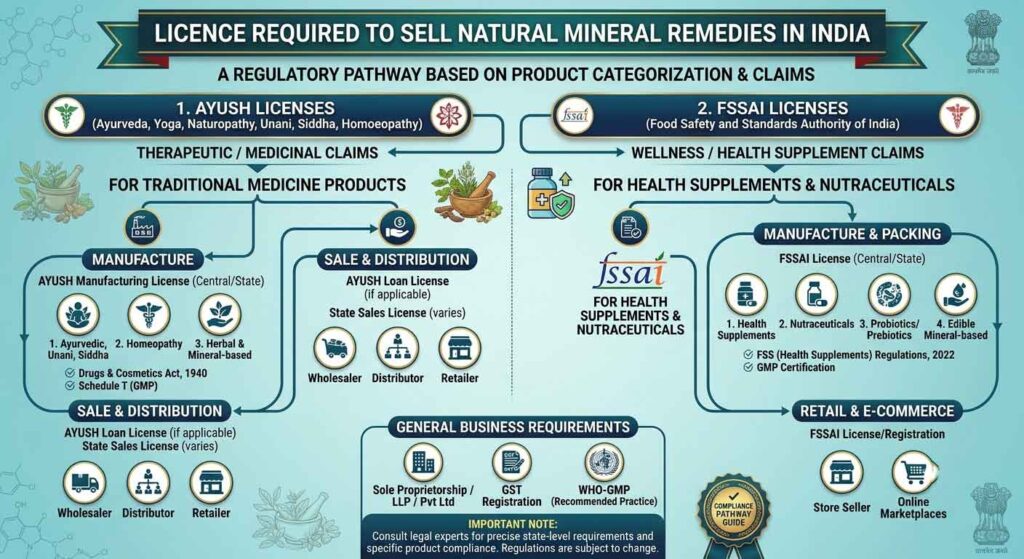
Yes, a licence or regulatory approval may be required if the product is sold with claims that it treats, prevents, cures or manages a disease or affects the structure or function of the human body.
The exact licence depends on whether the product is classified as:
A pharmaceutical drug
An Ayurvedic, Siddha or Unani medicine
A health supplement or nutraceutical
An Ayurveda Aahara product
A cosmetic or external-use product
A general mineral or industrial product
You should determine the legal classification before printing the label or starting commercial sale.
“Natural” Does Not Mean Unregulated
The following statements do not automatically exempt a product from regulation:
It is completely natural.
It is found in the earth.
It contains no synthetic chemical.
It is traditionally used.
It is only crushed and packed.
It contains no pharmaceutical API.
It is not manufactured in a factory.
It has been used by local people for many years.
Regulators examine what the product is and how it is presented to consumers.
A naturally occurring substance can still contain:
Heavy metals
Arsenic
Lead
Mercury
Cadmium
Pathogenic microorganisms
Pesticide residues
Industrial contaminants
Foreign matter
Radioactive substances
Variable mineral composition
Commercial sale therefore requires proper identification, specifications, testing and category-specific compliance.
The Product Claim Determines Regulatory Risk
A major deciding factor is the claim made on the:
Label
Carton
Brochure
Website
Social media page
Advertisement
Distributor literature
Verbal sales presentation
Product name
Consider the following examples.
General Mineral Description
“Natural mineral powder, packed for industrial use.”
This may fall outside the medicine or food category, depending on its actual purpose.
Nutritional Description
“Provides calcium as a dietary mineral.”
This may fall within the food-supplement framework only when the mineral source, form, dosage and use are permitted under applicable FSSAI standards.
Medicinal Description
“Treats arthritis, kidney stones, acidity or diabetes.”
This creates a clear medicinal or disease-treatment claim and may bring the product within drug regulation.
Ayurvedic Description
“Classical Ayurvedic mineral remedy for a stated disease.”
This may require classification and manufacturing permission as an Ayurvedic medicine, along with compliance with authoritative textual references and applicable processing standards.
Changing only the wording on the front label does not necessarily change the category if the website or advertisements continue making therapeutic claims.
Does Crushing, Screening and Packing Count as Manufacturing?
A common assumption is that no manufacturing licence is required because the mineral is not chemically processed.
That assumption is unsafe.
Activities such as:
Crushing
Grinding
Sieving
Screening
Blending
Standardising
Filling
Repacking
Labelling
Sealing
Preparing the product for sale
may be treated as manufacturing or processing activities under the applicable regulatory framework.
Therefore, a person should not purchase raw mineral, crush it at an ordinary premises, pack it in bottles and sell it as medicine without regulatory review.
Possible Regulatory Categories
1. Modern Pharmaceutical Drug
The product may be treated as a drug when it is intended for:
Diagnosis
Treatment
Mitigation
Prevention of disease
Therapeutic alteration of a body function
In this situation, the business may require:
Appropriate drug-manufacturing permission
Product approval or permission
Licensed manufacturing premises
Qualified technical staff
Quality-control arrangements
Compliant labelling
Applicable sale licence
A naturally occurring mineral does not become an approved pharmaceutical drug simply because published articles or traditional users describe medical benefits.
2. Ayurvedic, Siddha or Unani Medicine
Minerals are used in certain traditional formulations, but these products usually involve more than simple crushing.
Traditional mineral preparations may require processes such as:
Purification
Detoxification
Shodhana
Marana
Bhavana
Incineration
Controlled heating
Specific classical processing
The exact process depends on the recognized traditional formulation.
A raw mineral should not be labelled as a bhasma, pishti or other processed Ayurvedic medicine unless it has actually been prepared according to the appropriate recognized method and specifications.
Classical Ayurvedic Medicine
A classical product is generally based on an exact formulation appearing in an authoritative Ayurvedic text recognized under applicable law.
The manufacturer may need to document:
Authoritative book
Chapter or formulation reference
Ingredient identity
Mineral purification process
Manufacturing method
Dose
Indication
Quality specifications
Patent or Proprietary Ayurvedic Medicine
If the product is not an exact classical formulation, it may need evaluation as a patent or proprietary Ayurvedic medicine.
The authority may examine:
Whether its ingredients are recognized
Safety of the mineral
Intended use
Formula
Manufacturing process
Evidence and textual support
Testing specifications
Label claims
An old household remedy or family tradition does not automatically qualify for commercial Ayurvedic licensing.
3. Health Supplement or Nutraceutical
The FSSAI route may be possible only when the product genuinely qualifies as food or a regulated health supplement.
You must verify:
Whether the mineral is permitted
Permitted chemical form
Permitted source
Daily usage level
Purity standards
Contaminant limits
Target consumer
Required warnings
Labelling category
Whether prior approval is required
For example, calcium, iron, magnesium and zinc may be used in regulated supplement products only in suitable permitted forms and quantities.
A naturally mined stone or powdered earth does not automatically become a permitted mineral supplement.
4. Non-Specified Food or Ingredient
If a proposed mineral or its source is not covered by existing food standards, the business may need to examine whether it requires approval as a non-specified food or ingredient.
You should not commercially launch an unlisted mineral and wait for an inspector to decide its category later.
5. Ayurveda Aahara
Ayurveda Aahara is a separate food-regulatory category.
It should not be confused with an Ayurvedic medicine.
A product sold under the Ayurveda Aahara framework must satisfy the applicable food regulations and cannot simply use disease-treatment claims that make it a medicine.
6. Cosmetic or External-Use Product
A natural mineral may be intended for external use.
Examples may include products used for:
Cleansing
Beautifying
Skin appearance
Hair appearance
Body-care applications
In that situation, it may fall within cosmetic regulation.
However, medicinal claims can change the position.
For example:
Cosmetic-style claim: “Helps cleanse oily skin.”
Drug-style claim: “Treats fungal infection and eczema.”
The second claim may place the product within a drug category rather than an ordinary cosmetic category.
7. General Mineral or Industrial Product
When a mineral is sold only for:
Industrial use
Laboratory use
Agricultural use
Construction
Craft work
General raw-material supply
and no human-consumption or medicinal claims are made, drug or FSSAI licensing may not apply.
Other requirements may still apply, including:
Mining and mineral sourcing laws
Pollution-control requirements
Legal Metrology
Packaged commodity declarations
GST
Local trade licence
Transport requirements
Hazard communication
Consumer-protection law
Why You Cannot Simply Call It a Dietary Supplement
A food supplement should not be used as an alternative route merely to avoid drug licensing.
The following conditions should be checked:
Is the mineral permitted for human consumption?
Is its chemical form permitted?
Is the source food-grade?
Is the daily dose within permitted limits?
Is it safe for repeated oral consumption?
Are contaminants within acceptable limits?
Are the proposed claims permitted?
Is the product category available through FoSCoS?
Does the ingredient require separate approval?
If these questions cannot be answered, the FSSAI route should not be assumed.
Example Classifications
Example 1: Rock Salt
Rock salt intended for cooking may fall under the food category and applicable salt standards.
If the same pack claims to cure hypertension or kidney disease, the medicinal claim creates additional legal risk.
Example 2: Calcium Carbonate Supplement
A properly formulated calcium supplement may fall under food or drug regulation depending on:
Strength
Dosage form
Claims
Product category
Permitted source
Raw limestone powder should not automatically be marketed as a calcium supplement.
Example 3: Ayurvedic Mineral Bhasma
A bhasma generally requires recognized Ayurvedic processing, appropriate manufacturing permission and quality testing.
Plain crushed metal or mineral is not automatically a legally compliant bhasma.
Example 4: Multani Mitti
Multani mitti sold for cosmetic face-pack use may be regulated differently from a product claiming to treat psoriasis or skin infection.
Example 5: Shilajit-Type Substance
A natural exudate or mineral-rich substance may fall under different categories depending on:
Purification
Source
Composition
Dosage form
Claims
Regulatory pathway
It should not be sold merely on the basis of its natural origin.
Basic Testing Required
The testing programme depends on the mineral and product category.
Common considerations may include:
Identity
Mineral composition
Assay
Particle size
Moisture
Foreign matter
Heavy metals
Arsenic
Lead
Mercury
Cadmium
Microbial limits
Pesticide residues
Aflatoxins, where relevant
Stability
Packaging compatibility
Radioactivity assessment, where relevant to the source
A generic laboratory report saying “sample is natural” is not sufficient.
Testing should be linked to:
Batch number
Specification
Method
Acceptance limits
Authorized laboratory report
Documents You May Need
Depending on classification, documents may include:
Business Documents
Proprietorship, partnership, LLP or company registration
PAN
GST registration, where applicable
Premises proof
Local trade registration
Product Documents
Exact mineral name
Chemical composition
Geological or botanical source
Source and supplier details
Intended use
Manufacturing process
Particle-size specification
Proposed dosage
Proposed label
Product-category justification
Quality Documents
Raw-material specification
Finished-product specification
Certificate of Analysis
Heavy-metal report
Microbial report
Stability information
Packaging specification
Batch records
Regulatory Documents
Depending on category:
Drug-manufacturing licence
Ayurvedic manufacturing licence
Product permission
FSSAI registration or licence
Non-specified food approval
Cosmetic manufacturing licence
Wholesale or retail sale licence
Legal Metrology declarations
Third-Party Manufacturing Is Often Safer
A startup does not necessarily need to build its own mineral-processing facility.
After classification, it may be safer to work with a licensed third-party manufacturer that already has:
Suitable premises
Required licence
Qualified staff
Quality-control laboratory
Relevant product experience
Packaging facilities
Documentation system
However, the marketer should still verify:
Licence
Product permission
Testing
Quality agreement
Batch-wise COA
Complaint and recall procedure
Label Information
The final label depends on product category.
It may need information such as:
Product name
Legal product category
Complete composition
Quantity
Directions for use
Batch number
Manufacturing date
Expiry or best-before date
Manufacturer details
Marketer details
Licence number
Storage conditions
Warnings
MRP
Net quantity
Customer-care information
Do not print labels before the category and claims have been reviewed.
Product Name Can Also Create a Medical Claim
Even without an explicit sentence, a product name may imply treatment.
Names containing words such as:
Cure
Stone remover
Anti-diabetic
Arthritis relief
Cancer remedy
Kidney treatment
Infertility cure
may create a medicinal impression.
Choose a neutral brand name until the regulatory classification and approved claims are clear.
Recommended Step-by-Step Process
Step 1: Identify the Mineral Precisely
Do not use only a local or traditional name.
Determine:
Common name
Chemical name
Mineralogical identity
Source
Composition
Potential contaminants
Step 2: Decide the Intended Use
Will it be sold for:
Oral consumption
External use
Industrial use
Ayurvedic therapeutic use
Nutritional supplementation
Step 3: Prepare Proposed Claims
Write every claim you want to use on:
Label
Website
Brochure
Advertisements
Classification cannot be completed without considering the claims.
Step 4: Obtain Laboratory Analysis
Test identity, composition and safety parameters through a competent laboratory.
Step 5: Seek Written Classification Advice
Approach the appropriate authority:
State Drug Control Department
State AYUSH Drug Licensing Authority
FSSAI or state food authority
Cosmetic licensing authority
Provide the exact composition, process and label.
Step 6: Select the Regulatory Route
Choose the route based on written technical and legal review—not on which licence is easiest or cheapest.
Step 7: Select a Licensed Manufacturer
Use an appropriate third-party manufacturer if your own facility is unavailable.
Step 8: Complete Product and Label Approval
Finalize:
Product category
Composition
Claims
Dosage
Packaging
Warnings
Step 9: Manufacture and Test Commercial Batches
Maintain:
Batch records
COA
Source traceability
Packing records
Retention samples
Step 10: Sell Through the Correct Channel
Use the appropriate food, drug, cosmetic or general trade distribution system.
Common Mistakes to Avoid
Avoid:
Assuming natural products need no licence
Calling an unapproved mineral a dietary supplement
Selling raw mineral powder as medicine
Making disease-cure claims under FSSAI
Using an Ayurvedic name without classical support
Calling crushed mineral a bhasma
Skipping heavy-metal testing
Using a non-food-grade source for oral consumption
Printing the label before classification
Relying only on supplier statements
Selling without batch traceability
Hiding medicinal claims only on social media
Using customer testimonials to make prohibited claims
Practical Answer to the Query
If you crush, screen and pack a natural mineral and sell it as a medical remedy, you should assume that regulatory permission will be required until the competent authority confirms otherwise.
The possible routes are:
Drug licence if sold as a modern medicinal product
AYUSH manufacturing licence if it qualifies as an Ayurvedic, Siddha or Unani medicine
FSSAI licence only if it is a permitted food or supplement ingredient with compliant claims
Cosmetic licence if intended for cosmetic external use
General trade compliance if sold only as a non-medicinal mineral
Do not simply change the description to “dietary supplement” without confirming that the mineral, source, dosage and claims are permitted under FSSAI regulations.
Frequently Asked Questions
1. Does a completely natural product require a licence?
Yes, it may. Natural origin does not provide an automatic exemption from drug, food or cosmetic regulation.
2. Is crushing and packing considered manufacturing?
It may be treated as manufacturing or processing depending on the applicable law and product category.
3. Can every natural mineral be sold under FSSAI?
No. The mineral, source, chemical form, daily quantity and intended use must be permitted under the applicable food standards.
4. Can I sell it as a dietary supplement instead of medicine?
Only if it genuinely qualifies as a food supplement and all ingredients, doses, labels and claims comply with FSSAI requirements.
5. Can a food supplement claim to cure a disease?
Ordinary food supplements should not be marketed with medicinal disease-treatment or cure claims.
6. Can I sell raw mineral as Ayurvedic medicine?
Not automatically. Ayurvedic mineral medicines may require recognized ingredients, processing, textual references, product permission and licensed manufacturing.
7. Is a laboratory report enough to sell the product?
No. Testing is important but does not replace the required licence or product approval.
8. Do I need a manufacturing licence if I only pack the mineral?
Repacking and labelling may still be regulated. Confirm the requirement with the applicable licensing authority.
9. Can I get it manufactured by another company?
Yes, after determining the correct category, you can work with a licensed third-party manufacturer authorized for that product type.
10. Which authority should I contact first?
Contact the State Drug Control or State AYUSH Licensing Authority if medicinal claims are proposed. Contact the food authority when the product is genuinely intended as a permitted food or health supplement.
Final Thoughts
The legal category of a natural mineral product is decided by more than its origin or manufacturing process.
The correct sequence is:
Identify the mineral → Test its composition and safety → Decide its intended use → Review the claims → Confirm the regulatory category → Obtain the required licence → Manufacture and market
The statement “It is natural and only crushed, so no licence is required” is not a safe basis for launching a product.
Similarly, the statement “We will call it a dietary supplement and take FSSAI” is not correct unless the mineral is actually permitted as a food ingredient or supplement.
Obtain written classification advice before investing in packaging, advertising or commercial stock.
Looking for Ayurvedic Franchise or Distribution Opportunities?
Looking to start an Ayurvedic franchise, become a distributor, or launch your own herbal product range?
Elzac Herbal India offers:
Ayurvedic & Herbal Product Range
Franchise & Distribution Opportunities
Third-Party Manufacturing Services
Product Development Support
Marketing Guidance
PAN India Business Opportunities
Whether you are an entrepreneur, retailer, distributor, or healthcare professional, our team can help you explore the right business opportunity in the growing Ayurvedic sector.
Ajay Kamboj is an entrepreneur and business owners associated with many Ayurvedic and Pharmaceutical start-ups. With years of experience in Ayurvedic product marketing, pharmaceutical distribution, franchise development, and client relationship management, he regularly shares practical business insights based on real-world experiences. His articles focus on business growth, entrepreneurship, customer management, and lessons learned from the healthcare and wellness industry.




Leave a Reply Cancel reply
You must be logged in to post a comment.