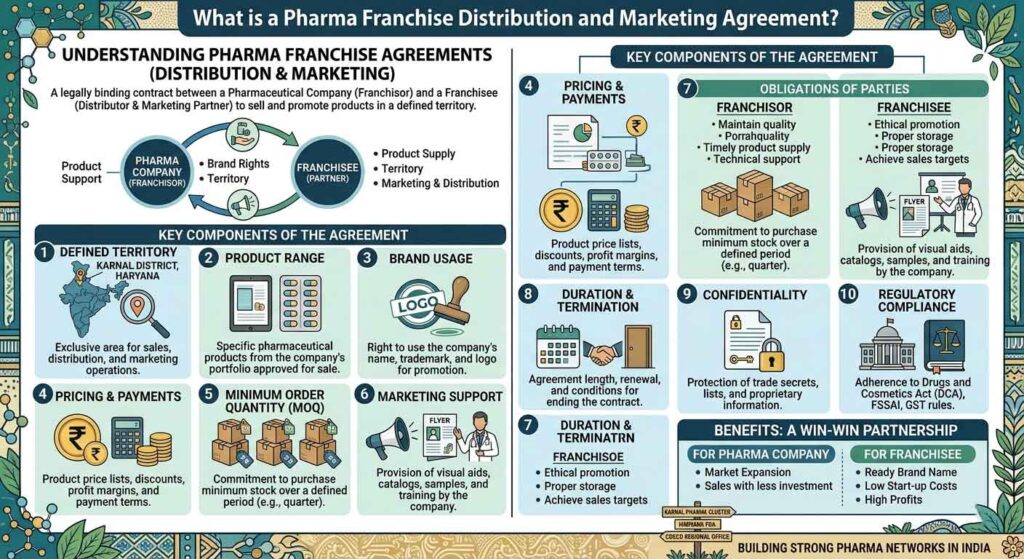
A Pharma Franchise Distribution and Marketing Agreement is a commercial contract between a pharmaceutical company and a distributor, franchise partner or PCD partner that defines how the partner may purchase, promote, distribute and sell the company’s pharmaceutical products within an agreed territory.
It commonly deals with:
Territory or monopoly rights
Product range
Purchase conditions
Net rates and price revisions
Payment terms
Drug-licence requirements
Stock and storage
Promotional rights
Trademark use
Expiry and returns
Quality complaints
Product recalls
Sales targets
Confidentiality
Term and renewal
Termination
Dispute resolution
The agreement protects both parties by recording what each party has actually agreed to do.
Quick Answer
A good PCD pharma agreement should clearly answer these questions:
Who are the parties?
Which products are covered?
Which territory is allotted?
Is the territory exclusive or non-exclusive?
What performance is required to retain monopoly rights?
What licences must the distributor maintain?
Who owns the trademarks?
At what rates will products be supplied?
Who pays GST and freight?
When does title/risk pass?
What is the payment or credit period?
What happens to expiry and damaged goods?
Who handles quality complaints and recalls?
Who approves promotional material?
How can the agreement be terminated?
What happens after termination?
How will disputes be resolved?
The agreement should be reviewed by a lawyer familiar with pharmaceutical distribution before execution, particularly when exclusivity, trademarks, credit, indemnities or large territories are involved.
Is a Pharma Franchise Agreement Compulsory?
There is no single special central statute called a “PCD Pharma Franchise Agreement Act.”
The commercial contract is principally governed by the general law of contracts and the pharmaceutical laws applicable to the activities performed by the parties.
Section 10 of the Indian Contract Act, 1872 deals with what agreements become contracts, while the Act also covers free consent, lawful consideration, performance and consequences of breach.
Even where a particular PCD arrangement could operate without a specially prescribed “franchise form,” putting the arrangement in writing is strongly advisable because verbal monopoly promises often create disputes concerning:
Territory
Product allocation
Rates
Targets
Expiry
Payment
Trademark ownership
There is also an important distinction where the relationship is not merely distribution but a formal manufacturer–marketer arrangement. CDSCO’s G.S.R. 101(E) specifically introduced provisions concerning the definition, responsibilities and labelling requirements of marketers of drugs.
Pharma Franchise Agreement vs Manufacturer–Marketer Agreement
These are not necessarily the same document.
Pharma Franchise Distribution Agreement
Primarily deals with:
Purchase
Distribution
Territory
Monopoly
Sales
Payment
Promotion
Example:
ABC Pharma → XYZ Distributor for Karnal district
Manufacturer–Marketer Agreement
Deals with the relationship where one entity manufactures the drug and another entity is identified as the marketer.
Example:
Manufactured by ABC Laboratories
Marketed by XYZ Healthcare Pvt. Ltd.
CDSCO’s G.S.R. 101(E) created specific regulatory provisions for marketers, including responsibility and labelling requirements.
Third-Party Manufacturing Agreement
Deals primarily with:
Formula
Manufacturing
Batch size
Quality
Packaging
testing
Product permissions
Artwork
Delivery
Manufacturing price
A PCD franchise agreement should therefore not automatically be used as a substitute for a third-party manufacturing agreement.
Who Are the Parties?
A typical agreement contains:
First Party
The pharmaceutical:
Manufacturer
Marketing company
PCD company
Brand owner
Distributor appointing another distributor
Second Party
The:
PCD franchisee
Distributor
Stockist
Wholesaler
Marketing partner
The legal names should match actual documents.
For example:
ABC Healthcare Private Limited
should not be casually written as:
ABC Pharma Group
if the latter is merely a trade description.
Mention:
Legal name
Constitution
Registered/business address
GSTIN
Drug licence, where relevant
Authorized signatory
Verify Drug Licences Before Signing
A pharmaceutical distributor should hold licences appropriate to the activities and categories of medicines handled.
Wholesale drug licensing under the Drugs Rules commonly involves Forms 20B/21B and other applicable forms according to the products involved. CDSCO also notified amendments on February 16, 2026 affecting conditions attached to Forms 20B, 20BB, 21B and 21BB, including competent-person requirements.
The agreement should require the distributor to:
Maintain valid licences.
Notify the company of suspension/cancellation.
Supply renewed licence copies.
Store medicines only at authorized premises.
Follow applicable prescription-drug restrictions.
Do not rely on a licence copy collected five years earlier.
Important Documents to Obtain
A company may collect copies of:
Drug licence
GST registration
PAN
Firm/company registration
Authorized-signatory proof
Address proof
Bank details
Udyam details, if relevant
Cancelled cheque
Distributor constitution documents
Where credit is given, additional financial checks may be appropriate.
1. Territory Clause
The territory clause is one of the most important provisions.
Avoid vague language such as:
“North India monopoly.”
Instead define territory precisely.
Example:
District Karnal, Haryana, excluding institutional tenders and government supplies.
Or:
Districts Karnal and Kurukshetra, subject to the exclusions in Annexure B.
Define whether rights include:
Retail sales
Hospital supply
Institutional business
Government tender
Online sales
Sub-distribution
Export
Otherwise both parties may interpret “monopoly” differently.
2. Exclusive vs Non-Exclusive Rights
The agreement should expressly state whether appointment is:
Exclusive
The company agrees not to appoint another franchise partner within the defined scope, subject to stated exceptions.
Non-Exclusive
The company may appoint additional distributors.
Conditional Exclusive
The distributor receives exclusivity only while fulfilling agreed conditions.
For PCD business, conditional exclusivity is often commercially safer.
For example:
Monopoly rights continue subject to:
Minimum quarterly sales
Timely payment
Adequate product coverage
Compliance with licence conditions
No diversion outside territory
Competition-Law Consideration
Exclusive distribution arrangements are vertical agreements.
The Competition Commission of India specifically identifies exclusive distribution arrangements and resale price maintenance among vertical arrangements under Section 3(4) of the Competition Act. Such arrangements may be examined for their effect on competition.
The Indian Contract Act also contains Section 27 dealing with agreements in restraint of trade.
This does not mean that every territorial PCD arrangement is prohibited. It means overly broad exclusivity, resale controls and post-termination restraints should be drafted carefully rather than copied from a generic internet template.
3. Minimum Business Clause
Do not write:
“Distributor must provide good business.”
Define measurable requirements.
Example:
First-quarter minimum purchase: ₹____
Thereafter quarterly purchase: ₹____
Performance reviewed every three months
Company may reduce or withdraw exclusivity after written notice if target is not achieved
Targets can also be based on:
Product range
Active retailers
Secondary sales
Territory development
Avoid Automatic Cancellation After One Bad Month
PCD sales fluctuate.
A better system may provide:
Review → Written warning → Improvement period → Territory restructuring
This is commercially more practical than immediately terminating monopoly rights.
4. Product Annexure
Attach a separate product list.
Include:
Brand name
Composition
Dosage form
Pack size
Net rate
MRP, where relevant
GST
Scheme
Product status
Use an annexure so that new products can be added without rewriting the complete agreement.
5. Price and Net Rate Clause
A clause can provide that:
Current rates appear in the price list.
GST is charged as legally applicable.
Freight terms are stated separately.
Rates may be revised by written/electronic notice.
Accepted purchase orders are governed by the agreed price applicable to that order.
Scheduled formulations remain subject to applicable NPPA requirements.
NPPA continues to administer the Drugs (Prices Control) Order, 2013 and ceiling-price controls for scheduled formulations.
Should the Agreement Fix PTR and PTS?
It may contain commercial guidance, but avoid poorly drafted clauses forcing unlawful resale pricing.
The Competition Commission identifies resale price maintenance as a vertical restraint subject to competition-law scrutiny.
For price-controlled medicines, applicable NPPA requirements must also be followed.
Therefore, have price-control language legally reviewed where necessary.
6. Purchase Order Clause
Specify how orders will be placed.
For example:
Email
ERP
Authorized WhatsApp number
Purchase-order document
Distributor portal
The agreement can state that an order becomes binding only after acceptance by the company.
Include provisions for:
MOQ
Case quantity
Product availability
Price confirmation
Dispatch schedule
7. Payment Clause
Clearly specify:
Advance Model
100% payment before dispatch.
Partial Advance
Example:
50% advance and balance before dispatch.
Credit Model
Example:
30-day credit subject to approved credit limit.
Also specify:
Bank account
Credit limit
Interest/delayed-payment consequences where legally valid
Cheque dishonour
Set-off
Outstanding settlement
Never leave credit terms only to verbal understanding.
8. GST and Tax Clause
State:
Whether quoted prices exclude or include GST
Who issues invoices
Responsibility for GST compliance
Credit-note treatment
Scheme treatment
Tax consequences of returns
If tax law changes, the agreement should permit corresponding invoice adjustments according to applicable law.
9. Delivery Clause
Define:
Dispatch location
Delivery location
Transporter selection
Freight responsibility
Expected dispatch period
Insurance
Proof of delivery
Avoid unconditional promises such as:
“Delivery always within three days.”
Use:
“Subject to stock availability, payment clearance, force majeure and agreed dispatch schedule.”
10. Risk in Transit
The Sale of Goods Act provides that risk generally passes with property unless the parties agree otherwise.
The contract should specifically state:
When title passes
When transit risk passes
Who insures the goods
Who files transporter claims
Documentation required for shortages
Time for reporting damage
For example:
Transit-risk arrangement should be defined separately from product-quality responsibility.
A damaged box in transit and a manufacturing defect are not the same issue.
11. Storage Conditions
The franchise partner should agree to store products according to:
Product label
Drug Rules
Manufacturer instructions
Temperature requirements
Particularly relevant for:
Insulin
Vaccines
Biologicals
Other cold-chain products
Improper distributor storage should not become the manufacturer’s responsibility if proper product was supplied and the deterioration resulted from documented mishandling after transfer of risk.
12. Expiry and Near-Expiry Clause
“Expiry will be responsibility of second party. Products once sold will not be taken back.”
is commercially possible as a narrow expiry policy but should not be drafted as an absolute exclusion.
Separate:
Commercial Expiry
Unsold stock approaching normal expiry.
Quality Defect
Product fails specification.
Regulatory Recall
Authority/company withdraws product.
Transit Damage
Goods damaged while being transported.
Wrong Supply
Incorrect item or quantity supplied.
These situations require different treatment.
Example Expiry Policy
You may specify:
Minimum remaining shelf life at dispatch
Period for raising expiry claims
Whether replacement/credit is allowed
Required invoice and batch proof
Maximum claim percentage
Exclusions for damaged/poorly stored stock
Avoid accepting open-ended returns without documentation.
13. Product Recall Clause
This is essential.
The franchisee should agree to:
Immediately stop sale of affected batch.
Segregate stock.
Inform downstream customers where instructed.
Provide batch-wise distribution records.
Return or destroy stock as instructed.
Cooperate with authorities.
A recall obligation should override an ordinary “no returns” clause.
14. Quality Complaint Clause
Define the complaint process for issues such as:
Broken tablets
Leakage
Colour variation
Failed dissolution
Short fill
Damaged strips
Suspected contamination
Suspected counterfeit product
Require:
Product name
Batch
Invoice
Photographs where relevant
Retained sample where available
Complaint date
Quantity affected
The manufacturer/Quality Unit should investigate according to its quality system.
15. Certificate of Analysis
That can be contractually agreed, particularly for institutional or specialized business, but it is not necessary to prescribe it mechanically for every ordinary PCD transaction.
A more flexible provision can state that:
Batch CoA or quality documentation will be provided where contractually agreed, legally required or reasonably required for investigation/tender purposes.
16. Independent Laboratory Testing
Independent Laboratory testing is useful where the parties disagree on quality.
Improve it by specifying:
Mutually agreed laboratory
NABL/accredited/approved status where appropriate
Sampling procedure
Sealed sample
Chain of custody
Cost allocation
Effect of official regulatory testing
Private contractual testing should not override statutory test results or regulatory authority.
17. Marketing and Promotion Clause
UCPMP 2024 is currently described by the Department of Pharmaceuticals as a mandatory code, and its official FAQ says it applies to pharmaceutical companies, their employees, agents and third parties acting on their behalf.
Therefore, the agreement should require the PCD partner to comply with applicable rules governing:
Promotional claims
Samples
Gifts
Hospitality
Healthcare-professional interaction
Promotional literature
Digital advertising
The franchise partner should not be allowed to create exaggerated medical claims simply because it paid for the brochure itself.
Approval of Promotional Material
A useful clause is:
No promotional literature, digital advertisement, social-media creative or product claim using the company’s products or trademarks may be released without prior written approval where approval is required under the company’s promotional-control procedure.
This protects both parties.
18. Medical Samples
Define:
Who supplies samples
Quantity
Cost
Records
Labelling
Distribution restrictions
Do not treat free samples as ordinary trade stock.
19. Trademark Ownership
This is one of the most important clauses.
The agreement should state:
Who owns each trademark
Whether registration is pending
Whether distributor has only limited permission to use it
Territory of permitted use
Duration of permission
Use after termination
Ownership of artwork and logos
The Trade Marks Act gives a registered proprietor exclusive rights, while “permitted use” can arise through consent contained in a written agreement subject to applicable conditions.
Do Not Allow Franchisee to Register the Company’s Brand
The contract should generally prohibit a franchise partner from filing:
Trademark
Domain
Social-media name
Company name
that improperly incorporates or claims ownership over the principal’s protected brand.
But responsibility for conducting the original trademark search should also remain clear.
20. What If the Brand Infringes Someone Else’s Trademark?
Agreement may place the entire responsibility on the first party.
A better clause should distinguish between:
Company-created trademark
Principal may indemnify the distributor for authorized use, subject to stated conditions.
Distributor modifies the mark
Distributor bears responsibility for unauthorized changes.
Distributor independently adopts a similar mark
Distributor bears its own risk.
Trademark infringement can arise where an unauthorized identical or deceptively similar mark creates the relevant likelihood of confusion.
21. Sub-Distributor Appointment
State whether the franchisee may appoint:
Stockists
Distributors
Retailers
Sub-franchisees
If allowed, define:
Licence verification
Territory restrictions
Company’s approval
Liability
UCPMP compliance
Trademark use
A PCD partner should not be able to sell the territory to another party unless the contract permits it.
22. No Diversion Outside Territory
The agreement can restrict active distribution outside the allocated territory.
However, exclusivity and market restrictions should be drafted with competition-law considerations in mind. CCI identifies exclusive distribution arrangements among vertical restraints subject to Section 3(4) analysis.
Avoid extremely broad language extending far beyond what is necessary to operate the franchise.
23. Confidentiality Clause
Protect:
Net rates
Customer information
Product pipeline
Business plans
Sales data
Unreleased products
Distributor lists
Artwork
Marketing strategy
Specify how long confidentiality continues after termination.
24. Personal Data Clause
Modern franchise businesses often exchange personal data involving:
Sales personnel
Doctors’ contact information
Distributor contacts
Leads
Customer representatives
India now has the Digital Personal Data Protection Act, 2023 and the Digital Personal Data Protection Rules, 2025, with provisions being brought into force on a phased timeline from November 13, 2025.
The agreement should therefore consider:
Lawful data use
Data-security responsibilities
Sharing restrictions
Deletion/return after termination
depending on the actual data-processing activities.
25. Records and Audit
The agreement may require the franchise partner to maintain:
Purchase records
Sale records
Batch records
Stock
Expiry
Complaints
Recall records
Promotional approvals
The company may reserve reasonable audit rights relevant to:
Regulatory compliance
Brand use
Territory
Stock
Recall
Avoid unlimited intrusive audit powers unrelated to the agreement.
26. Indemnity Clause
Indemnity allocates responsibility when one party’s breach causes loss to the other.
Examples include:
Company Responsibility
May include, depending on negotiated terms:
Unauthorized use of third-party intellectual property supplied by company
Manufacturing defect
Misrepresentation by company
Regulatory non-compliance attributable to company
Distributor Responsibility
May include:
Sale without required licence
Improper storage
Unauthorized promotion
Territory diversion
Trademark misuse
Tax violation caused by distributor
Unauthorized product modification
Avoid one-line unlimited indemnities.
Define:
Type of loss
Notice procedure
Defence of claims
Liability caps
Exclusions
through legal review.
27. Limitation of Liability
A commercial agreement can define liability, but contractual limitations should not be drafted as an attempt to eliminate mandatory statutory responsibilities.
For example, a clause saying:
“Manufacturer is never responsible for product quality after sale.”
would be problematic as a general statement.
The agreement should instead allocate controllable commercial risks while preserving applicable legal obligations.
28. Duration of Agreement
There is no compulsory three-year duration.
The parties may choose:
One year
Two years
Three years
Longer fixed period
Renewable arrangement
Your original template uses three years with another three-year renewal. That is one commercial option, not a legal rule.
A practical arrangement might be:
Initial term: 2 years
Performance review: every 6 months
Renewal: by written agreement
29. Termination Clause
Specify termination:
Without Cause
Example: 30/60/90 days’ notice.
For Cause
Immediate or shorter termination for:
Drug-licence cancellation
Fraud
Counterfeit activity
Serious regulatory breach
Non-payment
Trademark misuse
Diversion
Repeated target failure
Insolvency
30. Consequences of Termination
Specify what happens to:
Outstanding invoices
Unsold stock
Near-expiry goods
Promotional materials
Confidential documents
Territory rights
Trademark permission
Website/social accounts
Pending purchase orders
Termination should not leave these issues unresolved.
31. Force Majeure
A clause may cover events beyond reasonable control such as:
Natural disasters
War
Government restrictions
Major transport interruption
Epidemics/pandemics
Industrial disruption
It should specify:
Notification
Mitigation
Suspension of obligations
Long-stop termination period
Do not use force majeure to excuse ordinary financial difficulty or poor planning.
32. Dispute Resolution
The dispute resolution will be settled under the Arbitration and Conciliation Act, 1996. This remains a common approach; the Act continues to govern domestic and international commercial arbitration and enforcement of awards.
A stronger arbitration clause should specify:
Number of arbitrators
Appointment mechanism
Seat of arbitration
Venue
Language
Governing law
Do not simply write:
“Any dispute will go to arbitration in India.”
Seat vs Venue
These can have different legal consequences.
A lawyer should align:
Arbitration seat
Court jurisdiction
Governing law
rather than copying different cities into different clauses.
33. Notices
A present-day clause may permit notices through:
Registered post
Recognized courier
Designated official email
Define when an electronic notice is considered received.
Can a Pharma Franchise Agreement Be Signed Electronically?
Potentially yes.
The Information Technology Act recognizes electronic records, electronic signatures and the validity of contracts formed through electronic means.
However, proper:
Stamp duty
Signature authority
Record retention
State-specific requirements
should still be checked.
Is Stamp Paper Compulsory?
The better answer is:
Applicable stamp duty should be paid according to the nature of the instrument and the relevant State stamp law.
The Indian Stamp Act deals with instruments chargeable with stamp duty, but states have their own amendments/schedules and rates.
Therefore, there is no universal answer such as:
“Every pharma franchise agreement must be on ₹100 stamp paper.”
Check the state where the agreement is executed and the applicable instrument classification.
Are Two Witnesses Compulsory?
Not universally for every ordinary commercial distribution agreement.
Witnesses may nevertheless be useful for evidentiary purposes and may be required in particular transaction/document contexts.
Do not claim “two witnesses are legally compulsory” without checking the specific instrument and state law.
Is Notarization Compulsory?
Not automatically for every PCD distribution agreement.
Parties may still choose notarization for additional evidentiary formality.
Stamping, notarization and registration are different concepts.
Suggested Annexures
A well-structured agreement can keep frequently changing commercial information outside the main contract.
Annexure A
Products and compositions
Annexure B
Territory
Annexure C
Price list
Annexure D
Sales targets
Annexure E
Promotional support
Annexure F
Expiry/return policy
Annexure G
Authorized contacts and bank details
This makes future changes easier.
Recommended Structure of a Modern Pharma Franchise Agreement
A modern agreement can follow this order:
Title
Date
Parties
Recitals/background
Definitions
Appointment
Territory
Exclusivity
Products
Orders
Pricing
GST
Payment
Credit limit
Delivery
Risk and insurance
Storage
Licences
Quality
Recall
Expiry/returns
Complaints
Promotional activity
UCPMP compliance
Trademark and IP
Confidentiality
Personal data
Sub-distributors
Sales targets
Records/audit
Representations and warranties
Indemnity
Liability
Force majeure
Term
Termination
Consequences of termination
Notices
Dispute resolution
Arbitration
Governing law
Entire agreement
Amendments
Severability
Signatures
Annexures
Sample Short-Form Framework
DISTRIBUTION AND MARKETING AGREEMENT
This Agreement is entered into on __________ between [Pharma Company Legal Name], having its registered office at __________ (“Company”), and [Distributor Legal Name], having its business premises at __________ (“Distributor”).
Appointment
The Company appoints the Distributor to promote and distribute the products listed in Annexure A within the territory specified in Annexure B, subject to the terms of this Agreement.
Territory
The Distributor shall operate only within __________. Institutional, government, online or other excluded channels shall be governed by Annexure B.
Exclusivity
The appointment shall be [exclusive/non-exclusive/conditional exclusive]. Where exclusivity is granted, continuation shall be subject to agreed sales, payment and compliance requirements.
Licences
Each party shall maintain all licences and registrations required for the activities performed by it and shall promptly notify the other party of any suspension, cancellation or material regulatory restriction.
Products and Prices
Products and current rates shall be listed in Annexure A/C. Prices may be revised in accordance with the agreed notice procedure and applicable tax and price-control laws.
Payment
Payment shall be made on __________ terms. Any approved credit shall remain subject to the Distributor’s credit limit and payment performance.
Delivery
Orders shall be supplied subject to acceptance, availability and agreed dispatch terms. Freight, insurance and the point of transfer of risk shall be specified in the applicable purchase order or Annexure.
Storage
The Distributor shall store, handle and transport products according to their approved storage conditions and applicable legal requirements.
Quality and Recall
The Distributor shall promptly report suspected quality defects and cooperate fully with batch recalls. Recalled or defective products shall be handled under the Company’s applicable quality and recall procedures.
Promotion
The Distributor shall promote products only in accordance with applicable law, UCPMP requirements and approved product information. Unauthorized claims or alterations to approved promotional content are prohibited.
Trademark
All trademarks and associated intellectual property shall remain the property of their respective owners. The Distributor receives only a limited permission to use Company marks for authorized distribution and promotion during the term.
Sales Performance
The parties may agree minimum purchase or market-development targets in Annexure D. Failure to meet them may lead to review or modification of exclusive territory after the agreed notice/cure process.
Termination
Either party may terminate according to the notice period stated herein. Immediate termination may apply for serious licence, fraud, counterfeit, regulatory, payment or trademark breaches.
Arbitration
Disputes not resolved amicably shall be referred to arbitration under the Arbitration and Conciliation Act, 1996 in accordance with the agreed seat, appointment procedure and language.
Governing Law
The Agreement shall be governed by the laws of India.
For Company: __________________
For Distributor: _______________
This short form is only an illustrative clause framework, not a substitute for a state-specific legal agreement.
Common Mistakes in Pharma Franchise Agreements
Avoid:
Writing only “monopoly basis” without defining territory
Giving lifetime monopoly
No sales-performance condition
No product annexure
No price-revision mechanism
No drug-licence verification
No expiry policy
Absolute “no returns” language
Absolute “no liability after dispatch”
No recall clause
No storage clause
Allowing unrestricted promotional claims
Ignoring UCPMP
No trademark ownership clause
Allowing distributor to register brand names
Mandatory resale price clauses without competition-law review
No confidentiality
No data protection
No consequences of termination
No arbitration seat
Automatically using a three-year agreement
Practical Checklist Before Signing
Before execution, verify:
Legal names of both parties
Constitution of both entities
Drug licences
GST details
Authorized signatories
Product list
Exact territory
Exclusivity conditions
Minimum sales
Net rates
Price-revision procedure
GST and freight
Payment/credit terms
Delivery terms
Transit-risk point
Storage responsibility
Expiry policy
Recall procedure
Quality complaint process
Promotion/UCPMP requirements
Trademark ownership
Sub-distributor rights
Confidentiality
Term
Termination
Closing-stock treatment
Arbitration
Court jurisdiction
Applicable stamp duty
Signatures
Final Answer
A Pharma Franchise Distribution and Marketing Agreement is a written commercial agreement that defines the relationship between a pharma company and its PCD/franchise distributor.
Its most important clauses are not merely the names and signatures. It should clearly define:
At present, three additional areas deserve particular attention.
First, CDSCO’s marketer rules mean that a formal manufacturer–marketer relationship should not be confused with a simple distributorship arrangement.
Second, UCPMP 2024 applies not only to pharmaceutical companies but also to employees, agents and third parties acting on their behalf, making promotional-compliance clauses particularly important for PCD relationships.
Third, monopoly and resale-control clauses should be drafted carefully because exclusive distribution and resale price maintenance are recognized categories of vertical agreements under Indian competition law.
A strong agreement should protect the company without unfairly transferring every possible risk to the distributor, and it should protect the distributor without permanently blocking the company from an underperforming territory.
Looking for Ayurvedic Franchise or Distribution Opportunities?
Looking to start an Ayurvedic franchise, become a distributor, or launch your own herbal product range?
Elzac Herbal India offers:
Ayurvedic & Herbal Product Range
Franchise & Distribution Opportunities
Third-Party Manufacturing
Product Development Support
Marketing Guidance
PAN India Business Opportunities
Whether you are an entrepreneur, retailer, distributor, or healthcare professional, our team can help you explore the right business opportunity in the growing Ayurvedic sector.
Ajay Kamboj is an entrepreneur and business owners associated with many Ayurvedic and Pharmaceutical start-ups. With years of experience in Ayurvedic product marketing, pharmaceutical distribution, franchise development, and client relationship management, he regularly shares practical business insights based on real-world experiences. His articles focus on business growth, entrepreneurship, customer management, and lessons learned from the healthcare and wellness industry.
One response to “What Is a Pharma Franchise Distribution and Marketing Agreement?”
How to take agreement from a pharmaceutical company for marketing their products in my respective zone? I need a sample format for monopoly agreement and rules and regulations for monopoly agreement.








How to take agreement from a pharmaceutical company for marketing their products in my respective zone? I need a sample format for monopoly agreement and rules and regulations for monopoly agreement.