The pharmaceutical industry has one of the most complex supply chains of any business sector.
A medicine may appear to be a simple tablet, capsule or syrup when it reaches a patient, but before that product is consumed, multiple companies, professionals, quality systems and regulatory processes are involved.
The journey may include:
Chemical and key starting material suppliers
API manufacturers
Excipient suppliers
Packaging-material suppliers
Finished-product manufacturers
Quality-control laboratories
Marketing companies
C&F agents
Super stockists
Distributors
Wholesalers
Retail pharmacies
Hospitals
Doctors and healthcare professionals
Patients
Every stage has its own risks and challenges.
What Is Pharmaceutical Procurement?
Pharmaceutical procurement is the process of planning, selecting, purchasing, receiving, testing and controlling the materials, products and services required to manufacture and supply medicines.
Procurement in pharma is not simply:
Find the lowest price → place an order → receive material
A pharmaceutical company must also consider:
Supplier qualification
Regulatory compliance
Material specification
Quality consistency
Certificate of Analysis
Lead time
Batch traceability
Storage conditions
Change control
Supply continuity
Commercial terms
A low-cost material that does not meet specification can create a much larger financial and regulatory loss.
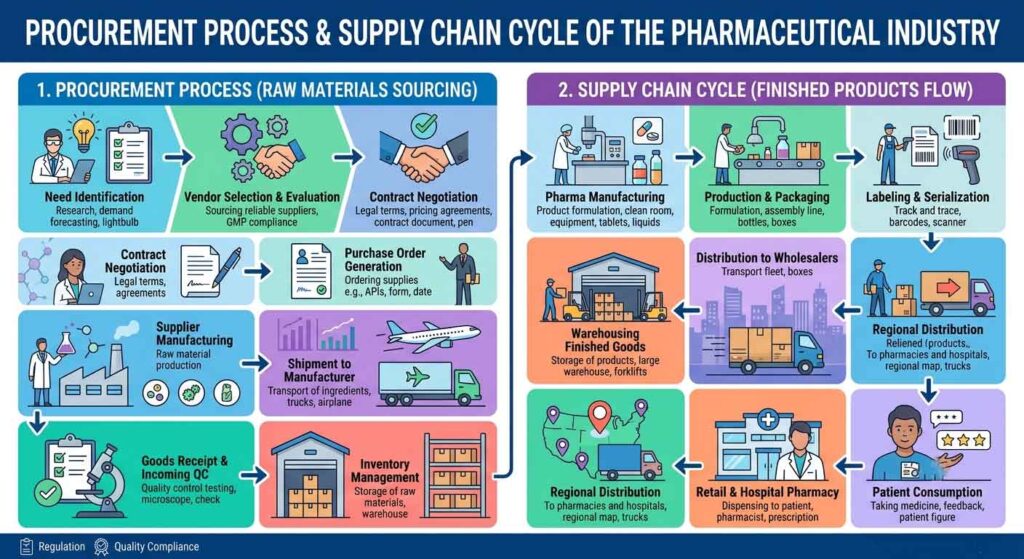
Pharmaceutical Supply Chain at a Glance
A simplified cycle is:
Key Starting Materials and Chemicals ↓ Drug Intermediates ↓ Active Pharmaceutical Ingredients ↓ Excipients and Packaging Materials ↓ Finished Pharmaceutical Manufacturing ↓ Quality Testing and Batch Release ↓ C&F / Company Warehouse / Super Stockist ↓ Distributor / Wholesaler / Stockist ↓ Retail Pharmacy / Hospital / Clinic ↓ Patient
Parallel to this physical supply chain is the demand-generation cycle:
Product Strategy ↓ Marketing Approval ↓ Scientific and Ethical Promotion ↓ Doctor or Healthcare Professional Awareness ↓ Prescription or Institutional Demand ↓ Pharmacy Availability ↓ Patient Access
The physical supply chain and the demand-generation chain must work together.
Important Correction: Doctor Is Not a Physical Supply-Chain Stage
Doctors do not normally purchase and move products through the standard wholesale distribution chain.
A doctor generally influences demand through prescribing or recommending a suitable treatment within the applicable professional and regulatory framework.
Changes should be evaluated rather than accepted informally.
13. Cold-Chain Management
Some products require controlled temperatures.
Examples may include:
Vaccines
Insulin
Certain biologics
A temperature excursion can damage products even if the packaging looks normal.
14. Counterfeit or Substandard Material Risk
Purchasing from unverified sources can create risks such as:
Wrong material
Adulteration
False COA
Counterfeit API
Industrial-grade material supplied as pharmaceutical grade
Supplier control is therefore essential.
15. Packaging-Material Delays
Many companies focus only on API availability and forget packaging.
Production may be complete but dispatch can stop because:
Carton is unavailable
Foil printing is delayed
Label artwork is incorrect
Bottle supply is short
Tube printing is pending
Packaging procurement must be planned with production.
Challenges in Finished-Product Manufacturing
Regulatory Compliance
A pharmaceutical manufacturing unit must work within applicable:
Licensing requirements
GMP requirements
Product permissions
Specifications
Record requirements
Compliance requires continuous effort.
Production Capacity Utilization
A factory has major fixed costs.
If capacity is underutilized, cost per unit increases.
Factories therefore need:
Own-brand sales
Third-party manufacturing
Contract manufacturing
Export orders
Institutional business
However, accepting too many orders beyond capacity can also create delays and quality problems.
Skilled Manpower
Pharmaceutical manufacturing needs trained:
Production personnel
Quality Assurance personnel
Quality Control personnel
Engineers
Warehouse personnel
Regulatory professionals
Staff turnover can affect consistency.
Equipment Breakdown
A single critical machine breakdown can stop production.
Preventive maintenance and spare-parts planning are important.
Batch Failure
A failed batch can result in:
Financial loss
Investigation
Production delay
Product shortage
Customer dissatisfaction
Manufacturing Lead Time
A marketing company may expect immediate supply, while the manufacturer has to arrange:
Raw materials
Packaging
Production slot
Testing
Release
Clear lead-time planning is essential.
Challenges in Pharma Distribution
Selecting the Right C&F Agent
A C&F agent should not be selected only because it offers low charges.
Check:
Reputation
Licence
Warehouse
Team
Inventory system
Dispatch accuracy
Market coverage
Financial stability
Distributor Performance
A distributor may have a licence but still provide poor service.
Problems include:
Delayed delivery
Weak retailer network
Poor collection
Low interest in new brands
Improper storage
Inventory Visibility
The company should know:
Stock at C&F
Stock at distributor
Product movement
Near-expiry stock
Out-of-stock products
Without visibility, the company may manufacture the wrong products.
Expiry and Returns
Expiry is a major challenge.
Poor forecasting and excessive channel loading can create large returns.
Do not confuse dispatch to distributor with actual market consumption.
Credit Management
High sales with poor payment collection can damage a company.
Control:
Credit limit
Outstanding
Payment cycle
Distributor exposure
The Biggest Challenge: Creating Sustainable Demand
Manufacturing a medicine does not automatically create sales.
A company also needs sustainable demand.
Demand may be generated through:
Ethical prescription promotion
Institutional contracts
Hospital supply
PCD or franchise partners
Generic distribution
OTC strategy
Export
Consumer awareness for legally permitted categories
For prescription products, healthcare-professional awareness and appropriate prescribing can be a major demand driver.
However, marketing must remain ethical, accurate and compliant.
Prescription Generation Is Difficult Because
Doctors receive many product presentations.
Established brands already have trust.
New brands need repeated professional follow-up.
Products must remain available at pharmacies.
Companies must provide credible information.
Field teams require training.
A good sales team cannot permanently compensate for:
Poor quality
Product shortage
Wrong product selection
Weak distribution
Major Challenges in Pharma Marketing
Product Differentiation
Many companies sell similar formulations.
The question becomes:
Why should the market choose your brand?
Differentiation may come from:
Quality
Formulation
Convenience
Packaging
Price
Availability
Service
Medical Representative Productivity
A large MR team is expensive.
Companies must monitor:
Doctor coverage
Product knowledge
Call quality
Market feedback
Sales conversion
Ethical Compliance
Marketing practices should not depend on:
Cash inducements
Personal gifts
Paid access to doctors
Unsubstantiated claims
Long-term brands should be built through quality, evidence, availability and service.
How to Improve Pharmaceutical Procurement
Use Approved Vendor Lists
Buy critical material only from qualified suppliers.
Develop Backup Suppliers
Avoid complete dependence on one source where feasible.
Track Supplier Performance
Measure:
Quality acceptance
On-time delivery
Complaint rate
Documentation
Price stability
Improve Forecasting
Use:
Sales history
Seasonal trends
Pending orders
Market intelligence
Safety stock
Maintain Safety Stock Carefully
Safety stock reduces shortage risk but should not be excessive.
Use FEFO
Follow:
First Expiry, First Out
This is especially important for pharmaceutical inventory.
Integrate Departments
Purchase should communicate with:
Sales
Production
QA
QC
Warehouse
Finance
Procurement should not work in isolation.
Use Digital Systems
ERP or inventory software can help with:
Stock visibility
Reorder levels
Batch tracking
Expiry alerts
Purchase planning
Supplier performance
Key Performance Indicators for Pharma Procurement
Useful procurement KPIs include:
On-time delivery rate
Supplier rejection rate
Purchase price variance
Lead time
Stock-out frequency
Inventory turnover
Expiry loss
Emergency purchase frequency
Supplier complaint rate
Material availability
Key Performance Indicators for Distribution
Track:
Fill rate
Order processing time
Out-of-stock days
Near-expiry stock
Distributor secondary sales
Return percentage
Collection period
Delivery accuracy
Common Procurement Mistakes
Avoid:
Buying only on lowest price
Purchasing from unapproved vendors
Ignoring lead time
Depending on one supplier
Over-ordering because of discount
Not checking shelf life
Ignoring packaging material
Poor documentation
No backup plan
Weak expiry monitoring
Common Distribution Mistakes
Avoid:
Appointing too many distributors
Excessive channel loading
Giving uncontrolled credit
Ignoring secondary sales
Keeping stock at unlicensed premises
Poor temperature control
Weak batch traceability
Ignoring product returns
A Modern End-to-End Pharma Cycle
A more complete pharmaceutical business cycle is:
Market Demand Forecast ↓ Product Planning ↓ Material Requirement Planning ↓ Supplier Qualification ↓ Procurement of KSM/API/Excipients/Packaging ↓ Receipt and Quarantine ↓ Quality Testing and Release ↓ Manufacturing ↓ In-Process Quality Control ↓ Packaging ↓ Finished-Product Testing ↓ Batch Release ↓ C&F / Warehouse ↓ Super Stockist / Distributor ↓ Retail Pharmacy / Hospital ↓ Patient
Running parallel to this:
Market Research ↓ Product Positioning ↓ Ethical Promotion ↓ Healthcare Professional Awareness ↓ Prescription / Institutional Demand ↓ Availability at Point of Sale ↓ Patient Access ↓ Feedback, Complaints and Pharmacovigilance
Final Thoughts
There is no easy stage in the pharmaceutical supply chain.
Procurement must balance:
Quality
Cost
Availability
Compliance
Working capital
Manufacturing must balance:
Productivity
GMP
Quality
Lead time
Distribution must balance:
Availability
Inventory
Credit
Expiry
Marketing must balance:
Demand generation
Ethical promotion
Product knowledge
Commercial sustainability
The pharmaceutical company that successfully connects all these functions has a much stronger chance of long-term growth.
The real objective is not simply to manufacture more products or dispatch more stock.
The objective is:
To make a quality medicine available to the right patient, through the right channel, at the right time and in the right condition.
Frequently Asked Questions
1. What is the pharmaceutical procurement cycle?
It is the process of forecasting demand, planning materials, qualifying suppliers, purchasing materials, receiving and testing them, manufacturing products and supplying released products through the distribution network.
2. What are the main raw materials in pharmaceutical manufacturing?
They include APIs, excipients, solvents and other formulation materials. Packaging materials are also an important part of procurement.
3. Does India manufacture APIs?
Yes. India has a significant domestic API industry, although the country continues to work on reducing dependence on imported sources for certain critical KSMs, intermediates and APIs.
4. What is the biggest procurement challenge?
There is no single challenge, but demand forecasting, supplier quality, supply continuity, long lead times and working capital are among the most important.
5. What is the role of a C&F agent?
A C&F agent generally handles storage, inventory and dispatch of products for a defined territory under the applicable commercial and licensing structure.
6. Is the doctor part of the pharmaceutical supply chain?
The doctor is primarily part of the demand-generation and treatment-decision process rather than the physical product-distribution chain.
7. Why is product availability important for prescription generation?
If a prescribed product is repeatedly unavailable at pharmacies, doctors and patients may shift to alternatives.
8. What is FEFO?
FEFO means First Expiry, First Out. Products with earlier expiry dates are issued first to reduce expiry loss.
9. Why should a company have multiple suppliers?
Backup suppliers can reduce the risk of production stoppage when the primary supplier faces quality, capacity or logistical problems.
10. What is the biggest mistake in pharmaceutical procurement?
Buying critical materials only on price without considering quality, reliability, documentation and regulatory suitability.
Looking for Ayurvedic Franchise or Distribution Opportunities?
Looking to start an Ayurvedic franchise, become a distributor, or launch your own herbal product range?
Elzac Herbal India offers:
Ayurvedic & Herbal Product Range
Franchise & Distribution Opportunities
Third-Party Manufacturing Services
Product Development Support
Marketing Guidance
PAN India Business Opportunities
Whether you are an entrepreneur, retailer, distributor, or healthcare professional, our team can help you explore the right business opportunity in the growing Ayurvedic sector.
Ajay Kamboj is an entrepreneur and business owners associated with many Ayurvedic and Pharmaceutical start-ups. With years of experience in Ayurvedic product marketing, pharmaceutical distribution, franchise development, and client relationship management, he regularly shares practical business insights based on real-world experiences. His articles focus on business growth, entrepreneurship, customer management, and lessons learned from the healthcare and wellness industry.





Leave a Reply Cancel reply
You must be logged in to post a comment.