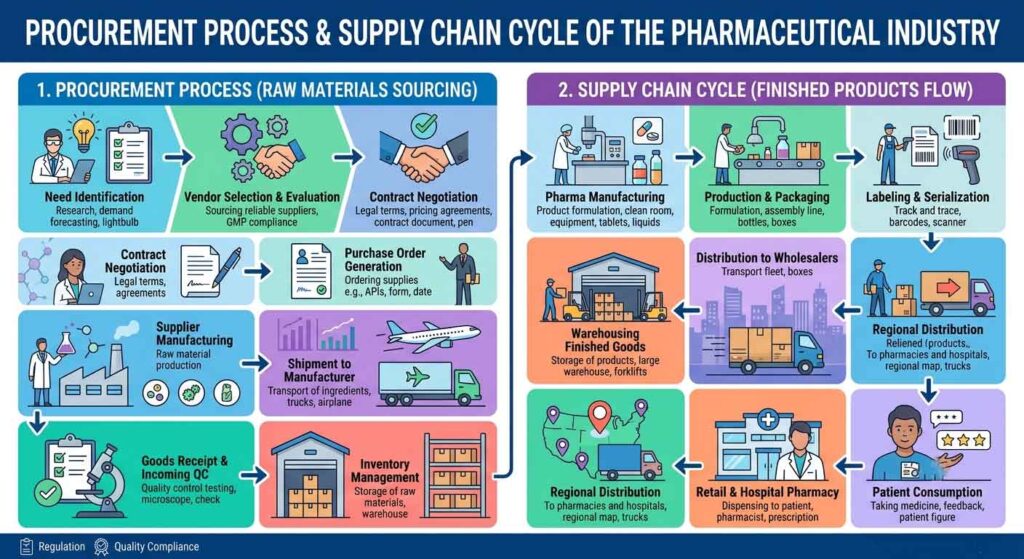
Procurement Process and Supply Chain Cycle of the Pharmaceutical Industry

The pharmaceutical industry has one of the most complex supply chains of any business sector.

A medicine may appear to be a simple tablet, capsule or syrup when it reaches a patient, but before that product is consumed, multiple companies, professionals, quality systems and regulatory processes are involved.

The journey may include:

  • Chemical and key starting material suppliers
  • API manufacturers
  • Excipient suppliers
  • Packaging-material suppliers
  • Finished-product manufacturers
  • Quality-control laboratories
  • Marketing companies
  • C&F agents
  • Super stockists
  • Distributors
  • Wholesalers
  • Retail pharmacies
  • Hospitals
  • Doctors and healthcare professionals
  • Patients

Every stage has its own risks and challenges.

What Is Pharmaceutical Procurement?

Pharmaceutical procurement is the process of planning, selecting, purchasing, receiving, testing and controlling the materials, products and services required to manufacture and supply medicines.

Procurement in pharma is not simply:

Find the lowest price → place an order → receive material

A pharmaceutical company must also consider:

  • Supplier qualification
  • Regulatory compliance
  • Material specification
  • Quality consistency
  • Certificate of Analysis
  • Lead time
  • Batch traceability
  • Storage conditions
  • Change control
  • Supply continuity
  • Commercial terms

A low-cost material that does not meet specification can create a much larger financial and regulatory loss.

Pharmaceutical Supply Chain at a Glance

A simplified cycle is:

Key Starting Materials and Chemicals

Drug Intermediates

Active Pharmaceutical Ingredients

Excipients and Packaging Materials

Finished Pharmaceutical Manufacturing

Quality Testing and Batch Release

C&F / Company Warehouse / Super Stockist

Distributor / Wholesaler / Stockist

Retail Pharmacy / Hospital / Clinic

Patient

Parallel to this physical supply chain is the demand-generation cycle:

Product Strategy

Marketing Approval

Scientific and Ethical Promotion

Doctor or Healthcare Professional Awareness

Prescription or Institutional Demand

Pharmacy Availability

Patient Access

The physical supply chain and the demand-generation chain must work together.

Important Correction: Doctor Is Not a Physical Supply-Chain Stage

Doctors do not normally purchase and move products through the standard wholesale distribution chain.

A doctor generally influences demand through prescribing or recommending a suitable treatment within the applicable professional and regulatory framework.

Therefore:

Physical product flow:

Manufacturer → Distributor → Retailer/Hospital → Patient

Demand flow:

Company promotion → Healthcare professional → Prescription or recommendation → Patient demand

Both are important, but they are different processes.

Complete Procurement Process in a Pharmaceutical Manufacturing Company

Step 1: Demand Forecasting

Procurement begins before a purchase order is created.

The company first estimates future demand.

Forecasting may consider:

  • Historical sales
  • Current stock
  • Pending orders
  • Seasonal demand
  • New product launch
  • Marketing plan
  • Tender commitments
  • Export orders
  • Customer forecasts
  • Safety stock
  • Expected growth

Poor forecasting can create either shortages or excess inventory.

Step 2: Sales and Operations Planning

The sales, production, purchase, finance and warehouse teams should coordinate.

They decide:

  • What products are required?
  • How much should be manufactured?
  • When is stock required?
  • What raw material is available?
  • What needs to be purchased?
  • What is production capacity?
  • How much working capital is available?

This planning process is commonly associated with sales and operations planning, or S&OP.

Step 3: Material Requirement Planning

The production plan is converted into material requirements.

For every product, the company checks its Bill of Materials.

Materials may include:

Active Pharmaceutical Ingredients

The substances responsible for the intended pharmacological action.

Excipients

Examples include:

  • Binders
  • Fillers
  • Coating materials
  • Preservatives
  • Flavours
  • Sweeteners
  • Colours
  • Solvents

Primary Packaging Materials

Examples include:

  • Blister foil
  • PVC
  • Alu-Alu foil
  • Bottles
  • Caps
  • Tubes
  • Vials
  • Ampoules

Secondary Packaging Materials

Examples include:

  • Cartons
  • Labels
  • Inserts
  • Shippers

One delayed packaging component can delay the entire finished product.

Step 4: Supplier Identification

The purchase team identifies possible suppliers.

Sources may include:

  • Approved domestic manufacturers
  • Importers
  • Authorized distributors
  • API manufacturers
  • Excipient companies
  • Packaging manufacturers
  • Existing approved vendors

A pharmaceutical company should not purchase critical materials from an unknown supplier only because the price is low.

Step 5: Supplier Qualification

Before regular procurement, the supplier may undergo qualification.

The process may include:

  • Company profile review
  • Manufacturing-licence review
  • GMP documents
  • Regulatory history
  • Technical questionnaire
  • Sample evaluation
  • Certificate of Analysis review
  • Audit, where required
  • Trial batch
  • Quality agreement
  • Vendor approval

Quality Assurance generally plays an important role in approving critical vendors.

Step 6: Request for Quotation

The company requests quotations from approved or potential vendors.

Comparison may include:

  • Price
  • Specification
  • MOQ
  • Lead time
  • Payment terms
  • Freight
  • Tax
  • Shelf life
  • Packing
  • Supply capacity
  • Quality history

The cheapest quotation is not necessarily the best quotation.

Step 7: Technical and Commercial Evaluation

Procurement should evaluate both technical and commercial factors.

Technical Factors

  • Specification compliance
  • Pharmacopoeial standard
  • Impurity profile
  • Stability
  • Regulatory suitability
  • Previous batch consistency

Commercial Factors

  • Price
  • Credit
  • Freight
  • MOQ
  • Lead time
  • Supply reliability

The final decision should balance quality, risk and cost.

Step 8: Purchase Order

After approval, a purchase order is issued.

The purchase order should clearly mention:

  • Material name
  • Grade
  • Specification
  • Quantity
  • Rate
  • Tax
  • Delivery address
  • Delivery date
  • Packing requirement
  • Required documents
  • Payment terms

For critical materials, quality requirements should not be left to verbal communication.

Step 9: Material Dispatch

The supplier dispatches the material.

Documents may include:

  • Invoice
  • Certificate of Analysis
  • Packing list
  • Transport documents
  • Regulatory documents, where applicable

Imported material may also involve:

  • Import documentation
  • Customs clearance
  • Freight forwarding
  • Port handling
  • Foreign exchange
  • Longer lead time

Step 10: Material Receipt

When material reaches the factory, the receiving team checks:

  • Supplier
  • Purchase order
  • Quantity
  • Container condition
  • Seal
  • Damage
  • Batch number
  • Manufacturing date
  • Expiry or retest date
  • Required documents

The material should not automatically be used in manufacturing immediately after receipt.

Step 11: Quarantine

Received material is generally kept under quarantine until the applicable quality process is completed.

The material status may be identified as:

  • Quarantine
  • Approved
  • Rejected

This prevents untested or rejected material from being used accidentally.

Step 12: Sampling and Testing

Authorized Quality Control personnel sample the material according to procedures.

Testing may include:

  • Identification
  • Assay
  • Purity
  • Moisture
  • Microbial limits
  • Impurities
  • Physical characteristics
  • Other specification-specific tests

The testing requirement depends on the material.

Step 13: Quality Release or Rejection

After testing:

  • Material meeting specification is approved.
  • Material failing specification is investigated and handled according to procedure.

Rejected material must be properly controlled to prevent accidental use.

Step 14: Storage

Approved materials are stored under specified conditions.

Examples include:

  • Controlled room temperature
  • Refrigerated storage
  • Protection from light
  • Protection from moisture
  • Controlled humidity

Poor storage can destroy a good material before it reaches production.

Step 15: Material Dispensing

Required quantities are issued for manufacturing according to the approved batch formula.

The dispensing process should ensure:

  • Correct material
  • Correct quantity
  • Correct batch
  • Correct documentation
  • Prevention of mix-up

Step 16: Finished-Product Manufacturing

Manufacturing begins according to approved procedures.

Depending on dosage form, processes may include:

Tablets

  • Sifting
  • Granulation
  • Drying
  • Blending
  • Compression
  • Coating

Capsules

  • Blending
  • Filling
  • Inspection

Syrups

  • Water preparation
  • Mixing
  • Dissolution
  • Filtration
  • Filling

Ointments and Creams

  • Phase preparation
  • Mixing
  • Homogenization
  • Filling

Every process requires control and documentation.

Step 17: In-Process Quality Control

Quality should not be checked only after the product is finished.

In-process checks may include:

  • Tablet weight
  • Hardness
  • Thickness
  • Disintegration
  • Fill volume
  • pH
  • Viscosity
  • Appearance
  • Sealing

Problems found during manufacturing should be addressed before the batch proceeds further.

Step 18: Packaging

The finished bulk product is packed.

Packaging is important for:

  • Product protection
  • Identification
  • Traceability
  • Patient information
  • Regulatory compliance
  • Shelf life
  • Brand presentation

Packaging errors can be as serious as manufacturing errors.

Step 19: Finished-Product Testing

Finished products are tested against approved specifications.

Testing may include:

  • Identification
  • Assay
  • Dissolution
  • Content uniformity
  • Microbial limits
  • Related substances
  • Physical parameters

The exact tests depend on the product.

Step 20: Batch Release

The finished batch should be released only after completion of the required quality review.

The review may include:

  • Manufacturing records
  • Packing records
  • Test reports
  • Deviations
  • Reconciliation
  • Investigation results
  • Compliance with specification

Only released stock should enter the commercial supply chain.

Finished Goods Distribution Cycle

After batch release, the supply chain moves into distribution.

Manufacturer to Marketing Company

In third-party manufacturing, the finished products may be supplied to the marketing company or its authorized distribution point.

The relationship should clearly define:

  • Product ownership
  • Batch release
  • Pricing
  • Transport
  • Complaints
  • Returns
  • Recall
  • Quality responsibility

Manufacturer or Company to C&F Agent

A Carrying and Forwarding agent may:

  • Receive goods
  • Store stock
  • Maintain inventory
  • Dispatch orders
  • Support state-level distribution

A C&F agent should have suitable infrastructure and applicable licence support.

C&F to Super Stockist

Some companies use super stockists for wider geographic distribution.

The super stockist may supply several distributors.

Distributor or Stockist

The distributor supplies:

  • Retail pharmacies
  • Hospitals
  • Clinics
  • Institutional buyers

The distributor should maintain:

  • Valid licence
  • Proper storage
  • Invoice records
  • Batch traceability
  • Expiry management
  • Timely delivery

Retail Pharmacy

The retailer is often the final commercial point before the patient.

Responsibilities include:

  • Proper purchase
  • Storage
  • Prescription compliance
  • Dispensing
  • Record maintenance
  • Expiry control

Patient

The final objective of the entire supply chain is to make the right medicine available:

  • At the right time
  • In the right condition
  • Through the right legal channel
  • At an appropriate price

Procurement Cycle for a Pharma Marketing Company

A marketing company that uses third-party manufacturing has a different procurement cycle.

It may look like this:

Sales Forecast

Product Requirement

Manufacturer Selection

Quotation

Purchase Order

Artwork Approval

Advance Payment

Raw and Packaging Material Procurement by Manufacturer

Manufacturing

Testing and Batch Release

Invoice

Dispatch

Receipt at Licensed Warehouse / C&F / Distributor

Market Supply

The marketing company must closely monitor the manufacturer.

Important points include:

  • MOQ
  • Lead time
  • Batch size
  • Packaging material
  • Artwork
  • Product permission
  • COA
  • Expiry
  • Reorder timing

Major Challenges in Pharmaceutical Procurement

1. Accurate Demand Forecasting

This is one of the biggest challenges.

If demand is underestimated:

  • Product goes out of stock.
  • Prescriptions may be lost.
  • Customers may shift to competitors.

If demand is overestimated:

  • Money gets blocked.
  • Stock becomes slow-moving.
  • Expiry loss increases.

Forecasting is especially difficult for:

  • New products
  • Seasonal products
  • Tender business
  • Rapidly changing markets

2. Raw-Material Supply Risk

Some critical KSMs, drug intermediates and APIs may depend on a limited number of sources.

Problems may arise from:

  • Supplier shutdown
  • Geopolitical disturbance
  • Freight disruption
  • Regulatory action
  • Port delays
  • Price increase
  • Currency fluctuation

A company should identify single-source dependencies.

3. Supplier Quality

Two suppliers may sell material with the same pharmacopoeial name but show differences in:

  • Impurity profile
  • Particle size
  • Flow properties
  • Stability
  • Manufacturing consistency

Changing supplier can affect finished-product quality.

4. Supplier Qualification

Finding a supplier is easy.

Finding a consistently reliable and compliant supplier is difficult.

Supplier qualification requires:

  • Documentation
  • Technical evaluation
  • Audit
  • Testing
  • Performance review

5. Long Lead Times

Imported or customized materials may require weeks or months.

Lead time may increase because of:

  • Manufacturing schedule
  • Shipping
  • Customs
  • Testing
  • Regulatory clearance
  • Transport delays

Poor lead-time planning can stop production.

6. Minimum Order Quantity

MOQ can create a major challenge for small companies.

A supplier may require a quantity much higher than immediate need.

This creates:

  • Excess inventory
  • Working-capital blockage
  • Storage requirement
  • Expiry risk

7. Price Fluctuation

Prices of:

  • APIs
  • Solvents
  • Chemicals
  • Aluminium
  • Plastic
  • Glass
  • Paper
  • Fuel

can change.

For products under price control or intense competition, the company may not be able to pass every cost increase to the market.

8. Working-Capital Pressure

Money can remain blocked at many stages:

  • Raw material
  • Packing material
  • Work in progress
  • Finished goods
  • Distributor credit
  • Market outstanding

A growing company can face a cash-flow crisis even when its sales appear strong.

9. Quality-Control Delays

Material cannot be used until required testing is complete.

Testing delay can stop production.

Causes include:

  • Laboratory backlog
  • Instrument breakdown
  • Reference-standard delay
  • Out-of-specification investigation
  • Retesting

10. Rejected Materials

A rejected API or packaging material can affect:

  • Production schedule
  • Customer delivery
  • Cash flow
  • Product availability

Companies should maintain backup suppliers where practical.

11. Documentation

Pharma procurement requires extensive documentation.

Examples include:

  • Purchase order
  • Specification
  • COA
  • Supplier qualification
  • Audit report
  • Quality agreement
  • Goods receipt
  • Sampling record
  • Test report
  • Release record

Poor documentation can become a regulatory risk.

12. Change Control

A supplier may change:

  • Manufacturing process
  • Raw-material source
  • Site
  • Specification
  • Packaging

Such changes may affect the finished product.

Changes should be evaluated rather than accepted informally.

13. Cold-Chain Management

Some products require controlled temperatures.

Examples may include:

  • Vaccines
  • Insulin
  • Certain biologics

A temperature excursion can damage products even if the packaging looks normal.

14. Counterfeit or Substandard Material Risk

Purchasing from unverified sources can create risks such as:

  • Wrong material
  • Adulteration
  • False COA
  • Counterfeit API
  • Industrial-grade material supplied as pharmaceutical grade

Supplier control is therefore essential.

15. Packaging-Material Delays

Many companies focus only on API availability and forget packaging.

Production may be complete but dispatch can stop because:

  • Carton is unavailable
  • Foil printing is delayed
  • Label artwork is incorrect
  • Bottle supply is short
  • Tube printing is pending

Packaging procurement must be planned with production.

Challenges in Finished-Product Manufacturing

Regulatory Compliance

A pharmaceutical manufacturing unit must work within applicable:

  • Licensing requirements
  • GMP requirements
  • Product permissions
  • Specifications
  • Record requirements

Compliance requires continuous effort.

Production Capacity Utilization

A factory has major fixed costs.

If capacity is underutilized, cost per unit increases.

Factories therefore need:

  • Own-brand sales
  • Third-party manufacturing
  • Contract manufacturing
  • Export orders
  • Institutional business

However, accepting too many orders beyond capacity can also create delays and quality problems.

Skilled Manpower

Pharmaceutical manufacturing needs trained:

  • Production personnel
  • Quality Assurance personnel
  • Quality Control personnel
  • Engineers
  • Warehouse personnel
  • Regulatory professionals

Staff turnover can affect consistency.

Equipment Breakdown

A single critical machine breakdown can stop production.

Preventive maintenance and spare-parts planning are important.

Batch Failure

A failed batch can result in:

  • Financial loss
  • Investigation
  • Production delay
  • Product shortage
  • Customer dissatisfaction

Manufacturing Lead Time

A marketing company may expect immediate supply, while the manufacturer has to arrange:

  • Raw materials
  • Packaging
  • Production slot
  • Testing
  • Release

Clear lead-time planning is essential.

Challenges in Pharma Distribution

Selecting the Right C&F Agent

A C&F agent should not be selected only because it offers low charges.

Check:

  • Reputation
  • Licence
  • Warehouse
  • Team
  • Inventory system
  • Dispatch accuracy
  • Market coverage
  • Financial stability

Distributor Performance

A distributor may have a licence but still provide poor service.

Problems include:

  • Delayed delivery
  • Weak retailer network
  • Poor collection
  • Low interest in new brands
  • Improper storage

Inventory Visibility

The company should know:

  • Stock at C&F
  • Stock at distributor
  • Product movement
  • Near-expiry stock
  • Out-of-stock products

Without visibility, the company may manufacture the wrong products.

Expiry and Returns

Expiry is a major challenge.

Poor forecasting and excessive channel loading can create large returns.

Do not confuse dispatch to distributor with actual market consumption.

Credit Management

High sales with poor payment collection can damage a company.

Control:

  • Credit limit
  • Outstanding
  • Payment cycle
  • Distributor exposure

The Biggest Challenge: Creating Sustainable Demand

Manufacturing a medicine does not automatically create sales.

A company also needs sustainable demand.

Demand may be generated through:

  • Ethical prescription promotion
  • Institutional contracts
  • Hospital supply
  • PCD or franchise partners
  • Generic distribution
  • OTC strategy
  • Export
  • Consumer awareness for legally permitted categories

For prescription products, healthcare-professional awareness and appropriate prescribing can be a major demand driver.

However, marketing must remain ethical, accurate and compliant.

Prescription Generation Is Difficult Because

  • Doctors receive many product presentations.
  • Established brands already have trust.
  • New brands need repeated professional follow-up.
  • Products must remain available at pharmacies.
  • Companies must provide credible information.
  • Field teams require training.

A good sales team cannot permanently compensate for:

  • Poor quality
  • Product shortage
  • Wrong product selection
  • Weak distribution

Major Challenges in Pharma Marketing

Product Differentiation

Many companies sell similar formulations.

The question becomes:

Why should the market choose your brand?

Differentiation may come from:

  • Quality
  • Formulation
  • Convenience
  • Packaging
  • Price
  • Availability
  • Service

Medical Representative Productivity

A large MR team is expensive.

Companies must monitor:

  • Doctor coverage
  • Product knowledge
  • Call quality
  • Market feedback
  • Sales conversion

Ethical Compliance

Marketing practices should not depend on:

  • Cash inducements
  • Personal gifts
  • Paid access to doctors
  • Unsubstantiated claims

Long-term brands should be built through quality, evidence, availability and service.

How to Improve Pharmaceutical Procurement

Use Approved Vendor Lists

Buy critical material only from qualified suppliers.

Develop Backup Suppliers

Avoid complete dependence on one source where feasible.

Track Supplier Performance

Measure:

  • Quality acceptance
  • On-time delivery
  • Complaint rate
  • Documentation
  • Price stability

Improve Forecasting

Use:

  • Sales history
  • Seasonal trends
  • Pending orders
  • Market intelligence
  • Safety stock

Maintain Safety Stock Carefully

Safety stock reduces shortage risk but should not be excessive.

Use FEFO

Follow:

First Expiry, First Out

This is especially important for pharmaceutical inventory.

Integrate Departments

Purchase should communicate with:

  • Sales
  • Production
  • QA
  • QC
  • Warehouse
  • Finance

Procurement should not work in isolation.

Use Digital Systems

ERP or inventory software can help with:

  • Stock visibility
  • Reorder levels
  • Batch tracking
  • Expiry alerts
  • Purchase planning
  • Supplier performance

Key Performance Indicators for Pharma Procurement

Useful procurement KPIs include:

  • On-time delivery rate
  • Supplier rejection rate
  • Purchase price variance
  • Lead time
  • Stock-out frequency
  • Inventory turnover
  • Expiry loss
  • Emergency purchase frequency
  • Supplier complaint rate
  • Material availability

Key Performance Indicators for Distribution

Track:

  • Fill rate
  • Order processing time
  • Out-of-stock days
  • Near-expiry stock
  • Distributor secondary sales
  • Return percentage
  • Collection period
  • Delivery accuracy

Common Procurement Mistakes

Avoid:

  • Buying only on lowest price
  • Purchasing from unapproved vendors
  • Ignoring lead time
  • Depending on one supplier
  • Over-ordering because of discount
  • Not checking shelf life
  • Ignoring packaging material
  • Poor documentation
  • No backup plan
  • Weak expiry monitoring

Common Distribution Mistakes

Avoid:

  • Appointing too many distributors
  • Excessive channel loading
  • Giving uncontrolled credit
  • Ignoring secondary sales
  • Keeping stock at unlicensed premises
  • Poor temperature control
  • Weak batch traceability
  • Ignoring product returns

A Modern End-to-End Pharma Cycle

A more complete pharmaceutical business cycle is:

Market Demand Forecast

Product Planning

Material Requirement Planning

Supplier Qualification

Procurement of KSM/API/Excipients/Packaging

Receipt and Quarantine

Quality Testing and Release

Manufacturing

In-Process Quality Control

Packaging

Finished-Product Testing

Batch Release

C&F / Warehouse

Super Stockist / Distributor

Retail Pharmacy / Hospital

Patient

Running parallel to this:

Market Research

Product Positioning

Ethical Promotion

Healthcare Professional Awareness

Prescription / Institutional Demand

Availability at Point of Sale

Patient Access

Feedback, Complaints and Pharmacovigilance

Final Thoughts

There is no easy stage in the pharmaceutical supply chain.

Procurement must balance:

  • Quality
  • Cost
  • Availability
  • Compliance
  • Working capital

Manufacturing must balance:

  • Productivity
  • GMP
  • Quality
  • Lead time

Distribution must balance:

  • Availability
  • Inventory
  • Credit
  • Expiry

Marketing must balance:

  • Demand generation
  • Ethical promotion
  • Product knowledge
  • Commercial sustainability

The pharmaceutical company that successfully connects all these functions has a much stronger chance of long-term growth.

The real objective is not simply to manufacture more products or dispatch more stock.

The objective is:

To make a quality medicine available to the right patient, through the right channel, at the right time and in the right condition.

Frequently Asked Questions

1. What is the pharmaceutical procurement cycle?

It is the process of forecasting demand, planning materials, qualifying suppliers, purchasing materials, receiving and testing them, manufacturing products and supplying released products through the distribution network.

2. What are the main raw materials in pharmaceutical manufacturing?

They include APIs, excipients, solvents and other formulation materials. Packaging materials are also an important part of procurement.

3. Does India manufacture APIs?

Yes. India has a significant domestic API industry, although the country continues to work on reducing dependence on imported sources for certain critical KSMs, intermediates and APIs.

4. What is the biggest procurement challenge?

There is no single challenge, but demand forecasting, supplier quality, supply continuity, long lead times and working capital are among the most important.

5. What is the role of a C&F agent?

A C&F agent generally handles storage, inventory and dispatch of products for a defined territory under the applicable commercial and licensing structure.

6. Is the doctor part of the pharmaceutical supply chain?

The doctor is primarily part of the demand-generation and treatment-decision process rather than the physical product-distribution chain.

7. Why is product availability important for prescription generation?

If a prescribed product is repeatedly unavailable at pharmacies, doctors and patients may shift to alternatives.

8. What is FEFO?

FEFO means First Expiry, First Out. Products with earlier expiry dates are issued first to reduce expiry loss.

9. Why should a company have multiple suppliers?

Backup suppliers can reduce the risk of production stoppage when the primary supplier faces quality, capacity or logistical problems.

10. What is the biggest mistake in pharmaceutical procurement?

Buying critical materials only on price without considering quality, reliability, documentation and regulatory suitability.

Looking for Ayurvedic Franchise or Distribution Opportunities?

Looking to start an Ayurvedic franchise, become a distributor, or launch your own herbal product range?

Elzac Herbal India offers:

  • Ayurvedic & Herbal Product Range
  • Franchise & Distribution Opportunities
  • Third-Party Manufacturing Services
  • Product Development Support
  • Marketing Guidance
  • PAN India Business Opportunities

Whether you are an entrepreneur, retailer, distributor, or healthcare professional, our team can help you explore the right business opportunity in the growing Ayurvedic sector.

Contact us today to discuss ayurvedic franchise, distribution, or third-party manufacturing opportunities.

Ajay Kamboj

Ajay Kamboj is an entrepreneur and business owners associated with many Ayurvedic and Pharmaceutical start-ups. With years of experience in Ayurvedic product marketing, pharmaceutical distribution, franchise development, and client relationship management, he regularly shares practical business insights based on real-world experiences. His articles focus on business growth, entrepreneurship, customer management, and lessons learned from the healthcare and wellness industry.
Leave a Reply