The pharmacy sector provides several business opportunities for graduates, entrepreneurs, pharmacists and healthcare professionals.
A common query is:
“I am a B.Com graduate. Please advise me on how to start a pharmacy business.”
A B.Com graduate can own a pharmacy, medical store, wholesale distribution firm, pharma marketing company or surgical-products business. However, the licence, staff and premises requirements depend on the business model selected.
The first step is to understand the different types of pharmacy businesses available.
Pharmacy Business Options in India
You can enter the pharmaceutical sector through any of the following models:
Retail pharmacy or medical store
Wholesale medicine distribution
Retail and wholesale pharmacy together
Hospital pharmacy
Online-supported pharmacy
Generic medicine store
Pharma marketing company
PCD or franchise business
Third-party manufactured product marketing
Surgical and medical-device distribution
Ayurvedic medicine store
Nutraceutical and health-supplement business
Pharmaceutical manufacturing
Each business has different investment, licensing, staffing and compliance requirements.
Can a B.Com Graduate Open a Pharmacy?
Yes. A B.Com graduate can become the proprietor, partner, director or business owner of a pharmacy.
However, a B.Com graduate cannot personally work as a registered pharmacist merely on the basis of a commerce degree.
For a retail pharmacy, you generally need to appoint a registered pharmacist who holds an approved pharmacy qualification and valid registration with the concerned State Pharmacy Council.
The pharmacist should genuinely work at the pharmacy during the approved working hours. The registration certificate should not be used only on paper.
Option 1: Start a Retail Pharmacy or Medical Store
A retail pharmacy sells medicines directly to patients and consumers.
It may sell:
Prescription medicines
Over-the-counter medicines
First-aid products
Medical devices
Personal-care products
Baby-care products
Nutraceuticals
Ayurvedic products
Health-monitoring products
A retail medical store is one of the most common pharmacy business models.
Basic Requirements for a Retail Pharmacy
Common requirements include:
Suitable commercial premises
Retail drug licence
Registered pharmacist
Refrigerator or cold-storage facility where required
Proper storage racks
Billing system
Purchase and sale records
Business constitution documents
Premises ownership or rent documents
Local registrations as applicable
GST registration where applicable
The exact document list and licensing procedure may differ between states.
Common Retail Drug-Licence Forms
Retail licences for allopathic medicines are commonly issued in relevant forms such as:
Form 20
Form 21
Additional or different licences may be needed depending on whether you want to stock Schedule X drugs, biological products, vaccines or other specially regulated products.
Confirm the correct combination of licences with the State Drug Control Department before applying.
Role of the Registered Pharmacist
The registered pharmacist is responsible for professional pharmacy functions such as:
Dispensing prescription medicines
Checking prescriptions
Maintaining applicable records
Guiding patients on proper medicine use
Ensuring restricted medicines are not sold improperly
Supervising medicine storage and dispensing
Complying with licence conditions
The business owner may manage accounts, purchases, staff, taxation, promotion and administration, but dispensing responsibilities must be handled properly.
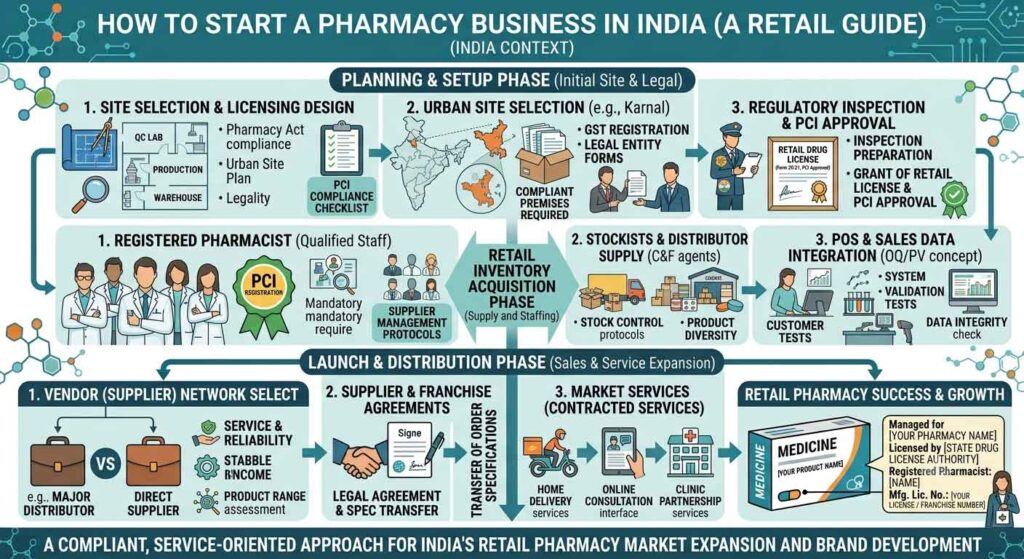
Step-by-Step Process to Open a Retail Pharmacy
Step 1: Select the Location
Choose a location with demand for medicines.
Suitable locations may include areas nearby:
Hospitals
Clinics
Nursing homes
Residential colonies
Diagnostic centres
Markets
Bus stands
Rural healthcare centres
Do not choose a location only because rent is low. Consider visibility, local population, competition, parking, doctor network and nearby medical facilities.
Step 2: Check Premises Suitability
Before signing a long-term rent agreement, confirm that the premises meet the State Drug Control Department’s requirements.
Check:
Required floor area
Commercial or permitted use
Ventilation
Cleanliness
Storage space
Electricity
Refrigerator placement
Accessibility
Separate storage for expired or rejected medicines
If you plan retail and wholesale activity from the same premises, additional area or conditions may apply.
Step 3: Arrange a Registered Pharmacist
Hire a pharmacist registered with the concerned State Pharmacy Council.
Collect:
Pharmacy qualification certificate
Registration certificate
Identity proof
Address proof
Appointment letter
Photographs
Affidavit or declaration, where required
Verify that the registration is valid.
Step 4: Choose the Business Constitution
You may start as:
Proprietorship
Partnership firm
LLP
Private Limited Company
For a small single-outlet pharmacy, proprietorship is often the simplest structure.
For multiple partners or expansion plans, an LLP or company may be considered.
Step 5: Apply for the Drug Licence
Submit the application to the State Drug Control Department through the applicable state portal or office.
The application generally requires:
Application form
Government fee
Business constitution documents
Premises documents
Site plan
Pharmacist documents
Refrigerator details
Storage details
Identity and address proofs
Declarations and affidavits
Photographs
Local approvals where applicable
The Drug Inspector may inspect the premises before the licence is granted.
Step 6: Obtain Other Business Registrations
Depending on your structure and state, you may require:
PAN
Current bank account
GST registration
Shop and Establishment registration
Municipal trade permission
Udyam registration
Professional-tax registration, where applicable
Fire-safety compliance, where applicable
Not every registration applies to every business. Confirm local requirements with a CA, CS or licensing consultant.
Step 7: Set Up the Store
A pharmacy usually requires:
Medicine racks
Counter
Computer
Billing software
Barcode scanner
Printer
Refrigerator
Temperature-monitoring arrangement
Inverter or power backup
CCTV
Fire extinguisher
Storage cabinets
Separate expired-stock section
The design should make stock management easy.
Step 8: Purchase Stock from Licensed Suppliers
Purchase medicines only from properly licensed manufacturers, wholesalers or authorized distributors.
Always collect:
Tax invoice
Supplier drug-licence details
Batch number
Expiry details
Quantity and rate information
Avoid purchasing medicines without bills or from unknown sources.
Step 9: Select the Initial Product Range
Do not buy excessive stock during the first month.
Start with products commonly prescribed in your area, such as:
Fever and pain medicines
Gastric medicines
Cough and cold products
Anti-allergic medicines
Diabetes medicines
Blood-pressure medicines
Common antibiotics against valid prescriptions
Vitamins and minerals
Pediatric products
Women’s healthcare products
First-aid items
Personal-care products
Study local prescriptions and ask nearby doctors and distributors about commonly required products.
Step 10: Start With Inventory Control
Pharmacy profit can be lost through expiry and dead stock.
Use software to track:
Batch number
Expiry date
Purchase rate
MRP
GST
Stock quantity
Supplier
Sales
Near-expiry products
Reorder levels
Follow the first-expiry-first-out system.
Option 2: Start a Wholesale Medicine Distribution Business
A wholesale drug business supplies medicines to:
Retail pharmacies
Hospitals
Nursing homes
Clinics
Other licensed wholesalers
Institutional buyers
Wholesale distribution can be suitable for a B.Com graduate with good sales, accounting and distribution knowledge.
Common Wholesale Drug-Licence Forms
Wholesale licences are commonly issued in relevant forms such as:
Form 20-B
Form 21-B
The exact forms depend on the products being stocked and supplied.
Competent Person for Wholesale Business
A wholesale drug business generally requires an approved competent person meeting the prescribed qualification or experience conditions.
The eligibility should be confirmed with the State Drug Control Department because documentation and approval practices may differ.
Requirements for Wholesale Distribution
Common requirements include:
Wholesale drug licence
Suitable premises
Competent person
Refrigerator, where required
GST registration
Storage racks
Billing software
Purchase and sale records
Supplier network
Retailer and hospital network
Delivery arrangement
How to Obtain a Pharma Distributorship
After obtaining the required licence:
Prepare your firm profile.
Select the therapeutic categories you want to distribute.
Contact pharmaceutical companies.
Submit your drug licence and GST documents.
Discuss territory and sales targets.
Review security-deposit requirements.
Check expiry and replacement policy.
Negotiate credit and payment terms.
Build relationships with retailers and hospitals.
Maintain regular stock and delivery.
Do not accept a large distributorship only because a company offers attractive schemes. First study local demand.
Option 3: Start Retail and Wholesale Together
You may operate retail and wholesale activities from one premises if you meet the applicable premises, staffing and licensing requirements.
This model allows you to:
Sell directly to patients
Supply nearby chemists
Supply clinics and hospitals
Develop a larger distribution network
However, it requires more investment, stock and working capital.
Option 4: Start an Online-Supported Pharmacy
An existing licensed pharmacy may use digital tools to receive local orders and arrange delivery, subject to applicable drug-sale, prescription, record, privacy and state requirements.
Do not assume that creating a website or mobile application allows medicines to be sold without a physical licensed pharmacy.
Before starting online sale or interstate delivery, obtain written regulatory advice regarding:
Prescription validation
Delivery area
State-wise licences
Patient-data protection
Sale of scheduled medicines
Record maintenance
Cold-chain delivery
Returns and recalls
Online advertising
A safer beginner model is a licensed local pharmacy offering compliant home delivery within its service area.
Option 5: Start a Generic Medicine Store
A generic medicine store focuses mainly on medicines sold by their generic or non-proprietary names or on affordable generic brands.
The licensing requirements for selling allopathic medicines remain applicable.
Success depends on:
Reliable suppliers
Quality products
Prescription acceptance
Competitive pricing
Doctor and patient awareness
Regular availability
Good counselling by the pharmacist
Do not purchase products only because their rates are very low. Verify the manufacturer, licence, invoice and quality documentation.
Option 6: Start a Pharma Marketing Company
A pharma marketing company markets products under its own brand name.
The products may be manufactured through third-party manufacturers.
The company generally handles:
Brand-name selection
Trademark application
Product selection
Packaging design
Third-party manufacturing
Marketing
PCD franchise appointment
Distribution
Promotion
This model can be suitable for people with marketing experience but requires product knowledge, working capital and a strong sales plan.
Option 7: Start a PCD or Pharma Franchise Business
In PCD business, you take distribution and marketing rights for a pharmaceutical company in a specific territory.
The company supplies:
Products
Price list
Promotional material
Product literature
Franchise support
Monopoly rights, where agreed
You handle:
Doctor promotion
Chemist availability
Stockist management
Local sales
Payment collection
This is a lower-investment route compared with setting up a manufacturing unit.
Option 8: Start a Surgical and Medical-Device Business
You may sell products such as:
Syringes
Gloves
Dressings
Catheters
Orthopaedic supports
Diagnostic devices
Hospital consumables
Surgical instruments
Medical devices are regulated according to their classification and applicable licensing provisions.
Before starting, check whether the products require:
Medical-device sale registration or licence
Drug licence
Manufacturer or importer authorization
Specific storage conditions
Installation or service support
Do not assume that every surgical product is completely unregulated.
Licensing requirements differ by state and product type.
If you also sell allopathic medicines, a regular retail drug licence and pharmacist requirements will apply to the allopathic section.
Option 10: Start a Nutraceutical and Health-Supplement Business
Nutraceuticals and food supplements generally fall under FSSAI-related compliance rather than conventional drug licensing, depending on the product category.
You may sell:
Protein powders
Multivitamins
Minerals
Probiotics
Health supplements
Sports-nutrition products
Check:
FSSAI registration or licence
Product category
Supplier documents
Label compliance
Health claims
Storage conditions
GST classification
Do not promote food supplements as guaranteed cures for diseases.
Option 11: Start Pharmaceutical Manufacturing
Pharmaceutical manufacturing requires much higher investment and compliance.
It generally requires:
Industrial premises
Manufacturing licence
Qualified technical staff
Machinery
Quality-control laboratory
GMP-compliant systems
Documentation
Water system
Pollution and fire approvals
Product permissions
Working capital
Manufacturing is generally not the best first option for a beginner without technical and regulatory experience.
Starting with retail, wholesale, PCD or third-party manufacturing is usually more practical.
Documents Commonly Required for a Retail Pharmacy
The exact list varies by state, but common documents may include:
Owner’s PAN and Aadhaar
Photographs
Business constitution proof
Rent agreement or ownership proof
Landlord’s NOC
Electricity bill
Site plan
Refrigerator invoice or declaration
Pharmacist qualification
Pharmacist registration certificate
Pharmacist appointment letter
Affidavit or declaration
GST certificate, where applicable
Shop registration, where applicable
Government fee receipt
Always check the latest state-specific checklist before applying.
How to Select the Best Pharmacy Location
Evaluate the following:
Number of nearby doctors
Number of existing pharmacies
Daily patient movement
Residential population
Hospital or clinic traffic
Rent
Visibility
Parking
Home-delivery potential
Local purchasing power
Availability of wholesalers
A pharmacy near a hospital may have high sales but also high rent and competition.
A residential pharmacy may develop slower but can build loyal repeat customers.
How Much Stock Should You Purchase Initially?
Do not fill the store with excessive stock.
Start with:
Common fast-moving medicines
Regular chronic medicines
Basic OTC products
First-aid products
Selected personal-care items
Limited premium products
Increase stock according to actual sales data.
Avoid overstocking:
Rare injections
Expensive specialty medicines
Short-expiry products
Seasonal products
Slow-moving cosmetic products
Pharmacy Profit Sources
Pharmacy income may come from:
Retail medicine margin
Generic-product margin
OTC products
Nutraceuticals
Personal-care products
Medical devices
Surgical items
Home delivery
Institutional supply
Wholesale supply
Actual profitability depends on rent, salary, discounts, credit, expiry loss, competition and sales volume.
Important Records to Maintain
Maintain proper records of:
Purchases
Sales
Prescriptions, where required
Schedule H1 transactions
Schedule X transactions, if authorized
Expired medicines
Returned medicines
Refrigerator temperature
Supplier licences
Pharmacist attendance
Product recalls
Complaints
Do not sell prescription medicines without following applicable prescription requirements.
How to Increase Pharmacy Sales
You can grow the business by:
Maintaining regular stock
Providing quick service
Offering compliant home delivery
Keeping transparent pricing
Accepting digital payments
Maintaining customer records with consent
Sending refill reminders for chronic medicines
Stocking essential medical devices
Building relationships with local doctors without unethical inducements
Reducing waiting time
Keeping the store clean and professional
Avoid misleading claims and unethical referral arrangements.
Common Mistakes to Avoid
Avoid these mistakes:
Opening without proper licence
Using a pharmacist’s certificate only on paper
Buying medicines without invoices
Selling expired medicines
Selling prescription products without valid prescriptions
Giving excessive discounts without margin calculation
Overstocking slow-moving products
Ignoring refrigerator temperature
Giving too much credit
Depending on only one supplier
Starting online medicine sales without regulatory review
Ignoring medical-device regulations
Poor inventory management
Which Pharmacy Business Is Best for a B.Com Graduate?
A B.Com graduate may be particularly suited to:
Retail Pharmacy Ownership
Suitable if you can appoint a registered pharmacist and manage daily store operations.
Wholesale Distribution
Suitable if you have sales, accounting, stock and retailer-network skills.
PCD Franchise
Suitable if you want to promote products in a limited territory with moderate investment.
Pharma Marketing Company
Suitable if you understand branding, marketing, distribution and business development.
Surgical Distribution
Suitable if you can build hospital, clinic and laboratory networks.
Manufacturing should generally be considered only after gaining industry experience and arranging adequate technical support.
Recommended Starting Path
For a beginner, a practical path can be:
Work or observe in an existing pharmacy or distribution business.
Study the local market.
Decide retail, wholesale or PCD model.
Calculate total working capital.
Select premises only after compliance verification.
Arrange the required pharmacist or competent person.
Obtain licences.
Start with limited stock.
Track sales and expiry daily.
Expand only after establishing regular cash flow.
Final Thoughts
A B.Com graduate can successfully start and own a pharmacy business, but the business must follow applicable drug-sale and professional pharmacy requirements.
For a retail medical store, appointing a genuine registered pharmacist and obtaining a retail drug licence are essential.
For wholesale distribution, obtain the appropriate wholesale licence and arrange an approved competent person.
For entrepreneurs with limited investment, retail pharmacy, wholesale distribution, PCD franchise, surgical distribution or pharma marketing may be more practical than manufacturing.
The best model depends on:
Your budget
Location
Experience
Available staff
Market network
Long-term goal
Start with a compliant and manageable business model, maintain proper records and expand gradually.
Frequently Asked Questions
1. Can a B.Com graduate open a pharmacy?
Yes. A B.Com graduate can own a pharmacy, but retail medicine dispensing must be handled according to licence conditions by a registered pharmacist.
2. Is a pharmacist compulsory for a medical store?
A registered pharmacist is generally required for the retail sale and dispensing of medicines under applicable retail licence conditions.
3. Can I use another pharmacist’s certificate without employing them?
No. The pharmacist should be genuinely appointed and present according to the approved working arrangement. Certificate renting can create serious regulatory problems.
4. Which licence is needed for a retail pharmacy?
Retail drug licences are commonly issued in relevant Forms 20 and 21, depending on the medicines being stocked. Confirm the exact forms with your State Drug Control Department.
5. Which licence is required for wholesale medicine distribution?
Wholesale licences are commonly issued in relevant Forms 20-B and 21-B. Additional requirements may apply for specific drug categories.
6. Can I start retail and wholesale business together?
Yes, subject to the required premises, staff and licences for both activities.
7. Can I start an online pharmacy?
Online ordering should operate through a properly licensed pharmacy and comply with prescription, record, delivery, privacy and state requirements. Obtain regulatory advice before launching.
8. Can I sell Ayurvedic medicines without a pharmacist?
Requirements vary according to the products and state rules. If allopathic medicines are also sold, the applicable retail drug-licence and pharmacist conditions apply.
9. Can I sell nutraceutical products in a pharmacy?
Yes, provided the products and supplier comply with applicable FSSAI, labelling and invoicing requirements.
10. Which pharmacy business requires the least investment?
A small PCD franchise, local surgical distribution or carefully planned retail pharmacy may require less investment than pharmaceutical manufacturing, but actual cost depends on stock, premises and territory.
Partner with Elzac Herbal India
Looking to start an Ayurvedic franchise, become a distributor, or launch your own herbal product range?
Elzac Herbal India offers:
Ayurvedic & Herbal Product Range
Franchise & Distribution Opportunities
Third-Party Manufacturing Services
Product Development Support
Marketing Guidance
PAN India Business Opportunities
Whether you are an entrepreneur, retailer, distributor, or healthcare professional, our team can help you explore the right business opportunity in the growing Ayurvedic sector.
Ajay Kamboj is an entrepreneur and business owners associated with many Ayurvedic and Pharmaceutical start-ups. With years of experience in Ayurvedic product marketing, pharmaceutical distribution, franchise development, and client relationship management, he regularly shares practical business insights based on real-world experiences. His articles focus on business growth, entrepreneurship, customer management, and lessons learned from the healthcare and wellness industry.



Leave a Reply
You must be logged in to post a comment.