“Can I start a small-scale pharmaceutical manufacturing unit on my farm or village land if road, electricity and water facilities are available?”
This is a very practical question because agricultural land is usually cheaper than industrial land, and many village locations have good road connectivity, electricity supply and water availability.
However, in pharmaceutical manufacturing, land ownership alone is not enough. The location must be legally suitable for industrial and pharmaceutical manufacturing activity.
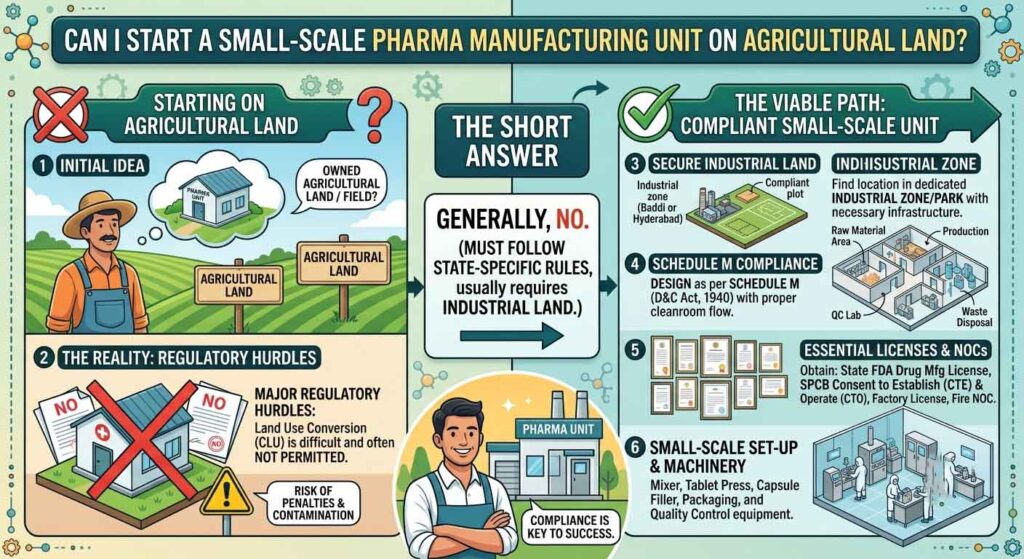
Can a Pharma Manufacturing Unit Be Started on Agriculture Land?
In most cases, a pharmaceutical manufacturing unit cannot be started directly on agricultural land unless the land is legally converted or approved for industrial use.
Pharma manufacturing is a regulated activity. Before granting a manufacturing license, authorities may check the premises, layout, location, building suitability, sanitation, storage area, quality control area, drainage, environmental compliance and other conditions.
Even if your farm has good road connectivity, electricity and water supply, it may still not be approved if the land use is agricultural.
Why Agricultural Land Is Usually Not Suitable Directly
Agricultural land is meant for farming and related activities. A pharmaceutical manufacturing unit is considered an industrial activity.
Therefore, before setting up a plant, you may need approval from departments such as:
State Drug Control Department
Town and Country Planning Department
Local municipal or panchayat authority
Pollution Control Board
Fire Department
Electricity Department
Factory/industrial safety department, where applicable
AYUSH department, if it is an Ayurvedic manufacturing unit
The exact approvals depend on your state, product category and type of manufacturing.
What Is Change of Land Use?
Change of Land Use, commonly known as CLU, means legal permission to use land for a purpose different from its original classification.
For example:
Agricultural land to industrial use
Agricultural land to commercial use
Residential land to commercial use
If you want to start a pharma manufacturing unit on your own agricultural land, you may first need to check whether industrial use is permitted in that area and whether CLU can be obtained.
Without proper land-use approval, your manufacturing license application may be rejected.
Is Industrial Area Better for Pharma Manufacturing?
Yes. In most cases, industrial areas are more suitable for pharmaceutical manufacturing units.
Industrial areas generally have:
Approved industrial land use
Better road connectivity
Better power infrastructure
Proper drainage system
Easier pollution control compliance
Better fire safety planning
Industrial building norms
Easier approval process
Better acceptance by licensing authorities
That is why many pharma units prefer industrial estates, industrial zones, pharma parks or approved industrial plots.
What If My Village Land Has Good Facilities?
Good facilities are helpful, but they are not enough.
Even if your village land has:
Wide road
Electricity
Water supply
Boundary wall
Large area
Nearby labour availability
you still need legal permission for industrial activity.
The key question is not only whether the land is suitable physically, but whether it is legally approved for pharmaceutical manufacturing.
Can Ayurvedic Manufacturing Be Started on Farm Land?
Ayurvedic manufacturing also requires proper licensing and approved premises.
Although Ayurvedic manufacturing may sometimes appear simpler than allopathic pharmaceutical manufacturing, it still requires compliance with applicable AYUSH rules, premises requirements, technical staff and product category norms.
Agricultural land still needs to be checked for legal land-use permission before starting an Ayurvedic manufacturing unit.
Can Food Supplement or Nutraceutical Manufacturing Be Started on Farm Land?
Food supplement or nutraceutical manufacturing may fall under a different regulatory framework, but it still requires proper business premises, FSSAI compliance, hygiene standards, local approval and suitable land use.
Agricultural land should not be assumed suitable without checking land-use rules and local authority requirements.
What Should You Do Before Planning a Pharma Unit on Farm Land?
Before investing money, follow these steps.
Step 1: Check Land Use Status
First, confirm the legal classification of your land.
Check whether your land is:
Agricultural
Residential
Commercial
Industrial
Mixed-use
Village abadi
Controlled area
Restricted zone
This can be checked from revenue records, local planning office or town and country planning department.
Step 2: Ask Whether CLU Is Possible
If the land is agricultural, ask the concerned authority whether Change of Land Use for industrial purpose is possible.
Important questions:
Is the area eligible for industrial CLU?
Is pharma manufacturing allowed there?
What documents are required?
What fees apply?
How much time will approval take?
Are there any restricted zones nearby?
Is there any master plan restriction?
Step 3: Consult State Drug Control Department
Before building anything, consult the State Drug Control Department or a regulatory consultant.
Ask whether they will consider a manufacturing license application at that location after CLU approval.
This step is very important because construction without drug department guidance can lead to costly mistakes.
Step 4: Check Pollution Control Requirements
Pharmaceutical manufacturing may require pollution control approval, depending on dosage form, process and effluent generation.
You may need:
Consent to Establish
Consent to Operate
Effluent management plan
Waste disposal system
Air/water pollution compliance
Hazardous waste handling permission, if applicable
Do not ignore pollution control requirements.
Step 5: Check Building Layout Requirements
A pharma manufacturing unit requires a proper layout.
The building must include suitable areas such as:
Raw material store
Packing material store
Manufacturing area
Quality control area
Finished goods store
Change room
Washing area
Documentation area
Utility area
Quarantine area
Rejected material area
Separate sections as required
The layout must be suitable for the product category and manufacturing section.
Step 6: Check Fire and Safety Requirements
Depending on your unit size and activity, fire safety approval may be required.
This may include:
Fire extinguishers
Emergency exits
Fire NOC
Electrical safety
Proper ventilation
Safe storage
Chemical handling precautions
Step 7: Estimate Total Cost Before Starting
Starting a pharma unit on agricultural land may look cheaper at first, but conversion and compliance costs can increase the budget.
Possible expenses include:
CLU charges
Building approval
Construction cost
Road/access improvement
Drainage system
Pollution control setup
Fire safety system
Electricity load approval
Water arrangement
Machinery
Technical staff
Licensing expenses
Quality control setup
Sometimes, an industrial plot may be more practical than converting agricultural land.
Practical Answer
If your land is agricultural, you generally should not start construction for a pharma manufacturing unit until you confirm:
Industrial use is permitted
CLU or land-use approval is possible
Drug department will consider the premises
Pollution control approval can be obtained
Building layout can meet pharma requirements
Local authority has no objection
Without these approvals, the unit may not receive a manufacturing license.
Best Option for Beginners
For beginners, the safer options are:
Option 1: Take an Approved Industrial Plot
This is usually the cleanest route for manufacturing license approval.
Option 2: Rent a Premises in an Industrial Area
This reduces land investment and helps you start faster.
Option 3: Start With Third-Party Manufacturing
If budget is limited, start a marketing company first and get products manufactured by a licensed third-party manufacturer.
Option 4: Start With Ayurvedic or Nutraceutical Business
If suitable and compliant, Ayurvedic or nutraceutical business may be easier than a full pharma manufacturing unit, but proper licensing and premises approval are still required.
Final Thoughts
Owning agricultural land does not automatically allow you to start a pharmaceutical manufacturing unit there.
Pharma manufacturing is a regulated industrial activity. The land must be legally suitable, the premises must meet technical requirements and approvals must be obtained from the concerned departments.
Before investing in construction, always verify land-use permission, drug license feasibility, pollution control requirements and building layout approval.
The safest approach is to start in an approved industrial area or take expert guidance before using agricultural land.
Frequently Asked Questions
1. Can I start a pharma manufacturing unit on my agriculture farm?
Generally, not directly. Agricultural land usually needs proper land-use conversion or industrial approval before it can be used for pharma manufacturing.
2. Is road, electricity and water enough for approval?
No. These facilities are helpful, but legal land use, premises suitability, licensing approval and compliance are more important.
3. What is CLU?
CLU means Change of Land Use. It is permission to use land for a different purpose, such as converting agricultural land to industrial use.
4. Is industrial area better for pharma manufacturing?
Yes. Industrial areas are usually more suitable because the land use is already approved for industrial activity.
5. Can I start Ayurvedic manufacturing on village land?
Only if the land and premises meet applicable legal, AYUSH and local authority requirements. Do not start without approval.
6. Who should I contact first?
You should first check land-use permission with the local planning authority and then consult the State Drug Control Department or a qualified regulatory consultant.
7. Can I build first and apply for license later?
This is risky. Always confirm approval feasibility before construction.
8. What if CLU is not available?
If CLU is not possible, you should consider an industrial plot, rented industrial premises or third-party manufacturing.
9. Can I use a farm building as a warehouse for medicines?
Medicine storage and wholesale activity also require proper licensed premises. Do not store medicines at unapproved premises.
10. What is the best low-risk option?
For beginners, third-party manufacturing or starting in an approved industrial area is usually safer than converting agricultural land.
Partner with Elzac Herbal India
Looking to start an Ayurvedic franchise, become a distributor, or launch your own herbal product range?
Elzac Herbal India offers:
Ayurvedic & Herbal Product Range
Franchise & Distribution Opportunities
Third-Party Manufacturing Services
Product Development Support
Marketing Guidance
PAN India Business Opportunities
Whether you are an entrepreneur, retailer, distributor, or healthcare professional, our team can help you explore the right business opportunity in the growing Ayurvedic sector.
Ajay Kamboj is an entrepreneur and business owners associated with many Ayurvedic and Pharmaceutical start-ups. With years of experience in Ayurvedic product marketing, pharmaceutical distribution, franchise development, and client relationship management, he regularly shares practical business insights based on real-world experiences. His articles focus on business growth, entrepreneurship, customer management, and lessons learned from the healthcare and wellness industry.







Leave a Reply Cancel reply
You must be logged in to post a comment.