Nutraceuticals, health supplements, food supplements, functional foods and foods for special dietary use are growing rapidly in India. Many pharma companies, Ayurvedic companies, nutritionists, dieticians, distributors and healthcare entrepreneurs are entering this segment because demand for wellness, preventive healthcare and nutrition-support products is increasing.
A common query is:
“I am a nutritionist and currently working as a nutrition representative. I want to start my own nutraceutical marketing company. How can I start?”
The answer is simple:
You can start a nutraceutical marketing company by obtaining the applicable FSSAI registration or licence, selecting products, creating brand names, choosing a third-party manufacturer, finalizing packaging, and starting marketing through distributors, doctors, dieticians, gyms, wellness stores, pharmacies or online channels.
However, nutraceuticals are regulated as food products, not as medicines. Therefore, licensing, labelling, ingredients, claims and advertisements must follow FSSAI requirements.
What Is a Nutraceutical?
The word “nutraceutical” is formed by combining “nutrition” and “pharmaceutical.”
In practical business language, nutraceutical products are specially formulated food or nutrition products that support health, nutrition, dietary requirements or wellness.
They may contain ingredients such as:
Vitamins
Minerals
Amino acids
Proteins
Enzymes
Probiotics
Prebiotics
Botanicals
Plant extracts
Fatty acids
Nutritional ingredients
Other permitted food ingredients
Nutraceuticals should not be marketed as medicines for curing diseases unless the product is legally approved under the correct category and the claim is permitted.
Nutraceuticals and health supplements are regulated by the Food Safety and Standards Authority of India, commonly known as FSSAI.
Any business involved in manufacturing, marketing, trading, wholesale, distribution, storage, import, export or retail sale of nutraceutical products may require FSSAI registration or licence according to its business activity and eligibility.
Is Drug Licence Required for Nutraceutical Marketing?
Generally, nutraceuticals and food supplements fall under FSSAI, not under a regular drug licence.
However, you must be careful.
If a product contains ingredients, claims or dosage forms that make it fall under drug regulation, AYUSH regulation or any other category, then a different licence may be required.
Before launching any product, confirm:
Product category
Ingredient permissibility
Label claim
Dosage format
Intended use
Applicable regulation
Manufacturer’s licence
FSSAI category
Do not assume every tablet, capsule or syrup is a nutraceutical just because it is marketed as a supplement.
Licences and Registrations Required
A nutraceutical marketing company may require the following:
1. FSSAI Registration or Licence
This is the most important requirement.
The type of FSSAI approval depends on:
Turnover
Kind of business
Product category
Manufacturing or marketing activity
Storage and distribution model
Number of locations
Import/export activity
Online selling activity
FSSAI approval may be in the form of basic registration, state licence or central licence, depending on eligibility.
Because thresholds and eligibility rules may change, always check the latest FoSCoS eligibility before applying.
2. GST Registration
GST registration may be required depending on turnover, interstate sale, e-commerce sale and business structure.
GST is important for:
Purchase invoice
Sale invoice
Distributor billing
Input tax credit
E-commerce sale
B2B business
3. Business Registration
You may start as:
Proprietorship
Partnership firm
LLP
Private Limited Company
Company registration is optional for small businesses but useful for long-term brand building, investment, expansion and credibility.
4. Trademark Registration
Trademark registration is not mandatory but strongly recommended.
Register:
Company name
Brand names
Logo
Product range name
This helps protect your brand from copying.
5. Other Registrations
Depending on your business model, you may also require:
Shop and Establishment registration
MSME/Udyam registration
Import Export Code, if importing or exporting
Local trade licence, if applicable
E-commerce marketplace registration
Professional tax registration, where applicable
FSSAI Product Categories for Nutraceuticals
Nutraceutical and health supplement products generally fall under food category 13, which relates to foods intended for particular nutritional uses.
Relevant categories may include:
Health Supplements
Nutraceuticals
Food for Special Dietary Use
Food for Special Medical Purpose
Functional Food
Food with added Probiotic Ingredients
Food with added Prebiotic Ingredients
Specialty Food containing plant or botanical ingredients
Novel Food, where applicable
Correct category selection is very important because the label, claim, ingredient and compliance requirements depend on it.
Basic Difference Between Categories
Health Supplements
Products intended to supplement the normal diet with permitted nutrients or ingredients.
Nutraceuticals
Products that provide health benefits beyond basic nutrition, using permitted ingredients under FSSAI regulations.
Food for Special Dietary Use
Foods specially processed or formulated to satisfy particular dietary requirements due to physical or physiological conditions.
Food for Special Medical Purpose
Foods intended for dietary management of specific medical conditions and generally used under medical advice.
Functional Food
Food products designed to provide physiological benefits beyond normal nutritional function.
Probiotic and Prebiotic Foods
Products containing permitted probiotic or prebiotic ingredients, subject to applicable requirements.
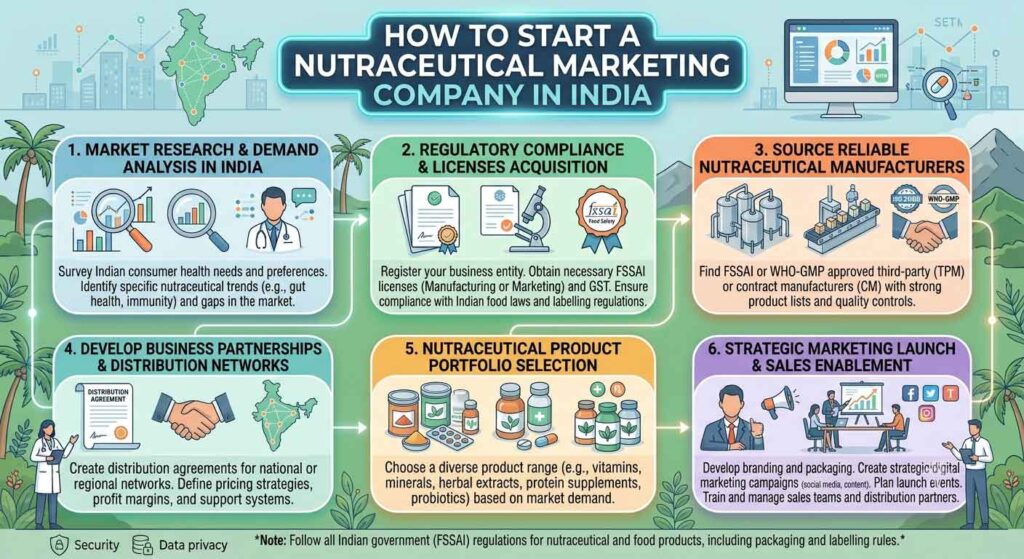
Steps to Start Nutraceutical Marketing Company
Step 1: Make a Business Plan
Before applying for licence or selecting products, prepare a business plan.
Your plan should include:
Product category
Target customers
Sales channel
Investment
Profit margin
Packaging strategy
Marketing strategy
Third-party manufacturing plan
Distributor model
Online/offline selling plan
Compliance budget
Do not start only by selecting attractive product names. Start with a clear business model.
Step 2: Choose Company Name
Choose a professional and flexible name.
A good nutraceutical company name should be:
Easy to remember
Easy to pronounce
Unique
Trademark-friendly
Health or wellness oriented
Suitable for future expansion
Domain-name friendly
Avoid names that directly suggest disease cure or guaranteed treatment.
Step 3: Choose Product Range
Select products according to market demand.
Good starter products may include:
Multivitamin tablets
Calcium + Vitamin D3
Vitamin D3 sachets
Iron + Folic Acid
Protein powder
Probiotic sachets
Digestive enzyme syrup
Omega-3 softgels
Lycopene antioxidant capsules
Methylcobalamin combinations
Joint support supplements
Women wellness supplements
Pediatric nutrition syrup
Liver support supplement
Collagen sachets
Start with a focused list instead of launching too many products at once.
Step 4: Select Brand Names
Choose brand names that are:
Short
Unique
Easy to speak
Relevant to the product
Legally available
Not misleading
Not disease-cure based
Avoid names like:
Diabetes Cure
Liver Repair Medicine
Cancer Guard
Arthritis Cure
Fatty Liver Cure
BP Control Medicine
Nutraceutical brand names should not create the impression of drug treatment unless legally permitted.
Step 5: Check Trademark Availability
Before finalizing brand names, check trademark availability.
Search:
Exact name
Similar spelling
Similar pronunciation
Same product category
Similar healthcare brands
After search, file trademark application for important brand names.
Step 6: Choose Premises
A nutraceutical marketing company needs a proper business premises for storage, office or distribution activity.
Premises may be:
Owned
Rented
Shared office, if accepted for your business model
Godown or warehouse
Distribution office
The premises should be clean, safe and suitable for food-product storage.
Step 7: Apply for FSSAI Registration or Licence
Apply online through FoSCoS, the FSSAI licensing portal.
During application, you need to select:
State
Premises location
Kind of business
Product category
Food category
Business activity
Turnover details
Documents
Authorized person details
Choose the correct category and business activity. Wrong selection can create problems later.
Step 8: Apply for GST
Apply for GST registration if applicable.
GST is commonly required for:
B2B sale
Interstate sale
Distributor billing
Marketplace sale
Proper input-output accounting
Step 9: Select Third-Party Manufacturer
If you are starting as a marketing company, you do not need your own manufacturing plant.
You can get products manufactured from an FSSAI-licensed nutraceutical manufacturer.
Before finalizing manufacturer, check:
FSSAI licence
Product category approval
Manufacturing capacity
Quality system
Ingredients used
Packaging quality
Minimum order quantity
Testing support
COA availability
Label compliance support
Delivery time
Past client feedback
Do not select manufacturer only on lowest rate.
Step 10: Finalize Formula and Product Category
Before printing labels, confirm:
Product category
Permitted ingredients
Dosage format
Serving size
Nutritional values
RDA limits
Warning statements
Target consumer group
Claims
Shelf life
Storage condition
A regulatory consultant should review the formula and label before final printing.
Step 11: Design Packaging
Packaging is very important in nutraceutical marketing.
Good packaging should be:
Attractive
Premium
Clean
Informative
Compliant
Easy to read
Category appropriate
Suitable for retail display
Packaging should include required information such as:
Product name
Category
Ingredients
Nutritional information
Recommended usage
FSSAI licence number
Net quantity
Batch number
Manufacturing date
Best before
Manufacturer details
Marketer details
Storage instruction
Warnings
Veg/non-veg logo, where applicable
Customer care details
Step 12: Place Manufacturing Order
After finalizing formula, brand name, packaging and licence details, place order with the third-party manufacturer.
Provide:
Company name
Brand name
Marketer address
FSSAI licence details
Packaging design
Product category
Label matter
Quantity
Packing size
MRP
Terms of payment
Collect invoice, COA and batch details after manufacturing.
Step 13: Build Sales Channel
You can sell nutraceutical products through:
Pharma distributors
Ayurvedic distributors
Nutrition stores
Gyms
Dieticians
Wellness clinics
Pharmacies
Doctors
Hospitals
Online marketplace
Company website
PCD franchise partners
Super stockists
Retail chains
Choose channels according to product type.
Step 14: Prepare Marketing Material
Marketing material may include:
Product catalogue
Product images
Visual aid
Social media creatives
Product cards
Digital brochure
Website content
Distributor proposal
Price list
Product training notes
FAQ sheets
All claims should be responsible and evidence-supported.
Step 15: Start Promotion
You can promote nutraceutical products through:
Distributor meetings
Doctor/dietician visits
Gym and wellness networks
Online ads, where permitted
SEO blogs
Social media
YouTube education videos
WhatsApp Business
E-commerce platforms
Health camps, where compliant
Retail displays
Do not promote nutraceuticals as guaranteed cures for diseases.
Documents Required for Nutraceutical Marketing Company
Common documents may include:
Photo ID of proprietor/partner/director
Address proof
Business constitution document
Rent agreement or ownership proof
Electricity bill
List of directors/partners/proprietor
Authorized signatory nomination
Form IX, where applicable
Recall plan
Food safety management plan, where applicable
GST certificate
PAN
Product list
Premises details
Declaration documents
Any additional document required by authority
The exact document list may vary according to licence type, state and business activity.
What Is a Recall Plan?
A recall plan explains what your company will do if a product is found unsafe, defective, wrongly labelled or non-compliant.
It should include:
Product identification system
Batch tracking
Customer/distributor contact list
Complaint handling
Recall decision process
Communication plan
Stock withdrawal process
Record maintenance
Corrective action
FSSAI may ask for recall-plan documentation.
Important Compliance Points
1. Do Not Use Drug Claims
Avoid claims like:
Cures diabetes
Treats arthritis
Reverses fatty liver
Removes cysts
Prevents heart attack
Cures PCOS
Works like medicine
Guaranteed result
Use responsible language such as:
Supports
Helps maintain
Contributes to
Nutritional support
Supports normal function
Helps meet dietary requirement
Only use claims that are permitted and substantiated.
2. Check Ingredient Limits
Nutraceutical products must use ingredients within permitted limits.
Check:
RDA
Upper limits
Permitted botanicals
Additives
Flavours
Sweeteners
Colours
Specific warnings
Target consumer restrictions
3. Maintain Quality Documents
Keep records such as:
COA
Ingredient specification
Finished product testing
Batch details
Manufacturer invoice
Product label approval
Complaint records
Recall records
Stability support, where required
4. Do Not Mix Drug and Food Categories
Some products look similar to medicines because they are sold in tablet, capsule or syrup form. Still, if marketed as nutraceuticals, they must follow FSSAI rules.
Do not mix drug claims with food-product licensing.
Third-Party Manufacturing for Nutraceuticals
Third-party manufacturing is the most practical option for beginners.
In this model:
You choose product and brand name.
Manufacturer makes product for you.
Your company markets the product.
Product is labelled with manufacturer and marketer details.
You focus on sales and branding.
Benefits include:
Low investment
No need for manufacturing plant
Faster launch
Access to experienced manufacturer
Product variety
Lower compliance burden compared with own manufacturing
How Many Products Should You Launch First?
Do not launch too many products at the start.
A beginner can start with 5 to 15 products.
Example starter range:
Multivitamin tablet
Calcium + Vitamin D3 tablet
Vitamin D3 sachet
Iron + Folic Acid tablet
Protein powder
Probiotic sachet
Omega-3 softgel
Digestive enzyme syrup
Liver support supplement
Joint support supplement
Expand after you understand demand and sales channels.
Investment Required
Investment depends on:
Number of products
Minimum order quantity
Packaging quality
Third-party manufacturing cost
Trademark filing
FSSAI licence
GST
Website
Marketing material
Stock
Distributor credit
Online listing
Sales team
Start with a limited product range to reduce expiry and dead-stock risk.
Marketing Strategy for Nutritionist
If you are a nutritionist, you have an advantage because you understand consumer needs, diet and wellness.
You can build your business around:
Dietician network
Wellness clinics
Fitness centres
Gyms
Women health segment
Weight management support
Protein and nutrition products
Deficiency-support products
Health education content
Your qualification can help build trust, but your product claims must still follow FSSAI rules.
Best Sales Channels for Nutraceutical Company
Pharma Channel
Useful for multivitamins, calcium, iron, probiotics and nutrition-support products.
Wellness Channel
Useful for protein powder, sports nutrition, weight-management and lifestyle products.
Dietician Channel
Useful for specialized nutrition products and health packages.
Online Channel
Useful for consumer-health, nutrition, protein, wellness and supplement products.
PCD Franchise Channel
Useful if you want to expand through distributors and area partners.
Common Mistakes to Avoid
Avoid these mistakes:
Launching without FSSAI registration or licence
Choosing wrong food category
Making disease-cure claims
Printing label without regulatory review
Using unapproved ingredients
Copying competitor formula blindly
Choosing manufacturer only by low rate
Launching too many products initially
Ignoring trademark search
Selling through unverified channels
Not maintaining COA and batch records
Not creating a recall plan
Promoting nutraceuticals as medicines
Difference Between Nutraceutical Marketing and Pharma Marketing
Point
Nutraceutical Marketing
Pharma Marketing
Main regulator
FSSAI
Drug Control/CDSCO/State Drug Authority
Product nature
Food/nutrition support
Medicine
Claims
Nutrition/health-support claims
Approved therapeutic claims
Licence
FSSAI
Drug licence/manufacturing licence
Channels
Pharmacy, wellness, online, dietician, gym
Doctor, pharmacy, hospital, stockist
Label
Food label rules
Drug label rules
Cure claims
Not allowed
Only approved indications
Final Thoughts
Starting a nutraceutical marketing company in India is a good opportunity for nutritionists, pharma professionals, distributors and healthcare entrepreneurs.
The basic steps are:
Make a business plan.
Choose company and brand names.
Select products.
Apply for FSSAI registration or licence.
Apply for GST.
Choose a third-party manufacturer.
Finalize formula and label.
Place manufacturing order.
Prepare marketing material.
Start sales through suitable channels.
The most important point is compliance. Nutraceuticals are food products, not medicines. Their ingredients, labels, claims, advertisements and category selection must be checked carefully.
A nutraceutical business can grow well if you focus on quality, responsible claims, attractive packaging, correct product selection and strong distribution.
Frequently Asked Questions
1. Can a nutritionist start a nutraceutical marketing company?
Yes. A nutritionist can start a nutraceutical marketing company by obtaining applicable FSSAI registration or licence and following product, label and claim requirements.
2. Is FSSAI licence required for nutraceutical marketing?
Yes. Nutraceutical marketing, trading, distribution or sale generally requires FSSAI registration or licence according to eligibility and business activity.
3. Is drug licence required for nutraceuticals?
Generally, nutraceuticals are regulated as food products under FSSAI, not as medicines. But product category must be verified before launch.
4. Can I manufacture nutraceutical products without my own factory?
Yes. You can use third-party manufacturing from an FSSAI-licensed nutraceutical manufacturer.
5. Can nutraceuticals be sold online?
Yes, subject to FSSAI compliance, e-commerce rules, product category, labelling and claim restrictions.
6. Can I claim that my supplement cures disease?
No. Nutraceuticals should not make disease-cure or drug-like treatment claims unless legally permitted under the applicable framework.
7. How many products should I launch first?
A beginner can start with 5 to 15 focused products and expand after understanding market demand.
8. What documents are required for FSSAI licence?
Common documents include ID proof, address proof, business constitution, premises proof, Form IX where applicable, recall plan, product category details and other documents required by authority.
9. Can I start nutraceutical business from rented premises?
Yes, rented premises can be used if documents and suitability are accepted for your business activity.
10. What is most important in nutraceutical business?
Correct FSSAI compliance, quality products, responsible claims, good packaging, suitable product selection and strong sales channels are the most important success factors.
Looking for Ayurvedic Franchise or Distribution Opportunities?
Looking to start an Ayurvedic franchise, become a distributor, or launch your own herbal product range?
Elzac Herbal India offers:
Ayurvedic & Herbal Product Range
Franchise & Distribution Opportunities
Third-Party Manufacturing Services
Product Development Support
Marketing Guidance
PAN India Business Opportunities
Whether you are an entrepreneur, retailer, distributor, or healthcare professional, our team can help you explore the right business opportunity in the growing Ayurvedic sector.
Ajay Kamboj is an entrepreneur and business owners associated with many Ayurvedic and Pharmaceutical start-ups. With years of experience in Ayurvedic product marketing, pharmaceutical distribution, franchise development, and client relationship management, he regularly shares practical business insights based on real-world experiences. His articles focus on business growth, entrepreneurship, customer management, and lessons learned from the healthcare and wellness industry.
9 responses to “How to Start A Nutraceutical Marketing Company in India”
I want to start a neutraceutical company but is pa/noc mandatory from FSSAI I hear that court cancelled it
My company has FSSAI License for trade/ Sell Nutraceutical. I want to import the product and sell in India, What is the further process ? We have to register the product at FSSAI or do we have to take NOC for each products ? Kindly guide.





I want to start a neutraceutical company but is pa/noc mandatory from FSSAI
I hear that court cancelled it
Please help me
hello..
How can we help you
You aren’t dealing in drug products then you don’t require drug license
I have register a company plan to sale and marketing of Nutraceutical products fssi license taken do I required Nutraceutical license too
fssai license and nutraceutical license are same
you need fssai license to sell nutraceutical products
My company has FSSAI License for trade/ Sell Nutraceutical. I want to import the product and sell in India, What is the further process ? We have to register the product at FSSAI or do we have to take NOC for each products ? Kindly guide.
I will Start food Supplements Nutrition unite in Malaysia
hi.. I want to start Nutraceuticals Marketing Company Can I ke Fssai or Office at residence address.. is there Any Size of Area Tequired