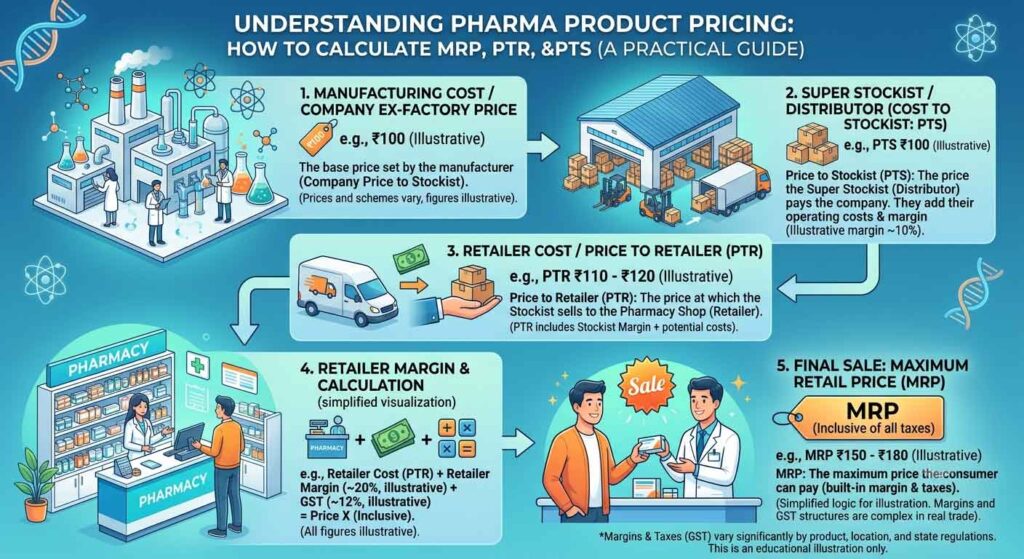
Pharmaceutical pricing usually involves several prices between the company and the final consumer.
The most commonly used terms are:
MRP: Maximum Retail Price
PTR: Price to Retailer
PTS: Price to Stockist
C&F Price: Price applicable before the stockist level
Net Rate: Actual commercial rate after discounts or schemes
GST: Goods and Services Tax
A common query is:
“How can I calculate MRP, Price to Retailer and Price to Stockist when GST and trade margins are known?”
The practical answer is:
First establish whether the percentages represent markup on purchase price or discount from the selling price. These two methods produce different results. After deciding the method, remove GST from MRP and calculate each price level sequentially.
Meaning of MRP, PTR and PTS
Maximum Retail Price
MRP means Maximum Retail Price.
It is the maximum amount at which a packaged product may be sold to the final consumer.
MRP normally includes:
GST
Retailer earnings
Stockist earnings
C&F or distribution cost
Company expenses
Marketing expenses
Company profit
Manufacturing and packaging costs
The product may be sold below MRP, but GST should not normally be added again over the printed MRP.
Price to Retailer
PTR means Price to Retailer.
It is the price at which a stockist, distributor or pharmaceutical company supplies the product to a retail chemist.
PTR may be quoted:
Excluding GST, or
Including GST
The quotation and invoice should clearly state which basis is being used.
Price to Stockist
PTS means Price to Stockist.
It is the price at which a pharmaceutical company, C&F agent or super stockist supplies the product to a stockist or distributor.
PTS may also be quoted:
Excluding GST, or
Including GST
For accurate comparison, always ask whether the quoted PTS is before or after GST.
Margin, Markup and Discount Are Different
The word “margin” is often used loosely in pharmaceutical trade.
Before calculating PTR or PTS, understand these three terms.
1. Markup on Purchase Price
Markup is calculated on the buyer’s purchase price.
Formula:
Markup % = Profit ÷ Purchase Price × 100
Example:
Retailer purchase price: ₹100
Retailer selling price: ₹120
Profit: ₹20
Markup:
₹20 ÷ ₹100 × 100 = 20%
Therefore, a 20% markup on a purchase price of ₹100 gives a selling price of ₹120.
2. Margin on Selling Price
Margin on sales is calculated on the selling price.
Formula:
Margin % = Profit ÷ Selling Price × 100
Using the same example:
₹20 ÷ ₹120 × 100 = 16.67%
Therefore:
Markup on cost is 20%.
Margin on selling price is 16.67%.
They are not the same.
3. Discount From MRP
Discount is calculated as a reduction from the listed price.
Formula:
Discount % = Discount Amount ÷ MRP × 100
Example:
MRP: ₹120
Supply price: ₹96
Difference: ₹24
Discount:
₹24 ÷ ₹120 × 100 = 20%
A 20% discount from MRP gives ₹96.
However, ₹96 increased by 20% becomes only ₹115.20—not ₹120.
This is why:
MRP × 80%
and:
MRP ÷ 120%
do not produce the same answer.
Decide Which Pricing Method You Are Using
There are two common commercial methods.
Method A: Markup on Purchase Price
Under this method:
Retailer earns a stated percentage on PTR.
Stockist earns a stated percentage on PTS.
C&F earns a stated percentage on its purchase or billing price.
This is the mathematically correct method when the agreement says:
20% markup to retailer
10% markup to stockist
6% markup to C&F
Method B: Discount From Selling Price
Under this method:
PTR is calculated by deducting a percentage from MRP.
PTS is calculated by deducting another percentage from PTR.
This method is correct when the agreement specifically says:
20% discount from MRP
10% discount from PTR
Do not describe a discount formula as a markup formula.
Therefore, the printed PTS may be ₹100, but the effective net rate after the scheme is ₹90.91.
Always distinguish between:
Invoice rate
Scheme rate
Effective net rate
GST
Freight
Cash discount
Cash Discount and Trade Discount
Trade Discount
A trade discount is generally adjusted before arriving at taxable value when it is part of the invoice and applicable GST conditions are met.
Cash Discount
A cash discount may be linked to:
Advance payment
Payment within a specified period
Immediate payment
Achievement of turnover
The GST treatment of post-sale discounts depends on documentation and applicable GST conditions.
Commercial teams should not reduce GST output merely because an informal discount was given later.
Freight and PTS
Clarify whether PTS is:
Ex-factory
Freight paid
Freight to pay
Door delivery
Godown delivery
Example:
PTS excluding GST: ₹100
Freight allocation: ₹3
Effective stockist cost: ₹103
A lower PTS with separate freight may be more expensive than a slightly higher freight-paid rate.
Regulatory Checks Before Fixing MRP
1. Check Whether the Medicine Is Scheduled
For a scheduled formulation:
Check the latest NPPA notification.
Confirm formulation, strength, dosage form and unit.
Calculate the ceiling price for the proposed pack.
Add applicable taxes only as permitted.
Do not exceed the allowed maximum price.
A company cannot ignore the ceiling price merely because its production or marketing expenses are high.
2. Check Whether It Is a New Drug Under DPCO
Certain new drugs require an NPPA-fixed retail price.
Do not freely fix the launch MRP without checking whether the formulation falls within the applicable definition.
3. Non-Scheduled Medicines
For non-scheduled formulations:
Initial commercial pricing is generally determined by the company.
NPPA continues to monitor prices.
MRP should not be increased by more than 10% during the preceding 12 months.
4. Verify the GST Rate
Do not assume that every medicine attracts 5% GST.
Depending on the product, applicable rates may include:
0%
5%
18%
Another notified rate
Check:
HSN
Composition
Product classification
Applicable notification
Exemption or specified list
5. Verify Pack Size
NPPA ceilings may be notified per:
Tablet
Capsule
Millilitre
Gram
Injection
Defined unit
Calculate the full-pack ceiling correctly.
Example:
Ceiling price per tablet × Number of tablets in pack
Scheduled Medicine and the 16% PTR Concept
Under the current NPPA pricing methodology, a 16% retailer margin is added to the average PTR while deriving the ceiling price of a scheduled formulation.
Simplified illustration:
Average PTR excluding applicable tax: ₹100
Retailer addition: 16%
Ceiling price
= ₹100 × 1.16
= ₹116
Where 5% GST is applicable:
Maximum GST-inclusive amount
= ₹116 × 1.05
= ₹121.80
This is only a simplified illustration. The latest product-specific NPPA notification must be followed.
Are 20% Retailer and 10% Stockist Margins Compulsory?
No universal rule makes 20% retailer and 10% stockist margins compulsory for every pharmaceutical product.
These percentages are frequently used as commercial benchmarks for certain non-scheduled products.
Actual terms may differ according to:
Product category
Scheduled or non-scheduled status
Prescription or trade-generic model
Hospital supply
Government tender
PCD franchise
Distributor arrangement
Product demand
Schemes
Company policy
The agreement should clearly state the calculation basis.
Common Calculation Mistakes
Avoid:
Using MRP × (1 − GST%) to remove GST
Confusing margin with discount
Quoting PTR without saying whether GST is included
Quoting PTS without freight terms
Adding all margins directly to manufacturing cost
Calculating GST as profit
Ignoring free-goods schemes
Ignoring cash discounts
Ignoring NPPA ceiling prices
Assuming all medicines attract 5% GST
Calculating trade earnings on GST-inclusive values
Comparing different pack sizes
Rounding every stage excessively
Printing MRP before final regulatory review
Recommended Price-List Format
A professional price list should contain:
Product
Pack
MRP Incl. GST
GST
PTR Excl. GST
PTR Incl. GST
PTS Excl. GST
PTS Incl. GST
Scheme
Freight
It should also mention:
Effective date
Price validity
GST treatment
Freight terms
Scheme conditions
Payment terms
Expiry policy
Right to revise rates
Applicable NPPA restrictions
Practical Formula Summary
Remove GST
Ex-GST price = Inclusive price ÷ (1 + GST rate)
PTR Using Retailer Markup
PTR Ex-GST
= MRP ÷ [(1 + GST) × (1 + Retailer markup)]
PTS Using Stockist Markup
PTS Ex-GST
= MRP ÷ [(1 + GST)
× (1 + Retailer markup)
× (1 + Stockist markup)]
MRP From PTS
MRP
= PTS × (1 + Stockist markup)
× (1 + Retailer markup)
× (1 + GST)
PTR Using Discount From MRP
PTR Ex-GST
= MRP × (1 − Retailer discount)
÷ (1 + GST)
PTS Using Sequential Discounts
PTS Ex-GST
= MRP × (1 − Retailer discount)
× (1 − Stockist discount)
÷ (1 + GST)
Frequently Asked Questions
1. What is the formula for PTR?
When retailer percentage means markup on the retailer’s purchase price:
PTR Ex-GST
= MRP ÷ [(1 + GST) × (1 + Retailer markup)]
2. What is the formula for PTS?
PTS Ex-GST
= PTR Ex-GST ÷ (1 + Stockist markup)
3. Is MRP inclusive of GST?
Yes, printed MRP is generally the maximum GST-inclusive consumer price.
4. Can GST be charged over MRP?
GST should not normally be added over the printed MRP.
5. Is 20% retailer margin equal to a 20% discount from MRP?
No.
A 20% discount from MRP is equivalent to a 25% markup on the reduced purchase price.
6. How do I remove 5% GST from MRP?
Divide the GST-inclusive MRP by 1.05.
Example:
₹120 ÷ 1.05 = ₹114.29
7. Is PTR inclusive or exclusive of GST?
It may be quoted either way. The price list should clearly specify the basis.
8. Can the company fix any MRP it wants?
Not for scheduled medicines or products with an NPPA-fixed retail price. Non-scheduled medicine pricing is also subject to DPCO monitoring and limits on subsequent increases.
9. Should free quantities be included in margin calculations?
Yes. Free-goods schemes reduce the buyer’s effective net cost and increase the effective commercial margin.
10. Which method should be used?
Use the method stated in the commercial agreement. For clarity, markup on purchase price is generally easier to verify across each distribution stage.
Final Thoughts
Correct pharma pricing starts by asking:
Is the stated percentage a markup, a sales margin or a discount?
The safest calculation sequence is:
Determine MRP excluding GST → Calculate PTR → Calculate PTS → Calculate C&F or company realization → Add GST separately on invoices → Verify schemes and freight → Check NPPA and GST compliance
Never rely on a formula that simply deducts percentages without identifying their basis.
The complete price should be commercially workable for:
Company
C&F agent
Stockist
Retailer
Consumer
while remaining compliant with:
NPPA ceiling prices
DPCO requirements
GST classification
Printed MRP
Product-specific pricing restrictions
Looking for Ayurvedic Franchise or Distribution Opportunities?
Looking to start an Ayurvedic franchise, become a distributor, or launch your own herbal product range?
Elzac Herbal India offers:
Ayurvedic & Herbal Product Range
Franchise & Distribution Opportunities
Third-Party Manufacturing Services
Product Development Support
Marketing Guidance
PAN India Business Opportunities
Whether you are an entrepreneur, retailer, distributor, or healthcare professional, our team can help you explore the right business opportunity in the growing Ayurvedic sector.
Ajay Kamboj is an entrepreneur and business owners associated with many Ayurvedic and Pharmaceutical start-ups. With years of experience in Ayurvedic product marketing, pharmaceutical distribution, franchise development, and client relationship management, he regularly shares practical business insights based on real-world experiences. His articles focus on business growth, entrepreneurship, customer management, and lessons learned from the healthcare and wellness industry.
13 responses to “How to Calculate Maximum Retail Price, PTR and PTS in the Pharmaceutical Industry”
The formula given herewith calculates the exact PTR and PTS but what will be the component of tax. what will be the actual rate and tax for the calculated PTR and PTS values the PTS we get .the example is MRP 100 Tax 13.5% the margins 20 and 10 % then we get PTR becomes 73.42 and PTS 66.75. My question what will be billing rate for retailer and stokist. means retailer will be billed at rate 73.42 and tax will be further added ?
we are a new start up company and iam opting for composition delaer, so in this case i will not charge any gst on bills and in this case how should i calculate percentages ?
We are new start up company and am opting for composition dealer in this case i will not charge any gst on bills so how should i calculate please suggest me ?
We are new start up company and am opting for composition dealer in this case i will not charge any gst on bills so how should i calculate please suggest me ?
@Kiran Procedure for you will also same. You won't charge but you have already given gst to manufacturer. In case you further don't charge gst or don't have gst registration, you will not be get reimbursement of gst That have been added in your costing.
It is seen that some Manufacturers fix very high prices as MRP (without any consideration to Cost of Production) and allow huge discounts on MRP. Is this legally correct?





The formula given herewith calculates the exact PTR and PTS but what will be the component of tax. what will be the actual rate and tax for the calculated PTR and PTS values the PTS we get .the example is MRP 100 Tax 13.5% the margins 20 and 10 % then we get PTR becomes 73.42 and PTS 66.75. My question what will be billing rate for retailer and stokist. means retailer will be billed at rate 73.42 and tax will be further added ?
HOW TO CLACULATE PTR PTS FOR AN MRP OF 49 UNDER NEW GST
we are a new start up company and iam opting for composition delaer, so in this case i will not charge any gst on bills and in this case how should i calculate percentages ?
We are new start up company and am opting for composition dealer in this case i will not charge any gst on bills so how should i calculate please suggest me ?
We are new start up company and am opting for composition dealer in this case i will not charge any gst on bills so how should i calculate please suggest me ?
Kindly inform us whether gst is to be charged on mrp or stockist price
@Kiran
Procedure for you will also same. You won't charge but you have already given gst to manufacturer. In case you further don't charge gst or don't have gst registration, you will not be get reimbursement of gst That have been added in your costing.
Therefore, people need more day time online.
how to calculate PTS and PTR for MRP 85 and GST 12%
Yes, Retailers can sell @250 + gst as you are selling below mrp.
It is seen that some Manufacturers fix very high prices as MRP (without any consideration to Cost of Production) and allow huge discounts on MRP. Is this legally correct?
hi
MRP is 349
DISCOUNT 10%
GST 12%
Mfg. Margin(%) 25
Stockist Margin(%) 12
Retail Margin(%) 25
Plz calculet pts and ptr with gst and without gst
mrp is 349 and discount 10% selling price 314
gst calcutale on mrp or selling price ?