Many people want to start a small medical store or pharmacy business but are confused about the qualification requirement.
A common question is:
“Do I need a D.Pharm certificate to open a small pharmacy?”
The answer is:
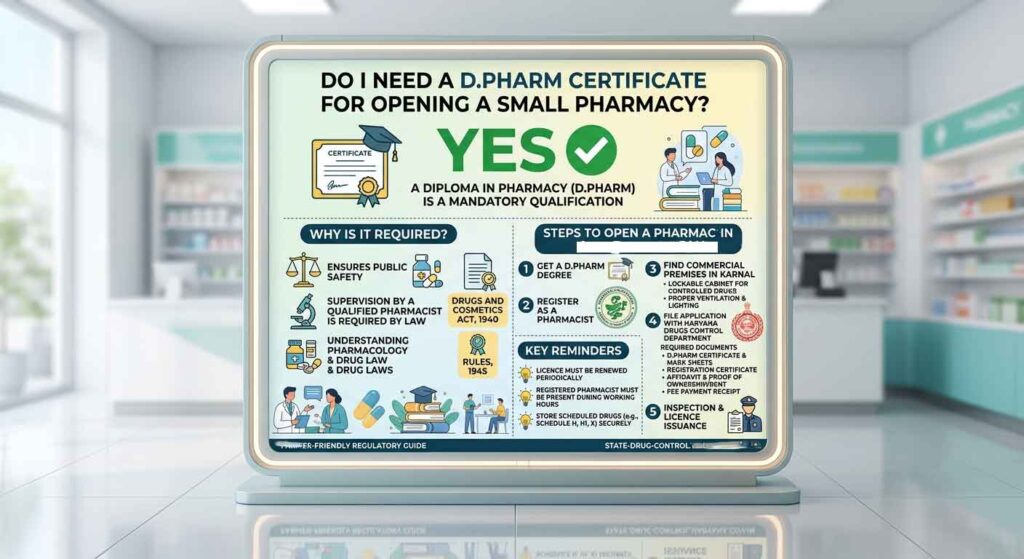
You personally do not always need to have D.Pharm if you employ a registered pharmacist, but a normal pharmacy store must have a registered pharmacist for dispensing medicines.
A pharmacy may be small or large, but the requirement of a registered pharmacist is important for retail sale of medicines.
What Is D.Pharm?
D.Pharm means Diploma in Pharmacy.
It is a pharmacy qualification that can help a person become eligible for registration as a pharmacist, subject to completion of required course, practical training, examination, and registration with the State Pharmacy Council.
But only passing D.Pharm is not enough. To work as a pharmacist, the person should also be registered with the concerned State Pharmacy Council.
Is D.Pharm Compulsory for Opening a Pharmacy?
If you want to personally work as the pharmacist in your own pharmacy, then you need a recognized pharmacy qualification such as:
D.Pharm
B.Pharm
Pharm.D
Other qualification approved for pharmacist registration
After qualification, you must register with the State Pharmacy Council.
If you are not a pharmacist, you can still own the pharmacy business, but you must employ a registered pharmacist to supervise dispensing and sale of medicines as required.
Can a Non-Pharmacy Background Person Open a Pharmacy?
Yes, a person from a non-pharmacy background can start a pharmacy business.
For example, a businessman, engineer, retired professional, trader, or entrepreneur may open a pharmacy store.
But he or she must fulfill licence requirements and appoint a registered pharmacist for the pharmacy.
So, ownership and pharmacist qualification are two different things.
The owner may be non-pharma, but the dispensing and professional pharmacy work should be handled by a registered pharmacist.
Small Pharmacy vs Big Pharmacy: Is Rule Different?
No. Whether the pharmacy is small or large, the basic licensing requirement remains important.
Even a small pharmacy needs:
Retail drug licence
Registered pharmacist
Suitable premises
Proper storage
Purchase and sale records
Prescription handling
Compliance with drug rules
Proper billing system
A small size of business does not remove the need for a registered pharmacist.
Can I Open Pharmacy Without D.Pharm?
Yes, you can open a pharmacy without personally having D.Pharm if you appoint a registered pharmacist.
In this case:
You may be the owner of the business.
The registered pharmacist will be the qualified person in charge.
The pharmacist’s documents will be submitted with the licence application.
The pharmacist should be available as per licence conditions.
This is a common model for non-pharma entrepreneurs.
Can I Run the Pharmacy Myself Without Pharmacist Registration?
No. If you are not a registered pharmacist, you should not personally dispense prescription medicines or act as the pharmacist.
You may manage business activities such as:
Investment
Accounts
Purchase planning
Staff management
Business promotion
Store operations
But professional dispensing work should be done by the registered pharmacist.
Eligibility for D.Pharm Admission
For D.Pharm admission, the basic requirement is generally 10+2 science stream with:
Physics
Chemistry
Biology or Mathematics
So, a student who has completed 12th with PCM may be eligible for D.Pharm admission, subject to admission rules of the state, institute, and pharmacy council requirements.
For example, if a person has passed 12th with Physics, Chemistry, and Mathematics, he or she may apply for D.Pharm admission.
Can an Engineer Do D.Pharm?
Yes. If an engineer has passed 10+2 science with required subjects, he or she may be eligible for D.Pharm admission.
A B.E. or engineering degree does not replace pharmacy qualification, but it also does not stop a person from taking admission in D.Pharm if basic eligibility is fulfilled.
For example, a B.E. Electronics and Telecommunication engineer with 12th PCM background may be eligible to apply for D.Pharm.
D.Pharm Certificate vs Pharmacist Registration
This is very important.
Only having a D.Pharm certificate is not enough to act as a pharmacist.
You need:
D.Pharm or other approved pharmacy qualification
Completion of practical training, where applicable
Passing required examination
Registration with State Pharmacy Council
Valid pharmacist registration certificate
Only after registration can a person work as a registered pharmacist.
Documents Required for Opening Pharmacy Store
The exact documents may vary by state, but commonly required documents include:
Application form
Government fee
Proprietor, partner, or director ID proof
Premises ownership proof or rent agreement
Site plan and key plan
Registered pharmacist qualification certificate
Pharmacist registration certificate
Pharmacist appointment letter
Pharmacist affidavit or declaration
Refrigerator purchase bill, if required
Electricity bill
Constitution of firm
GST registration, where applicable
Passport-size photographs
Affidavits and declarations
Inspection documents
Always confirm the latest checklist from your State Drug Control Department or local Drug Inspector office.
Area Required for Pharmacy Store
For a retail pharmacy, a minimum area of around 10 square metres is commonly required.
If you want to apply for both retail and wholesale drug licence at the same premises, around 15 square metres may be required.
Final approval depends on the State Drug Licensing Authority and premises inspection.
Basic Steps to Open a Small Pharmacy
Step 1: Decide Business Structure
You can start as:
Proprietorship
Partnership firm
LLP
Private Limited Company
For a small pharmacy, proprietorship is commonly used.
Step 2: Arrange Suitable Premises
The premises should be clean, accessible, properly constructed, and suitable for medicine storage.
It should have:
Proper racks
Counter
Storage space
Refrigerator, if required
Electricity
Clean environment
Protection from heat, sunlight, moisture, and pests
Step 3: Arrange Registered Pharmacist
If you are not a registered pharmacist, appoint one.
Collect pharmacist documents such as:
Qualification certificate
Registration certificate
ID proof
Photograph
Appointment letter
Declaration or affidavit
Step 4: Apply for Retail Drug Licence
Apply to the State Drug Licensing Authority through the local drug department or online portal.
Common retail licences include Form 20 and Form 21 for allopathic medicines, depending on drug category.
Step 5: Inspection by Drug Inspector
The Drug Inspector may inspect your premises and verify:
Area
Storage
Pharmacist documents
Refrigerator
Records system
Premises suitability
Licence application details
Step 6: Receive Licence Approval
After approval, you can start pharmacy business as per licence conditions.
Step 7: Maintain Proper Records
After opening the pharmacy, maintain:
Purchase bills
Sale invoices
Prescription records
Schedule H/H1 records, where applicable
Expiry records
Stock register
Return and replacement records
Refrigerator temperature records, if applicable
Important Responsibilities of a Pharmacy Owner
A pharmacy owner should ensure:
Medicines are purchased only from licensed suppliers.
Prescription medicines are sold as per rules.
Registered pharmacist is available as required.
Expired medicines are not sold.
Cold-chain products are stored properly.
Sale bills are issued.
Records are maintained.
Drug licence is displayed.
Changes in pharmacist or constitution are informed to authority.
Should You Do D.Pharm or Hire Pharmacist?
This depends on your long-term plan.
If You Want to Personally Handle Pharmacy
You should do D.Pharm, B.Pharm, or another approved course and get registered as a pharmacist.
This is better if you want to build your career in pharmacy and remain directly involved in dispensing.
If You Want to Invest and Manage Business
You can hire a registered pharmacist and focus on business management.
This is better if you already have another profession or do not want to spend years completing pharmacy education.
Practical Advice for a Non-Pharma Entrepreneur
If you are from IT, engineering, trading, or any other non-pharma background, first understand the pharmacy business before investing.
You should learn:
Medicine categories
Prescription handling
Generic and branded medicines
Expiry and replacement system
Stock management
Retail margins
Billing software
Cold-chain storage
Local competition
Doctor and patient demand
Legal compliance
A pharmacy business looks simple from outside, but it requires discipline and compliance.
Common Mistakes to Avoid
Avoid these mistakes while starting a small pharmacy:
Opening pharmacy without registered pharmacist
Using another person’s pharmacist certificate without actual supervision
Selling medicines without prescription where prescription is required
Not maintaining bills and records
Buying medicines from unauthorized sources
Overstocking slow-moving medicines
Not checking expiry dates
Ignoring refrigerator and storage requirements
Running wholesale activity from retail-only licence
Not informing authority about pharmacist change
Final Answer
For opening a small pharmacy, you do not necessarily need to personally hold a D.Pharm certificate if you employ a registered pharmacist.
But if you want to work as the pharmacist yourself, you must complete an approved pharmacy qualification such as D.Pharm or B.Pharm and register with the State Pharmacy Council.
A person with 12th PCM is generally eligible for D.Pharm admission. Therefore, even if you are a B.E. engineer with IT experience, you may apply for D.Pharm if you meet the admission criteria.
The best approach is:
Either become a registered pharmacist yourself or appoint a registered pharmacist before applying for a retail drug licence.
Frequently Asked Questions
1. Do I need D.Pharm to open a small pharmacy?
You personally need D.Pharm only if you want to become the registered pharmacist. Otherwise, you can appoint a registered pharmacist.
2. Can a non-pharma person open a medical store?
Yes, a non-pharma person can own a medical store, but a registered pharmacist is required for dispensing and pharmacy supervision.
3. Is registered pharmacist compulsory for retail pharmacy?
Yes, for a normal retail pharmacy, registered pharmacist supervision is required.
4. Is D.Pharm certificate enough to run pharmacy?
No. After D.Pharm, registration with the State Pharmacy Council is required to work as a registered pharmacist.
5. Am I eligible for D.Pharm after 12th PCM?
Yes, 10+2 science with Physics, Chemistry, and Mathematics may make you eligible for D.Pharm admission, subject to institute and state admission rules.
6. Can an engineer do D.Pharm?
Yes, an engineer can do D.Pharm if he or she meets the basic 10+2 science eligibility criteria.
7. Can I hire a pharmacist and open pharmacy?
Yes, you can hire a registered pharmacist and apply for a retail drug licence.
8. What area is required for a pharmacy store?
A retail pharmacy generally requires around 10 square metres of premises area. Combined retail and wholesale may require around 15 square metres.
9. Which licence is required for pharmacy store?
Retail drug licence is required. Common forms include Form 20 and Form 21, depending on drug category.
10. Can I sell medicines without pharmacist?
No. Prescription medicine dispensing should be done by or under the personal supervision of a registered pharmacist.
Looking for Ayurvedic Franchise or Distribution Opportunities?
Looking to start an Ayurvedic franchise, become a distributor, or launch your own herbal product range?
Elzac Herbal India offers:
Ayurvedic & Herbal Product Range
Franchise & Distribution Opportunities
Third-Party Manufacturing
Product Development Support
Marketing Guidance
PAN India Business Opportunities
Whether you are an entrepreneur, retailer, distributor, or healthcare professional, our team can help you explore the right business opportunity in the growing Ayurvedic sector.
Ajay Kamboj is an entrepreneur and business owners associated with many Ayurvedic and Pharmaceutical start-ups. With years of experience in Ayurvedic product marketing, pharmaceutical distribution, franchise development, and client relationship management, he regularly shares practical business insights based on real-world experiences. His articles focus on business growth, entrepreneurship, customer management, and lessons learned from the healthcare and wellness industry.