Fertilizer and insecticide businesses form an important part of India’s agricultural-input sector.
An entrepreneur may start:
A fertilizer retail shop
A fertilizer wholesale or distribution business
An insecticide and pesticide retail shop
An insecticide distribution agency
A commercial pest-control business
A fertilizer mixing or manufacturing unit
A biofertilizer or organic-fertilizer unit
An insecticide formulation unit
A technical-grade pesticide manufacturing facility
A combined agricultural-input shop
These activities do not have the same licensing requirements.
The correct procedure is:
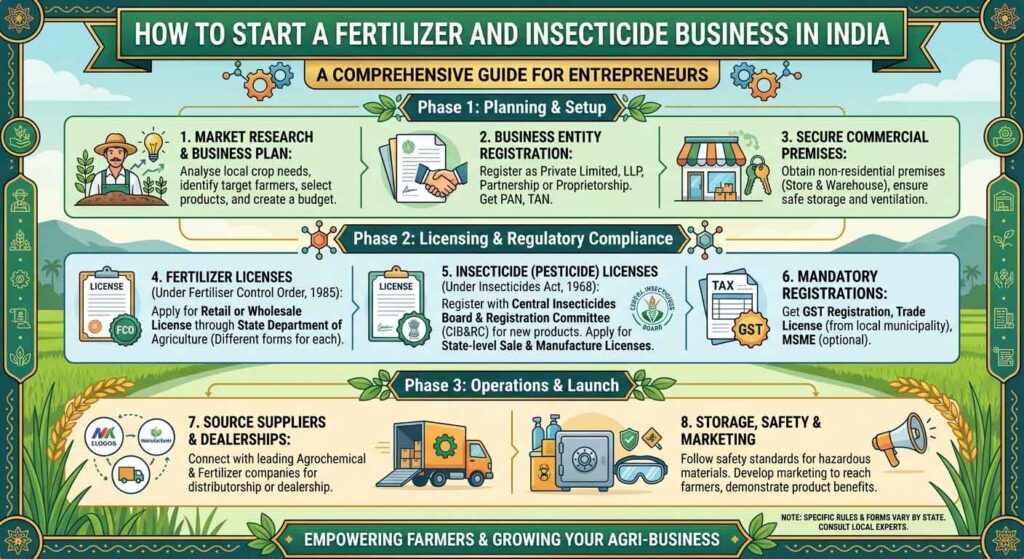
Select the business activity → Classify the proposed products → Register the business entity → Arrange suitable premises → Appoint qualified technical personnel → Obtain manufacturer or supplier authorizations → Apply to the appropriate licensing authority → Install safe storage and record systems → Begin sale or manufacture only after approval
Profitability is not guaranteed. Actual results depend on:
Agricultural demand
Crop seasons
Product mix
Dealer competition
Credit recovery
Expired stock
Government price controls
Product quality
Weather and crop conditions
Fertilizers and Insecticides Are Regulated Separately
Insecticides and Pesticides
Insecticides are regulated under:
The Insecticides Act, 1968
The Insecticides Rules, 1971
Subsequent amendments
Product-specific registration conditions
State licensing procedures
The term may cover notified:
Insecticides
Fungicides
Herbicides
Weedicides
Rodenticides
Fumigants
Plant-protection chemicals
Certain biological pesticides
No person may manufacture, sell, stock, exhibit for sale, distribute or commercially use a regulated insecticide without the applicable licence.
Fertilizers
Fertilizer sale and manufacture are mainly regulated under:
The Essential Commodities Act, 1955
The Fertiliser (Control) Order, 1985
Central amendments
State-government notifications and procedures
The FCO regulates matters such as:
Product specifications
Manufacture
Sale
Distribution
Sampling
Labelling
Packing
Dealer authorization
Quality-control laboratories
Fertilizer inspectors
Decide Which Business You Want to Start
1. Insecticide Retail Shop
The shop sells registered insecticides directly to:
Farmers
Agricultural users
Pest-management customers
Other legally eligible buyers
It requires an insecticide sale licence for each approved premises.
2. Insecticide Wholesale or Distribution Business
The distributor purchases registered products from licensed manufacturers or authorized suppliers and supplies them to licensed dealers.
It requires:
Sale, stock and distribution licence
Principal certificate from the manufacturer
Qualified technical person
Safe storage
Product-wise endorsement
3. Commercial Pest-Control Operator
A commercial pest-control operator applies insecticides at:
Houses
Offices
Warehouses
Factories
Hotels
Hospitals
Food establishments
Agricultural premises
This activity requires a commercial pest-control licence and qualified personnel.
4. Insecticide Manufacturing Unit
A manufacturer may produce:
Technical-grade pesticide
Formulated insecticide
Biopesticide
Herbicide
Fungicide
Rodenticide
Household insecticide
The product must first have the applicable registration with the Registration Committee.
5. Fertilizer Retail Shop
A fertilizer retailer sells fertilizers to farmers and agricultural users.
It requires the applicable Form A2 authorization and, for new retail applicants, the prescribed educational qualification or training.
6. Fertilizer Wholesaler
A wholesaler purchases fertilizer from manufacturers, importers or approved suppliers and supplies retail dealers.
A separate Form A1 memorandum and Form A2 authorization are required for wholesale activity.
7. Fertilizer Manufacturing Unit
Depending on the project, a unit may manufacture or prepare:
Physical mixtures
Granulated mixtures
Micronutrient mixtures
Organic fertilizers
Biofertilizers
Special mixtures
Notified fertilizer products
The product must conform to the applicable FCO specifications.
Product Registration vs Business Licence
These two approvals should not be confused.
Product Registration
Product registration establishes that a particular insecticide formulation or technical product is approved for manufacture or import subject to specified conditions.
It is handled by the Central Insecticides Board and Registration Committee framework.
Business Licence
The state licence authorizes a particular business and premises to:
Manufacture
Sell
Stock
Distribute
Use insecticides commercially
A registered insecticide cannot be manufactured or sold from an unlicensed premises.
Similarly, holding a dealer licence does not authorize the dealer to introduce an unregistered pesticide product.
Registration of an Insecticide Product
An application for registration of an insecticide is made in:
Form I
The application is submitted to the Registration Committee under the Central Insecticides Board and Registration Committee system.
The application may require data concerning:
Composition
Technical source
Manufacturing process
Specifications
Analytical methods
Storage stability
Shelf life
Toxicology
Bio-efficacy
Residues
Packaging
Proposed labels and leaflets
First-aid and safety instructions
The current Form I requires information on composition, storage stability, toxicity, bio-effectiveness, specifications, analytical reports, packing and proposed labels.
Insecticide Registration Certificates
Form II
Form II is the certificate for provisional registration under section 9(3B).
A provisional certificate is generally granted for the specified provisional period, commonly two years as stated in the certificate.
Form III
Form III is the regular certificate of registration.
Does a Dealer Need to Register Every Product With CIBRC?
No.
A retail or wholesale dealer does not ordinarily obtain a fresh central product registration for products already registered by their manufacturer or registrant.
The dealer must obtain:
State sale licence
Product-wise endorsement
Valid principal certificate
Products from authorized sources
The registration number of each insecticide should appear in the licence and supporting documents.
Insecticide Manufacturing Licence
An insecticide manufacturer requires two important approvals:
Product registration
State manufacturing licence
Application Form
The current application for a manufacturing licence is:
Form V
Manufacturing Licence
The licence is issued in:
Form VI
Separate Licence for Each Manufacturing Location
A separate application is required for every manufacturing premises.
A licence issued for one factory does not automatically cover:
Another factory
Contract premises
Repacking unit
Additional warehouse
Branch manufacturing site
Qualification for Insecticide Manufacturing
Under the 2015 amendment, the applicant should possess or employ the prescribed technical expert.
For technical-grade pesticide manufacture, the prescribed route includes:
Master’s degree in Chemistry with a doctorate, or
Graduate degree in Chemical Engineering
For pesticide formulation manufacture, the prescribed route includes:
Graduate degree in Agricultural Science with Chemistry
The State Licensing Authority may request further manufacturing, quality-control and safety personnel according to the products and processes.
Manufacturing Requirements
The plant should provide adequate facilities for:
Raw-material receipt
Quarantine
Approved-material storage
Manufacturing
In-process control
Filling and packing
Finished-product storage
Rejected products
Expired products
Quality control
Waste treatment
Personnel decontamination
Emergency response
Important Manufacturing Approvals
Depending on the project, approvals may include:
Insecticide product registration
State manufacturing licence
Consent to Establish
Consent to Operate
Environmental clearance where applicable
Factory-plan approval
Factory licence
Fire NOC
Hazardous-waste authorization
Electrical approval
Boiler or pressure-vessel approval
Groundwater permission
GST registration
Legal Metrology compliance
BIS certification where applicable
ISI or BIS Requirement
Form VI includes a condition requiring the licensee to obtain the applicable ISI-mark certificate from the Bureau of Indian Standards within the prescribed period after commencement of manufacture and prohibits sale without the required certification.
The exact BIS standard and current compulsory-certification position should be verified product-wise before commercial production.
Machinery and Safety
A manufacturing unit may require:
Mixing or formulation vessels
Reactors
Mills
Blenders
Filling equipment
Sealing equipment
Ventilation
Fume extraction
Dust control
Solvent-handling systems
Effluent-treatment plant
Fire-protection systems
Emergency showers
Spill-control equipment
Personal protective equipment
The machinery list should be prepared according to the exact product and production process.
Insecticide Sale, Stock and Distribution Licence
Application Form
An application to sell, stock, exhibit for sale or distribute insecticides is currently made in:
Form VII
Licence Form
The licence is issued in:
Form VIII
The same form framework also covers the licence for stocking and using insecticides in commercial pest-control operations.
Principal Certificate
The applicant must ordinarily obtain a principal certificate from the manufacturer or principal.
The current principal-certificate format is:
Form IX
It identifies:
Manufacturer
Manufacturing premises
Manufacturing licence
Registered insecticides
Authorized dealer
Area of operation
Approved source of supply
Validity
A dealer should purchase only through the source identified in the principal certificate.
Qualification for an Insecticide Dealer
The applicant must possess or employ a person possessing an eligible graduate degree.
The current central rule identifies qualifications such as:
Agricultural Sciences
Biochemistry
Biotechnology
Life Sciences
Science with Chemistry
Science with Botany
Science with Zoology
The technical person should be:
Regularly employed
Available at the licensed premises
Properly documented
Familiar with product use and safety
Approved by the Licensing Authority
The detailed state checklist should be verified before recruitment.
Can a Person Without an Agriculture Degree Own the Business?
Yes.
The proprietor, partner or director does not necessarily need to hold the prescribed technical qualification personally.
The business may employ an eligible full-time technical person.
However, the qualification should not exist only on paper.
Avoid:
Borrowing a qualification certificate
Showing an employee who works elsewhere
Submitting a false appointment letter
Operating without the approved person
Allowing untrained sales staff to recommend hazardous products
Dealer Premises
The premises should be:
Legally usable
Secure
Dry
Ventilated
Protected from direct sunlight
Suitable for chemical storage
Away from food and animal-feed contamination
Equipped with safety arrangements
Accessible for inspection
Separate licences are normally required for separate sale or storage locations.
Insecticide Dealer Documents
The state checklist may require:
Form VII
Prescribed fee
PAN
Aadhaar or identity proof
Business-entity documents
GST certificate
Ownership proof or rent agreement
Owner’s NOC
Site plan
Location plan
Municipal or panchayat NOC
Technical-person qualification
Appointment letter
List of products
Form IX principal certificate
Manufacturer’s registration certificates
Storage details
Safety-equipment list
Photographs
Affidavits or declarations
Licence Validity and Renewal
A manufacturing licence based on provisional product registration expires when the provisional registration expires.
State portals and state administrative procedures should still be checked for:
Retention requirements
Product endorsements
Amendments
Technical-person changes
Premises changes
Pest-control renewal
Annual Compliance
Manufacturers and dealers licensed under Rules 9 and 10 are required to submit an annual self-certification in:
Form X
The Licensing Officer is required to inspect infrastructure, premises, stock and records at least once every two years.
Insecticide Registers
Important records include:
Form XI
Register of date-expired pesticides.
Form XII
Insecticide-wise register for sale and distribution, including products used in commercial pest-control operations.
The records should include:
Receipt date
Manufacturer
Supplier
Batch number
Manufacturing date
Expiry date
Invoice
Quantity received
Quantity sold
Closing balance
Expired Insecticides
Expired insecticides should:
Be removed from saleable stock
Be clearly identified
Be stored separately
Be entered in Form XI
Not be sold or used
Be returned or disposed of through the approved process
Do not:
Alter expiry labels
Mix expired stock with saleable stock
Sell it at a discount
Dispose of it in drains, fields or ordinary waste
Commercial Pest-Control Operator Licence
A commercial pest-control operator must apply in:
Form VII
The licence is issued in:
Form VIII
The business should maintain:
Qualified technical supervision
Approved products
Safety equipment
Antidotes
Application equipment
Chemical-use records
Employee health and training records
Customer treatment records
Pest-Control Operator Qualification
The Rules traditionally require the person applying for commercial pest-control operations to possess:
Graduation in Agriculture, or
Graduation in Science with Chemistry
along with a minimum 15-day training certificate from an approved institution.
State authorities may request updated course and institution details, so the applicant should confirm the accepted qualification before joining a training programme.
Fumigation Permission
Pest-control operators undertaking fumigation require special technical approval from the Plant Protection Adviser to the Government of India in addition to the state pest-control licence.
Restricted fumigants should not be purchased, stored or used merely on the basis of an ordinary pest-control licence.
Pest-Control Safety
The operator should provide:
Respirators
Gloves
Protective clothing
Goggles
First-aid kit
Antidote information
Spill kit
Warning signs
Calibrated equipment
Secure chemical transport
Emergency contact system
Employees should receive:
Product training
Exposure training
First-aid training
Equipment training
Medical surveillance where required
Fertilizer Business Regulatory Framework
Fertilizer business is governed through the Fertiliser (Control) Order, 1985 under the Essential Commodities Act.
The FCO prohibits unauthorized sale and regulates:
Dealers
Manufacturers
Importers
Fertilizer quality
Product standards
Packing
Labelling
Prices
Sampling
Enforcement
Fertilizer Dealer Authorization
A person intending to sell fertilizer as a wholesaler or retailer generally submits:
Form A1 – Memorandum of Intimation
It is accompanied by:
Prescribed state fee
Certificate of source in Form O
Supporting documents
After verification, the Notified Authority issues:
Form A2 – Acknowledgement
Form A2 is treated as the authorization letter for the fertilizer dealership.
Separate Wholesale and Retail Authorizations
A separate Form A1 is required for:
Wholesale dealership
Retail dealership
A wholesale authorization does not automatically authorize retail sale to farmers.
Similarly, a retail authorization does not automatically permit wholesale distribution.
Certificate of Source: Form O
Form O is issued by an approved source such as:
Manufacturer
Importer
Pool-handling agency
Eligible wholesaler
The dealer must obtain source certificates covering the fertilizers proposed to be sold.
Where fertilizer is purchased from several sources, a Form O may be required from every applicable source.
Retail Fertilizer Dealer Qualification
For a new retail fertilizer dealership, the applicant must generally possess a 15-day certificate course from an approved institution such as:
State Agricultural University
Krishi Vigyan Kendra
MANAGE
NIRDPR
Fertilizer Association of India
Another approved government institution
A separate certificate course is generally not required where the person possesses:
B.Sc. Agriculture
B.Sc. Chemistry
Diploma in Agricultural Science
Equivalent notified course containing fertilizer or agricultural-input subjects
This qualification rule was confirmed by the Ministry of Agriculture and Farmers Welfare in a Lok Sabha answer dated 18 March 2025.
Can a Technical Person Be Employed?
State procedures may permit the qualification requirement to be met through an eligible employed person in specified cases.
The concerned state’s rules and portal checklist should be verified before appointing a technical employee.
Fertilizer Authorization Validity
Current state implementations commonly issue Form A2 authorization for a defined period, often five years, followed by renewal.
Exact:
Validity
Fee
Renewal period
Late fee
Processing authority
may differ between states.
For example, Goa’s current procedure specifies a five-year validity for the Form A2 authorization.
Documents for Fertilizer Dealership
Common documents may include:
Form A1
Form O
Prescribed fee
PAN
Aadhaar
Entity documents
GST registration
Qualification or training certificate
Ownership proof
Rent or lease agreement
Owner’s NOC
Local-body trade licence
Site plan
Storage details
Passport photographs
Bank details
Manufacturer or supplier authorization
Kerala’s official checklist includes Form A1, Form O, qualification records, local-body licence, premises documents and building-suitability verification.
Fertilizer Shop Requirements
The shop should have:
Adequate covered storage
Dry flooring
Protection from rain
Ventilation
Pallets
Separate damaged-stock area
Proper stock records
Price and stock displays
Weighing equipment
Safe loading and unloading
Fertilizer bags should not be stored:
Directly on wet floors
Near food products
Near animal feed
Beside drinking water
In residential rooms
In areas exposed to rain
With incompatible pesticides without segregation
Fertilizer Dealer Records
Maintain:
Purchase invoices
Sale invoices
Stock register
Product-wise opening stock
Receipts
Sales
Closing stock
Supplier details
Form O certificates
Batch or lot details
Price records
Customer or farmer bills
Monthly reports where required by the state
Fertilizer Manufacturing
Fertilizer manufacturing requirements depend on the exact product.
The business may involve:
Straight fertilizer manufacture
Physical mixtures
Granulated mixtures
Micronutrient mixtures
Organic fertilizer
Biofertilizer
Special mixture
Biostimulant
Import or repacking
The product must be recognized or included under the FCO and must comply with the notified composition and quality standards.
Form D
Form D is used to apply for a certificate of manufacture for applicable categories such as:
Physical or granulated fertilizer mixtures
Organic fertilizer
Biofertilizer
Applicable micronutrient mixtures
The certificate is ordinarily granted in:
Form F
Official state portals continue to use Form D for fertilizer-manufacturing applications.
Form E
Form E is used for an application to manufacture a special mixture of fertilizers based on the purchaser’s specific requisition.
The certificate is issued in:
Form G
Form E requires details of the special mixture, purchaser’s requisition, applicant’s qualification and laboratory facilities.
Qualification for Fertilizer Manufacturing
The person preparing fertilizer mixtures should possess the qualification prescribed by the State Government or operate under the direction and supervision of an eligible person.
The manufacturing unit must also possess the prescribed minimum laboratory facilities.
Qualification and laboratory requirements therefore need to be verified with the concerned state authority before machinery is purchased.
Fertilizer Manufacturing Documents
The application may require:
Form D or Form E
Fee receipt
Legal-entity documents
Land or lease documents
Site plan
Factory layout
Machinery list
Process-flow chart
Product composition
Raw-material sources
Laboratory-equipment list
Technical-person qualification
Appointment letter
Analysis report
Pollution Control Board approvals
Factory approval
Fire NOC
Water and power details
Packing details
Label design
Quality-control procedures
Laboratory Requirements
Depending on the product, testing may include:
Nitrogen
Phosphorus
Potassium
Micronutrients
Moisture
pH
Particle size
Organic carbon
Microbial count
Viable-cell count
Contamination
Heavy metals
Product-specific parameters
The testing facility should match the FCO specifications of the products manufactured.
Organic Fertilizers and Biofertilizers
The word “organic” does not create an exemption from the FCO.
Retailers and traders selling regulated organic fertilizers must obtain authorization under Clause 8.
Manufacturers should verify:
Product inclusion in the FCO
Composition
Raw materials
Process
Laboratory requirements
Packing and label
State authorization
The Ministry of Agriculture has confirmed that traders and retailers selling organic fertilizers must obtain the applicable state authorization.
Biostimulants and Unlisted Agricultural Products
A product should not be introduced merely as:
Bio-product
Herbal pesticide
Plant tonic
Crop booster
Organic growth promoter
to avoid regulation.
Where the product makes fertilizer or plant-nutrition claims, the FCO may apply.
Where it makes pesticidal, fungicidal, herbicidal or insect-control claims, the Insecticides Act may apply.
Novel biostimulants may require the applicable central inclusion, registration or provisional-approval route before manufacture and sale.
Combined Fertilizer and Insecticide Shop
A combined agricultural-input shop requires separate approvals for:
Fertilizer retail or wholesale activity
Insecticide retail or wholesale activity
One licence does not replace the other.
The premises should provide controlled segregation between:
Fertilizers
Pesticides
Seeds
Food
Animal feed
Household goods
Seeds
A fertilizer or insecticide licence does not authorize seed sale.
Where seeds are also sold, the business must comply separately with:
Seeds Act
Seeds Rules
Seeds Control Order
State seed-dealer licensing procedure
Business-Entity Registration
The business may operate as:
Proprietorship
Partnership
LLP
Private Limited Company
Common registrations include:
PAN
Current bank account
GST
Shop and Establishment registration
Municipal trade licence
Udyam registration
Trademark
Factory registration
Pollution approvals
GST on Fertilizers and Pesticides
GST must be checked product-wise.
As of July 2026:
Fertilizers under the applicable Chapter 31 entries generally attract 5% GST.
Specified bio-pesticides and several FCO micronutrients were reduced from 12% to 5% from 22 September 2025.
Many conventional chemical pesticides under HSN 3808 generally remain subject to the applicable higher rate, commonly 18%.
Products not actually used or classified as fertilizers may attract a different rate.
The exact HSN should be verified from the product composition and notified entry.
Step-by-Step Procedure for an Insecticide Dealership
Step 1: Select the Business Model
Choose retail, wholesale, distribution or pest-control activity.
Step 2: Register the Business
Establish a proprietorship, partnership, LLP or company.
Step 3: Finalize the Premises
Confirm commercial use, safe storage and state requirements.
Step 4: Arrange the Technical Person
Appoint a person with the qualification accepted under Rule 10.
Step 5: Obtain Principal Certificates
Collect Form IX from manufacturers or approved principals.
Step 6: Prepare the Product List
List every registered insecticide proposed to be sold.
Step 7: Apply in Form VII
Submit the application and state-specific documents.
Step 8: Complete Inspection
The licensing authority may inspect:
Premises
Storage
Safety equipment
Technical person
Source documents
Product registration
Step 9: Obtain Form VIII
Do not begin sale before the licence is granted.
Step 10: Maintain Records
Maintain product-wise stock, sale and expiry registers.
Step-by-Step Procedure for a Fertilizer Dealership
Step 1: Select Retail or Wholesale
Separate authorization is needed for each category.
Step 2: Complete Required Training
A new retail applicant should obtain the required qualification or 15-day certificate.
Step 3: Select the Premises
Arrange dry, suitable and inspected storage.
Step 4: Obtain Form O
Collect a source certificate from every relevant approved supplier.
Step 5: Apply in Form A1
Submit the Memorandum of Intimation with fee and supporting documents.
Step 6: Complete Verification
The Agriculture Department may verify:
Premises
Qualification
Supplier
Storage
Business documents
Step 7: Obtain Form A2
Form A2 acts as the authorization letter.
Step 8: Maintain Stock and Price Records
Issue proper bills and comply with inspection and reporting requirements.
Step-by-Step Procedure for Insecticide Manufacturing
Select the technical or formulation product.
Confirm whether the product is already registered.
Obtain or arrange product registration.
Prepare the industrial project report.
Select a suitable hazardous-process location.
Obtain environmental and factory approvals.
Design manufacturing, QC and safety areas.
Recruit qualified technical staff.
Install machinery and laboratory equipment.
Apply in Form V.
Complete licensing inspection.
Obtain Form VI.
Complete applicable BIS requirements.
Manufacture only approved products.
Maintain Form X, XI and XII records.
Step-by-Step Procedure for Fertilizer Manufacturing
Select the fertilizer category.
Confirm inclusion and specifications under the FCO.
Prepare the formula and process.
Select an industrial site.
Obtain pollution, factory and fire approvals.
Recruit the prescribed qualified person.
Install machinery and laboratory facilities.
Apply in Form D or Form E as applicable.
Complete inspection and product testing.
Obtain Form F or Form G.
Obtain dealer authorization for sale where applicable.
Manufacture, pack and label according to FCO standards.
Investment Required
There is no fixed statutory investment.
Broad planning ranges may be:
Business model
Illustrative investment
Small fertilizer retail shop
₹5–15 lakh
Combined fertilizer and pesticide shop
₹10–30 lakh
Wholesale agricultural-input distributor
₹25 lakh–₹1 crore or more
Small pest-control operator
₹5–20 lakh
Biofertilizer or organic-fertilizer unit
₹40 lakh–₹3 crore or more
Fertilizer mixing or granulation unit
₹75 lakh–₹5 crore or more
Insecticide formulation unit
₹2–15 crore or more
Technical-grade pesticide plant
Project-specific; substantially higher
These are business-planning estimates—not government-prescribed minimums.
Working-Capital Formula
Working Capital
=
Opening Inventory
+ Customer Credit
+ Seasonal Stock
+ Operating Expenses
+ Expiry Reserve
− Supplier Credit
Seasonal-Credit Risk
Agricultural-input businesses often provide credit until:
Crop sale
Harvest
Government procurement
Dealer collection
Sales should not be treated as profit until payment is collected.
Maintain:
Customer credit limits
Due dates
Outstanding reports
Cheque-return controls
Crop-season collection plans
Common Mistakes
Avoid:
Calling fertilizer business automatically more profitable than pharma
Using outdated insecticide forms
Applying to a state committee for central insecticide registration
Selling an unregistered pesticide
Starting sale before obtaining Form VIII
Selling fertilizer without Form A2
Operating retail and wholesale under one fertilizer authorization
Appointing a technical person only on paper
Buying from an unauthorized source
Ignoring Form IX or Form O
Mixing pesticide stock with food or animal feed
Selling expired insecticides
Marketing an unapproved product as a bio-product
Making pesticidal claims for an FCO-only product
Ignoring pollution and fire approvals
Assuming every agricultural input attracts 5% GST
Giving uncontrolled seasonal credit
Frequently Asked Questions
1. Which licence is required to sell insecticides?
Apply in Form VII. The licence is issued in Form VIII.
2. Which form is used for insecticide manufacturing?
The current manufacturing application is Form V, and the licence is issued in Form VI.
3. Is CIBRC registration required for a dealer?
The dealer does not ordinarily register already-approved products again but must obtain a state sale licence, product endorsement and valid principal certificate.
4. What is Form IX?
Form IX is the principal certificate issued by the manufacturer to authorize the dealer or distributor.
5. Which qualification is required for an insecticide shop?
The applicant must possess or employ a graduate with an eligible agriculture, life-science, biotechnology, biochemistry, chemistry, botany or zoology qualification accepted by the authority.
6. Can a non-graduate own an insecticide shop?
Yes, provided the business employs an eligible full-time technical person accepted by the Licensing Authority.
7. Which licence is required for pest-control business?
Commercial pest-control operations require application in Form VII and licence in Form VIII, along with the prescribed qualification and training.
8. Is separate permission required for fumigation?
Yes. Special approval from the Plant Protection Adviser is required for applicable fumigation activity.
9. Which form is required for a fertilizer dealership?
Submit Form A1 with the prescribed fee and Form O source certificate. Form A2 is issued as the authorization.
10. Is separate fertilizer authorization required for retail and wholesale?
Yes. Separate Memoranda of Intimation and authorizations are required.
11. Which qualification is required for a fertilizer retailer?
A new applicant generally needs the approved 15-day certificate course unless exempt through an eligible agriculture, chemistry or agricultural-science qualification.
12. Is a licence required for organic fertilizer?
Regulated organic fertilizers and biofertilizers fall under the FCO. Manufacturers and sellers require the applicable approvals, subject to any specific exemption.
13. Which forms apply to fertilizer manufacturing?
Form D commonly applies to physical or granulated mixtures, organic fertilizers and biofertilizers, with certificate in Form F. Form E applies to special mixtures, with certificate in Form G.
14. Can fertilizers and pesticides be sold from the same shop?
Yes, when the business has both applicable authorizations and maintains safe, segregated storage.
15. What GST applies?
Fertilizers generally attract 5%. Specified bio-pesticides and micronutrients attract 5%, while many conventional chemical pesticides generally attract 18%. Product-wise HSN verification is necessary.
Final Conclusion
Starting a fertilizer and insecticide business requires two separate compliance paths:
For Insecticides
Registered product → Form IX principal certificate → Qualified technical person → Form VII application → Form VIII sale licence → Safe storage and records
For Fertilizers
Approved fertilizer source → Retail qualification where applicable → Form O source certificate → Form A1 intimation → Form A2 authorization → Stock, price and sale records
For manufacturing:
Insecticide Manufacturing
Product registration → Industrial and environmental approvals → Form V application → Form VI manufacturing licence → Quality, safety and BIS compliance
Fertilizer Manufacturing
FCO product specification → Plant and laboratory → Qualified supervisor → Form D or E application → Form F or G certificate
The final application, fee, validity and document checklist should always be verified with the concerned State Agriculture Department because state portals and administrative procedures differ.
Looking for Ayurvedic Franchise or Distribution Opportunities?
Looking to start an Ayurvedic franchise, become a distributor, or launch your own herbal product range?
Elzac Herbal India offers:
Ayurvedic & Herbal Product Range
Franchise & Distribution Opportunities
Third-Party Manufacturing Services
Product Development Support
Marketing Guidance
PAN India Business Opportunities
Whether you are an entrepreneur, retailer, distributor, or healthcare professional, our team can help you explore the right business opportunity in the growing Ayurvedic sector.
Ajay Kamboj is an entrepreneur and business owners associated with many Ayurvedic and Pharmaceutical start-ups. With years of experience in Ayurvedic product marketing, pharmaceutical distribution, franchise development, and client relationship management, he regularly shares practical business insights based on real-world experiences. His articles focus on business growth, entrepreneurship, customer management, and lessons learned from the healthcare and wellness industry.





Leave a Reply
You must be logged in to post a comment.