Refrigerated drugs are medicines that must be stored and transported within a specified low-temperature range to maintain their quality, stability and potency.
Many refrigerated medicines are stored between:
2°C and 8°C
However, this range does not apply to every temperature-sensitive medicine. Some products may require:
Controlled room temperature
Storage below 25°C
Storage between 8°C and 15°C
Frozen storage below –15°C or –20°C
Ultra-low-temperature storage
Protection from light without refrigeration
Therefore, the approved label, package insert and manufacturer’s instructions should always be treated as the final source for storage conditions.
Quick Answer
Common refrigerated medicine categories include:
Vaccines
Insulins
Antisera and immunoglobulins
Certain monoclonal antibodies
Some hormone injections
Erythropoietin and colony-stimulating factors
Certain blood products
Some fertility medicines
Selected biological medicines
Certain medicines after reconstitution
Some veterinary vaccines and biological products
This is not an exhaustive list. Storage requirements can differ between brands containing the same molecule.
What Is a Refrigerated Drug?
A refrigerated drug is a medicine whose approved storage condition requires it to remain within a controlled refrigerated temperature range, commonly 2°C to 8°C.
These medicines may lose potency or stability when exposed to:
Excessive heat
Freezing
Direct sunlight
Repeated temperature changes
Prolonged storage outside the permitted range
Incorrect transport conditions
Refrigerated medicines are often referred to as:
Cold-chain medicines
Temperature-sensitive medicines
Biological products
Cold-storage medicines
However, these expressions are not always interchangeable. Some temperature-sensitive medicines do not require refrigeration, while some cold-chain products require freezing or ultra-low temperatures.
What Is the Pharmaceutical Cold Chain?
The pharmaceutical cold chain is a temperature-controlled system used to maintain medicines within their approved storage range from manufacture until use.
It may include:
Manufacturing storage
Transport from manufacturer
C&F or depot storage
Distributor storage
Stockist storage
Hospital or pharmacy storage
Last-mile delivery
Storage before administration
The chain must remain controlled at every stage. A well-maintained refrigerator at the wholesaler’s premises cannot correct damage caused by improper transportation before the medicine arrived.
Are All Schedule C Products Refrigerated?
No.
Schedule C under the Drugs Rules covers biological and special products, including categories such as:
Sera
Injectable serum proteins
Vaccines for parenteral use
Toxins
Antigens
Antitoxins
Insulin
Adrenaline preparations
Parenteral antibiotics
Sterile parenteral preparations
Bacteriophages
Ophthalmic preparations
Certain sterile products
However, Schedule C also includes sterile products that do not require refrigerator storage.
Similarly, Schedule C(1) includes certain hormones, vitamins, non-parenteral antibiotics and other special products, many of which may be stored at room temperature.
Therefore:
Schedule classification determines licensing and regulatory treatment; it does not by itself determine the storage temperature.
Always check the product label.
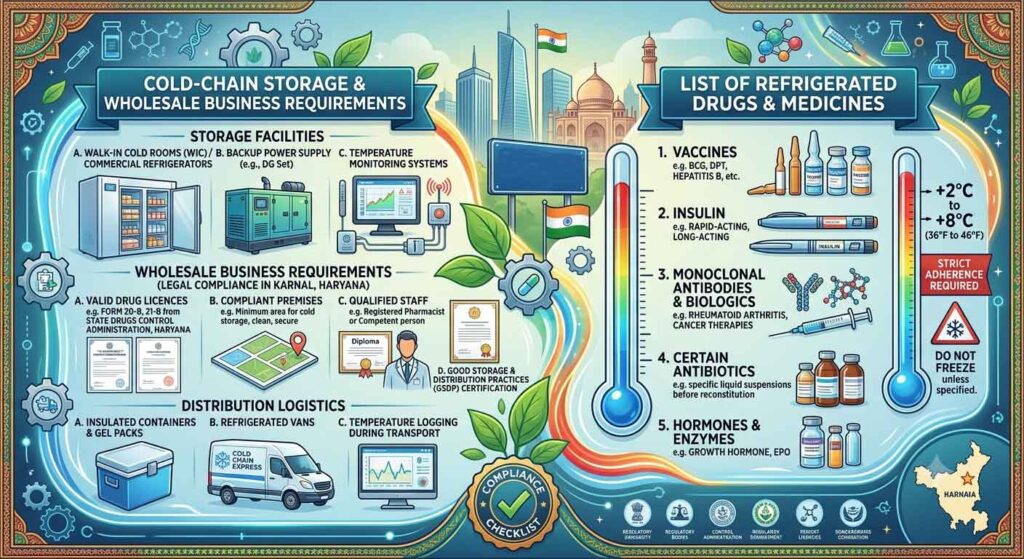
Common List of Refrigerated Drugs and Medicines
The following categories commonly include refrigerated products. The exact brand and presentation must be checked before storage or purchase.
1. Vaccines
Many human vaccines require storage between 2°C and 8°C.
Examples may include vaccines used against:
Hepatitis
Influenza
Tetanus
Diphtheria
Pertussis
Rabies
Human papillomavirus
Pneumococcal disease
Meningococcal disease
Rotavirus
Measles, mumps and rubella
Typhoid
Varicella
Some vaccines may require frozen storage, while freezing can permanently damage other vaccines.
Never assume that two vaccines require the same storage conditions.
2. Veterinary Vaccines
Many veterinary vaccines also require strict cold-chain storage.
These may include vaccines for:
Poultry
Cattle
Sheep and goats
Pigs
Dogs
Cats
Other livestock and companion animals
Some veterinary vaccines may be stored at 2°C to 8°C, while others may require frozen storage.
A veterinary cold-chain distributor should follow the manufacturer’s label and veterinary product documentation.
Many insulin products have separate instructions for storage after opening or once a pen is in use.
The in-use storage period and permitted temperature vary by brand, so a stockist should never generalise the conditions.
4. Antisera and Antitoxins
These products commonly require cold-chain storage.
Examples may include:
Anti-snake venom
Tetanus antitoxin
Diphtheria antitoxin
Rabies immunoglobulin
Other disease-specific antisera
These products are sensitive biological preparations and require careful temperature control.
5. Immunoglobulins
Many immunoglobulin preparations are refrigerated.
Examples may include:
Normal human immunoglobulin
Intravenous immunoglobulin
Rabies immunoglobulin
Hepatitis B immunoglobulin
Tetanus immunoglobulin
Varicella-zoster immunoglobulin
Anti-D immunoglobulin
Storage requirements vary according to formulation and manufacturer.
6. Monoclonal Antibodies and Biosimilars
Many monoclonal antibody products require refrigeration and protection from light.
These may be used in:
Cancer treatment
Rheumatoid arthritis
Inflammatory bowel disease
Psoriasis
Asthma
Autoimmune disorders
Osteoporosis
Neurological disorders
Examples of molecules that commonly have refrigerated presentations may include:
Adalimumab
Trastuzumab
Rituximab
Bevacizumab
Infliximab
Tocilizumab
Denosumab
Omalizumab
Secukinumab
Pembrolizumab
The exact storage condition must be checked for each brand, vial, prefilled syringe or pen.
7. Erythropoietin Products
Erythropoietin and related products commonly require refrigerated storage.
These may include:
Epoetin alfa
Epoetin beta
Darbepoetin alfa
These products may be used in patients with anaemia related to kidney disease, chemotherapy or other clinical conditions.
They should generally be protected from shaking and freezing according to label instructions.
8. Colony-Stimulating Factors
Many colony-stimulating factor injections require refrigeration.
Examples may include:
Filgrastim
Pegfilgrastim
Lenograstim
These products are often used to support white blood cell production.
9. Interferons
Some interferon products require refrigerated storage.
These may include:
Interferon alfa
Interferon beta
Pegylated interferons
Storage requirements vary by formulation and brand.
10. Fertility and Reproductive Hormones
Some fertility products require refrigeration.
Examples may include:
Follicle-stimulating hormone
Human menopausal gonadotropin
Certain human chorionic gonadotropin preparations
Gonadotropin-releasing hormone products
Certain progesterone products
Not every product in these categories requires refrigeration. Some lyophilised or powder presentations may have different conditions before and after reconstitution.
11. Growth Hormone
Many somatropin or human growth hormone products require refrigeration.
Storage may differ between:
Unopened cartridges
Reconstituted products
Prefilled pens
Products currently in use
The product-specific instructions should be followed.
12. Blood-Coagulation Factors
Certain coagulation-factor products require refrigeration.
These may include:
Factor VIII
Factor IX
Von Willebrand factor products
Other plasma-derived or recombinant coagulation products
Some products may allow limited storage at controlled room temperature. Such products should not be returned to refrigerated storage unless the manufacturer permits it.
13. Other Blood-Derived Products
Some blood-derived medicines are temperature sensitive.
These may include:
Albumin products
Plasma protein products
Specific immunoglobulins
Certain clotting-factor concentrates
The storage range varies significantly, so the approved label must be checked.
14. Enzyme-Replacement Therapies
Many enzyme-replacement products are refrigerated.
These are specialised biological products used for certain inherited or metabolic disorders.
They usually require:
Controlled refrigerated storage
Protection from light
Careful handling
Validated transport
15. Injectable Diabetes and Metabolic Medicines
Some injectable medicines used for diabetes or weight management require refrigerated storage before first use.
These may include certain:
GLP-1 receptor agonists
Dual-acting metabolic injections
Prefilled diabetes pens
After first use, some brands may be stored under different conditions for a limited period.
16. Certain Ophthalmic Products
Some eye preparations require refrigeration, but many do not.
Refrigerated ophthalmic products may include:
Certain glaucoma preparations
Selected antibiotic eye preparations
Specially compounded eye drops
Some biologic or injectable ophthalmic products
Certain products after opening or reconstitution
The fact that a product is an eye drop does not automatically mean that it should be refrigerated.
17. Selected Antibiotics After Reconstitution
Some dry syrups, injections and suspensions may require refrigeration after reconstitution.
Examples may include selected:
Antibiotic suspensions
Antifungal suspensions
Injectable preparations
Compounded preparations
Other products may specifically instruct users not to refrigerate.
Always follow the reconstitution and storage instructions printed on the label.
18. Certain Hormonal and Biological Injections
Some other hormones and biological injections require refrigeration.
These may include selected:
Calcitonin products
Parathyroid hormone analogues
Gonadotropins
Biological hormone preparations
Pituitary-derived or recombinant products
Again, storage varies by brand.
19. Diagnostic Sera and Reagents
Some blood-grouping sera, diagnostic reagents and laboratory biologicals require refrigeration.
However, in-vitro diagnostic products and devices may have separate regulatory and licensing requirements.
A pharmaceutical wholesaler should not assume that the ordinary wholesale drug licence automatically covers every diagnostic device.
20. Cell, Gene and Advanced Biological Therapies
Certain advanced therapies may require:
Frozen storage
Ultra-low-temperature storage
Cryogenic storage
These products require specialised facilities, validated equipment and trained personnel. They are normally outside the scope of an ordinary small stockist unless a formal specialised arrangement is established.
Refrigerated, Frozen and Controlled-Room-Temperature Storage
Storage Description
Typical Range
Important Note
Refrigerated
2°C to 8°C
Do not freeze unless permitted
Cool storage
Usually 8°C to 15°C
Check exact product definition
Controlled room temperature
Commonly around 20°C to 25°C
Excursion limits may apply
Frozen
Product-specific, often below –15°C
Requires dedicated freezer
Ultra-low temperature
Product-specific
Requires specialised equipment
The exact wording on the product label takes priority over general temperature definitions.
Why Cold-Chain Medicines Require Special Care
Temperature excursions may result in:
Reduced potency
Protein denaturation
Loss of biological activity
Physical instability
Aggregation
Precipitation
Loss of sterility assurance
Shortened shelf life
Product rejection
Patient-safety risks
A product may appear normal even after temperature damage. Visual inspection alone cannot prove that it remains suitable for sale.
Can a Temperature-Excursion Product Be Sold?
Do not automatically sell, return to stock or destroy a product after a temperature excursion.
The stockist should:
Quarantine the affected batch.
Record the minimum and maximum temperatures.
Record the duration of the excursion.
Identify the affected quantity and batch numbers.
Inform the manufacturer or marketing-authorisation holder.
Obtain written quality advice.
Release, return or destroy the stock only according to documented instructions.
Do not make an independent decision merely because the package still looks normal.
Wholesale Drug Licence Required
A wholesaler intending to deal in both ordinary and biological or special products may generally require:
Form 20B for wholesale sale of drugs other than Schedule C, C(1) and X
Form 21B for wholesale sale of Schedule C and C(1) drugs, excluding Schedule X
Schedule X products require a separate applicable licence.
The exact licence combination should be confirmed with the State Drugs Control Department before taking premises on rent or purchasing cold-storage equipment.
A pharmaceutical-grade refrigerator is preferable because it is designed for:
Better temperature uniformity
Continuous operation
Alarm functions
Reduced freezing risk
Digital temperature recording
A domestic household refrigerator may develop hot and cold spots and should not be used without proper qualification and temperature mapping.
2. Separate Freezer
If frozen medicines are stocked, use a dedicated freezer that can maintain the exact labelled range.
Do not store a frozen product in the freezer compartment of an ordinary refrigerator without validating its performance.
3. Continuous Temperature Monitoring
Use:
Calibrated digital temperature logger
Min-max thermometer
Continuous data logger
Remote alarm, where possible
Temperature should be monitored continuously or at a frequency supported by written procedures.
4. Alarm System
The system should alert staff in case of:
High temperature
Low temperature
Power failure
Refrigerator malfunction
Door remaining open
5. Backup Power
Cold-chain storage should have reliable backup, such as:
Generator
Inverter
UPS for monitoring and alarm equipment
Alternate qualified refrigerator
Emergency transfer arrangement
6. Temperature Mapping
Before regular use, the refrigerator or cold room should be mapped to identify:
Cold spots
Hot spots
Areas at risk of freezing
Suitable sensor location
Maximum storage capacity
Mapping should be repeated after major repair, relocation or significant change.
7. Calibration
Temperature-monitoring instruments should be calibrated at defined intervals.
Calibration certificates and equipment-maintenance records should be preserved.
8. Quarantine Area
Provide a separate and clearly marked area for:
Temperature-excursion stock
Returned goods
Damaged products
Expired stock
Recalled batches
Suspected counterfeit products
9. Restricted Access
Only trained and authorised personnel should handle cold-chain inventory.
Storage Practices
Follow these precautions:
Store products according to label temperature.
Do not overcrowd the refrigerator.
Allow air circulation.
Do not store products against cooling plates.
Keep stock away from refrigerator walls where freezing may occur.
Minimise door opening.
Keep products in original packaging.
Protect light-sensitive products.
Use first-expiry-first-out principles.
Do not store food or drinks with medicines.
Maintain separate quarantine stock.
Keep refrigerator shelves clean.
Avoid placing stock directly on the floor.
Receiving Cold-Chain Products
When receiving a shipment, check:
Supplier’s licence
Invoice
Product name
Batch number
Expiry date
Quantity
Packaging condition
Seal condition
Transport temperature
Data logger or temperature indicator
Ice-pack condition
Evidence of freezing
Time of dispatch and receipt
Move the stock to qualified refrigerated storage immediately after inspection.
Do not leave cold-chain boxes in the receiving area while completing routine paperwork.
Transportation Requirements
Cold-chain products should be transported through validated arrangements such as:
Refrigerated vehicles
Qualified insulated boxes
Validated cool boxes
Conditioned gel packs
Temperature indicators
Electronic data loggers
Avoid direct contact between freeze-sensitive products and frozen gel packs.
Incorrectly placed ice packs may freeze and damage medicines that are meant to remain between 2°C and 8°C.
Records to Maintain
A cold-chain wholesaler should maintain records covering:
Daily or continuous temperature
Temperature alarms
Excursions
Equipment calibration
Refrigerator maintenance
Power failure
Stock receipt
Batch and expiry
Dispatch
Transport temperature
Returns
Product recalls
Damaged stock
Disposal
Employee training
Electronic records should be backed up and protected against unauthorised changes.
Standard Operating Procedures Required
Prepare written SOPs for:
Product receipt
Storage
Temperature monitoring
Alarm response
Power failure
Refrigerator breakdown
Stock transfer
Cold-box preparation
Dispatch
Temperature excursion
Product return
Recall
Cleaning
Calibration
Maintenance
Training
Disposal
Employees should be trained before being allowed to handle temperature-sensitive products.
How to Prepare a Brand-Wise Refrigerated-Drug List
Do not prepare the inventory list only by molecule.
Prepare a spreadsheet with the following columns:
Field
Details
Brand name
Exact marketed brand
Generic name
Molecule or biological name
Strength
Product strength
Dosage form
Vial, pen, syringe, bottle, etc.
Manufacturer
Manufacturer name
Batch number
Current batch
Storage range
As printed on label
Freeze warning
Yes or no
Light protection
Yes or no
In-use condition
If applicable
Excursion guidance
Manufacturer contact/reference
Licence category
Applicable licence
Supplier
Authorised supplier
Expiry date
Product expiry
This is safer than publishing one permanent list because storage conditions may differ by brand or be updated by the manufacturer.
Common Mistakes to Avoid
Treating Schedule C as a refrigeration list
Assuming every injectable must be refrigerated
Assuming every vaccine can be frozen
Using a domestic refrigerator without qualification
Keeping products against ice packs
Failing to arrange backup power
Not recording temperatures continuously
Buying from unauthorised suppliers
Ignoring transport temperature
Selling excursion-affected stock without approval
Overstocking expensive biologicals
Not maintaining batch-wise records
Depending only on visual inspection
Storing food in the medicine refrigerator
Frequently Asked Questions
1. What temperature is required for refrigerated medicines?
Many refrigerated medicines require 2°C to 8°C, but the exact condition printed on the product label must be followed.
2. Are all Schedule C drugs refrigerated?
No. Schedule C includes biological and sterile products that may or may not require refrigerator storage.
3. Does insulin require refrigeration?
Unopened insulin commonly requires refrigeration, but in-use storage conditions and duration differ between brands.
4. Can refrigerated medicine be kept in a domestic refrigerator?
A qualified pharmaceutical refrigerator is preferable. A domestic refrigerator should not be relied upon without temperature mapping, monitoring and risk assessment.
5. What wholesale licence is required?
Form 21B is generally used for wholesale sale of Schedule C and C(1) drugs, excluding Schedule X. Form 20B covers other wholesale drugs. The required combination should be confirmed with the State Licensing Authority.
6. Is a pharmacist compulsory for a wholesale drug licence?
A wholesale premises must be under a competent person meeting the qualifications prescribed under the Drugs Rules. A registered pharmacist is one permitted category.
7. Is air conditioning compulsory?
The premises must maintain every product under its labelled storage conditions. Air conditioning may be practically necessary for ambient stock but is not a substitute for dedicated refrigeration.
8. Can a medicine be used after a temperature excursion?
Quarantine it and obtain written quality guidance from the manufacturer or marketing-authorisation holder before making any decision.
9. Can frozen gel packs touch refrigerated medicines?
Direct contact should generally be avoided for freeze-sensitive products because it can cause accidental freezing.
10. Should all eye drops be refrigerated?
No. Only refrigerate an ophthalmic product when the label or manufacturer’s instructions require it.
11. Can I prepare a permanent molecule-wise refrigerated list?
A brand-wise list based on approved labels is safer because formulations and storage requirements can differ between manufacturers.
12. What is the biggest risk in this business?
Loss of product quality due to an unnoticed temperature excursion is one of the most serious risks.
Looking for Ayurvedic Franchise or Distribution Opportunities?
Looking to start an Ayurvedic franchise, become a distributor, or launch your own herbal product range?
Elzac Herbal India offers:
Ayurvedic & Herbal Product Range
Franchise & Distribution Opportunities
Third-Party Manufacturing
Product Development Support
Marketing Guidance
PAN India Business Opportunities
Whether you are an entrepreneur, retailer, distributor, or healthcare professional, our team can help you explore the right business opportunity in the growing Ayurvedic sector.
Ajay Kamboj is an entrepreneur and business owners associated with many Ayurvedic and Pharmaceutical start-ups. With years of experience in Ayurvedic product marketing, pharmaceutical distribution, franchise development, and client relationship management, he regularly shares practical business insights based on real-world experiences. His articles focus on business growth, entrepreneurship, customer management, and lessons learned from the healthcare and wellness industry.
One response to “List of Refrigerated Drugs and Medicines: Cold-Chain Storage and Wholesale Business Requirements”



Which pharmacy stored in freezer