Liquid oral dosage forms contain one or more active ingredients dissolved, suspended or dispersed in a suitable liquid vehicle.
The vehicle may contain:
Purified water
Sugar
Polyols
Sweeteners
Preservatives
Flavours
Colours
Buffers
Viscosity modifiers
Suspending agents
Emulsifying agents
Antioxidants
Solubilizers
The formulation must remain stable, safe and within specification throughout its approved shelf life.
Main Types of Oral Liquids
1. Oral Solution
An oral solution is a clear, homogeneous liquid in which the active ingredient and excipients are dissolved.
Examples include:
Paracetamol oral solution
Vitamin solutions
Electrolyte solutions
Iron solutions
A true solution should not show visible settling or phase separation.
2. Syrup
A syrup is a concentrated, sweetened oral liquid.
Traditional syrups contain sucrose, but modern syrups may use:
Sorbitol
Glycerin
Maltitol
Xylitol
Sucralose
Saccharin sodium
Other permitted sweeteners
Not every syrup is sugar-based.
3. Sugar-Free Syrup
Sugar-free syrups are commonly developed for:
Diabetic patients
Dental-care considerations
Low-calorie products
Formulations in which sucrose is unsuitable
Sugar-free formulations may require stronger preservation and viscosity-control strategies because high sucrose concentrations can contribute to microbial control and product texture.
4. Suspension
A suspension contains fine insoluble drug particles dispersed in a liquid vehicle.
Examples include:
Antacid suspensions
Antibiotic suspensions
Paracetamol suspensions
Ibuprofen suspensions
A good suspension should:
Redisperse easily on shaking
Pour uniformly
Avoid hard caking
Maintain dose uniformity
Have acceptable viscosity
Remain physically stable
5. Emulsion
An emulsion contains two immiscible liquids, such as oil and water, with one phase dispersed in the other.
An emulsifying agent helps maintain stability.
The manufacturer must control:
Droplet size
Creaming
Coalescence
Phase separation
Viscosity
Homogeneity
6. Elixir
An elixir is a clear, sweetened hydroalcoholic oral liquid.
Because it may contain alcohol, its formulation, labelling, storage and sale must comply with applicable legal requirements.
7. Linctus
A linctus is a viscous oral liquid generally intended for cough relief.
It is usually administered in small quantities and may be designed to remain in contact with the throat.
8. Oral Drops
Oral drops are concentrated preparations supplied with:
Dropper
Calibrated pipette
Metering device
Dose-delivery accuracy is particularly important.
9. Dry Syrup for Reconstitution
A dry syrup is supplied as powder or granules and converted into a liquid suspension by adding a specified quantity of water before use.
Dry syrups are commonly used for moisture-sensitive drugs, including certain antibiotics.
They require controls for:
Powder flow
Fill weight
Reconstitution volume
Reconstitution time
Redispersibility
In-use stability
Measuring-device accuracy
Syrup vs Suspension
Point
Syrup or solution
Suspension
Drug state
Dissolved
Dispersed as particles
Appearance
Usually clear
Usually opaque
Settling
Should not occur
Controlled settling may occur
Shaking
Usually unnecessary
“Shake well” normally required
Main challenge
Solubility and crystallization
Redispersibility and sedimentation
Common equipment
Mixing vessel and filter
Mixer, homogenizer or colloid mill
Dose uniformity
Depends on solution uniformity
Depends on continuous redispersion
Regulatory Requirements in India
Manufacturing of oral pharmaceutical liquids in India requires:
Applicable drug-manufacturing licence
Approved premises
Qualified technical staff
Current GMP compliance
Product permission or approval
Quality-control facilities
Validated processes
Approved raw-material and finished-product specifications
Proper batch documentation
The revised Schedule M was notified on December 28, 2023, and CDSCO subsequently issued notifications concerning its implementation timeline. Manufacturers should use the current notification, corrigenda and State Licensing Authority directions rather than relying only on old Schedule M summaries.
WHO defines GMP as the part of quality management that ensures products are consistently manufactured and controlled according to the standards appropriate for their intended use and product specifications.
Technical Staff Required
A liquid pharmaceutical manufacturing unit may require:
Head of Production
Manufacturing chemist
Quality Control head
Analytical chemist
Microbiologist
Quality Assurance manager
Production supervisors
Maintenance and engineering staff
Warehouse personnel
Machine operators
Helpers
The required qualifications and experience should comply with the Drugs Rules and be accepted by the concerned Licensing Authority.
Production and Quality Control functions should remain appropriately independent.
Production Responsibilities
Production staff may be responsible for:
Dispensing
Manufacturing
Equipment operation
Process controls
Cleaning
Batch records
Yield reconciliation
Transfer and holding
Filling and packing
Quality Control Responsibilities
Quality Control may be responsible for:
Raw-material testing
Purified-water testing
Packing-material testing
In-process testing
Finished-product testing
Microbial testing
Stability testing
Reference standards
Analytical records
Quality Assurance Responsibilities
Quality Assurance may be responsible for:
Batch-document review
Line clearance
Deviation management
Change control
CAPA
Validation
Training
Self-inspection
Product-quality review
Batch release
Manufacturing Sections Required
A liquid oral manufacturing facility may contain the following sections:
Warehousing Areas
Raw-material receiving area
Raw-material quarantine
Approved raw-material area
Rejected-material area
Packing-material warehouse
Printed-packing-material store
Finished-goods quarantine
Released finished-goods warehouse
Returned and recalled-goods areas
Production Areas
Dispensing room
Sugar-syrup preparation area
Solution-preparation area
Suspension or emulsion area
Manufacturing area
Filtration area
Bulk holding area
Container-cleaning area
Filling and capping area
Labelling and packing area
Equipment-washing area
Quality Areas
Chemical laboratory
Instrument laboratory
Microbiology laboratory
Stability section
Retained-sample room
Supporting Areas
Change rooms
Airlock
Material airlock
Utility room
Purified-water system
Engineering area
Cleaning-material storage
Premises Requirements
The facility should be designed to minimize:
Contamination
Cross-contamination
Product mix-ups
Microbial growth
Incorrect material movement
Accumulation of residues
Important design considerations include:
Smooth and washable surfaces
Adequate drainage
Prevention of backflow
Pest control
Proper ventilation
Controlled temperature and humidity where required
Logical material flow
Logical personnel flow
Adequate working space
Segregation of status-labelled materials
Liquid-manufacturing areas are especially vulnerable to microbial contamination because water and nutrient-containing ingredients can support microbial growth.
Water Used in Liquid Manufacturing
The appropriate term is generally Purified Water meeting the applicable pharmacopoeial specification, not simply DM water.
Demineralization removes many dissolved minerals, but it does not by itself guarantee:
Microbiological quality
Organic impurity control
Endotoxin control
Continuous system hygiene
Pharmacopoeial compliance
A pharmaceutical water system may include:
Pretreatment
Filtration
Softening
Reverse osmosis
Electrodeionization
UV treatment
Ultrafiltration
Storage
Recirculation
Sanitization
The final design depends on source-water quality and required pharmacopoeial standard.
WHO guidance requires pharmaceutical-water systems to be appropriately designed, qualified, operated, monitored, maintained and periodically reviewed.
Water-System Controls
Controls may include:
Chemical testing
Conductivity
Total organic carbon, where applicable
Microbial count
Specified organism testing
Temperature
Flow
Sanitization
Sampling-point monitoring
Trend analysis
Water should not be allowed to remain stagnant in poorly designed storage or distribution lines.
Main Machinery and Equipment
Water-System Equipment
Raw-water storage tank
Sand filter
Activated-carbon filter
Water softener
Reverse-osmosis unit
Electrodeionization unit, where used
UV system
Purified-water storage tank
Recirculation loop
Sanitization system
A water distillation unit is not universally required for ordinary non-sterile oral liquids if a validated system consistently produces pharmacopoeial Purified Water.
Manufacturing Equipment
Sugar-melting vessel
Steam-jacketed manufacturing vessel
Stainless-steel mixing vessel
Storage or holding vessel
Mechanical stirrer
Variable-speed agitator
High-shear mixer
Homogenizer
Colloid mill
Transfer pump
Inline filter
Cartridge-filter assembly
Vacuum system for deaeration
Load-cell system
Stainless-steel pipelines
Clean-in-place system, where applicable
Container-Preparation Equipment
Bottle washing machine
Air-rinsing machine
Vacuum cleaning system
Bottle unscrambler
Cap cleaning or handling system
The appropriate cleaning process depends on:
Glass or plastic container
Supplier cleanliness
Product risk
Container specification
Filling-line design
Filling and Packing Equipment
Liquid filling machine
Suspension-filling machine
Bottle-capping machine
ROPP cap-sealing machine
Induction-sealing machine
Measuring-cup placement machine
Dropper-inserting machine
Label machine
Batch-coding machine
Cartoning machine
Shrink-wrapping machine
Quality-Control Equipment
Depending on the products, the laboratory may require:
Analytical balance
pH meter
Viscometer
Refractometer
Specific-gravity apparatus
UV-visible spectrophotometer
HPLC
Dissolution equipment, where applicable
Microbiological-testing equipment
Stability chambers
Incubators
Autoclave
Laminar-flow cabinet
Colony counter
Particle-size equipment, where required
Materials Used in Syrup Formulation
Active Pharmaceutical Ingredient
The active ingredient provides the intended therapeutic action.
Before formulation, the manufacturer should assess:
Solubility
pH stability
Temperature sensitivity
Light sensitivity
Oxidation
Interaction with excipients
Taste
Dose
Particle size, for suspensions
Sweeteners
Possible sweeteners include:
Sucrose
Sorbitol
Glycerin
Maltitol
Xylitol
Sucralose
Saccharin sodium
Aspartame, where suitable and permitted
Preservatives
Possible preservatives include:
Sodium benzoate
Benzoic acid
Methyl paraben
Propyl paraben
Potassium sorbate
Preservative selection depends on:
Product pH
Solubility
Packaging
Microbial risk
Compatibility
Applicable permitted limits
Preservatives do not replace hygienic manufacturing.
Buffers and pH Adjusters
Examples include:
Citric acid
Sodium citrate
Phosphate buffers
Hydrochloric acid
Sodium hydroxide
pH may affect:
Drug stability
Preservative effectiveness
Solubility
Taste
Colour
Viscosity
Viscosity Modifiers and Suspending Agents
Examples may include:
Xanthan gum
Sodium carboxymethyl cellulose
Hydroxypropyl methylcellulose
Microcrystalline cellulose systems
Tragacanth
Acacia
Carbomers, where suitable
Solubilizers and Co-solvents
Possible materials include:
Propylene glycol
Polyethylene glycol
Glycerin
Polysorbates
Approved surfactants
Flavours and Colours
Only approved pharmaceutical or legally permitted grades should be used.
Flavours are often added after cooling to reduce loss of volatile components.
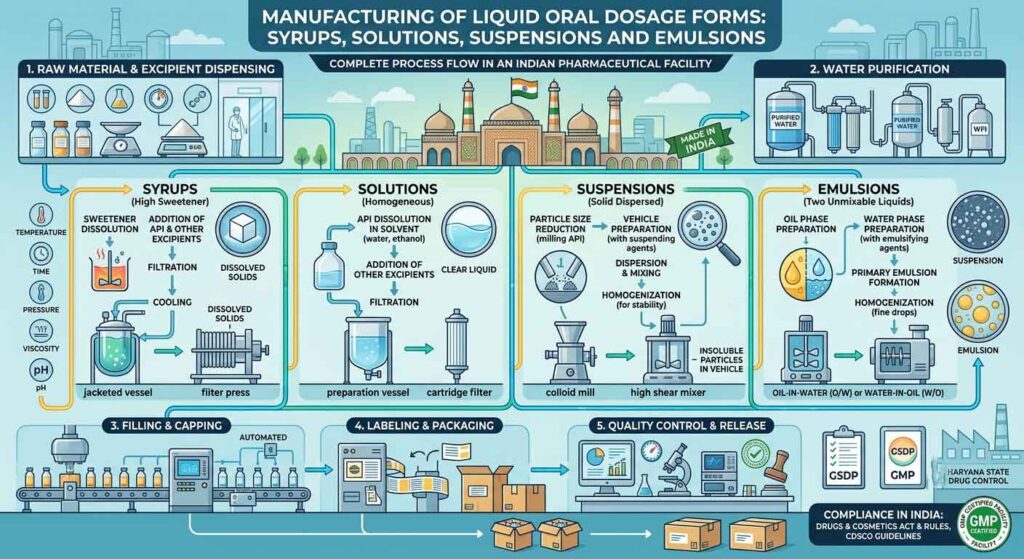
Manufacturing of Sugar Syrup
A typical sugar-syrup process may include:
Charge the required quantity of Purified Water into the vessel.
Start the agitator.
Heat the water to the validated temperature.
Add approved and sifted sugar gradually.
Continue mixing until dissolved.
Avoid unnecessary overheating or caramelization.
Filter the sugar solution.
Transfer it to the main manufacturing vessel.
Add other prepared solutions according to the Master Formula.
Adjust the final volume with Purified Water.
Mix for the validated time.
Test the bulk before release for filling.
The exact temperature and mixing time should be defined through product development and process validation.
Why Sugar Syrup Is Filtered
Sugar may contain:
Fibres
Insoluble matter
Foreign particles
Processing residues
Filtration helps improve clarity, but filtration does not correct poor-quality sugar or inadequate raw-material testing.
Typical Manufacturing Process for Clear Syrup
Step 1: Line Clearance
Before starting, verify that:
Previous product has been removed.
Equipment is clean.
Correct status labels are displayed.
Correct documents are available.
Correct materials are issued.
Area is free from unrelated items.
Step 2: Dispensing
Dispense:
API
Sugar or sweetener
Preservatives
Buffers
Flavours
Colours
Other excipients
Each material should be identified and independently checked.
Step 3: Prepare Syrup Base
Dissolve sugar in a defined quantity of Purified Water using the validated:
Temperature
Mixing speed
Mixing time
Step 4: Filter the Syrup Base
Filter through the specified filter or screen and transfer to the manufacturing vessel.
Step 5: Prepare Ingredient Solutions
Prepare separate solutions when required for:
Preservatives
Colours
Buffers
Water-soluble API
Co-solvents
Do not add all ingredients together without considering compatibility.
Step 6: Add Active and Excipients
Add ingredients according to the approved sequence.
Temperature-sensitive materials may need to be added after cooling.
Step 7: Adjust pH
Check and adjust pH within the approved bulk specification.
Step 8: Adjust Final Volume
Add Purified Water to achieve the target batch volume.
Step 9: Mix
Mix for the validated time and speed.
Overmixing may introduce excessive air or damage some formulations.
Step 10: Deaerate
If necessary, remove entrapped air using:
Vacuum
Controlled resting
Low-speed mixing
Step 11: Filter
Clear solutions may be passed through a validated polishing filter.
A syrup should not be filtered so aggressively that active ingredients or required components are removed.
Step 12: Transfer to Holding Tank
Transfer through a clean, closed system where possible.
Define:
Holding temperature
Agitation requirement
Maximum holding time
Microbial controls
Step 13: Bulk Testing
Quality Control may test:
Appearance
Colour
Odour
pH
Specific gravity
Refractive index
Assay
Preservative content
Viscosity
Microbial quality
Step 14: Filling
After bulk approval, fill into approved containers.
Step 15: Capping and Sealing
Fit:
Screw caps
ROPP caps
Child-resistant caps, where required
Induction seals
Measuring cups
Droppers
Step 16: Labelling and Packing
Apply approved labels and secondary cartons.
Step 17: Finished-Product Testing
Release the batch only after complete review and testing.
Manufacturing of Sugar-Free Syrup
A sugar-free syrup process differs because replacing sucrose may change:
Viscosity
Taste
Mouthfeel
Microbial susceptibility
Preservative effectiveness
Density
Stability
A typical process may involve:
Charging Purified Water
Dissolving preservatives and soluble excipients
Adding polyols or bulk sweeteners
Hydrating viscosity modifiers
Adding active ingredient
Adjusting pH
Adding flavours and high-intensity sweeteners
Adjusting volume
Mixing
Deaerating
Bulk testing
Filling
Do not replace sugar with artificial sweetener on a weight-for-weight basis without redevelopment and stability studies.
Manufacturing of Oral Suspensions
Suspensions require a different process from clear syrups.
A typical process may include:
Dispense and sift the API.
Prepare the aqueous vehicle.
Hydrate suspending agents.
Prepare preservative, sweetener and buffer solutions.
Wet the insoluble API using a suitable wetting agent.
Disperse the API into the vehicle.
Homogenize or pass through colloid mill, where required.
Add flavours and colours.
Adjust pH and final volume.
Mix until homogeneous.
Transfer to a holding tank with controlled agitation.
Continue suitable agitation during filling.
Fill into bottles.
Apply “Shake well before use” instructions where applicable.
Critical Suspension Controls
Particle size
Sedimentation rate
Redispersibility
Viscosity
Pourability
Dose uniformity
Crystal growth
Caking
Microbial quality
A colloid mill is useful only when justified by the suspension design. Excessive milling may change particle properties and product stability.
Manufacturing of Oral Emulsions
A typical emulsion process may include:
Prepare the oil phase.
Prepare the aqueous phase.
Heat both phases to validated temperatures, where required.
Add one phase to the other in the approved sequence.
Mix using a high-shear mixer.
Homogenize to achieve target droplet size.
Cool under controlled mixing.
Add heat-sensitive ingredients.
Adjust pH and final volume.
Deaerate.
Transfer to a holding vessel.
Maintain controlled mixing during filling where necessary.
Critical Emulsion Controls
Droplet size
Creaming
Coalescence
Phase separation
Viscosity
pH
Appearance
Homogeneity
Microbial quality
Heating During Manufacturing
Heating is not compulsory for every ingredient or every syrup.
Heating may be useful for:
Dissolving sugar
Dissolving selected excipients
Reducing viscosity
Preparing emulsion phases
Supporting controlled processing
Excessive heat may cause:
API degradation
Sugar caramelization
Colour change
Flavour loss
Preservative degradation
Vitamin degradation
Increased impurity levels
The batch should follow validated time-and-temperature limits.
Filtration
Filtration may be used for:
Syrup-base clarification
Removal of insoluble particles
Polishing clear solutions
Protecting filling equipment
Possible filters include:
Stainless-steel screens
Bag filters
Cartridge filters
Plate filters
Filtration should be validated or qualified for:
Material compatibility
Pore size
Flow rate
Product loss
Adsorption
Cleaning
Integrity, where applicable
Suspensions and emulsions are normally not filtered through fine filters after final dispersion because the process may remove the intended dispersed phase.
Holding Time
Bulk liquid should not remain in a tank indefinitely.
The manufacturer should validate:
Maximum time between manufacture and filling
Holding temperature
Agitation conditions
Microbial quality
Physical stability
Assay
Preservative content
WHO’s hold-time guidance states that the principles can also be applied to dosage forms such as liquids, creams and ointments.
Mixing and Homogeneity
Mixing studies should establish:
Minimum mixing time
Maximum mixing time
Agitator speed
Sampling locations
Batch-size range
Tank geometry
Order of addition
Risk of foaming
Risk of sedimentation
Samples may be collected from:
Top
Middle
Bottom
Beginning of transfer
End of transfer
This helps demonstrate batch uniformity.
Filling Process
Before filling:
Line clearance should be completed.
Bulk should be approved.
Containers and closures should be released.
Filling machine should be clean.
Fill-volume settings should be verified.
Coding details should be checked.
During filling, monitor:
Fill volume
Bottle appearance
Cap torque
Seal integrity
Leakage
Coding
Bulk homogeneity
Line speed
Rejection
Suspensions and emulsions may require controlled agitation in the filling tank to maintain uniformity.
Container and Closure Selection
Common containers include:
Amber glass bottles
Clear glass bottles
PET bottles
HDPE bottles
Polypropylene containers
Unit-dose containers
Dropper bottles
The container-closure system should be compatible with the product.
Compatibility studies may examine:
Sorption
Leaching
Permeation
Moisture loss
Light protection
Oxygen entry
Closure integrity
Flavour loss
Preservative adsorption
Measuring Devices
Products may include:
Measuring cup
Measuring spoon
Oral syringe
Dropper
Calibrated pipette
The device should deliver the intended dose accurately and carry appropriate markings.
In-Process Quality Checks
Possible in-process checks include:
Appearance
Colour
Odour
pH
Specific gravity
Refractive index or Brix
Viscosity
Homogeneity
Fill volume
Cap torque
Seal integrity
Bulk assay
Particle size
Sedimentation
Microbial count
Finished-Product Testing
Depending on the product specification, testing may include:
Description
Identification
Assay
Related substances
pH
Specific gravity
Viscosity
Refractive index
Preservative content
Alcohol content, where applicable
Microbial limits
Specified microorganisms
Deliverable volume
Uniformity of delivered dose
Particle size
Redispersibility
Sedimentation volume
Emulsion stability
Container-closure integrity
Leak testing
Microbiological Control
Oral liquids are non-sterile, but they must comply with applicable microbiological quality limits.
Microbial contamination may arise from:
Water
Sugar
Natural gums
Flavours
Raw materials
Dirty equipment
Poor drainage
Operators
Long holding times
Inadequate preservatives
Control measures include:
Qualified water system
Approved raw-material suppliers
Cleaning validation
Sanitization
Environmental hygiene
Controlled holding time
Preservative-effectiveness studies
Closed transfer
Pest control
Microbiological monitoring
Preservative Effectiveness
The presence of a preservative does not automatically prove that the product is adequately protected.
Preservative effectiveness may be influenced by:
pH
Preservative concentration
API
Surfactants
Container
Flavour
Suspended solids
Microbial load
The formulation should undergo appropriate antimicrobial-preservative-effectiveness testing where required.
Cleaning and Sanitization
Liquid equipment can retain product in:
Dead legs
Pumps
Valves
Transfer lines
Vessel outlets
Gaskets
Filling nozzles
Equipment should be designed to permit effective:
Cleaning
Rinsing
Inspection
Drainage
Sanitization
Drying
Cleaning procedures should specify:
Cleaning agent
Concentration
Water quality
Contact time
Temperature
Rinse volume
Acceptance criteria
Dirty and clean hold times
Cleaning Validation
Cleaning validation may evaluate:
API residues
Detergent residues
Microbial residues
Preservatives
Colours
Flavours
Hard-to-clean locations
Worst-case products may be selected based on:
Potency
Toxicity
Solubility
Cleanability
Colour
Flavour
Batch size
Shared-equipment use
Process Validation
Process validation should demonstrate consistent performance of:
Dispensing
Syrup-base preparation
Ingredient addition
Mixing
Homogenization
Filtration
Holding
Transfer
Filling
Capping
Critical process parameters may include:
Temperature
Mixing speed
Mixing time
Addition sequence
pH
Homogenization time
Filter size
Holding time
Filling speed
Documentation Required
Important documents may include:
Master Formula Record
Batch Manufacturing Record
Batch Packing Record
Raw-material specifications
Packing-material specifications
Finished-product specifications
Cleaning records
Equipment logbooks
Water-system records
In-process test records
Environmental records
Calibration records
Maintenance records
Yield reconciliation
Deviation records
Change controls
CAPA records
Stability records
Analytical reports
Batch-release documents
Batch Manufacturing Record Details
A BMR may include:
Product name
Batch number
Batch size
Manufacturing date
Expiry date
Equipment numbers
Raw-material details
Quantities
Control numbers
Purified-water quantity
Addition sequence
Mixing time and speed
Temperature
pH
Filtration details
Bulk volume
Bulk yield
Holding time
In-process results
Operator signatures
Supervisor checks
Stability Studies
Stability studies should support:
Shelf life
Storage condition
Preservative system
Container compatibility
Physical stability
Chemical stability
Microbial stability
For suspensions and emulsions, monitor:
Settling
Redispersibility
Particle-size change
Crystal growth
Viscosity
Phase separation
Colour and odour
Common Manufacturing Mistakes
Avoid these mistakes:
Calling every oral liquid a syrup
Assuming every syrup must contain sugar
Using DM water without pharmacopoeial qualification
Adding all ingredients together
Heating temperature-sensitive APIs
Adding flavours at excessive temperature
Using colloid mill for every clear solution
Filtering final suspensions through fine filters
Ignoring microbial quality
Using preservatives without effectiveness studies
Keeping bulk for an undefined period
Filling suspensions without agitation
Poorly designed tanks and pipelines
No cleaning validation
Ignoring bottle and closure compatibility
Adjusting pH without approved limits
Releasing a batch only on the basis of appearance
Copying another product’s manufacturing process
Investment Required
Investment depends on:
Production capacity
Manual, semi-automatic or automatic plant
Number of dosage forms
Water-system design
Filling speed
Bottle types
Laboratory instruments
HVAC
Construction
Validation
Technical staff
Product permissions
Working capital
Main Investment Heads
Industrial premises
GMP construction
Purified-water system
Manufacturing vessels
Storage tanks
Homogenizer
Colloid mill
Transfer pumps
Pipelines
Bottle-cleaning equipment
Filling line
Capping line
Labelling line
Packing equipment
Quality-control laboratory
Microbiology laboratory
Stability chambers
Electrical and utility systems
Licence and professional costs
Raw materials
Packing materials
Salaries
Working capital
Semi-Automatic vs Fully Automatic Plant
Point
Semi-automatic plant
Fully automatic plant
Investment
Lower
Higher
Production capacity
Lower to medium
Medium to high
Labour requirement
Higher
Lower per unit
Filling consistency
Operator-dependent
Better automated control
Changeover
Often simpler
May require more technical setup
Suitable for
Startups and smaller batches
Large-volume production
Maintenance
Relatively simpler
More specialized
A fully automatic plant is not automatically better. Machinery should match:
Expected demand
Batch size
Product range
Changeover frequency
Available technical support
Working capital
Practical Manufacturing Flow
Raw materials received
↓
Quarantine and Quality Control approval
↓
Dispensing
↓
Purified-water preparation
↓
Vehicle or syrup-base preparation
↓
API and excipient preparation
↓
Mixing or homogenization
↓
pH and final-volume adjustment
↓
Filtration or deaeration where applicable
↓
Bulk holding and testing
↓
Container preparation
↓
Filling
↓
Capping and sealing
↓
Labelling and packing
↓
Finished-product testing
↓
Quality Assurance release
Best Startup Strategy
A new manufacturer should:
Select a limited number of products.
Decide whether products are solutions, suspensions or emulsions.
Develop formulas through qualified formulation professionals.
Conduct compatibility and stability studies.
Design the plant around actual products.
Install a qualified Purified Water system.
Start with scalable vessels and filling equipment.
Establish microbiological testing.
Validate cleaning and holding times.
Obtain product permissions before commercial manufacture.
It may be more practical for a new brand to begin through a licensed third-party liquid manufacturer before establishing its own plant.
Final Answer
Manufacturing of liquid oral dosage forms includes much more than dissolving sugar and adding active ingredients.
The correct process depends on whether the product is:
A clear solution
A sugar syrup
A sugar-free syrup
A suspension
An emulsion
An elixir
A dry syrup
The most critical controls are:
Pharmacopoeial Purified Water
Correct sequence of ingredient addition
Validated temperature and mixing
pH and viscosity
Microbial control
Preservative effectiveness
Homogeneity
Bulk holding time
Filling accuracy
Container compatibility
Cleaning validation
Complete batch documentation
A colloid mill or homogenizer should be used only where technically necessary, especially for suspensions and emulsions. Clear syrups generally require proper dissolution, mixing and filtration rather than unnecessary high-shear processing.
Commercial manufacturing should follow the approved Master Formula, current Schedule M, product permissions and the requirements of the concerned Licensing Authority.
Frequently Asked Questions
1. What water is used for pharmaceutical syrup manufacturing?
Purified Water meeting the applicable pharmacopoeial specification should generally be used.
2. Is DM water the same as Purified Water?
Not necessarily. Demineralization removes minerals, but the complete water system must also meet chemical and microbiological specifications.
3. Are all syrups made with sugar?
No. Sugar-free syrups may use polyols and high-intensity sweeteners.
4. Is heating necessary for every syrup?
No. Heating is mainly used where required for dissolution or processing. Heat-sensitive ingredients may need to be added after cooling.
5. Is a colloid mill compulsory?
No. It is generally more relevant to suspensions and emulsions than to clear solutions.
6. Why are suspensions stirred during filling?
Stirring helps prevent particle settling and maintains dose uniformity.
7. What is the difference between syrup and suspension?
In a syrup or solution, ingredients are dissolved. In a suspension, insoluble drug particles remain dispersed in the liquid.
8. Why is pH important?
pH can affect drug stability, solubility, preservative effectiveness, taste and product appearance.
9. Can oral liquids contain preservatives?
Yes, where appropriate and permitted, but the preservative system should be justified and shown to be effective.
10. Are oral liquids sterile?
Ordinary oral liquids are non-sterile, but they must comply with applicable microbial limits and specified-organism requirements.
11. What is bulk holding time?
It is the approved maximum time for which a manufactured bulk liquid may be held before filling under specified conditions.
12. What tests are performed on syrup?
Tests may include appearance, identification, assay, pH, specific gravity, viscosity, preservative content, related substances, microbial limits and deliverable volume.
13. Can a sugar syrup crystallize?
Yes. Incorrect sugar concentration, temperature, storage or formulation can result in crystallization.
14. Is microbial testing required?
Yes. Water, raw materials, bulk product and finished product require appropriate microbiological control.
15. Which regulations apply in India?
The Drugs and Cosmetics Act and Rules, revised Schedule M, applicable pharmacopoeial standards, manufacturing licence conditions and product permissions apply.
Looking for Ayurvedic Franchise or Distribution Opportunities?
Looking to start an Ayurvedic franchise, become a distributor, or launch your own herbal product range?
Elzac Herbal India offers:
Ayurvedic & Herbal Product Range
Franchise & Distribution Opportunities
Third-Party Manufacturing
Product Development Support
Marketing Guidance
PAN India Business Opportunities
Whether you are an entrepreneur, retailer, distributor, or healthcare professional, our team can help you explore the right business opportunity in the growing Ayurvedic sector.
Ajay Kamboj is an entrepreneur and business owners associated with many Ayurvedic and Pharmaceutical start-ups. With years of experience in Ayurvedic product marketing, pharmaceutical distribution, franchise development, and client relationship management, he regularly shares practical business insights based on real-world experiences. His articles focus on business growth, entrepreneurship, customer management, and lessons learned from the healthcare and wellness industry.
2 responses to “Manufacturing of Liquid Oral Dosage Forms: Syrups, Solutions, Suspensions and Emulsions”
I have just passed my B Pharm and I want to start small unit of syrup as a loan license so I require details of it.


I have just passed my B Pharm and I want to start small unit of syrup as a loan license so I require details of it.
document