One of the first decisions every new pharmaceutical entrepreneur face is choosing the right manufacturing model.
Should you opt for Third-Party Manufacturing or Loan License Manufacturing?
If you are planning to start a pharma marketing company, selecting the right approach can significantly impact your investment, operational complexity, and long-term growth.
In this article, we compare both models to help beginners make an informed decision.
What Is Third-Party Manufacturing?
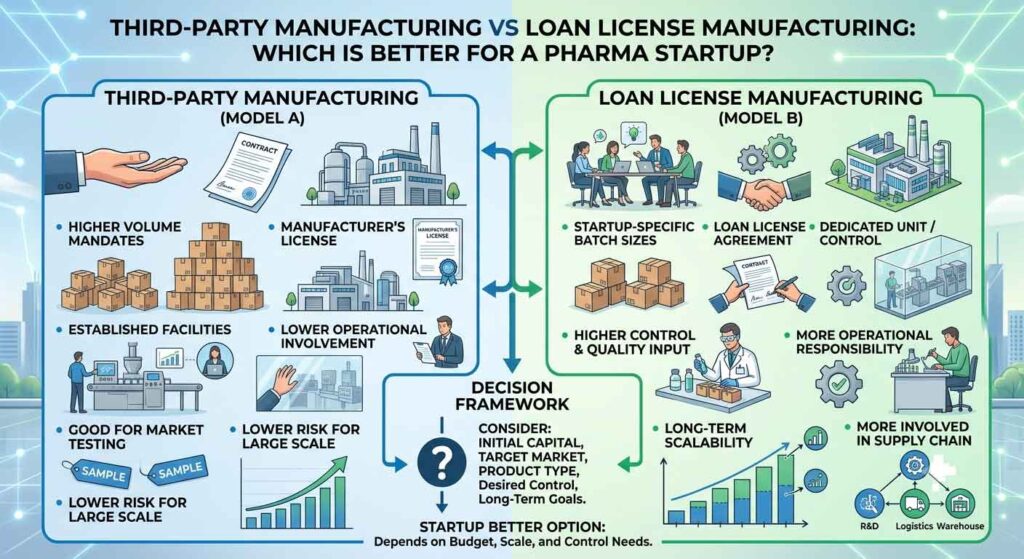
Third-party manufacturing is a business arrangement where you outsource the manufacturing of your products to an existing pharmaceutical manufacturer.
The products are manufactured under your brand name, while the manufacturer takes care of production, quality control, and regulatory compliance related to manufacturing.
How It Works
You select the products and formulations.
The manufacturer provides quotations.
You approve packaging and artwork.
The products are manufactured under your brand.
You focus on marketing, sales, and distribution.
What Is Loan License Manufacturing?
Loan license manufacturing allows a company to manufacture products using another manufacturer’s facilities after obtaining the necessary approvals from regulatory authorities.
Although the manufacturing facility belongs to another company, the loan license holder assumes greater responsibility for compliance and production activities.
How It Works
Regulatory approvals are obtained.
Manufacturing is carried out using another facility.
Additional documentation and coordination are required.
The loan license holder has greater involvement in the manufacturing process.
Third-Party Manufacturing vs Loan License: Quick Comparison
Factor
Third-Party Manufacturing
Loan License Manufacturing
Initial Investment
Lower
Higher
Documentation
Minimal
Extensive
Regulatory Complexity
Lower
Higher
Operational Involvement
Low
High
Time to Launch
Faster
Slower
Suitable for Beginners
Yes
Usually No
Control Over Manufacturing
Moderate
Higher
Compliance Responsibility
Lower
Higher
Which Option Is Better for Beginners?
For most first-time entrepreneurs, Third-Party Manufacturing is the preferred option.
Why?
✔ Lower startup costs
✔ Faster product launch
✔ Less regulatory burden
✔ Easier to manage
✔ Ability to focus on marketing and distribution
✔ Access to established manufacturing expertise
Loan licensing may be considered later as the business grows and operational capabilities increase.
Is There a Huge Difference in Production Margins?
This is another common question.
The answer is:
It depends.
Production margins vary based on factors such as:
Order quantity
Product category
Packaging specifications
Manufacturer capabilities
Market demand
Raw material costs
Example
Suppose you want to manufacture a tablet formulation under your own brand.
You may receive quotations such as:
300 boxes: Higher per-unit cost
500 boxes: Moderate per-unit cost
1,000 boxes: Lower per-unit cost
Generally, larger order quantities help reduce manufacturing costs through economies of scale.
Don’t Compare Only the Rates
Many entrepreneurs choose manufacturers solely based on the lowest quotation.
This can become a costly mistake.
Before selecting a manufacturing partner, evaluate:
Product Quality
Consistent quality is essential for building trust.
Delivery Timelines
Delayed dispatches can disrupt your supply chain and affect customer relationships.
Responsiveness
A manufacturer who communicates effectively can save time and prevent operational issues.
Documentation Support
Ensure proper support for product documentation and regulatory requirements.
Reputation
Review the manufacturer’s track record and client feedback.
Sometimes paying slightly more for reliable service can be far more profitable in the long run.
Where Should You Obtain Drug License and GST Registration?
This is particularly important for entrepreneurs operating across multiple states.
As a general principle:
Obtain registrations in the state from where you plan to operate and manage your business activities.
The location should support stock handling, administration, and operational convenience.
Medicines should only be stored and distributed from appropriately licensed premises.
If operating across multiple states, consult a qualified regulatory professional to understand state-specific compliance requirements.
Since regulations evolve over time, always verify the latest requirements with local drug authorities, GST consultants, or legal advisors.
Final Thoughts
If you are launching your first pharma marketing company, third-party manufacturing offers a practical and cost-effective path to market.
It allows you to focus on what matters most:
Building your brand
Developing distribution networks
Generating sales
Understanding market dynamics
As your business matures, you can evaluate more advanced models such as loan licensing or even setting up your own manufacturing facility.
For most startups, success comes not from owning a factory, but from choosing the right products, the right manufacturing partners, and executing a strong marketing strategy.
Frequently Asked Questions (FAQs)
1. Which is better for beginners: Third-Party Manufacturing or Loan License?
Third-party manufacturing is generally considered the better option for beginners due to lower investment requirements and simpler operations.
2. Is loan license manufacturing more profitable?
Not necessarily. While it may offer greater control, it also involves higher compliance responsibilities and operational complexity.
3. Does third-party manufacturing reduce profit margins?
Profitability depends more on product selection, pricing strategy, order quantity, and marketing efficiency than on the manufacturing model itself.
4. How do I choose the right third-party manufacturer?
Compare manufacturers based on quality, pricing, delivery timelines, documentation support, and market reputation.
5. Can I manufacture products under my own brand through third-party manufacturing?
Yes. Products can be manufactured by manufacturer and marketed under your own brand name.
6. Is larger order quantity beneficial?
Generally, yes. Higher quantities often result in lower per-unit manufacturing costs.
7. Can I operate my pharma business in one state and sell in another?
Yes, but licensing, storage, GST, and distribution requirements should comply with applicable regulations. Professional guidance is advisable for multi-state operations.
Partner with Elzac Herbal India
Looking to start an Ayurvedic franchise, become a distributor, or launch your own herbal product range?
Elzac Herbal India offers:
✔ Ayurvedic & Herbal Product Range ✔ Franchise & Distribution Opportunities ✔ Third-Party Manufacturing Services ✔ Product Development Support ✔ Marketing Guidance ✔ PAN India Business Opportunities
Whether you are an entrepreneur, retailer, distributor, or healthcare professional, our team can help you explore the right business opportunity in the growing Ayurvedic sector.
Ajay Kamboj is an entrepreneur and business owners associated with many Ayurvedic and Pharmaceutical start-ups. With years of experience in Ayurvedic product marketing, pharmaceutical distribution, franchise development, and client relationship management, he regularly shares practical business insights based on real-world experiences. His articles focus on business growth, entrepreneurship, customer management, and lessons learned from the healthcare and wellness industry.





Leave a Reply Cancel reply
You must be logged in to post a comment.