“What percentage should be offered to marketing and distribution firms? Should it be calculated on MRP, PTS, PTR or manufacturing cost?”
This is an important question because wrong pricing can either reduce your profit or make your offer unattractive for distributors.
Short Answer
In the pharma PCD/franchise model, companies generally do not offer a fixed percentage on MRP.
Instead, they supply products to marketing and distribution firms at a net rate.
This net rate is usually calculated on the basis of:
Manufacturing cost
Packing material cost
Testing cost
Administrative expense
Transport or dispatch cost
Company margin
Market competition
Product category
DPCO or price-control status, where applicable
The marketing or distribution firm then calculates its own margin according to MRP, PTS, PTR, schemes and market expenses.
What Is Net Rate?
Net rate is the final supply rate at which a manufacturing company sells the product to its marketing or distribution partner.
For example, if a manufacturer gives a product at ₹30 per strip to a PCD partner, then ₹30 is the net rate.
The PCD partner will then sell through stockist, retailer or direct distribution depending on the business model.
Is Net Rate Calculated on MRP?
No, net rate is not directly calculated as a fixed percentage of MRP.
MRP is the maximum retail price printed on the product. But the manufacturer’s net rate should be calculated mainly from cost and competition.
If you calculate net rate only from MRP, you may make mistakes because:
Some products have high MRP but high competition.
Some products have low MRP but good volume.
Some products are under price control.
Some products require higher packing cost.
Some products have higher raw material cost.
Some products need more promotional support.
Therefore, net rate should be cost-based and market-based, not only MRP-based.
Is Net Rate Calculated on PTS or PTR?
Not usually.
PTS and PTR are used in the distribution chain.
PTS means Price to Stockist.
PTR means Price to Retailer.
MRP means Maximum Retail Price.
In ethical/prescription marketing, PTS and PTR are important because stockist and retailer margins are calculated through the supply chain.
But in PCD/franchise or marketing-rights business, the manufacturer usually gives net rate to the marketing partner. The partner then manages the downstream margin.
Why Manufacturers Prefer Net Rate Basis
Net rate basis is simple because:
Manufacturer fixes its own margin.
Distributor manages local marketing.
Company does not directly bear field expense.
Pricing becomes easier to communicate.
Franchise partner can calculate his own profitability.
It avoids confusion about percentage sharing.
This model is widely used in PCD, franchise and marketing-rights business.
How to Calculate Net Rate
Use this formula:
Net Rate = Manufacturing Cost + Packing Cost + Testing/Documentation Cost + Overheads + Company Margin
After this, compare the rate with market competition.
If your calculated net rate is much higher than competitors, distributors may not accept it.
If your rate is too low, your company may not sustain quality and service.
Example Calculation
Suppose a product has:
MRP: ₹100
GST: 5%
Manufacturing and packing cost: ₹25
Testing and admin cost: ₹3
Dispatch/handling cost: ₹2
Desired company margin: ₹8
Then estimated net rate may be:
₹25 + ₹3 + ₹2 + ₹8 = ₹38
So, you may offer the product to the marketing/distribution firm at around ₹38 net rate, depending on market competition.
The distributor will then calculate:
Stockist margin
Retailer margin
Field expense
Promotional expense
Credit risk
Expiry risk
Own profit
Example with MRP ₹100
If MRP is ₹100 before tax or excluding 5% GST, do not simply say:
Distributor gets 50%
Company gets 50%
Stockist gets 10%
Retailer gets 20%
That is too simple and may not work.
Instead, calculate like this:
Step 1: Check product cost
Find actual production cost including packing.
Step 2: Add your company margin
Decide your sustainable margin.
Step 3: Check market competition
Compare with similar net rates in the market.
Step 4: Check DPCO/NPPA status
If the product is under price control, ensure MRP and margin structure are compliant.
Step 5: Finalize net rate
Offer the distributor a rate that is competitive and still profitable for you.
What Is a Good Rate to Offer on MRP ₹100 Product?
There is no fixed universal answer.
For a product with MRP ₹100, the net rate to a marketing/distribution firm may vary depending on category.
For example:
Product Type
Possible Net Rate Range
Highly competitive product
Lower net rate required
High-demand fast-moving product
Moderate margin possible
Specialty product
Higher margin possible
DPCO-controlled product
Must follow price-control limits
Nutraceutical/Ayurvedic product
May allow flexible pricing depending on category
Low-volume product
Higher cost pressure
High-volume product
Lower net rate may still be profitable
A practical approach is to offer a rate where the distributor has enough margin to sell, promote and repeat orders.
Do You Need to Offer a Percentage?
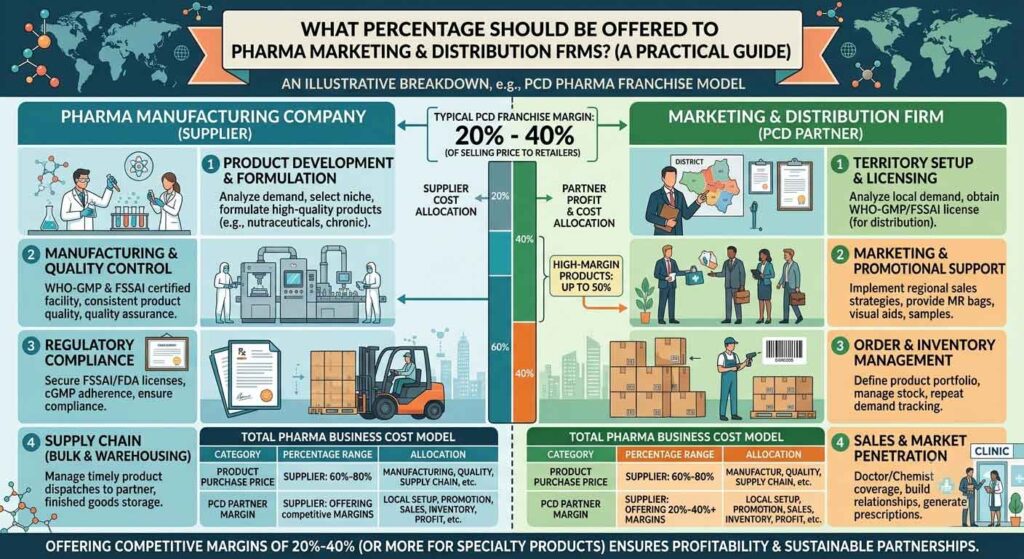
In PCD/franchise business, instead of saying “we offer 30% or 40%,” it is better to say:
“We supply at competitive net rates.”
The distributor will calculate his own percentage based on MRP.
Your responsibility is to ensure:
Your net rate is competitive.
Product quality is good.
Packaging is attractive.
Delivery is timely.
Margin is practical.
Product list is strong.
MRP is realistic.
Promotional support is available.
Why Product-Wise Margin Differs
Every product has different profitability.
Some products give high margin but low volume.
Some products give low margin but high sales.
For example:
Low-Margin, High-Competition Products
Antibiotics
Painkillers
PPIs
Common generics
DPCO-covered products
Better-Margin Products
Nutraceuticals
Multivitamins
Ayurvedic products
Herbal syrups
Protein powders
Specialty combinations
Cosmetic and wellness products
Moderate-Margin Products
Calcium supplements
Iron products
Digestive products
Cough syrups
Liver tonics
Joint support products
Therefore, do not use one margin formula for all products.
What Marketing and Distribution Firms Expect
A good marketing/distribution partner looks for:
Competitive net rates
Strong product range
Attractive packing
Good MRP structure
Quality assurance
Timely dispatch
Replacement policy
Monopoly or area support, if offered
Promotional material
Clear payment terms
Good company reputation
If your rates are competitive but service is poor, partners will not continue.
What Manufacturer Should Consider Before Offering Rights
Before appointing marketing/distribution partners, decide:
Which states or territories are available?
Will you offer monopoly rights?
What will be minimum order quantity?
What will be payment terms?
What will be replacement policy?
Who will bear transport cost?
What promotional support will be given?
What sales commitment will be required?
How will disputes be handled?
What will happen if sales are low?
Clear terms help avoid future conflict.
Marketing Expense in PCD Model
In the PCD model, the distributor or marketing partner usually handles field marketing expenses.
That means the manufacturer generally does not add MR salary, doctor promotion cost or local field expense in the same way as ethical marketing.
However, the manufacturer may still spend on:
Product catalogue
Visual aid
Digital marketing
Franchise lead generation
Product samples, where legally permitted
Packaging design
Brand development
Website
Sales support team
So, keep your own company-level marketing cost in mind while calculating margin.
How to Attract Good PCD and Marketing Partners
To attract serious partners, offer:
Professional product list
Transparent net rates
Good packaging
Quality documentation
Fast dispatch
Area-wise support
Digital catalogue
Promotional tools
Reasonable starting order
Good communication
Product training
Regular stock availability
Good partners do not select a company only because of low rates. They also check credibility and support.
How to Find Marketing and Distribution Firms
You can find PCD/franchise distributors through:
Company website
SEO
Google Ads
Pharma portals
Pharma directories
LinkedIn
Facebook groups
WhatsApp marketing
Existing distributor references
Pharma exhibitions
State-wise dealer networks
Medical representative references
Pharma trade publications
For states like Tamil Nadu, Karnataka, Andhra Pradesh, Telangana and Kerala, create state-specific pages and ads such as:
Pharma PCD Franchise in Tamil Nadu
Pharma Franchise Company in Karnataka
PCD Pharma Franchise in Andhra Pradesh
Pharma Franchise Opportunity in Kerala
Marketing Rights for Pharma Products in South India
Both manufacturer and distributor must have workable margins. Otherwise, the business will not continue.
Final Thoughts
There is no fixed industry-standard percentage that every pharma manufacturer must offer to marketing and distribution firms.
In PCD/franchise business, products are generally supplied at net rate basis. The net rate is calculated from manufacturing cost, packing cost, overhead and manufacturer margin, then adjusted according to market competition and regulatory pricing limits.
For a product with MRP ₹100, a good offer cannot be decided only by MRP. You must first calculate the actual cost, check competition, verify DPCO/NPPA status and then fix a sustainable net rate.
The best pricing strategy is simple:
Give a competitive net rate that allows your partner to earn, while protecting your own quality and company margin.
Frequently Asked Questions
1. What percentage should be offered to marketing and distribution firms?
There is no fixed percentage. In PCD/franchise business, companies usually offer products at net rates instead of fixed percentage sharing.
2. Is the percentage calculated on MRP or PTS?
Net rate is generally calculated on manufacturing cost and company margin, not directly on MRP or PTS.
3. What is net rate in pharma PCD?
Net rate is the final supply price at which the manufacturer sells products to the marketing or distribution partner.
4. What rate should be offered if MRP is ₹100?
It depends on product cost, competition, DPCO status, packing, GST, product demand and distributor margin. There is no fixed formula based only on MRP.
5. Should manufacturer include marketing expense in net rate?
In PCD model, local marketing expense is usually handled by the distributor. But company-level expenses such as catalogue, lead generation and support should be considered.
6. Which products give better margin?
Nutraceuticals, Ayurvedic products, multivitamins, protein powders, herbal products and specialty products may provide better margins than highly competitive generic products.
7. Should monopoly rights be given?
Monopoly can be given area-wise, but it should be linked with minimum sales commitment and written terms.
8. How can I attract good PCD partners?
Offer competitive net rates, quality products, attractive packaging, promotional material, timely dispatch and transparent business terms.
9. What is the biggest pricing mistake?
The biggest mistake is calculating distributor price only from MRP without considering cost, competition and regulatory price control.
10. Can one margin formula apply to all products?
No. Every product has different cost, demand, competition and margin potential.
Partner with Elzac Herbal India
Looking to start an Ayurvedic franchise, become a distributor, or launch your own herbal product range?
Elzac Herbal India offers:
Ayurvedic & Herbal Product Range
Franchise & Distribution Opportunities
Third-Party Manufacturing Services
Product Development Support
Marketing Guidance
PAN India Business Opportunities
Whether you are an entrepreneur, retailer, distributor, or healthcare professional, our team can help you explore the right business opportunity in the growing Ayurvedic sector.
Ajay Kamboj is an entrepreneur and business owners associated with many Ayurvedic and Pharmaceutical start-ups. With years of experience in Ayurvedic product marketing, pharmaceutical distribution, franchise development, and client relationship management, he regularly shares practical business insights based on real-world experiences. His articles focus on business growth, entrepreneurship, customer management, and lessons learned from the healthcare and wellness industry.





Leave a Reply Cancel reply
You must be logged in to post a comment.