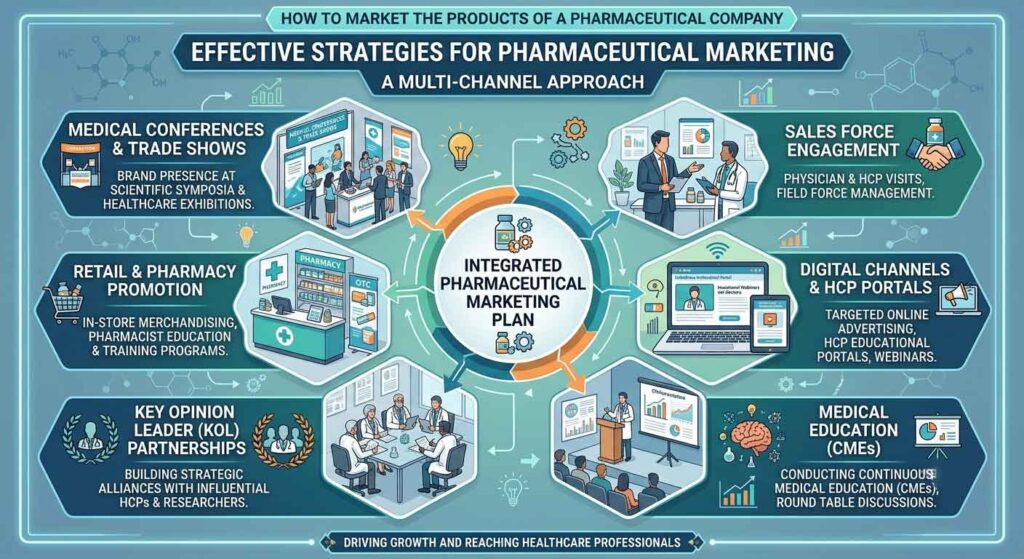
A B.Pharm graduate or healthcare entrepreneur can start marketing the products of an existing pharmaceutical company without owning a manufacturing plant.
The most common way to do this is through:
PCD pharma franchise
Monopoly pharma franchise
Authorized distributorship
Super-stockist arrangement
C&F arrangement
Independent marketing agreement
Medical representative or sales agency arrangement
The correct model depends on whether you want to:
Promote products only
Purchase and resell medicines
Maintain your own stock
Supply pharmacies and hospitals
Work under another company’s brands
Launch your own product brands later
A common query is:
“I am a B.Pharm graduate and want to start my own pharmaceutical marketing business. How can I obtain the products of a company and market them? How can I work as a franchisee?”
The practical answer is:
You can tie up with a pharmaceutical company as its PCD franchisee, authorized distributor or marketing partner. Before starting, finalize your territory, licensing structure, product range, commercial terms and written agreement.
What Is a PCD Pharma Franchise?
PCD commonly stands for:
Propaganda Cum Distribution
In practical pharmaceutical trade, a PCD arrangement means that a pharmaceutical company authorizes another person or firm to promote and distribute its products in a defined territory.
The parent company generally provides:
Finished pharmaceutical products
Existing product brands
Price list
Product literature
Promotional materials
Product samples, where legally permitted
Territory authorization
Commercial support
The franchisee generally handles:
Local product promotion
Doctor and hospital coverage
Distributor or chemist development
Order generation
Stock planning
Payment
Market feedback
Expiry and return coordination
Is PCD Franchise a Separate Licence?
No separate licence called a “PCD licence” is generally issued.
The legal requirements depend on your actual activity.
When You Only Promote Products
Suppose you:
Meet doctors
Introduce products
Collect orders
Send orders to the parent company
Do not purchase or hold stock
Do not issue medicine-sale invoices
The parent company or its licensed distributor may directly supply and invoice customers.
In this structure, your role may be mainly that of:
Marketing agent
Sales representative
Commission agent
Territory promoter
Your own drug-sale licensing requirement may differ because you are not physically stocking or selling medicines.
However, the agreement should clearly state:
Who receives the order
Who supplies the medicine
Who raises the invoice
Who collects payment
Who handles expiry
Who manages complaints
When You Purchase, Stock and Sell Products
If your firm will:
Buy medicines from the parent company
Receive products at your premises
Keep inventory
Raise wholesale invoices
Supply retailers, hospitals or distributors
Dispatch medicines
then appropriate wholesale drug-licence support is generally required at the premises from which these activities are conducted.
For common allopathic drug categories, licences in Forms 20-B and 21-B are ordinarily relevant.
Additional or separate requirements apply to:
Schedule X products
Controlled products
Special biological products
Cold-chain products
Certain restricted categories
The final licence structure should be confirmed with the State Drug Control Department.
Does a B.Pharm Graduate Automatically Get Permission to Sell Medicines?
No.
A B.Pharm qualification does not itself replace:
Business registration
Wholesale drug licence
GST registration
Approved premises
Storage facilities
Company authorization
However, a B.Pharm graduate may qualify as a competent technical person for certain wholesale operations, subject to acceptance by the concerned Licensing Authority and applicable qualification or experience requirements.
Your qualification can also help in:
Product understanding
Doctor communication
Drug-safety awareness
Storage management
Regulatory documentation
Complaint handling
Training the sales team
Main Ways to Market Another Company’s Products
1. PCD Franchise
You obtain the right to promote and distribute the company’s products in a particular area.
This is suitable when:
You want to work with doctors and chemists.
You want an established product range.
You have limited capital.
You do not want to develop your own brands immediately.
You want territory-based rights.
2. Authorized Distributor
You purchase products and supply them to:
Retail pharmacies
Hospitals
Nursing homes
Clinics
Sub-distributors
Your main focus is distribution rather than prescription generation.
3. Monopoly Franchise
The company may promise not to appoint another franchise partner for specified products in an agreed territory.
Monopoly rights should be documented clearly.
They are not created merely by using the word “monopoly” on a letterhead.
4. Super Stockist
A super stockist buys larger quantities and supplies multiple district distributors or stockists.
This model normally requires:
More investment
Warehouse
Strong credit control
Larger territory
Delivery and inventory systems
5. C&F Agent
A Carrying and Forwarding agent generally stores and dispatches products on behalf of the company.
The stock may remain owned by the company, depending on the agreement.
The C&F agent earns:
Handling charges
Service charges
Commission
This is different from buying products as a distributor.
6. Marketing Agency
A marketing agency promotes the company’s products but may not own or stock the goods.
It may earn:
Fixed service fees
Sales commission
Performance incentive
Territory-development charges
Step-by-Step Procedure to Become a Pharma Franchisee
Step 1: Decide Your Business Model
Before approaching a company, decide whether you want to work as:
Marketing agent
PCD franchisee
Distributor
Monopoly franchisee
Super stockist
C&F agent
Do not sign an agreement until the commercial model is clear.
Step 2: Select Your Territory
Choose a manageable territory, such as:
One town
One tehsil
One district
A group of nearby towns
One state
A beginner should avoid taking an excessively large territory without:
Sales staff
Distributor network
Delivery system
Sufficient working capital
A smaller well-covered territory is generally more valuable than a large territory with no regular market visits.
Step 3: Study the Local Market
Before selecting products, meet:
Doctors
Retail chemists
Hospital pharmacies
Distributors
Nursing homes
Study:
Frequently prescribed products
Existing leading brands
Price ranges
Seasonal products
Product shortages
Competitor schemes
Distributor margins
Doctor specialties
Credit practices
Do not select products only from a company catalogue.
Step 4: Select the Therapy Segment
You may focus on:
General medicine
Paediatrics
Gynaecology
Orthopaedics
Dermatology
Dental
Cardiology
Diabetology
Neurology
Urology
Gastroenterology
Ayurvedic products
Nutraceuticals
For a beginner, one or two focused specialties are often easier to manage than a very large mixed range.
Step 5: Prepare a Shortlist of Companies
Search for companies through:
Industry exhibitions
Pharmaceutical directories
Distributor references
Doctor references
Online research
Trade associations
Existing franchisees
Professional contacts
Online visibility alone does not prove that a company is reliable.
Shortlist at least three to five companies for comparison.
Step 6: Verify the Company
Before paying an advance, verify the company’s legal and quality documents.
Company Documents
Ask for:
GST certificate
PAN and legal constitution
Wholesale drug licence
Registered or operating address
Bank-account details in the legal entity’s name
Manufacturer Documents
Ask for:
Manufacturing licence
Manufacturing-site address
Product permissions
Applicable GMP documents
Product-wise manufacturing authorization
Batch-wise Certificate of Analysis
Product Documents
Verify:
Composition
Strength
Dosage form
Pack size
MRP
Schedule status
Storage conditions
Expiry
Manufacturer
Label warnings
Quality and Market History
Check:
Product complaints
Not-of-standard-quality reports
Recall history
Delivery performance
Expiry replacement
Existing franchisee experience
Regulatory history
Step 7: Ask Whether the Company Is a Manufacturer or Marketer
Some PCD companies own manufacturing plants.
Others get products manufactured through third-party manufacturers.
Both models may be legitimate.
The important questions are:
Who actually manufactures each product?
Does the manufacturer have product permission?
Is the product supplied with a batch-wise COA?
Who investigates a quality complaint?
Who replaces defective stock?
Who handles a recall?
Does the marketer frequently change manufacturers?
Do not assume that a company is a manufacturer merely because the word “Laboratories,” “Pharma” or “Lifesciences” appears in its name.
Step 8: Compare Product Lists and Net Rates
Compare companies using the same commercial basis.
Check:
Product composition
Pack size
MRP
Net rate
GST
Freight
Minimum order
Scheme
Payment terms
Expiry
Promotional support
A lower net rate is not always better when the product has:
Poor packaging
Short expiry
Irregular supply
Weak market acceptance
No replacement policy
Step 9: Calculate the Complete Cost
Your actual cost may include:
Product net rate
GST
Freight
Bank charges
Sales staff salary
Travelling allowance
Samples
Promotional materials
Distributor margin
Expiry replacement
Breakage
Credit loss
Office cost
Example:
Product invoice value: ₹1,00,000 GST and freight: ₹14,000 Promotional and field cost: ₹20,000 Expiry and credit provision: ₹6,000
Total effective cost: ₹1,40,000
Do not calculate profit only by comparing net rate with MRP.
Step 10: Arrange Your Business Registrations
Depending on the model, you may need:
Proprietorship, partnership, LLP or company registration
PAN
GST
Current bank account
Wholesale drug licence
Shop and Establishment registration
Local trade registration
Udyam registration, where suitable
A sole person may begin as a proprietorship.
Two or more founders may consider:
Partnership
LLP
Private Limited Company
Step 11: Arrange Wholesale Drug-Licence Support
There are two common structures.
Own Wholesale Licence
You maintain stock and issue invoices from your own licensed premises.
Advantages:
Better control
Direct billing
Own stock visibility
Ability to supply multiple companies’ products
Responsibilities:
Licensed premises
Competent person
Storage
Records
Inspections
Batch traceability
Expiry control
Work Through a Licensed Distributor
A licensed distributor purchases or stocks the products and supplies retailers.
You focus mainly on marketing and order generation.
Advantages:
Lower starting investment
No need to establish a warehouse immediately
Existing delivery network
Limitations:
Less stock control
Dependence on distributor
Lower margin
Possible availability problems
The arrangement should be written and accepted by the parent company.
Step 12: Apply for GST Where Applicable
GST depends on:
Aggregate turnover
Interstate supplies
Nature of business
E-commerce
Compulsory-registration conditions
State of operation
Many PCD businesses take GST registration from the beginning because:
The parent company requires GST details.
Interstate purchases may be involved.
Distributors require tax invoices.
Input tax credit is commercially important.
GST and drug licence are separate.
Step 13: Finalize the Agreement
Do not depend only on WhatsApp messages or a one-page authorization letter.
A proper PCD or distribution agreement should mention:
Legal names of both parties
Territory
Product list
Nature of rights
Purchase obligations
Minimum order
Sales targets
Payment terms
Credit policy
Price revisions
Freight
Expiry replacement
Breakage
Quality complaints
Recall
Promotional materials
Termination
Dispute resolution
Remaining stock after termination
What Should a Monopoly Agreement Contain?
A monopoly agreement should clearly answer:
Territory
Is the right for:
City
District
State
PIN codes
Specific headquarters
Products
Does monopoly apply to:
Entire company range
Selected brands
Selected divisions
Products purchased regularly
Duration
Is the appointment:
For one year
Renewable
Open-ended
Subject to performance
Minimum Purchase
Specify:
Monthly target
Quarterly target
Annual target
Product-wise target
Performance Conditions
The company may reserve the right to cancel monopoly when:
Orders stop
Payments are delayed
Targets are not achieved
Products are not promoted
Territory is inactive
Nearby Supply
Clarify whether the company can supply:
Hospitals
Government tenders
Online pharmacies
Institutional customers
Existing distributors
National chains
Without this clause, “monopoly” may create disputes.
Breach and Compensation
Specify what happens if:
The company appoints another franchisee.
The franchisee sells outside the territory.
Either party violates pricing or payment terms.
Step 14: Obtain an Authorization Certificate
The company may issue a certificate confirming that you are its:
Authorized franchisee
Authorized distributor
Territory marketing partner
Monopoly franchisee
The certificate should mention:
Your legal firm name
Territory
Effective date
Product range
Company signature and stamp
This certificate is commercial evidence of appointment.
It is not a government licence.
Step 15: Place a Controlled First Order
Do not start with a very large order merely to obtain monopoly rights.
A reasonable first order should cover:
15–30 focused products
Approximately one to two months of expected sales
Adequate shelf life
Limited slow-moving products
Avoid excessive quantities of:
Seasonal products
Expensive injections
Specialist medicines
Products with uncertain demand
Short-expiry stock
Step 16: Check the Goods on Receipt
When products arrive, check:
Product name
Quantity
Batch number
Manufacturing date
Expiry date
MRP
Physical condition
Leakage or breakage
Manufacturer details
Invoice
COA availability
Immediately report:
Damaged cartons
Wrong product
Quantity shortage
Short expiry
Label discrepancy
Step 17: Establish Proper Storage
Store products according to labelled conditions.
Control:
Temperature
Humidity
Direct sunlight
Dust
Pest exposure
Water damage
Separate:
Saleable stock
Damaged stock
Expired stock
Returned stock
Recalled stock
Follow:
First Expiry, First Out
Step 18: Appoint a Distributor
A local distributor may supply products to chemists.
Select a distributor based on:
Valid drug licence
Market reputation
Retail network
Delivery capability
Payment discipline
Storage
Sales team
Interest in your range
Do not appoint a distributor only because it asks for a low margin.
Distributor Agreement
The agreement may specify:
Territory
Products
Billing structure
Margin
Credit
Stock level
Delivery
Returns
Expiry
Collections
Sales reports
Termination
Step 19: Build Pharmacy Availability
Prescription generation is not useful when the product is unavailable.
Ensure availability at:
Pharmacies near target doctors
Hospital pharmacies
Major chemists
Distributor counters
Track:
Stock availability
Secondary sales
Reorder level
Near-expiry stock
Do not load stock into the market without monitoring actual sales.
Step 20: Begin Ethical Product Promotion
A pharma franchisee may promote products through:
Personal calls to healthcare professionals
Scientific literature
Product cards
Approved visual aids
Product demonstrations, where applicable
Medical education within applicable rules
Availability and service
Product information should be:
Accurate
Balanced
Current
Verifiable
Consistent with approved indications
Avoid:
Cash for prescriptions
Personal gifts
Paid holidays
Unapproved inducements
False clinical claims
Unapproved indications
Disparaging competitors without evidence
Difference Between Franchisee and Distributor
Franchisee
Main focus:
Promotion
Territory development
Doctor coverage
Product demand
Local distribution coordination
Distributor
Main focus:
Stock
Invoicing
Retail supply
Delivery
Collection
Inventory
One person or firm may perform both roles when it has:
Marketing ability
Wholesale licence
Storage
Delivery infrastructure
Documents to Ask From the Parent Pharma Company
Collect:
Company GST certificate
Wholesale drug licence
Company constitution details
Manufacturer’s licence
Product permissions
GMP documentation
Batch-wise COAs
Product list
Price list
Monopoly agreement
Authorization certificate
Expiry policy
Complaint and recall contact
Bank details
Written payment terms
Documents the Company May Ask From You
The parent company may request:
PAN
GST
Drug licence
Firm registration
Address proof
Proprietor, partner or director details
Distributor licence
Purchase order
Territory details
Bank details
Agreement
Payment
How to Evaluate Product Quality
Do not assess quality only from:
Packaging appearance
Company advertisements
Low rate
GMP logo
Salesperson assurances
Review:
Manufacturer
Product permission
COA
Packaging integrity
Shelf life
Complaint response
Market history
Batch consistency
Periodic independent testing of selected products may also be considered as part of quality oversight.
How to Calculate Profit
Your gross trade margin is not your final profit.
Basic Calculation
Sales realization minus product purchase cost minus GST impact minus freight minus distributor margin minus field expenses minus salary and travel minus samples and promotion minus expiry and bad debt equals operating profit
Example
Net product purchase: ₹100 Freight and handling: ₹5 Marketing expense allocation: ₹15 Expiry and credit provision: ₹5
Effective cost: ₹125
Sale realization: ₹150
Estimated operating contribution: ₹25
The MRP may be much higher, but the full difference between MRP and purchase rate does not automatically become your profit.
Important Commercial Questions to Ask the Company
Before finalizing, ask:
Is the territory vacant?
Is monopoly written or verbal?
Which products are covered?
What is the minimum first order?
Is there a monthly target?
Is advance payment required?
Who pays freight?
What is the expiry policy?
What is the breakage policy?
Are batch-wise COAs provided?
How often are prices revised?
Can products be returned?
How are quality complaints handled?
Can the company supply institutions directly?
What happens if either party terminates?
Red Flags While Selecting a PCD Company
Be cautious when a company:
Refuses to share its drug licence
Cannot show manufacturer details
Offers monopoly without an agreement
Demands a large advance immediately
Provides products with short expiry
Changes manufacturers frequently
Has no written replacement policy
Does not provide invoices
Promises guaranteed doctor prescriptions
Encourages illegal inducements
Has no quality-complaint process
Uses unapproved or misleading claims
Offers an unrealistically large territory at a very small order
Common Mistakes New Franchisees Make
Avoid:
Selecting a company only by low rates
Taking too many products
Accepting verbal monopoly
Working without clear licensing
Stocking products at an unlicensed premises
Giving excessive credit
Ignoring expiry
Appointing an inactive distributor
Hiring too many MRs immediately
Depending only on doctor promotion
Not ensuring chemist availability
Not checking product permissions
Making unethical payments
Confusing dispatch with actual sales
Recommended Startup Model for a B.Pharm Graduate
A practical starting model may be:
Stage 1: Market Study
Select one district.
Meet doctors and chemists.
Identify 15–25 suitable products.
Choose one or two specialties.
Stage 2: Licensed Distribution Structure
Either:
Obtain your own wholesale drug licence, or
Work with an established licensed distributor.
Stage 3: Company Selection
Compare three to five PCD companies.
Verify licences and quality documents.
Speak with existing franchisees.
Stage 4: Written Appointment
Sign territory and commercial agreement.
Obtain authorization certificate.
Confirm expiry and replacement policy.
Stage 5: Controlled Launch
Start with limited stock.
Personally cover the market.
Ensure pharmacy availability.
Track secondary sales.
Stage 6: Expansion
After six to twelve months of stable performance:
Add products.
Add nearby territories.
Appoint an MR.
Consider launching own brands.
Suggested 60-Day Action Plan
Days 1–10
Select business model
Select territory
Study doctors, hospitals and chemists
Estimate capital
Days 11–20
Register firm
Arrange GST
Select premises or distributor
Begin drug-licence process where required
Days 21–30
Shortlist PCD companies
Collect price lists
Verify documents
Compare products and policies
Days 31–40
Negotiate territory
Finalize agreement
Select 15–25 products
Calculate complete costs
Days 41–50
Place controlled order
Appoint distributor
Prepare approved promotional materials
Plan doctor and chemist coverage
Days 51–60
Receive and inspect stock
Begin pharmacy placement
Start ethical product promotion
Monitor sales and availability
Start commercial stocking and sale only after the required licensing arrangement is operational.
Frequently Asked Questions
1. How can I market another pharmaceutical company’s products?
You may become its PCD franchisee, authorized distributor, marketing agent, super stockist or C&F agent, depending on the commercial arrangement.
2. Is a PCD licence required?
There is generally no separate government licence called a PCD licence. Drug-sale, GST and business requirements depend on your actual activity.
3. Do I need a wholesale drug licence?
If you purchase, stock, invoice, sell or distribute allopathic medicines from your premises, wholesale drug-licence support is generally required.
4. Can I work through another distributor?
Yes. A licensed distributor may handle stock, invoicing and pharmacy supply while you handle promotion, provided the structure is properly documented.
5. Is B.Pharm sufficient to start the business?
B.Pharm is a professional qualification, but it does not replace the required business registrations and drug licences.
6. What is monopoly pharma franchise?
It is a private agreement under which the company restricts appointment of other franchise partners for specified products in a defined area, subject to agreed conditions.
7. Is monopoly permanent?
Not necessarily. It may depend on minimum purchases, timely payment, sales activity and agreement duration.
8. Can I market products throughout a whole state?
Potentially, but a large territory requires adequate staff, distribution and working capital. Beginners are usually better served by starting with a limited area.
9. Can I later launch my own brands?
Yes. After building market knowledge, you can launch your own products through licensed third-party manufacturers.
10. What is the biggest risk in PCD business?
Major risks include poor company selection, weak product availability, uncontrolled credit, short-expiry stock, verbal monopoly promises and insufficient market follow-up.
Final Thoughts
Marketing another pharmaceutical company’s products is possible without owning a manufacturing plant.
The correct process is:
Choose business model → Arrange business and licensing structure → Study the market → Select a reliable company → Verify documents → Sign a written agreement → Appoint distribution → Launch limited products → Promote ethically → Monitor stock, sales and quality
A B.Pharm graduate has an advantage because of technical knowledge, but business success also depends on:
Product selection
Relationship building
Supply reliability
Financial discipline
Ethical promotion
Pharmacy availability
Quality oversight
Do not begin only with the question:
“Which company gives the highest margin?”
Begin with:
“Which company can provide quality products, reliable supply, fair commercial terms and long-term support?”
Looking for Ayurvedic Franchise or Distribution Opportunities?
Looking to start an Ayurvedic franchise, become a distributor, or launch your own herbal product range?
Elzac Herbal India offers:
Ayurvedic & Herbal Product Range
Franchise & Distribution Opportunities
Third-Party Manufacturing Services
Product Development Support
Marketing Guidance
PAN India Business Opportunities
Whether you are an entrepreneur, retailer, distributor, or healthcare professional, our team can help you explore the right business opportunity in the growing Ayurvedic sector.
Ajay Kamboj is an entrepreneur and business owners associated with many Ayurvedic and Pharmaceutical start-ups. With years of experience in Ayurvedic product marketing, pharmaceutical distribution, franchise development, and client relationship management, he regularly shares practical business insights based on real-world experiences. His articles focus on business growth, entrepreneurship, customer management, and lessons learned from the healthcare and wellness industry.





Leave a Reply Cancel reply
You must be logged in to post a comment.