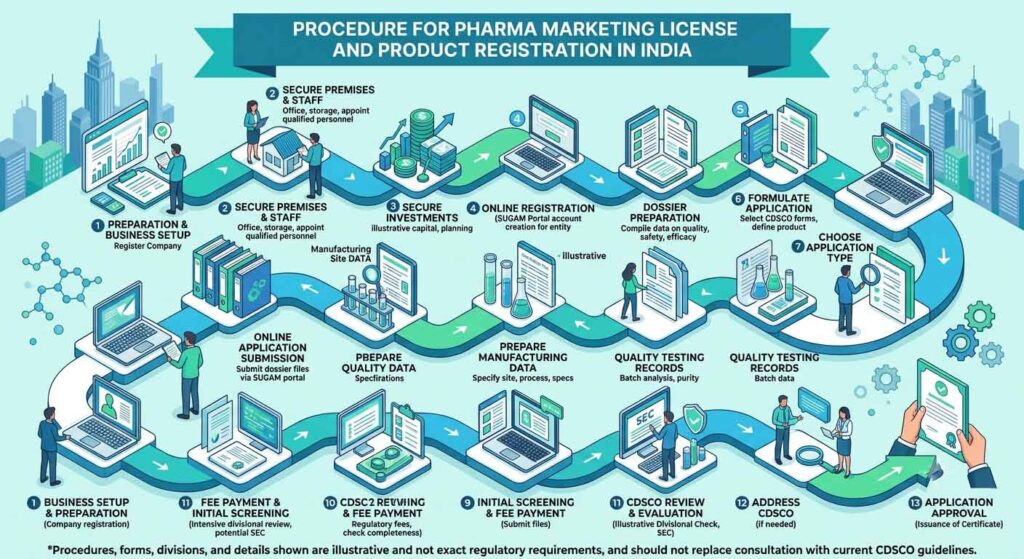
If you want to start a pharmaceutical marketing company in India, the process generally involves:
Registering your business.
Obtaining GST registration.
Obtaining the appropriate drug licence (where applicable).
Selecting products and brand names.
Choosing a third-party manufacturer.
Applying for trademark protection.
Getting products manufactured under your brand name.
Building a distribution and marketing network.
Many first-time entrepreneurs are surprised to learn that in most cases, pharmaceutical marketing companies do not need to own a manufacturing facility. Products can be manufactured through licensed third-party manufacturers.
Disclaimer: Regulatory requirements vary depending on whether you are dealing with pharmaceutical medicines, Ayurvedic products, nutraceuticals, cosmetics, or food supplements. Always consult a qualified regulatory professional before starting operations.
Query
I want to start a pharma marketing company with a few products. What is the procedure for obtaining a marketing licence and product registration?
This is one of the most common questions asked by entrepreneurs entering the pharmaceutical industry.
Let’s understand the process step by step.
What Is a Pharma Marketing Company?
A pharma marketing company is a business that markets and sells products under its own brand name while manufacturing is carried out by a licensed manufacturer.
The company focuses on:
Branding
Marketing
Distribution
Sales
Franchise development
Business expansion
Manufacturing is usually outsourced through third-party manufacturing arrangements.
Step 1: Register Your Business
Before launching products, establish your business entity.
Common options include:
Proprietorship
Suitable for individual entrepreneurs.
Partnership Firm
Suitable when two or more partners are involved.
LLP (Limited Liability Partnership)
Provides liability protection and operational flexibility.
Private Limited Company
Popular among growing pharmaceutical businesses.
The ideal structure depends on your future plans and investment goals.
Step 2: Obtain GST Registration
GST registration is generally required for:
Invoicing
Product purchases
Product sales
Business operations
Most pharmaceutical marketing companies obtain GST registration before launching products.
Step 3: Obtain the Required Drug Licence
Requirements vary depending on your business model.
For pharmaceutical products, a wholesale drug licence is often required for:
Storage
Sale
Distribution
Requirements can vary from state to state, so local regulatory guidance is important.
Start with a focused range rather than an excessively large product list.
Step 5: Choose Brand Names
Your brand names will become valuable business assets.
When selecting brand names:
✓ Keep them easy to pronounce.
✓ Make them easy to remember.
✓ Avoid confusion with existing brands.
✓ Ensure they fit the product category.
Step 6: Apply for Trademark Registration
Trademark registration helps protect:
Company name
Product names
Logo
Brand identity
Early trademark filing can help avoid future disputes and strengthen your market position.
Step 7: Select a Third-Party Manufacturer
A licensed manufacturer can produce products under your brand name.
When evaluating manufacturers, consider:
Regulatory Compliance
Manufacturing licences
GMP compliance
Quality systems
Product Range
Available formulations
Packaging options
Production capacity
Service Standards
Delivery timelines
Product availability
Technical support
Step 8: Product Approval and Registration
Many entrepreneurs ask:
“Do I need to register every product myself?”
The answer depends on the product category.
Pharmaceutical Products
Product approvals are generally linked to licensed manufacturers and applicable regulatory requirements.
Ayurvedic Products
Approvals are generally handled through licensed Ayurvedic manufacturers in accordance with applicable regulations.
Nutraceuticals and Food Supplements
Requirements depend on product classification and applicable food regulations.
Always verify the current requirements before product launch.
Step 9: Design Packaging and Promotional Material
Develop:
Product labels
Packaging designs
Product literature
Visual aids,
Marketing materials
Professional packaging helps create a strong first impression.
Step 10: Launch and Market Your Products
Once products are ready, focus on market development.
Common channels include:
PCD Franchise Network
Appoint franchise partners across different territories.
Distributors and Stockists
Develop a distribution network.
Direct Marketing
Build relationships with healthcare professionals and retailers.
Digital Marketing
Strengthen brand visibility online.
Is Product Registration Necessary Before Launch?
Many entrepreneurs ask:
“Should I register my product name before launching?”
While product registration requirements vary by category, trademark protection is strongly recommended.
Trademark registration helps:
Protect your brand identity
Reduce future disputes
Increase business value
Third-Party Manufacturing vs Loan Licence Manufacturing
New entrepreneurs often compare these models.
Third-Party Manufacturing
✓ Lower investment
✓ Faster market entry
✓ Less operational complexity
Loan Licence Manufacturing
✓ Greater manufacturing control
✓ Higher compliance responsibility
✓ More complex operations
For many startups, third-party manufacturing is often the more practical option.
Common Mistakes to Avoid
❌ Launching products without trademark verification.
❌ Selecting products without market research.
❌ Choosing manufacturers solely on price.
❌ Ignoring regulatory compliance.
❌ Starting with too many products.
❌ Underestimating marketing expenses.
Final Thoughts
Starting a pharmaceutical marketing company is often simpler than many entrepreneurs expect.
You do not necessarily need to own a factory or manufacture products yourself.
A well-planned pharmaceutical marketing company can be built by:
Choosing the right products,
Protecting your brands,
Partnering with reliable manufacturers,
Building a strong distribution network.
Success depends less on infrastructure and more on product quality, marketing strategy, customer relationships, and long-term business planning.
Frequently Asked Questions
Can I start a pharma marketing company without a manufacturing unit?
Yes. Many companies operate through third-party manufacturing arrangements.
Is GST registration necessary?
In most cases, GST registration is required for commercial business operations.
Do I need a drug licence?
Requirements depend on the products being marketed and the business model being followed.
Is trademark registration compulsory?
Trademark registration is not always mandatory before launch, but it is highly recommended for brand protection.
What is the easiest way to start a pharma company?
For many entrepreneurs, starting with third-party manufacturing is one of the simplest and most cost-effective approaches.
How many products should I launch initially?
Many successful startups begin with a focused product portfolio and expand gradually as the business grows.
Partner with Elzac Herbal India
Looking to start an Ayurvedic franchise, become a distributor, or launch your own herbal product range?
Elzac Herbal India offers:
Ayurvedic & Herbal Product Range
Franchise & Distribution Opportunities
Third-Party Manufacturing Services
Product Development Support
Marketing Guidance
PAN India Business Opportunities
Whether you are an entrepreneur, retailer, distributor, or healthcare professional, our team can help you explore the right business opportunity in the growing Ayurvedic sector.
Ajay Kamboj is an entrepreneur and business owners associated with many Ayurvedic and Pharmaceutical start-ups. With years of experience in Ayurvedic product marketing, pharmaceutical distribution, franchise development, and client relationship management, he regularly shares practical business insights based on real-world experiences. His articles focus on business growth, entrepreneurship, customer management, and lessons learned from the healthcare and wellness industry.




Leave a Reply Cancel reply
You must be logged in to post a comment.