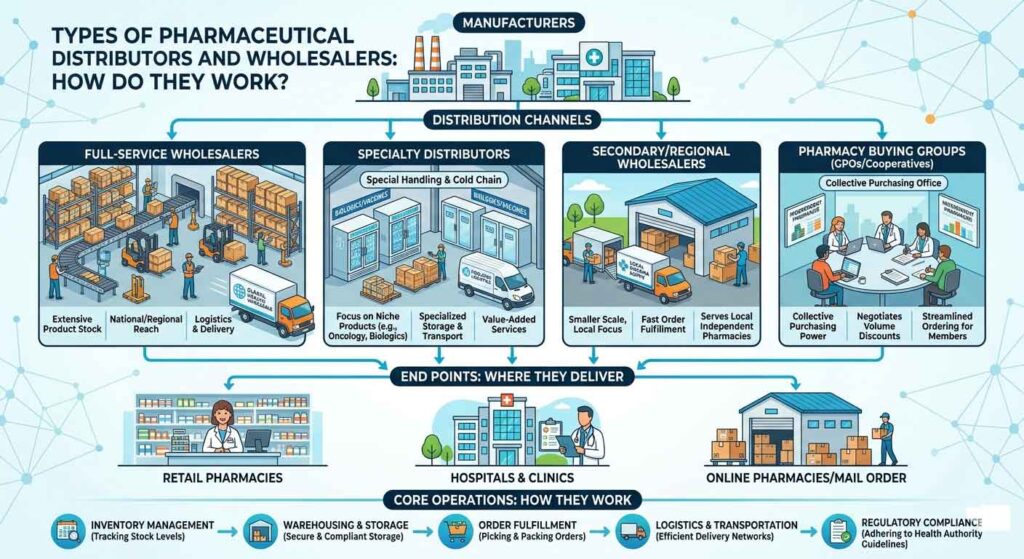
Pharmaceutical distributors act as the link between pharmaceutical companies and the final points of sale, such as pharmacies, hospitals, clinics, and healthcare institutions. Depending on their business model, distributors may only handle supply and logistics or may also participate in marketing and promotional activities.
The major types of pharmaceutical distributors in India include:
Ethical (Branded) Pharma Distributors
Generic Pharma Distributors
PCD/Franchise Pharma Distributors
OTC (Over-the-Counter) Distributors
Institutional Supply Distributors
Understanding how each model works can help you select the right business opportunity based on your experience, investment capacity, and local market conditions.
Query
I want to start medicine wholesale distribution in my location. I have 15 years of industrial sales experience but not in pharmaceuticals. Could you guide me on how the medicine market works and which medicine segment is good for sale—cardiac, diabetic, general, etc.?
Fifteen years of sales experience is a significant advantage. While pharmaceutical distribution has its own dynamics, the fundamentals of relationship building, customer service, and market development remain the same.
Before choosing a segment, it is important to understand how pharmaceutical distribution actually works.
How Does Pharmaceutical Distribution Work?
In its simplest form, the pharmaceutical supply chain looks like this:
However, the role of the distributor changes depending on the type of pharmaceutical business.
1. Ethical (Branded) Pharma Distributors
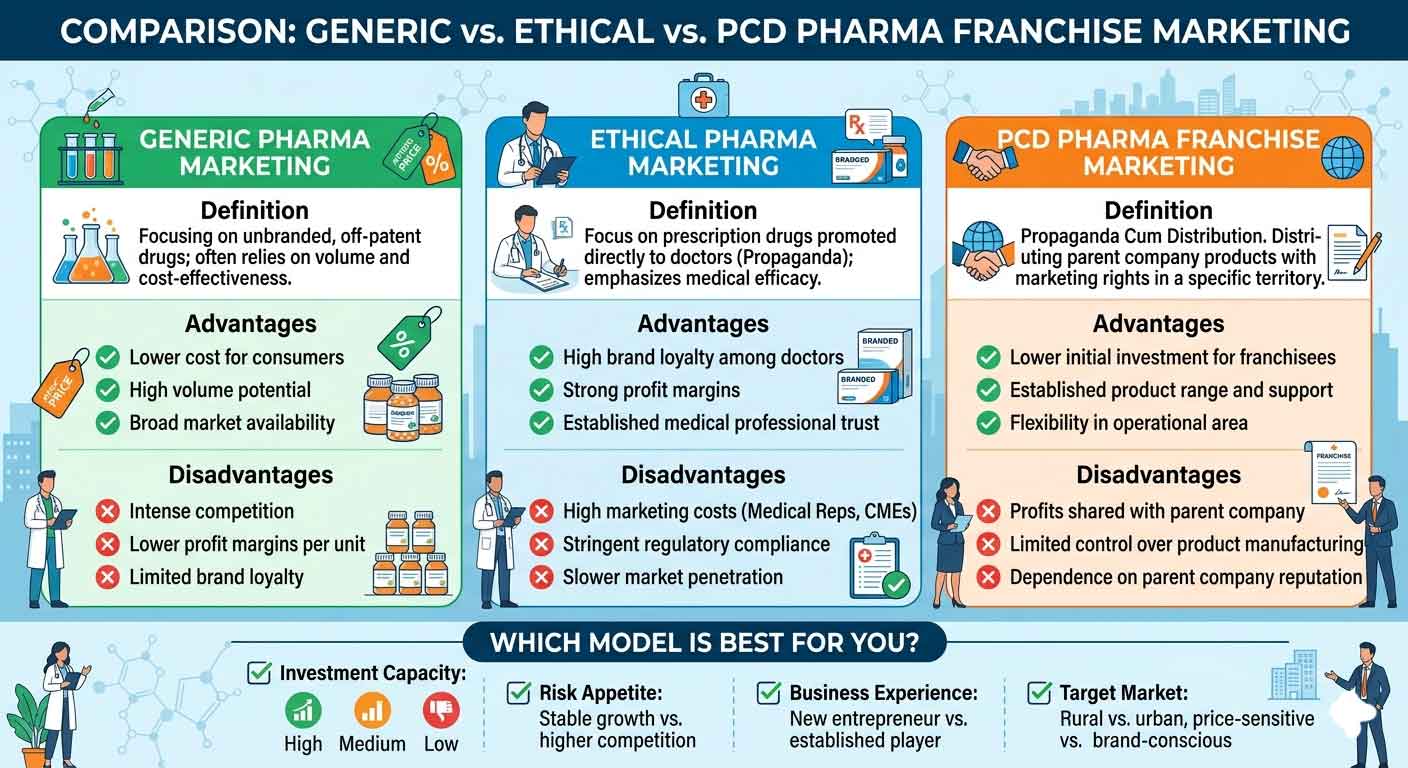
Ethical pharmaceutical distribution is based on prescription demand generated by doctors.
How It Works
Pharmaceutical companies appoint Medical Representatives (MRs) to promote products to doctors.
Doctors prescribe medicines.
Patients purchase those medicines from pharmacies.
Pharmacies place orders through distributors.
Business Flow
Company → Medical Representative → Doctor → Chemist → Distributor → Patient
Key Features
Prescription-driven demand
Fixed trade margins
Strong support from pharmaceutical companies
Doctor-centric marketing
Advantages
✓ Established brands
✓ Predictable demand
✓ Company-managed promotion
Challenges
Competition among multiple brands
Credit management
Dependence on prescription generation
2. Generic Pharma Distributors
Generic distributors primarily focus on supplying lower-cost alternatives directly to retailers.
How It Works
Distributor → Retailer → Patient
Unlike ethical products, generic distributors often generate demand themselves by approaching pharmacies directly.
Key Features
Competitive pricing
Flexible margins
Retailer-focused sales
Advantages
✓ Better pricing flexibility
✓ Lower promotional costs
✓ Growing acceptance among consumers
Challenges
High price competition
Dependence on retailer relationships
Longer credit cycles
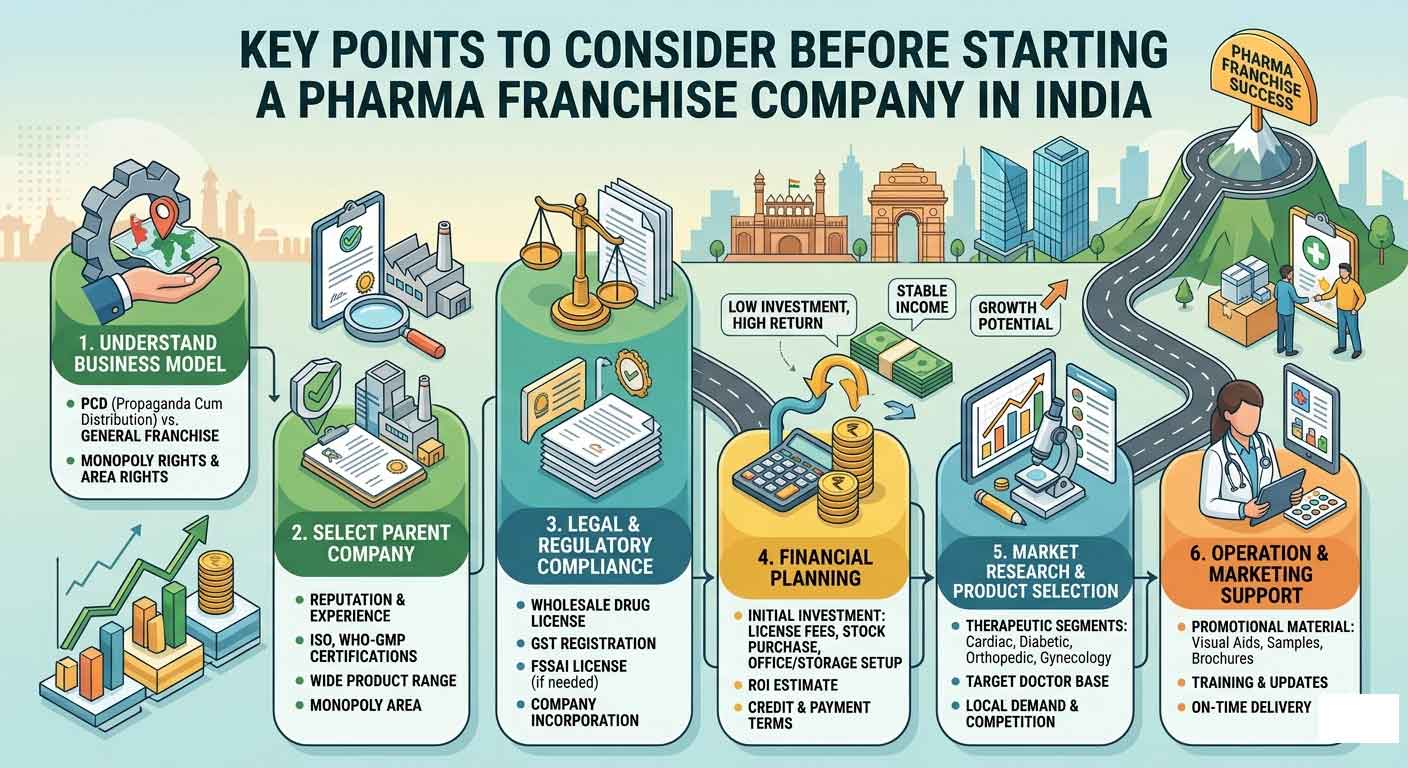
3. PCD (Propaganda Cum Distribution) Pharma Distributors
PCD distribution combines marketing with distribution.
The distributor functions as an entrepreneur responsible for promoting and selling the company’s products within a designated territory.
How It Works
Company → PCD Distributor → Doctor → Chemist → Patient
The company supplies products and promotional materials.
The distributor handles:
Doctor coverage,
Retailer development,
Local marketing,
Sales activities.
Key Features
Monopoly or semi-exclusive territories
Entrepreneurial model
Independent operations
Advantages
✓ Lower investment compared to manufacturing
✓ Freedom to build your own team
✓ Good profit potential
Challenges
Local marketing responsibility
Need for field execution
Relationship management
4. OTC (Over-the-Counter) Pharma Distributors
OTC products are consumer healthcare products that can generally be purchased without a prescription, subject to applicable regulations.
Examples
Vitamins and supplements
Wellness products
Certain topical products
Personal care products
How It Works
Company → Distributor → Retailer → Consumer
Advantages
✓ High repeat business
✓ Consumer-driven demand
✓ Growing wellness market
Challenges
Retail competition
Brand-building requirements
5. Institutional Supply Distributors
Institutional distributors supply products directly to healthcare institutions.
Customers Include
Government hospitals
Private hospitals
Nursing homes
Clinics
Healthcare organizations
How It Works
Company → Institutional Distributor → Institution → Patient
Advantages
✓ Bulk orders
✓ Stable customer base
✓ Large transaction volumes
Challenges
Tender procedures
Documentation requirements
Longer payment periods
Which Pharma Segment Should You Choose?
Many new distributors ask whether they should focus on:
Cardiology
Diabetology
General Medicine
Gynecology
Dermatology
Pediatrics
Orthopedics
Respiratory
The reality is:
There is no “best” segment for everyone.
Success depends more on local demand and execution than the therapy segment itself.
Factors to Consider
Doctor availability in your area
Competition levels
Existing market demand
Investment capacity
Your comfort with the therapy area
Recommendation for Beginners
If you are entering the pharmaceutical market for the first time, consider starting with:
General medicine products
Chronic therapy products
Fast-moving products
Selected specialty products based on local demand
This provides a balanced portfolio while reducing risk.
How to Start a Pharma Wholesale Distribution Business
Step 1: Complete Registrations
Typically, you may require:
Appropriate wholesale drug licence
GST registration
Business registration
Current account in the business name
Requirements may vary by state.
Step 2: Select Your Distribution Model
Choose whether you want to become:
Ethical distributor
Generic distributor
PCD distributor
Institutional supplier
Step 3: Identify Suitable Companies
Evaluate companies based on:
Product quality
Product availability
Service standards
Reputation
Commercial policies
Step 4: Finalize Commercial Terms
Discuss:
Trade margins
Credit policies
Expiry replacement
Promotional support
Order quantities
Step 5: Build a Territory Database
Prepare a list of:
Doctors
Chemists
Hospitals
Clinics
Nursing homes
A good understanding of your market is a major competitive advantage.
Step 6: Research Fast-Moving Products
Study:
Frequently prescribed medicines
Seasonal demand
Chronic therapy trends
Local prescribing patterns
Data-driven decisions reduce inventory risk
Step 7: Focus on Relationships and Service
Pharmaceutical distribution is built on trust.
Your long-term success depends on:
Product availability
Timely delivery
Prompt communication
Ethical business practices
Consistent service
Often, superior service creates stronger customer loyalty than aggressive selling.
Final Thoughts
Pharmaceutical distribution offers excellent opportunities for professionals with strong sales backgrounds.
Whether you choose ethical products, generic medicines, PCD franchise, or institutional supply, sustainable growth comes from:
Understanding your market,
Managing finances wisely,
Building relationships,
Providing reliable service,
Maintaining professional ethics.
Your fifteen years of industrial sales experience can become a significant advantage in the pharmaceutical sector.
Start with a manageable product range, learn continuously, and expand steadily.
Frequently Asked Questions
Which type of pharmaceutical distribution is best for beginners?
Many newcomers find PCD distribution or general pharmaceutical distribution easier to start because of their lower complexity and investment requirements.
Can I become a pharmaceutical distributor without prior pharma experience?
Yes. Sales experience, business discipline, and a willingness to learn can compensate for limited pharmaceutical experience.
Is generic distribution more profitable than ethical distribution?
Both models can be profitable. Generic distribution often provides greater margin flexibility, while ethical distribution benefits from prescription-based demand.
Can I distribute products from multiple companies?
Yes, subject to your agreements with those companies and compliance with applicable regulations.
Which medicine segment should I start with?
General medicine and fast-moving chronic therapy products are often suitable starting points, but the ideal segment depends on your local market conditions.
Is institutional supply suitable for first-time entrepreneurs?
It can be, but it requires familiarity with tender procedures, documentation, and managing longer payment cycles.
Partner with Elzac Herbal India
Looking to start an Ayurvedic franchise, become a distributor, or launch your own herbal product range?
Elzac Herbal India offers:
Ayurvedic & Herbal Product Range
Franchise & Distribution Opportunities
Third-Party Manufacturing Services
Product Development Support
Marketing Guidance
PAN India Business Opportunities
Whether you are an entrepreneur, retailer, distributor, or healthcare professional, our team can help you explore the right business opportunity in the growing Ayurvedic sector.
Ajay Kamboj is an entrepreneur and business owners associated with many Ayurvedic and Pharmaceutical start-ups. With years of experience in Ayurvedic product marketing, pharmaceutical distribution, franchise development, and client relationship management, he regularly shares practical business insights based on real-world experiences. His articles focus on business growth, entrepreneurship, customer management, and lessons learned from the healthcare and wellness industry.
One response to “Type of Distributor and Wholesaler In Pharmaceutical Sector. How They work?”
I am a whole seller I surgical disposable and general medicine.please tell the online markets to sell my products.And what’s the procedure of whole seller cum retailer licence.

I am a whole seller I surgical disposable and general medicine.please tell the online markets to sell my products.And what’s the procedure of whole seller cum retailer licence.