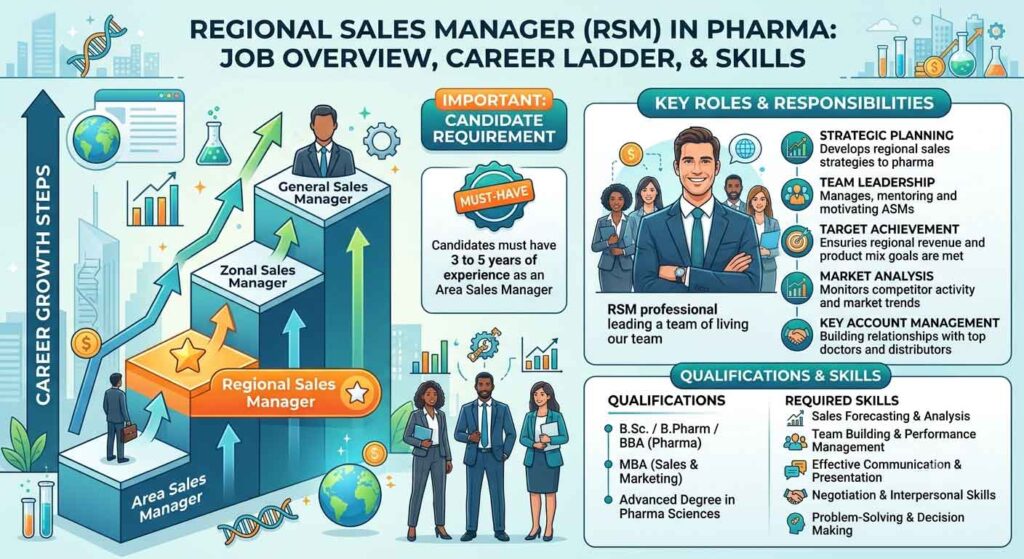
A Regional Sales Manager (RSM) is one of the key managerial positions in a pharmaceutical sales team. The RSM manages a team of Area Sales Managers (ASMs) and Medical Representatives (MRs) within a specific region.
In most pharma companies, a hardworking and experienced Area Sales Manager is promoted to the position of Regional Sales Manager after consistently achieving sales targets, managing teams effectively and developing strong market relationships.
The role of an RSM is similar to an ASM, but with a larger territory, bigger team, higher sales responsibility and greater involvement in business planning.
RSM Full Form in Pharma Sales
RSM stands for Regional Sales Manager.
In pharmaceutical sales and marketing, the Regional Sales Manager is also known as:
Regional Business Manager
Second Line Manager
Regional Manager
Sales Region Head
Regional Sales Head
The designation may vary from company to company, but the core responsibility remains the same: to manage sales growth and team performance across a region.
What Is a Regional Sales Manager?
A Regional Sales Manager is a second-line sales manager who leads a team of Area Sales Managers and ensures that the company’s sales targets are achieved across the assigned region.
The RSM guides, motivates and monitors ASMs and MRs to improve doctor coverage, product promotion, stock availability, distributor coordination and overall sales performance.
An RSM also works closely with important doctors, distributors, hospitals and senior company management to develop business in the region.
In simple words:
An ASM manages Medical Representatives, while an RSM manages Area Sales Managers and the overall sales performance of a region.
Position of RSM in Pharma Sales Hierarchy
A typical pharma sales hierarchy may look like this:
The exact structure may differ depending on company size, product division and sales model.
In smaller companies, an RSM may directly report to the Sales Head. In larger companies, the RSM usually reports to the Zonal Sales Manager.
Main Role of Regional Sales Manager in Pharma
The main role of an RSM is to convert company sales strategy into regional business growth.
An RSM is responsible for:
Achieving regional sales targets
Managing Area Sales Managers
Monitoring Medical Representative performance
Developing doctors and distributor networks
Planning regional sales activities
Reviewing product-wise and territory-wise sales
Building strong market relationships
Supporting product launches
Monitoring competitor activity
Reporting to senior management
Roles and Responsibilities of Regional Sales Manager
1. Managing Area Sales Managers
The RSM manages a team of ASMs who are responsible for different territories.
This includes:
Reviewing ASM performance
Guiding them in fieldwork
Monitoring their team management
Helping them solve market problems
Training them for better leadership
Ensuring discipline and regular reporting
A good RSM develops strong ASMs who can independently handle their areas.
2. Achieving Regional Sales Targets
The RSM is responsible for achieving sales targets for the entire assigned region.
Sales targets may be reviewed:
Monthly
Quarterly
Half-yearly
Yearly
The RSM tracks performance based on:
Product-wise sales
Area-wise sales
ASM-wise performance
MR-wise productivity
New product sales
Stockist-wise business
Growth compared to previous year
3. Preparing Regional Sales Plans
An RSM prepares regional sales plans according to company goals.
Planning may include:
Monthly sales planning
Product promotion strategy
Territory development plan
Doctor coverage plan
New product launch plan
Distributor appointment plan
Sales growth plan
Weak-area improvement plan
Strong planning helps the company achieve sustainable growth.
4. Making Monthly Work Plans for ASMs
The RSM reviews and approves monthly work plans of ASMs.
These plans may include:
Joint fieldwork schedule
Doctor visit planning
Stockist visit planning
MR review meetings
Campaign planning
Product focus planning
Sales target follow-up
Regular follow-up ensures proper field implementation.
5. Conducting Joint Fieldwork
An RSM regularly joins ASMs and MRs in the field.
During joint fieldwork, the RSM:
Meets important doctors
Observes ASM and MR performance
Supports difficult calls
Checks product detailing quality
Guides the field team
Collects market feedback
Builds relationships with key customers
Joint fieldwork helps the RSM understand real market conditions.
6. Building Relationships with Doctors and Healthcare Professionals
An RSM plays an important role in developing relationships with key doctors, hospitals, clinics and healthcare professionals.
This is especially important for:
High-value doctors
Key opinion leaders
Hospital consultants
Specialists
Product launch support
Regional brand development
Strong doctor relationships help build long-term business.
7. Distributor and Stockist Management
The RSM must maintain strong coordination with distributors and stockists.
Responsibilities include:
Appointment of new distributors
Reviewing distributor performance
Checking stock availability
Managing claims and settlements
Ensuring timely payments
Monitoring primary and secondary sales
Solving supply-related issues
Supporting distributor relationships
Without proper stock availability, prescription generation cannot convert into actual sales.
8. Sales Analysis
An RSM regularly analyzes sales performance.
Important sales analysis areas include:
Value-wise sales
Product-wise sales
Territory-wise sales
Growth percentage
Target vs achievement
Fast-moving products
Slow-moving products
New product performance
Competitor impact
Stock movement
Sales analysis helps the RSM identify opportunities and problem areas.
9. Team Building and Motivation
A Regional Sales Manager must build a strong and motivated sales team.
Team-building responsibilities include:
Motivating ASMs and MRs
Removing field obstacles
Supporting underperforming team members
Recognizing good performance
Creating a positive work culture
Developing future leaders
Maintaining healthy communication
A motivated team can deliver better results even in competitive markets.
10. Recruitment and Induction
An RSM may participate in selecting new team members.
This includes:
Interviewing candidates
Selecting ASMs or MRs
Inducting new employees
Introducing them to the market
Training them about company products
Explaining reporting systems
Guiding them about field discipline
Good recruitment directly affects future sales performance.
11. Organizing Doctor Meetings and Conferences
An RSM may organize or supervise promotional activities such as:
Doctor meetings
CME programs
Product launch meetings
Healthcare seminars
Retailer meetings
Stockist meetings
Patient awareness campaigns
These activities help improve brand awareness and doctor engagement.
12. Monitoring Competitor Activities
An RSM must keep track of competitors in the region.
Competitor analysis includes:
New product launches
Pricing changes
Promotional strategies
Doctor coverage
Distributor schemes
Field-force activity
Market feedback
Strengths and weaknesses of competing brands
This information helps the company improve its regional strategy.
13. Coordinating With Head Office
The RSM acts as a link between field teams and company management.
The RSM communicates:
Market feedback
Sales performance
Product demand
Stock issues
Team requirements
Competitor updates
Promotional material needs
New product suggestions
This helps management take better business decisions.
14. Reporting to Senior Management
The Regional Sales Manager submits reports to senior authorities such as the Zonal Sales Manager, General Sales Manager or Sales Head.
Reports may include:
Regional sales report
Product-wise sales report
ASM performance report
MR productivity report
Stockist performance report
Expense report
Tour plan
Market feedback report
Competitor activity report
Monthly business review report
Most companies now use online reporting systems, mobile apps or CRM software.
Qualification Required for Regional Sales Manager
Qualification requirements vary from company to company.
Commonly preferred qualifications include:
Graduation in any stream
B.Pharma, B.Sc. or life-science background may be preferred
MBA in marketing may be an added advantage
Strong pharma sales experience is usually more important than academic qualification
Most companies prefer candidates with 3 to 5 years of experience as an Area Sales Manager before promoting them to RSM.
Skills Required for Regional Sales Manager
A successful Regional Sales Manager should have strong managerial, analytical and field-sales skills.
Important skills include:
1. Leadership Skills
The RSM must lead ASMs and MRs with confidence and clarity.
2. Team-Building Ability
A good RSM builds a strong, motivated and disciplined team.
3. Sales Planning
The RSM should be able to prepare practical sales plans for the region.
4. Communication Skills
Clear communication is needed for doctors, distributors, field teams and senior management.
5. Product Knowledge
Strong product knowledge helps in field training and doctor discussion.
6. Analytical Ability
The RSM must analyze sales data, market trends and team performance.
7. Networking Skills
Good networking with doctors, distributors and healthcare professionals helps business growth.
8. Problem-Solving Skills
Field sales involves daily challenges. An RSM must solve problems quickly and practically.
9. Market Knowledge
The RSM should understand the region, competitors, doctors, distributors and product demand.
10. Motivation Skills
The RSM must inspire the sales team to achieve targets.
Important Qualities of a Good RSM
A good Regional Sales Manager should be:
Inspiring
Practical
Disciplined
Target-oriented
Hardworking
Good listener
Strong motivator
Good planner
Confident
Flexible
Ethical
Result-focused
Strong in follow-up
Good at relationship building
How Much Area Does an RSM Cover?
The area covered by an RSM depends on company policy, business volume and team size.
An RSM may handle:
2 to 5 Area Sales Managers
Multiple districts
One full state
Part of a state
Multiple small states
A high-potential region
The exact area depends on product range, company turnover, market size and sales structure.
To Whom Does an RSM Report?
A Regional Sales Manager usually reports to:
Zonal Sales Manager
General Sales Manager
National Sales Manager
Sales Head
In smaller companies, the RSM may report directly to the company owner or director.
How Does an RSM Submit Reports?
Most companies now use digital reporting systems.
An RSM may submit reports through:
CRM software
Mobile reporting app
Company sales portal
Email
Excel sheets
Monthly review meetings
Video meetings
WhatsApp groups, in smaller companies
Reports may be submitted daily, weekly, monthly, quarterly or annually.
Difference Between Regional Sales Manager and Area Sales Manager
Point
Area Sales Manager
Regional Sales Manager
Position
First-line manager
Second-line manager
Team handled
Medical Representatives
Area Sales Managers and MRs
Area covered
Smaller area
Larger region
Main focus
Field sales execution
Regional sales management
Reporting to
RSM or RBM
ZSM or Sales Head
Responsibility
Area target
Regional target
Fieldwork
More direct doctor-level work
Fieldwork plus regional planning
Promotion path
Can become RSM
Can become ZSM or higher
RSM vs ASM: Simple Explanation
An ASM is closer to daily field execution and directly manages Medical Representatives.
An RSM manages multiple ASMs and focuses more on regional planning, team development, sales analysis, distributor management and overall regional growth.
Both roles are important, but the RSM carries broader responsibility.
Career Growth After RSM
After gaining experience as a Regional Sales Manager, a person may grow to higher positions such as:
Zonal Sales Manager
Divisional Sales Manager
General Sales Manager
National Sales Manager
Sales Head
Business Unit Head
Marketing Head
Commercial Head
Career growth depends on performance, leadership ability, region growth and company opportunities.
How to Find RSM Jobs in Pharma
RSM jobs can be found through:
Internal promotion
Job portals
Pharma recruitment consultants
LinkedIn
Company career pages
Internal references
Pharma industry networks
Direct applications to companies
Popular job portals include:
Naukri
LinkedIn
Indeed
Shine
Foundit
TimesJobs
Internal references play an important role in pharma sales recruitment.
Tips to Become a Successful RSM
To become a successful Regional Sales Manager:
Stay connected with your ASMs and MRs.
Review sales regularly.
Focus on product-wise growth.
Maintain strong distributor relationships.
Visit important doctors personally.
Train weak team members.
Motivate good performers.
Monitor competitor activities.
Ensure product availability.
Keep communication clear.
Report honestly to seniors.
Plan for long-term regional growth.
Final Thoughts
The Regional Sales Manager is a critical position in pharmaceutical sales management.
An RSM is responsible for managing a bigger team, larger territory and higher business volume than an Area Sales Manager. The role requires leadership, planning, market knowledge, team motivation and strong sales analysis.
A successful RSM does not only manage sales numbers. He builds teams, develops territories, strengthens doctor relationships and creates long-term growth for the company.
For Area Sales Managers who want to grow in pharma sales, becoming an RSM is the next major step in their career.
Frequently Asked Questions
1. What is the full form of RSM in pharma?
RSM stands for Regional Sales Manager.
2. What is the role of RSM in pharma?
The RSM manages Area Sales Managers, Medical Representatives, regional sales targets, distributor coordination, doctor relationships and overall sales growth in a region.
3. Is RSM higher than ASM?
Yes. RSM is a higher position than ASM. An ASM manages MRs, while an RSM manages ASMs and regional sales performance.
4. Who reports to an RSM?
Area Sales Managers usually report to the RSM. In some companies, senior Medical Representatives may also report directly to the RSM.
5. Who does an RSM report to?
An RSM usually reports to a Zonal Sales Manager, General Sales Manager or Sales Head.
6. What qualification is required for RSM?
Graduation is usually required. A B.Pharma, science background or MBA may be preferred, but pharma sales experience and team management ability are more important.
7. How much experience is required to become an RSM?
Most companies prefer candidates with 3 to 5 years of successful experience as an Area Sales Manager.
8. What is the difference between ASM and RSM?
ASM is a first-line manager who handles Medical Representatives. RSM is a second-line manager who handles ASMs and manages a larger region.
9. What skills are required for RSM?
Important skills include leadership, team management, sales planning, communication, analysis, doctor relationship, distributor management and market knowledge.
10. What is the next promotion after RSM?
The next promotion after RSM is usually Zonal Sales Manager or Divisional Sales Manager.
Looking for Ayurvedic Franchise or Distribution Opportunities?
Looking to start an Ayurvedic franchise, become a distributor, or launch your own herbal product range?
Elzac Herbal India offers:
Ayurvedic & Herbal Product Range
Franchise & Distribution Opportunities
Third-Party Manufacturing Services
Product Development Support
Marketing Guidance
PAN India Business Opportunities
Whether you are an entrepreneur, retailer, distributor, or healthcare professional, our team can help you explore the right business opportunity in the growing Ayurvedic sector.
Ajay Kamboj is an entrepreneur and business owners associated with many Ayurvedic and Pharmaceutical start-ups. With years of experience in Ayurvedic product marketing, pharmaceutical distribution, franchise development, and client relationship management, he regularly shares practical business insights based on real-world experiences. His articles focus on business growth, entrepreneurship, customer management, and lessons learned from the healthcare and wellness industry.
4 responses to “Regional Sales Manager (RSM) in Pharma: Job Description, Roles, Responsibilities, Qualification and Skills”







Nice Information, Short and Important. Thank you…
Good information
Thanks for Valuable Advice in This Article
Very useful information, thank you very much