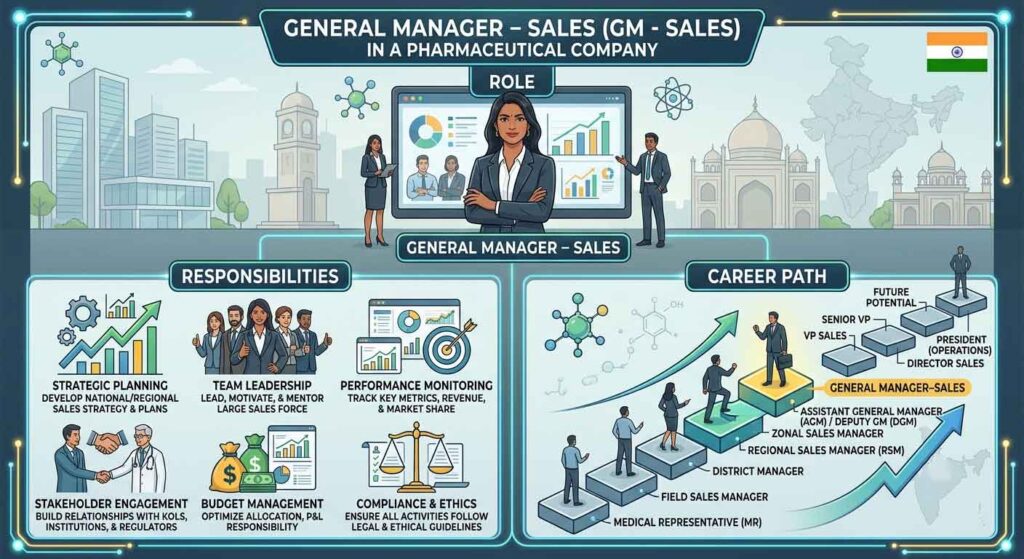
The General Manager–Sales, commonly referred to as GM-Sales, is one of the most senior positions in a pharmaceutical sales organisation.
A sales professional normally reaches this position after gaining substantial experience in field sales, team management, territory development, forecasting and business strategy.
Unlike a Medical Representative or Area Sales Manager, a GM-Sales is not responsible only for one territory or district. Depending on the size and structure of the company, the GM may supervise several regions, zones, business divisions or even the company’s complete domestic sales operation.
The title and responsibilities may vary between pharmaceutical companies, but the central purpose remains the same:
To develop and execute the company’s sales strategy, lead the sales organisation and achieve sustainable revenue growth.
Quick Answer
A General Manager–Sales is a senior sales leader responsible for:
Preparing sales plans and budgets
Setting regional and national targets
Managing zonal and regional sales teams
Reviewing sales performance
Developing new markets
Supporting product launches
Forecasting demand
Monitoring competitors
Coordinating with senior management
Ensuring ethical and compliant promotion
Building a strong and motivated sales organisation
The position involves less routine fieldwork than junior sales roles but considerably more responsibility, decision-making and mental pressure.
What Is a General Manager–Sales?
A General Manager–Sales can be defined as:
A senior executive who plans, directs and controls the sales activities of a company or business division and ensures that sales strategies are implemented effectively through the sales-management team.
In a pharmaceutical company, the GM-Sales may lead teams responsible for promoting products to:
Doctors
Hospitals
Pharmacies
Distributors
Stockists
Institutions
Government buyers
Franchise partners
Ayurvedic practitioners
Other healthcare professionals
The exact market depends on whether the company operates through:
Ethical or prescription marketing
Generic marketing
PCD or franchise marketing
OTC marketing
Institutional sales
Hospital sales
Ayurvedic marketing
Veterinary marketing
Position of GM-Sales in the Pharmaceutical Sales Hierarchy
A common pharmaceutical sales hierarchy may look like this:
Head of Sales, Sales Director or Vice President–Sales
In some smaller pharmaceutical companies, the GM-Sales may be the overall head of the sales department and report directly to the Managing Director.
In larger organisations, the GM may report to:
Sales Director
Vice President–Sales
Business Unit Head
Commercial Director
Chief Operating Officer
Managing Director
General Manager–Sales vs Sales Manager
The titles may sound similar, but the level of responsibility is different.
Factor
Sales Manager
General Manager–Sales
Area covered
Territory, area or region
Several regions, zones or national business
Team managed
Representatives or first-line managers
Zonal, regional and area managers
Focus
Execution of sales plan
Strategy, planning and organisation-wide execution
Reporting
Reports to senior sales leadership
Reports to top management or business head
Budget role
Limited
Significant
Forecasting
Area or regional level
Division or company level
Decision-making
Operational
Strategic and operational
Product launch role
Implements launch
Plans and monitors launch strategy
Key Responsibilities of a General Manager–Sales
1. Preparing Long-Term Sales Strategy
The GM-Sales helps define where the company wants to reach over the next several years.
Long-term planning may include:
Revenue-growth targets
Market expansion
New therapy areas
New divisions
New product categories
Institutional business
Export opportunities
Digital sales systems
Distribution expansion
Team-development plans
The strategy should be practical and supported by market data, product strength and company resources.
2. Setting Short-Term Sales Goals
The GM converts the broader business strategy into monthly, quarterly and annual objectives.
Targets may be set for:
Company sales
Zone
Region
Area
Product
Therapy segment
New product
New customer acquisition
Distributor appointment
Collection
Secondary sales
Prescription generation
Targets should be challenging but realistic.
Unrealistic targets may damage employee morale and encourage unhealthy selling practices.
3. Preparing the Annual Sales Budget
The GM-Sales is often involved in preparing the sales budget.
This may include:
Expected revenue
Product-wise sales
Territory-wise targets
Promotional expenses
Field-force cost
Travel budget
Samples
Conferences
Training
Incentives
Recruitment
New-product launch expenses
The GM must balance growth ambitions with profitability and available resources.
4. Sales Forecasting
Sales forecasting helps the company estimate future demand.
The GM may review:
Historical sales
Seasonal demand
Doctor coverage
Distributor stock
Product availability
Competitor activity
New launches
Market growth
Team vacancies
Price changes
Government policy changes
Good forecasting is important for:
Production planning
Inventory management
Purchase of raw materials
Packaging planning
Cash-flow management
Preventing stockouts
Avoiding overstocking
5. Reviewing Sales Performance
A GM-Sales regularly reviews sales performance at different levels.
Common reviews include:
Daily sales update
Weekly performance
Monthly sales review
Quarterly business review
Annual performance review
Product-wise analysis
Region-wise analysis
Manager-wise analysis
Customer-wise analysis
The purpose is not merely to identify low sales. The GM must understand why performance is above or below target.
Possible reasons include:
Product shortage
Territory vacancy
Weak doctor coverage
Poor distributor service
High pricing
Competitor launch
Low team motivation
Inadequate product knowledge
Delayed promotional material
Poor payment collection
6. Leading the Sales Team
A GM-Sales manages the sales organisation through senior and middle-level managers.
The GM should:
Set clear expectations
Communicate goals
Develop managers
Review performance fairly
Resolve conflicts
Recognise good work
Correct poor performance
Maintain discipline
Encourage teamwork
Build future leaders
A successful GM does not only demand results. The GM creates the conditions required for the team to achieve them.
7. Motivating Employees
Pharmaceutical sales can be demanding because employees face:
Frequent travel
Target pressure
Doctor waiting time
Market competition
Rejection
Product shortages
Payment problems
Managerial pressure
The GM should maintain motivation through:
Clear communication
Fair incentives
Recognition
Coaching
Career opportunities
Timely support
Practical target setting
Respectful leadership
Fear may produce temporary activity, but trust and development produce sustainable performance.
8. Recruitment and Workforce Planning
The GM-Sales may participate in recruitment for positions such as:
Zonal Sales Manager
Regional Sales Manager
Area Sales Manager
First-Line Manager
Medical Representative
Institutional Sales Manager
Key Account Manager
Workforce planning includes:
Identifying vacant territories
Estimating future team size
Approving replacements
Creating reporting structures
Reviewing employee productivity
Succession planning
Hiring should be based on competence and market fit, not only on previous sales figures.
9. Training and Development
The GM should ensure that employees receive proper training in:
Product knowledge
Disease knowledge
Communication
Doctor detailing
Objection handling
Territory management
Distributor management
Ethical promotion
Reporting
Digital tools
Leadership
Managers also require training in:
Coaching
Performance review
Conflict resolution
Target planning
Data interpretation
Team motivation
10. Coordinating With Company Management
The GM-Sales acts as an important link between top management and the field-sales organisation.
Top management may communicate:
Business objectives
Investment priorities
New product plans
Profitability requirements
Policy changes
Expansion plans
The GM then converts these decisions into field-level action.
Similarly, the GM brings field information back to management, including:
Customer feedback
Product complaints
Competitor activity
Market opportunities
Pricing concerns
Product shortages
Team issues
11. Coordinating With Marketing Department
Sales and marketing must work together.
The GM-Sales may coordinate with marketing regarding:
Product positioning
Promotional strategy
Visual aids
Medical literature
Samples
New product launches
Doctor segmentation
Campaign feedback
Market research
Conference participation
Marketing prepares the strategy and communication; sales executes it in the market and reports the response.
12. Coordinating With Supply Chain and Production
Sales cannot grow if products are unavailable.
The GM may coordinate with:
Production
Purchase
Warehouse
Distribution
Logistics
C&F agents
The purpose is to ensure:
Product availability
Timely dispatch
Correct stock allocation
Reduced expiry risk
Management of high-demand products
Launch-stock availability
Resolution of supply complaints
13. Distributor and Stockist Management
The GM may review the company’s distribution network.
Responsibilities can include:
Appointing distributors
Evaluating stockists
Reviewing stock levels
Monitoring secondary sales
Resolving supply issues
Managing credit policies
Reviewing payment collection
Preventing excessive inventory
Improving market coverage
A distributor should not be forced to hold stock far beyond realistic market demand.
14. New Product Launches
A new product launch requires coordination across several departments.
The GM-Sales may be involved in:
Estimating sales potential
Selecting launch territories
Setting targets
Training the sales team
Planning initial stock
Identifying key doctors
Monitoring prescription generation
Reviewing launch performance
Collecting market feedback
A launch should be judged not only by primary dispatch but also by repeat orders and actual market movement.
15. Market Development
The GM identifies opportunities for growth.
These may include:
New territories
Uncovered districts
New hospitals
New specialties
New therapy segments
New distribution channels
Digital customer engagement
PCD franchise expansion
Institutional tenders
Expansion should be supported by market potential, manpower and supply capability.
16. Competitor Analysis
The GM should monitor:
New product launches
Price changes
Promotional strategies
Field-force expansion
Distributor schemes
Product availability
Doctor response
Brand positioning
New combinations
Market share trends
Competitor monitoring should be used to improve strategy, not to copy claims or engage in unfair practices.
17. Customer and Key Account Management
The GM may personally manage or supervise important relationships with:
Large hospitals
Institutional buyers
Key distributors
Major stockists
Corporate chains
High-value franchise partners
The objective should be to create sustainable relationships rather than dependence on personal influence alone.
18. Collection and Credit Control
Sales without payment can create serious cash-flow problems.
The GM may review:
Outstanding payments
Credit limits
Overdue accounts
Distributor payment history
Sales-return risk
Blocked orders
Collection targets
The sales team should coordinate with finance while maintaining professional customer relationships.
19. Ensuring Ethical and Compliant Promotion
The pharmaceutical sector requires responsible promotion.
The GM should ensure that the team does not:
Make unsupported claims
Promote unapproved indications
Hide important safety information
Misuse medical samples
Offer prohibited personal benefits
Create misleading comparisons
Use outdated literature
Encourage irrational use of medicines
Sales growth should not come at the cost of patient safety or company compliance.
20. CRM and Sales-Data Management
Modern sales teams increasingly use:
CRM software
Sales-force automation
Electronic daily-call reports
Distributor-management systems
Dashboards
Order-management software
Expense-management systems
The GM should ensure that data is:
Accurate
Updated
Useful
Reviewed
Protected
Not entered merely as a formality
Good data helps the company make better decisions.
21. Conducting Sales Meetings
The GM may lead:
Monthly sales meetings
Quarterly reviews
Annual sales conferences
Product-launch meetings
Strategy meetings
Budget meetings
Manager-development sessions
A productive meeting should result in:
Clear decisions
Assigned responsibilities
Deadlines
Follow-up
Measurable action points
22. Preparing Reports for Management
The GM collects information from the field organisation and submits consolidated reports to management.
Reports may include:
Sales achievement
Target comparison
Product performance
Regional performance
New customer development
Product launch status
Collections
Outstanding payments
Distributor inventory
Team vacancies
Competitor activity
Forecast
Action plan
The report should explain both results and reasons.
Key Performance Indicators for GM-Sales
A General Manager–Sales may be evaluated on:
Sales growth
Target achievement
Profitability
Collection efficiency
Market expansion
Product-wise growth
New product performance
Secondary sales
Distributor productivity
Employee retention
Team productivity
Vacancy control
Forecast accuracy
Stock availability
Expiry and return control
Compliance
Customer retention
Sales turnover alone does not provide a complete picture of performance.
Qualifications Required for GM-Sales
There is no single compulsory qualification for every GM-Sales position.
Companies may prefer candidates with:
B.Pharm
B.Sc.
MBA in Marketing
Postgraduate qualification
Life-science background
Extensive pharmaceutical sales experience
In many companies, practical experience, leadership and business performance may be more important than a particular degree.
Experience Required
The experience requirement depends on:
Company size
Therapy segment
Geographic coverage
Team size
Business turnover
Product portfolio
A GM-Sales generally requires substantial experience in roles such as:
Area Sales Manager
Regional Sales Manager
Zonal Sales Manager
National Sales Manager
Business Unit Manager
Previous experience as a Zonal or National-level manager is commonly valuable.
Promotion should depend on demonstrated leadership, not only years of service.
Skills Required for a General Manager–Sales
1. Strategic Thinking
The GM should understand long-term business direction and convert it into practical plans.
2. Leadership
The role requires the ability to guide managers with different personalities and experience levels.
3. Communication
The GM must communicate effectively with:
Management
Field team
Doctors
Distributors
Marketing
Finance
Production
4. Analytical Ability
The GM should interpret:
Sales reports
Market data
Expenses
Forecasts
Product performance
Team productivity
5. Decision-Making
The position requires timely decisions even when complete information is not available.
6. Negotiation
Negotiation may be needed with:
Distributors
Institutions
Vendors
Employees
Senior management
Business partners
7. Coaching Ability
A GM should develop managers instead of personally trying to control every representative.
8. Problem-Solving
Problems may involve:
Product shortage
Territory conflict
Employee resignation
Payment delay
Distributor dispute
Poor product response
Competitor pressure
9. Financial Understanding
The GM should understand:
Sales budget
Gross margin
Discounts
Expenses
Credit
Collections
Return on investment
10. Emotional Stability
Senior sales leadership involves pressure from both management and the field team.
The GM should remain calm, fair and solution-oriented.
Personal Qualities of a Successful GM-Sales
A successful General Manager–Sales should demonstrate:
Integrity
Discipline
Confidence
Patience
Accountability
Adaptability
Fairness
Professionalism
Future-oriented thinking
Competitive spirit
Respect for employees
Willingness to learn
The role requires a strong personality, but not an aggressive or disrespectful management style.
How Much Area Does a GM-Sales Cover?
The geographical area depends on company policy.
A GM may be responsible for:
Two or more zones
One business division
North, South, East or West India
Complete national sales
One therapeutic segment
One product group
Domestic plus institutional business
The area depends on:
Company turnover
Team size
Product range
Distribution structure
Market potential
Reporting hierarchy
To Whom Does GM-Sales Report?
A GM-Sales may report to:
Managing Director
Director–Sales
Vice President–Sales
Business Unit Head
Commercial Head
Chief Operating Officer
Chief Executive Officer
The GM normally receives reports from:
Zonal Sales Managers
Regional Sales Managers
National or Institutional Managers
Key Account Managers
Other senior sales managers
How to Become a General Manager–Sales
A typical career path may be:
Medical Representative → Area or First-Line Manager → Regional Sales Manager → Zonal Sales Manager → National Sales Manager or Deputy GM → General Manager–Sales
Progress depends on:
Consistent results
Team-development ability
Ethical conduct
Market knowledge
Leadership
Strategic thinking
Communication
Willingness to accept larger responsibilities
An employee should focus not only on achieving personal targets but also on developing the people reporting to them.
How to Find GM-Sales Jobs
General Manager–Sales positions are commonly filled through:
Internal promotion
Industry references
Executive recruitment consultants
Professional networking platforms
Company career pages
Job portals
Direct applications
Senior-management referrals
At this level, a professional profile should highlight:
Team size managed
Geographic coverage
Sales growth
Product launches
Market expansion
Turnaround assignments
Employee development
Collection improvement
Business planning
Compliance record
Avoid mentioning sales achievements without explaining the period, market and responsibility involved.
Challenges Faced by a GM-Sales
The position may involve:
Pressure to achieve ambitious targets
Balancing sales and profitability
Managing a large team
High employee turnover
Product shortages
Distributor credit issues
Competitor pressure
Regulatory restrictions
New product failures
Market changes
Conflict between departments
Maintaining employee motivation
Although routine fieldwork may decrease at senior levels, decision-making pressure and accountability increase.
Common Mistakes Made by Sales Leaders
A GM should avoid:
Setting impossible targets
Managing through fear
Ignoring field feedback
Focusing only on primary sales
Forcing excessive distributor stock
Blaming the team for supply problems
Promoting employees only on personal loyalty
Ignoring ethical compliance
Depending only on a few large customers
Holding meetings without action points
Taking credit for success and blaming others for failure
Micromanaging Medical Representatives directly
Ignoring coaching and succession planning
Final Thoughts
The General Manager–Sales is not simply the highest-ranking salesperson.
The role combines:
Strategy
Leadership
Forecasting
Team development
Market understanding
Financial discipline
Cross-functional coordination
Ethical responsibility
A strong GM-Sales builds a sales system that can perform consistently, rather than depending on temporary schemes, pressure or one individual.
The true success of a General Manager is reflected not only in sales figures, but also in the quality of the team, customer trust, sustainable growth and future leaders developed under their guidance.
Frequently Asked Questions
1. What is the main role of a GM-Sales?
The primary role is to plan and lead the company’s sales strategy, manage the sales organisation and achieve sustainable revenue growth.
2. Is GM-Sales higher than Zonal Sales Manager?
Generally, yes. A GM-Sales may supervise one or more Zonal Sales Managers, depending on company structure.
3. Does a GM-Sales visit doctors?
A GM may conduct selected field visits, joint work and key-customer meetings, but routine doctor coverage is usually handled by the field-sales team.
4. Is a pharmacy qualification compulsory?
Not in every company. Employers may prefer pharmacy, science or management qualifications, but experience and leadership ability are also important.
5. How many years of experience are required?
There is no fixed requirement. The role usually requires extensive pharmaceutical sales and senior-management experience.
6. Who reports to GM-Sales?
Zonal, Regional, Institutional, Key Account or other senior sales managers may report to the GM.
7. To whom does GM-Sales report?
The GM may report to the Managing Director, Sales Director, Vice President, Business Head or another senior executive.
8. What reports does a GM-Sales prepare?
Reports may cover sales achievement, forecast, regional performance, product performance, collections, inventory, team status and competitor activity.
9. What is the difference between GM-Sales and National Sales Manager?
The distinction depends on company structure. In some organisations, the National Sales Manager reports to the GM. In others, the titles may have similar responsibilities.
10. What is the most important quality of a GM-Sales?
The ability to convert business strategy into consistent team performance while maintaining trust, discipline and ethical standards is among the most important qualities.
Looking for Ayurvedic Franchise or Distribution Opportunities?
Looking to start an Ayurvedic franchise, become a distributor, or launch your own herbal product range?
Elzac Herbal India offers:
Ayurvedic & Herbal Product Range
Franchise & Distribution Opportunities
Third-Party Manufacturing
Product Development Support
Marketing Guidance
PAN India Business Opportunities
Whether you are an entrepreneur, retailer, distributor, or healthcare professional, our team can help you explore the right business opportunity in the growing Ayurvedic sector.
Ajay Kamboj is an entrepreneur and business owners associated with many Ayurvedic and Pharmaceutical start-ups. With years of experience in Ayurvedic product marketing, pharmaceutical distribution, franchise development, and client relationship management, he regularly shares practical business insights based on real-world experiences. His articles focus on business growth, entrepreneurship, customer management, and lessons learned from the healthcare and wellness industry.








Leave a Reply Cancel reply
You must be logged in to post a comment.