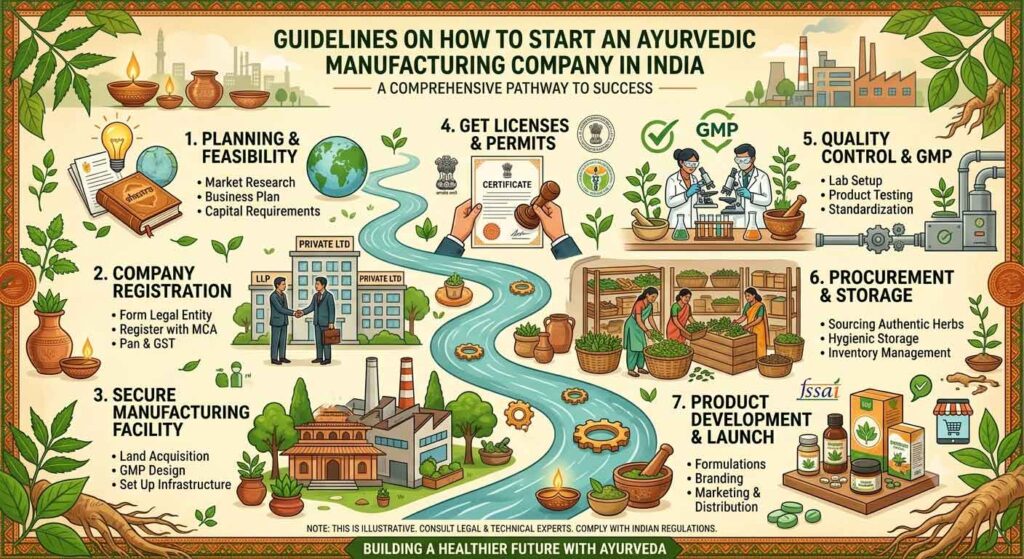
Starting an Ayurvedic manufacturing company requires careful planning, technical knowledge, a compliant premises, qualified personnel, product approvals, quality-control arrangements and sufficient working capital.
Ayurvedic medicines are regulated products. A business cannot legally manufacture medicines merely because:
The ingredients are natural.
The formula is traditional.
Production is small.
Products are sold only online.
Products are prepared at home.
The owner is an Ayurvedic practitioner.
Commercial manufacturing must be carried out under the applicable licence and in premises complying with Good Manufacturing Practices under Schedule T of the Drugs Rules, 1945. Manufacturers must also meet applicable safety, effectiveness and pharmacopoeial-quality requirements.
The practical sequence is:
Choose the product category → Prepare a business plan → Select an industrial premises → Design the facility under Schedule T → Recruit qualified technical staff → Install machinery and quality-control facilities → Apply through the State Licensing Authority → Obtain Form 25-D and GMP certification → Obtain product approvals → Manufacture and release controlled batches → Establish distribution, complaint and recall systems
What Is an Ayurvedic Medicine?
Under the Drugs and Cosmetics Act, an Ayurvedic drug generally includes a medicine intended for internal or external use in diagnosis, treatment, mitigation or prevention of disease and manufactured according to the formula described in authoritative books specified in the First Schedule.
Ayurvedic products are commonly divided into:
Classical Ayurvedic medicines
Patent or proprietary Ayurvedic medicines
Classical Ayurvedic Medicine
A classical medicine follows a formula given in an authoritative Ayurvedic text listed under the law.
A classical product should not be materially modified and still presented as the original classical formulation.
Patent or Proprietary Ayurvedic Medicine
A patent or proprietary Ayurvedic medicine is a formulation that is not itself taken exactly from an authoritative classical book but uses ingredients recognized in the authoritative books.
It does not mean:
The product is patented.
Any herbal ingredient may be used.
A food ingredient automatically becomes an Ayurvedic drug.
Any disease claim may be printed.
Patent or proprietary products are evaluated under the applicable licensing and evidence requirements. Rule 158-B prescribes requirements concerning safety and evidence of effectiveness for different categories of Ayurvedic, Siddha and Unani medicines.
Ayurvedic Medicine vs Food Supplement
A product should not be licensed as an Ayurvedic drug merely because it contains herbs.
Classification depends on:
Ingredients
Intended use
Formula
Claims
Dosage
Presentation
Applicable regulatory definition
A herbal protein powder, food beverage, gummy or general nutrition product may fall under FSSAI rather than Ayurvedic drug licensing.
The classification must be finalized before:
Developing the formula
Selecting the manufacturer
Applying for licences
Designing labels
Advertising the product
Ayurvedic Medicine vs Cosmetic
A herbal cream, shampoo, oil or face wash may be:
An Ayurvedic medicine
A cosmetic
A product requiring another classification
The category depends substantially on the formula and claims.
For example:
Cosmetic-type claim: “Moisturizes dry skin and improves appearance.”
Medicinal claim: “Treats eczema and fungal infection.”
The medicinal claim may require an appropriate drug licence and approved indication.
Can Ayurvedic Medicines Be Manufactured at Home?
An ordinary residential kitchen or household room is not a substitute for a licensed Schedule T manufacturing facility.
The premises should provide:
Hygienic manufacturing areas
Raw-material storage
Packing-material storage
Finished-goods storage
Quality-control facilities
Washing and cleaning
Quarantine areas
Rejected-goods storage
Documentation and records
Pest-control arrangements
Commercial manufacture through social media, local markets or an online store does not create an exemption from manufacturing licensing.
Select the Business Model
There are three main ways to enter the Ayurvedic medicine business.
1. Own Ayurvedic Manufacturing Unit
Under this model, the business establishes its own:
Factory
Machinery
Quality-control system
Technical staff
Manufacturing licence
GMP system
Raw-material and finished-goods inventory
The licence is granted in Form 25-D.
This model gives greater control but requires substantial capital and daily regulatory management.
2. Ayurvedic Loan Licence
A loan-licensee does not establish the complete manufacturing facility but uses another Form 25-D licensee’s approved manufacturing facilities under a separate regulatory arrangement.
The application is generally made in Form 24-E, and the loan licence is issued in Form 25-E.
A loan licence should not be confused with an ordinary purchase order placed with a third-party manufacturer.
3. Third-Party Ayurvedic Manufacturing
Under third-party manufacturing:
A licensed Ayurvedic manufacturer produces the medicines.
The marketing company owns or uses the brands.
Products are manufactured according to an agreed formula and approved product permission.
The parties execute a written manufacturing or marketing agreement.
This is usually the most practical model where the entrepreneur primarily wants to:
Build brands
Appoint distributors
Start PCD franchise
Market products
Avoid investment in a factory
Licence Forms
Requirement
Application or Approval
Own manufacturing application
Form 24-D
Own manufacturing licence
Form 25-D
Loan-licence application
Form 24-E
Loan licence
Form 25-E
GMP application
Form 24-E-I under the applicable state process
Approved testing laboratory application
Form 47
Manufacturing licence authority
State Licensing Authority
The Form 25-D manufacturing licence is generally perpetual unless suspended or cancelled. The GMP certificate is generally valid for five years and must be maintained according to the applicable regulatory process.
Who Issues the Ayurvedic Manufacturing Licence?
Ayurvedic manufacturing licences are granted and enforced by the State Drug Controller or State Licensing Authority appointed by the respective state or union territory.
The Ministry of Ayush develops national policies, standards and regulatory frameworks, but an entrepreneur does not ordinarily obtain the routine Form 25-D manufacturing licence directly from the central Ministry.
e-AUSHADHI Portal
The e-AUSHADHI system provides online licensing services for Ayurveda, Siddha, Unani and Homoeopathy manufacturers and drug-testing laboratories.
The exact workflow may depend on the state, but the portal is used for functions such as:
New licence applications
Product applications
GMP applications
Technical-person endorsements
Licence tracking
Product updates
Is GMP Certification Compulsory?
Yes. Ayurvedic manufacturing premises must comply with Schedule T Good Manufacturing Practices.
Schedule T covers matters such as:
Factory location and surroundings
Building and hygiene
Water
Waste disposal
Raw materials
Production
Quality control
Documentation
Storage
Personnel
Equipment
Complaints and recalls
Compliance with Schedule T is mandatory for licensing of Ayurveda, Siddha and Unani manufacturing units.
Minimum Area Required
A commonly applied state checklist requires approximately 1,200 square feet of compliant built-up premises for an initial manufacturing category.
This means built-up manufacturing and supporting space—not simply ownership of 1,200 square feet of vacant land.
State authorities may require additional space according to:
Number of dosage forms
Production capacity
Machinery
Raw-material volume
Separate sections
Products containing minerals or metals
Fermentation
Furnace or heating processes
Quality-control operations
Storage needs
Official state guidance in Kerala and Assam refers to a minimum 1,200-square-foot building or space for an initial manufacturing setup.
Do not lease or purchase the building before the proposed layout is reviewed by an experienced Schedule T consultant and, where possible, discussed with the concerned licensing office.
Typical Factory Areas
A professionally planned unit may require separate areas for:
Receipt of raw materials
Raw-material quarantine
Approved raw-material storage
Herb sorting and cleaning
Drying
Grinding and pulverizing
Sieving
Dispensing and weighing
Manufacturing
In-process material storage
Primary packaging
Secondary packaging
Finished-goods quarantine
Released finished goods
Rejected materials
Returned products
Quality-control laboratory
Retention samples
Equipment washing
Change rooms
Documentation
Waste storage
The actual layout depends on the dosage forms manufactured.
Dosage Forms and Sections
An Ayurvedic unit may manufacture one or more sections.
Churna and Powder Section
Possible operations include:
Herb cleaning
Drying
Pulverizing
Sieving
Blending
Filling
Sealing
Major controls include:
Dust extraction
Cross-contamination prevention
Sieve control
Cleaning
Moisture
Microbial quality
Tablet and Vati Section
Possible equipment includes:
Pulverizer
Sifter
Mass mixer
Granulator
Dryer
Blender
Tablet compression machine
Coating equipment
Packing machine
Capsule Section
Possible equipment includes:
Pulverizer
Sifter
Blender
Capsule-filling machine
Capsule-polishing machine
Metal detector
Bottle or blister-packing equipment
Syrup and Liquid Section
Possible equipment includes:
Purified-water system
Manufacturing vessels
Storage vessels
Homogenizer
Filtration equipment
Filling machine
Capping machine
Labelling machine
Taila and Ghrita Section
The unit may require:
Heating vessels
Steam-jacketed kettles
Filtration
Storage vessels
Filling and sealing equipment
Avaleha Section
Possible equipment includes:
Heating vessels
Mixing equipment
Concentration equipment
Filling equipment
Controlled cooling
Asava and Arishta Section
These products require controlled fermentation arrangements.
Such a section should not be added merely to increase the product catalogue.
Factory Location
Prefer a legally approved industrial area.
Before finalizing the premises, examine:
Land-use permission
Pollution category
Factory applicability
Water availability
Electricity load
Fire access
Waste disposal
Drainage
Road connectivity
Labour availability
Future expansion
Nearby contamination sources
Avoid premises near uncontrolled:
Sewage
Smoke
Dust
Chemical vapours
Pest sources
Open drains
Polluting industries
Owned or Rented Premises
The manufacturing premises may be:
Owned
Rented
Leased
A rented building should have:
Proper rent or lease agreement
Owner’s NOC
Ownership proof
Industrial-use permission
Adequate lease duration
Permission for structural modifications
Separate electricity and access arrangements where required
A short rental agreement is risky when the promoter will invest heavily in:
Flooring
Partitions
Machinery
Water systems
Laboratories
Fire controls
Utilities
Technical Staff
The required staffing depends on:
State checklist
Product categories
Raw materials
Testing arrangements
Number of sections
Scale of manufacturing
Common technical functions include:
Manufacturing Expert
The manufacturing section is commonly supervised by a qualified Ayurveda, Siddha or Unani professional, such as a BAMS, BSMS or BUMS graduate, according to the system being manufactured.
Quality-Control Chemist
A qualified person is required for chemical and analytical quality-control work.
State guidance may recognize qualifications such as:
B.Sc. Chemistry
B.Pharm
B.Pharm Ayurveda
Botanist or Pharmacognosy Function
Where crude herbs are received and identified, the unit may require a botanist or suitably qualified professional to verify:
Botanical identity
Plant part
Adulteration
Foreign matter
Macroscopic characteristics
Microscopic characteristics
Kerala’s current official guidance lists manufacturing, QC chemistry and botanical technical roles for a Form 25-D facility.
The State Licensing Authority’s checklist should be treated as the final requirement for the proposed plant.
Quality-Control Laboratory
An Ayurvedic manufacturer should establish suitable quality-control arrangements for:
Raw materials
Packing materials
In-process materials
Finished products
Water
Microbial quality
Stability
The laboratory may require sections for:
Pharmacognosy
Chemistry
Instrumental analysis
Microbiology
Retention samples
Reference standards
Recognized private testing laboratories may conduct approved tests under Rules 160-A to 160-J, but outsourcing does not remove the manufacturer’s responsibility for product quality.
Common Quality-Control Equipment
Depending on the products, equipment may include:
Analytical balance
pH meter
Moisture balance
Muffle furnace
Hot-air oven
Microscope
Soxhlet apparatus
Distillation equipment
UV-visible spectrophotometer
HPTLC or TLC arrangements
Microbial-testing equipment
Alcohol-testing equipment
Stability chambers
Disintegration apparatus
Friability tester
Hardness tester
The equipment list should be prepared from actual product specifications—not copied from a generic checklist.
Pharmacopoeial Standards
Ayurvedic medicines must meet applicable standards of identity, purity and strength prescribed in official pharmacopoeias and formularies.
The Pharmacopoeia Commission for Indian Medicine and Homoeopathy develops official standards and serves as the Central Drugs Laboratory for Indian Medicine and Homoeopathy. Compliance with relevant standards is mandatory.
Raw-Material Control
Every raw material should be controlled through:
Approved supplier
Purchase specification
Botanical name
Common or Sanskrit name
Part used
Source
Batch or lot number
Receipt date
Sampling
Identification
Testing
Approval or rejection
Storage condition
Expiry or retest date
Do not purchase herbs merely on the basis of:
Low rate
Common name
Visual similarity
Verbal assurance
Unverified certificate
Different plants may share similar regional names, creating a serious substitution risk.
Schedule TA Raw-Material Reporting
Ayurveda, Siddha and Unani manufacturers are required to maintain raw-material consumption data and submit the prescribed Schedule TA information for the preceding financial year by 30 June of the following year to the State Licensing Authority and the National Medicinal Plants Board.
The National Medicinal Plants Board provides an online submission system for this requirement.
Product Categories and Evidence
The product dossier should identify whether the medicine is:
Classical
Patent or proprietary
Balya or Poshak category
Intended for a particular indication
Made with Schedule E(1) ingredients
Intended for internal or external use
Rule 158-B determines the safety and effectiveness evidence expected for different categories. The requirement cannot be reduced to submitting only an ingredient list.
Product Application Information
A product application may require:
Brand name
Dosage form
Complete composition
Quantity of every ingredient
Botanical or scientific name
Part used
Classical reference
Page or verse reference
Manufacturing process
Finished-product specification
Test method
Dose
Indications
Cautions
Shelf life
Proposed label
Safety and effectiveness support
Preservatives and excipients
Supporting trial or experience data where applicable
Exact requirements vary according to the state and product category.
Brand-Name Selection
Before finalizing the brand:
Search existing trademarks.
Search similar medicine names.
Avoid names resembling government schemes.
Avoid names implying guaranteed cure.
Avoid names misleadingly suggesting approval.
Avoid copying another company’s brand.
A manufacturing licence or product permission does not create trademark ownership.
Labelling Requirements
The label should contain applicable declarations such as:
Name of the medicine
Product category
Complete ingredient information
Quantity of ingredients
Dose
Manufacturing licence number
Batch number
Manufacturing date
Expiry or use-before date
Net contents
Manufacturer’s name and address
Cautions
Storage conditions
Schedule E(1) warning where applicable
Marketed-by details where applicable
Rules governing Ayurvedic labelling are found in Part XVII of the Drugs Rules. The ingredients and quantities should be properly declared.
Schedule E(1) Ingredients
Certain potentially toxic ingredients are listed in Schedule E(1).
Where an internal medicine contains a Schedule E(1) substance, the label must carry the prescribed caution indicating that it should be taken under medical supervision.
Online sale of such products should also be handled carefully, including applicable prescription requirements.
Product Claims and Advertising
Do not make claims such as:
Guaranteed cure
Permanent cure
No side effects
100% safe for everyone
Clinically proven without evidence
Government-approved cure
Replaces all medical treatment
Cures serious disease within a fixed period
Advertisements of Ayush medicines remain subject to laws including:
Drugs and Magic Remedies (Objectionable Advertisements) Act
Consumer Protection Act
Media advertising rules
Applicable drug and labelling requirements
The Ayush Suraksha portal monitors adverse-drug-reaction reports and objectionable or misleading advertisements.
Pharmacovigilance
An Ayurvedic manufacturer should establish a system to receive and investigate:
Adverse-event reports
Product complaints
Unexpected reactions
Medicine interactions
Quality defects
Misuse reports
The belief that a product is natural does not remove the need for safety monitoring.
Ayush Suraksha was launched to capture suspected adverse reactions and misleading advertisements relating to Ayush medicines.
Manufacturing Documentation
The company should prepare controlled documents such as:
Site Master File
Quality manual
Standard operating procedures
Master formula records
Batch manufacturing records
Batch packing records
Raw-material specifications
Finished-product specifications
Test methods
Equipment logbooks
Cleaning records
Calibration records
Training records
Vendor-approval records
Complaint records
Recall records
Distribution records
Stability records
Important SOPs
SOPs may cover:
Raw-material receipt
Sampling
Approval and rejection
Cleaning
Pest control
Personnel hygiene
Dispensing
Manufacturing
Packaging
Equipment operation
Calibration
Maintenance
Deviation handling
Change control
Market complaints
Product recall
Returned goods
Destruction
Document control
Training
Batch Manufacturing Record
Every batch should have a traceable record containing:
Product name
Batch number
Batch size
Ingredient details
Raw-material batch numbers
Quantities required
Quantities actually used
Manufacturing steps
Processing time
In-process checks
Yield
Packaging details
Test report
Release authorization
Water System
The factory should have a controlled water supply suitable for its products.
The system may include:
Potable-water source
Filtration
Softening
Reverse osmosis
Storage tank
Distribution
Cleaning and sanitization
Water should be tested at defined intervals.
Environmental and Factory Approvals
Depending on the state, process and employee strength, the unit may need:
Consent to Establish
Consent to Operate
Pollution Control Board approval
Factory-plan approval
Factory licence
Fire NOC
Boiler approval
Electrical approval
Hazardous-waste authorization
Local trade permission
Labour registrations
A dry herbal-powder unit and a plant manufacturing fermented or mineral preparations may have different environmental requirements.
Other Business Registrations
Depending on the structure, registrations may include:
Proprietorship, partnership, LLP or company formation
PAN
GST registration
Current bank account
Udyam registration
Trademark
Import Export Code
Shops and Establishment or factory registration
Professional-tax registration
EPF and ESI where applicable
Udyam registration does not replace the manufacturing licence.
IEC is relevant only where import or export activity is planned.
GST on Ayurvedic Medicines
From 22 September 2025, drugs and medicines generally attract 5% GST except products specifically placed under the nil-rate category.
Product classification should still be confirmed because herbal foods, cosmetics and wellness products may fall under different HSN entries.
Documents Commonly Required
A Form 24-D application may require:
Business Documents
Constitution documents
PAN
Identity and address proofs
Authorization
Partnership deed or incorporation documents
Non-conviction declarations
Premises Documents
Ownership proof
Lease or rent agreement
Owner’s NOC
Utility bill
Site plan
Layout plan
Location plan
Industrial-use proof
Technical Documents
Technical-person qualifications
Registration documents
Experience documents where required
Appointment and joining letters
Identity proofs
Affidavits or declarations
Plant Documents
Machinery list
Laboratory-equipment list
Water-analysis report
HVAC or exhaust details where relevant
Waste-disposal details
Schedule T compliance documents
Site Master File
SOP list
Product Documents
Product list
Composition
Classical references
Manufacturing process
Specifications
Test methods
Safety and effectiveness evidence
Proposed labels
Brand declarations
The exact checklist is determined by the state authority and the product sections.
Inspection Process
The Licensing Authority may inspect:
Factory location
Premises
Layout
Machinery
Technical staff
Raw-material storage
Manufacturing sections
Laboratory
Records
Hygiene
Water
Waste disposal
Product applications
Schedule T compliance
Do not appoint staff or install equipment only for the inspection.
The facility should remain compliant throughout commercial operations.
Step-by-Step Procedure
Step 1: Select the Products
Decide which dosage forms and product categories will be manufactured.
Step 2: Conduct Market Research
Study:
Product demand
Competitors
Prices
Distribution
Third-party manufacturing demand
Raw-material availability
Step 3: Prepare the Business Plan
Calculate:
Plant capacity
Project cost
Working capital
Product cost
Sales projection
Break-even point
Step 4: Select the Legal Entity
Choose:
Proprietorship
Partnership
LLP
Private Limited Company
Step 5: Select the Premises
Confirm:
Industrial use
Schedule T layout
Area
Water
Electricity
Pollution requirements
Expansion space
Step 6: Obtain Preliminary Approvals
Arrange pollution, fire, factory and local approvals where applicable.
Step 7: Design the Facility
Finalize:
Personnel flow
Material flow
Manufacturing sections
Storage
Laboratory
Utilities
Waste movement
Step 8: Install Machinery
Purchase equipment matching the approved:
Products
Batch sizes
Processes
Capacity
Step 9: Recruit Technical Staff
Appoint genuine full-time manufacturing and quality personnel.
Step 10: Establish the Quality System
Prepare:
SOPs
Specifications
Batch records
Testing arrangements
Complaint and recall procedures
Step 11: Apply for Licence
Submit Form 24-D through the applicable state or e-AUSHADHI process.
Step 12: Apply for GMP
Complete the applicable Schedule T GMP application and certification process.
Step 13: Apply for Product Permissions
Submit each product with the required formula, evidence, specifications and label.
Step 14: Complete Inspection
Respond properly to deficiencies and observations.
Step 15: Obtain Form 25-D
Do not begin commercial manufacturing before licence and product approval.
Step 16: Manufacture Validation or Initial Batches
Follow approved batch records and complete quality testing.
Step 17: Release Through Quality Control
Only approved batches should enter saleable stock.
Step 18: Begin Distribution
Maintain batch-wise sales and traceability records.
Investment Required
There is no statutory fixed investment amount.
Investment depends on:
Premises
Dosage forms
Machinery
Laboratory
Technical staff
Raw materials
Packaging
Utilities
Environmental controls
Working capital
Broad Illustrative Investment Ranges
Business Model
Indicative Planning Range
Small Ayurvedic PCD or marketing company
₹4–12 lakh
Structured third-party marketing company
₹12–30 lakh
Small leased single-category manufacturing unit
₹40 lakh–₹1.25 crore
Multi-section Ayurvedic manufacturing unit
₹1.25–₹5 crore or more
Large automated or export-oriented facility
₹5 crore to several crores
Rasaushadhi, mineral or specialized processing addition
Additional project-specific investment
These are planning estimates—not government-fixed minimums.
Illustrative Small Manufacturing Budget
A small leased powder, tablet, capsule and liquid project may require:
Investment Head
Illustrative Amount
Premises deposit and initial rent
₹4,00,000
Schedule T civil work and partitions
₹12,00,000
Manufacturing machinery
₹20,00,000
Packing machinery
₹8,00,000
Water and utility systems
₹5,00,000
Quality-control laboratory
₹10,00,000
Licensing, consultancy and pre-operative work
₹4,00,000
Initial raw and packing materials
₹10,00,000
Six-month operating reserve
₹12,00,000
Contingency
₹8,00,000
Illustrative Total
₹93,00,000
The actual figure may be lower or substantially higher after quotations and state requirements are obtained.
Working-Capital Formula
Working Capital
=
Raw-Material Stock
+ Packing-Material Stock
+ Finished-Goods Stock
+ Customer Receivables
+ Operating Cash
− Supplier Credit
Break-Even Formula
Break-Even Sales
=
Monthly Fixed Expenses
÷ Contribution-Margin Percentage
Example:
Monthly expenses: ₹5 lakh
Contribution margin: 25%
Break-Even Sales
= ₹5,00,000 ÷ 25%
= ₹20,00,000 per month
How to Reduce Investment Safely
A promoter may reduce investment by:
Starting with one or two dosage-form sections
Renting a compliant industrial building
Selecting appropriate semi-automatic machinery
Limiting the first product range
Using approved outside testing for specialized tests
Starting with third-party manufacturing
Expanding after demand is established
Do not reduce cost by compromising:
Technical staff
Quality testing
Schedule T layout
Raw-material identification
Fire safety
Pollution compliance
Batch documentation
Product evidence
Own Plant vs Third-Party Manufacturing
Choose Third-Party Manufacturing When:
The main objective is brand marketing.
Capital is limited.
Demand is not yet established.
Many dosage forms are required.
The promoter lacks production experience.
Faster market entry is required.
Consider an Own Plant When:
Regular demand is already proven.
Third-party manufacturing orders are available.
Qualified staff can be retained.
Long-term capital is available.
The promoter understands manufacturing compliance.
Capacity utilization can be maintained.
Export Requirements
Exporting Ayurvedic medicines may require:
IEC
Importing-country registration
Certificate of Pharmaceutical Product
Free-sale certificate
GMP documents
Product dossier
Stability data
Heavy-metal and microbial testing
Country-specific labels
Importer authorization
Domestic GMP certification should not automatically be described as WHO-GMP or export approval.
CDSCO maintains records relating to Ayurvedic products receiving CoPP under the WHO-GMP certification scheme.
Common Mistakes
Avoid:
Claiming Ayurvedic medicines have no side effects
Assuming ₹10 lakh is sufficient for a complete plant
Taking residential premises
Confusing a marketing company with a manufacturing unit
Applying to the central Ministry instead of the State Licensing Authority
Assuming only one technical person is needed
Starting construction without a Schedule T layout
Purchasing machinery before selecting products
Manufacturing unapproved formulas
Using ingredients not permitted in the category
Ignoring pharmacopoeial standards
Printing exaggerated disease claims
Failing to file Schedule TA data
Appointing staff only on paper
Starting production before obtaining Form 25-D
Calling domestic GMP “WHO-GMP”
Ignoring working capital and second-batch funding
Frequently Asked Questions
1. Which licence is required to manufacture Ayurvedic medicines?
An application is generally made in Form 24-D, and the manufacturing licence is issued in Form 25-D.
2. Who grants the licence?
The concerned State Licensing Authority or State Drug Controller grants and regulates the licence.
3. Is GMP compulsory?
Yes. The facility must comply with Schedule T GMP requirements.
4. Is the licence valid for five years?
The Form 25-D licence is generally perpetual unless suspended or cancelled. The GMP certificate is generally valid for five years.
5. What is a loan licence?
A Form 25-E loan licence permits an approved applicant to manufacture through another licensed Form 25-D facility under the regulatory arrangement.
6. What is the minimum area?
State checklists commonly refer to approximately 1,200 square feet for an initial manufacturing category. More space may be required according to products and operations.
7. Are two technical persons sufficient?
Not necessarily. Manufacturing, chemistry and botanical quality-control functions may require separate qualified personnel according to the state and product range.
8. Can a B.Pharm person supervise Ayurvedic manufacturing?
Manufacturing supervision generally requires the qualification accepted for the Ayurvedic manufacturing function. A B.Pharm qualification may be considered for certain QC roles, subject to State Licensing Authority approval.
9. Can products be manufactured before formula approval?
No. Commercial manufacture should begin only after the licence and applicable product permissions are granted.
10. Can Ayurvedic medicine be manufactured at home?
Commercial manufacture requires a licensed Schedule T premises and should not be carried out from an ordinary residence.
11. Is ₹15 lakh sufficient?
It may support a small marketing or third-party manufacturing business. It is generally inadequate for a complete own manufacturing facility with premises, machinery, laboratory, staff and working capital.
12. Can a manufacturer advertise guaranteed cures?
No. Claims must remain lawful, supported and non-misleading.
Final Thoughts
Starting an Ayurvedic manufacturing company requires the integration of:
**Correct product classification
Form 25-D manufacturing licence
Schedule T GMP
Qualified manufacturing and QC staff
Authentic raw materials
Product-wise approval
Pharmacopoeial testing
Correct labelling
Responsible advertising
Adequate working capital**
The safest approach is:
Validate demand → Select limited dosage forms → Prepare a detailed project report → Design under Schedule T → Obtain licences and approvals → Begin with controlled production → Expand only after achieving regular sales
Entrepreneurs mainly interested in launching Ayurvedic brands should compare own manufacturing with:
Third-party manufacturing
PCD franchise
Loan licensing
before investing in land, machinery and laboratories.
Looking for Ayurvedic Franchise or Distribution Opportunities?
Looking to start an Ayurvedic franchise, become a distributor, or launch your own herbal product range?
Elzac Herbal India offers:
Ayurvedic & Herbal Product Range
Franchise & Distribution Opportunities
Third-Party Manufacturing Services
Product Development Support
Marketing Guidance
PAN India Business Opportunities
Whether you are an entrepreneur, retailer, distributor, or healthcare professional, our team can help you explore the right business opportunity in the growing Ayurvedic sector.
Ajay Kamboj is an entrepreneur and business owners associated with many Ayurvedic and Pharmaceutical start-ups. With years of experience in Ayurvedic product marketing, pharmaceutical distribution, franchise development, and client relationship management, he regularly shares practical business insights based on real-world experiences. His articles focus on business growth, entrepreneurship, customer management, and lessons learned from the healthcare and wellness industry.