Starting a pharmaceutical or Ayurvedic manufacturing unit requires proper planning, approved premises, suitable machinery, qualified technical staff, documentation, quality control systems and licensing approval.
Many entrepreneurs ask:
“How can we arrange building, WHO-GMP setup, machinery and third-party manufacturing support for pharma or Ayurvedic products?”
This is a common question for people who want to enter manufacturing but do not know where to begin.
The answer depends on whether you want to start:
Allopathic pharmaceutical manufacturing
Ayurvedic manufacturing
Nutraceutical or food supplement manufacturing
Cosmetic manufacturing
Third-party manufacturing business
Own brand marketing with third-party manufacturing support
Each category has different licensing, building, machinery and compliance requirements.
First Decide Which Type of Manufacturing You Want
Before arranging building or machinery, decide your product category.
You may choose:
Tablets
Capsules
Syrups
Dry syrups
Ointments
Creams
Gels
Injections
Eye drops
Ayurvedic syrups
Ayurvedic tablets
Herbal capsules
Oils
Churna
Kwath
Nutraceuticals
Cosmetics
Do not purchase machinery before finalizing the manufacturing section.
Different sections require different area, layout, machinery, staff and permissions.
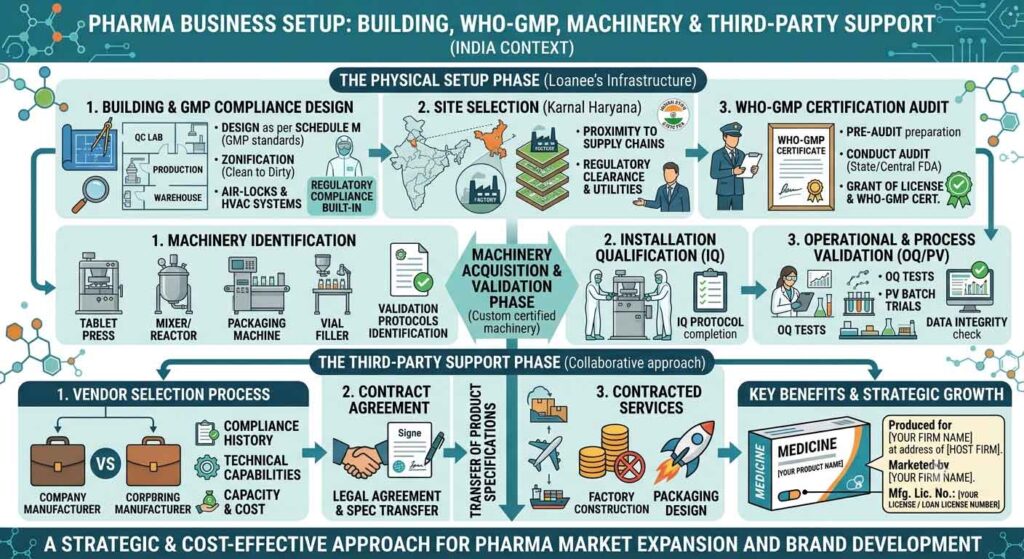
What Is WHO-GMP?
WHO-GMP means Good Manufacturing Practices based on World Health Organization guidelines.
In simple words, GMP means a system that ensures medicines are manufactured consistently with proper quality, safety, hygiene, documentation and process control.
GMP is not only about machinery. It includes:
Building design
Clean manufacturing area
Proper workflow
Trained staff
Quality control
Documentation
Raw material control
Equipment qualification
Batch records
Cleaning procedures
Testing
Storage
Complaint handling
Recall system
A factory cannot become GMP-compliant only by buying machines. The full system must be designed properly.
Step-by-Step Process to Start a Manufacturing Unit
Step 1: Select Product Category
First, decide whether you want to manufacture:
Allopathic medicines
Ayurvedic medicines
Nutraceuticals
Cosmetics
Herbal products
Veterinary products
This decision affects every next step.
Step 2: Choose Manufacturing Section
Select one or more sections according to your budget.
For beginners, it is better to start with one section such as:
Liquid/syrup section
Tablet section
Capsule section
Powder section
Ointment/cream section
Ayurvedic liquid section
Nutraceutical powder section
Do not start with too many sections in the beginning.
Step 3: Consult Regulatory Expert Before Building
Before purchasing land, renting premises or constructing a building, consult:
State Drug Control Department for allopathic medicines
State AYUSH Department for Ayurvedic medicines
FSSAI consultant for nutraceuticals and food supplements
Cosmetic regulatory expert for cosmetic products
Pollution control consultant
Fire safety consultant
GMP layout consultant
This step can save major losses.
If the building layout is wrong, approval may become difficult later.
Step 4: Select Suitable Location
Manufacturing premises should be legally suitable for industrial activity.
Prefer:
Industrial area
Approved industrial premises
Pharma industrial zone
Premises with proper road access
Area with electricity and water availability
Location suitable for pollution and fire approval
Premises with future expansion possibility
Avoid starting construction on agricultural or residential land without checking land-use permission.
Step 5: Prepare Building Layout
A pharma or Ayurvedic manufacturing unit needs a proper layout.
Common areas may include:
Raw material store
Packing material store
Quarantine area
Sampling area
Manufacturing area
Packing area
Quality control laboratory
Finished goods store
Rejected material area
Change rooms
Washing area
Utility area
Documentation area
Office area
Dispatch area
Layout should allow proper movement of men and materials without cross-contamination.
Step 6: Plan Machinery According to Section
Machinery depends on the product section.
Tablet Section Machinery
Common machinery may include:
Mass mixer
Multi-mill
Granulator
Fluid bed dryer
Tablet compression machine
Coating pan or auto coater
Vibro sifter
Blender
De-dusting machine
Blister packing machine
Strip packing machine
Labeling machine
Weighing balance
Capsule Section Machinery
Common machinery may include:
Capsule filling machine
Capsule polishing machine
Vibro sifter
Blender
De-dusting machine
Blister or strip packing machine
Weighing balance
Liquid/Syrup Section Machinery
Common machinery may include:
Manufacturing vessel
Storage tank
Sugar syrup vessel
Filter press
Bottle washing machine
Bottle filling machine
Capping machine
Labeling machine
Induction sealing machine
Batch coding machine
Ointment/Cream/Gel Section Machinery
Common machinery may include:
Ointment manufacturing vessel
Planetary mixer
Homogenizer
Tube filling machine
Tube sealing machine
Batch coding machine
Labeling machine
Ayurvedic Manufacturing Machinery
Depending on product type, machinery may include:
Pulverizer
Disintegrator
Grinder
Mixer
Edge runner
Tablet machine
Capsule filling machine
Syrup manufacturing vessel
Oil manufacturing vessel
Filter press
Filling machine
Labeling machine
Batch coding machine
Powder and Sachet Section Machinery
Common machinery may include:
Pulverizer
Blender
Vibro sifter
Sachet packing machine
Powder filling machine
Sealing machine
Weighing balance
Step 7: Arrange Quality Control Laboratory
Quality control is essential in manufacturing.
QC laboratory may require:
Chemical testing instruments
Microbiology section, where applicable
Glassware
Reagents
Analytical balances
pH meter
Stability chamber, where required
Dissolution apparatus for tablets, where required
Disintegration apparatus
Hardness tester
Friability tester
Moisture analyzer
HPLC/UV or other instruments, depending on product category
The exact laboratory requirement depends on dosage form and regulatory expectations.
Step 8: Hire Qualified Technical Staff
Manufacturing unit requires qualified and approved technical staff.
Common staff may include:
Manufacturing chemist
Analytical chemist
Quality control chemist
Quality assurance person
Production supervisor
Store in-charge
Machine operators
Packing staff
Maintenance staff
Documentation staff
For Ayurvedic manufacturing, technical staff requirements may differ from allopathic medicines.
Step 9: Prepare Documents
Documentation is a major part of GMP.
Common documents may include:
Site master file
Standard operating procedures
Master formula record
Batch manufacturing record
Batch packing record
Cleaning records
Equipment log books
Calibration records
Validation records
Raw material specifications
Finished product specifications
Stability records
Training records
Complaint records
Recall procedure
Vendor qualification records
Water testing reports
Pest control records
Without documentation, manufacturing compliance is incomplete.
Step 10: Apply for Manufacturing License
After premises, machinery, staff and documents are ready, apply to the concerned department.
For allopathic manufacturing, approach the State Drug Control Department.
For Ayurvedic manufacturing, approach the State AYUSH Licensing Authority.
For nutraceuticals, check FSSAI requirements.
Application requirements may vary by state and product category.
Step 11: Inspection by Authority
Before granting license, the concerned authority may inspect the premises.
They may check:
Building layout
Machinery
Storage area
Quality control lab
Staff qualification
Water system
Documentation
Hygiene
Production flow
GMP compliance
Product list
Safety arrangements
If everything is satisfactory, license may be granted.
Step 12: Start Manufacturing
After license approval, you can start manufacturing approved products.
Do not manufacture products before approval.
How to Get Machinery
For machinery, contact pharmaceutical machinery manufacturers.
You can find them through:
Pharma machinery exhibitions
Google search
IndiaMART
TradeIndia
Pharmafranchisehelp.org
Pharma industrial areas
Machinery consultants
Existing manufacturer references
LinkedIn
Pharma engineering companies
Before purchasing machinery, compare:
Machine capacity
GMP suitability
Material of construction
After-sales service
Installation support
Qualification documents
Spare parts availability
Warranty
Price
Delivery timeline
Do not purchase machinery only on the basis of low price.
New Machinery vs Used Machinery
New Machinery
Advantages:
Better warranty
Better documentation
Latest design
Easier qualification
Better after-sales service
Disadvantages:
Higher cost
Longer delivery time
Used Machinery
Advantages:
Lower cost
Faster availability
Useful for small budget
Disadvantages:
Maintenance risk
Documentation may be weak
Qualification may be difficult
Spare parts issue
Hidden defects
If you buy used machinery, inspect it properly before purchase.
Building Requirements
Building should be designed according to the product section.
Important points include:
Smooth walls and flooring
Proper drainage
Adequate ventilation
Proper lighting
Controlled entry
Separate storage areas
Pest control system
Change rooms
Cleanable surfaces
Proper water supply
Waste disposal arrangement
Fire safety
Utility area
Proper material movement
For sterile products such as injections or eye drops, building requirements are much stricter.
What About WHO-GMP Certification?
WHO-GMP certification or GMP compliance may be required for certain tenders, exports, institutional supplies or business credibility.
But before thinking about WHO-GMP certificate, focus on:
Proper building design
Correct licensing
GMP documentation
Qualified staff
Quality control laboratory
Process validation
Equipment qualification
SOP implementation
Clean manufacturing practices
Batch-wise records
Certification is meaningful only when the system is actually compliant.
Third-Party Manufacturing Option
If you do not want to invest in building and machinery, third-party manufacturing is a better option.
In third-party manufacturing:
You select products.
You select brand names.
A licensed manufacturer produces the products.
Products are manufactured under your brand.
You focus on marketing and sales.
This is suitable for startups with limited budget.
Benefits of Third-Party Manufacturing
No need to build factory
No machinery investment
No manufacturing staff requirement
Faster product launch
Lower risk
Easier for beginners
Access to experienced manufacturers
Focus on sales and distribution
When Should You Choose Third-Party Manufacturing?
Choose third-party manufacturing if:
Your budget is limited.
You want to test the market first.
You do not have manufacturing experience.
You want faster launch.
You want to focus on marketing.
You are not ready for compliance burden.
Many companies start with third-party manufacturing and later set up their own unit after building sales.
Own Manufacturing vs Third-Party Manufacturing
Point
Own Manufacturing
Third-Party Manufacturing
Investment
High
Low to medium
Building required
Yes
No
Machinery required
Yes
No
License required
Manufacturing license
Marketing/distribution license as applicable
Staff requirement
High
Low
Control
Full
Limited
Compliance responsibility
High
Lower
Suitable for
Established companies
Startups and marketing companies
Time to start
Longer
Faster
Documents Commonly Required for Manufacturing License
Exact documents may vary, but common documents include:
Application form
Government fee receipt
Firm registration documents
Premises ownership or rent agreement
Site plan and layout
Machinery list
Equipment list
Technical staff documents
Qualification and experience certificates
Water analysis report
Electricity load details
Pollution control approval, where applicable
Fire safety approval, where applicable
Product list
Manufacturing process details
Quality control details
SOP list
GMP compliance documents
Always confirm the updated document list from the concerned licensing authority.
Common Mistakes to Avoid
Avoid these mistakes:
Buying machinery before finalizing product section
Constructing building without approved layout guidance
Choosing wrong location
Ignoring land-use permission
Ignoring pollution control requirements
Underestimating QC laboratory cost
Hiring unqualified staff
Starting too many sections at once
Confusing third-party manufacturing with own manufacturing
Assuming WHO-GMP is only a certificate
Ignoring documentation
Selecting machinery only by low price
Practical Advice for Beginners
If you are new to manufacturing, follow this approach:
Low Budget
Start with third-party manufacturing and build your market.
Medium Budget
Start with one simple section such as syrup, powder, capsule or Ayurvedic products.
Higher Budget
Set up a multi-section manufacturing unit with proper GMP planning.
Export or Tender Focus
Plan WHO-GMP/cGMP compliance from the beginning with expert consultants.
Final Thoughts
To get building, WHO-GMP setup, machinery and third-party manufacturing support, first decide your product category and business model.
If you want to manufacture yourself, you need approved premises, proper layout, machinery, QC lab, qualified staff, documentation and license from the concerned authority.
If you do not want to invest heavily, third-party manufacturing is the easiest and fastest way to launch your own products.
The best path depends on your budget, experience, product category and long-term business plan.
Do not start construction or purchase machinery without consulting regulatory and GMP experts.
A correct beginning can save lakhs of rupees and months of delay.
Frequently Asked Questions
1. How do I start a pharma manufacturing unit?
First select product category and dosage form, then arrange suitable premises, layout, machinery, technical staff, QC lab, documentation and apply for manufacturing license.
2. Who gives license for allopathic manufacturing?
The concerned State Drug Control Department usually handles manufacturing license for allopathic medicines, depending on product category and applicable rules.
3. Who gives license for Ayurvedic manufacturing?
The State AYUSH Licensing Authority generally handles Ayurvedic manufacturing license.
4. What is WHO-GMP?
WHO-GMP refers to Good Manufacturing Practices based on WHO standards. It focuses on quality, hygiene, documentation, process control and consistent manufacturing.
5. Can I start without WHO-GMP?
Manufacturing must comply with applicable licensing and GMP requirements. WHO-GMP certification may be required for exports, tenders or certain business needs.
6. How can I buy pharma machinery?
Contact pharmaceutical machinery manufacturers through exhibitions, online portals, references or machinery consultants. Compare quality, capacity, documentation and service before purchase.
7. Is used machinery suitable?
Used machinery may reduce investment but should be inspected carefully for condition, documentation, spare parts and GMP suitability.
8. What is third-party manufacturing?
Third-party manufacturing means getting products manufactured from an existing licensed manufacturer under your brand name.
9. Which is better: own manufacturing or third-party manufacturing?
For beginners, third-party manufacturing is easier and requires less investment. Own manufacturing gives more control but needs higher investment and compliance responsibility.
10. Should I consult an expert before starting?
Yes. Consult regulatory, GMP, layout, machinery and licensing experts before investing in building or machinery.
Partner with Elzac Herbal India
Looking to start an Ayurvedic franchise, become a distributor, or launch your own herbal product range?
Elzac Herbal India offers:
Ayurvedic & Herbal Product Range
Franchise & Distribution Opportunities
Third-Party Manufacturing Services
Product Development Support
Marketing Guidance
PAN India Business Opportunities
Whether you are an entrepreneur, retailer, distributor, or healthcare professional, our team can help you explore the right business opportunity in the growing Ayurvedic sector.
Ajay Kamboj is an entrepreneur and business owners associated with many Ayurvedic and Pharmaceutical start-ups. With years of experience in Ayurvedic product marketing, pharmaceutical distribution, franchise development, and client relationship management, he regularly shares practical business insights based on real-world experiences. His articles focus on business growth, entrepreneurship, customer management, and lessons learned from the healthcare and wellness industry.




Leave a Reply
You must be logged in to post a comment.