Generating enquiries is only the first stage of sales.
The real challenge is converting suitable enquiries into:
PCD franchise partners
Monopoly distributors
Third-party manufacturing clients
Ayurvedic product distributors
Nutraceutical buyers
Institutional customers
Long-term business partners
A prospective client may receive price lists from several companies on the same day. Sending another catalogue without understanding the client’s requirement rarely closes the deal.
Successful follow-up requires:
Fast acknowledgement
Proper qualification
Relevant information
Accurate records
Planned next actions
Respectful communication
Commercial clarity
Consistent service
The purpose of follow-up is not to call a person repeatedly.
The purpose is to help a suitable prospect make a clear decision.
Why Most Enquiries Do Not Convert
A company may receive enquiries from:
Its website
Google advertisements
Social media
WhatsApp campaigns
Business portals
Trade exhibitions
Existing clients
Distributor references
YouTube videos
Online directories
However, every enquiry is not a genuine sales opportunity.
Some people may be:
Comparing prices
Collecting information
Planning a future business
Looking for employment
Searching for a manufacturer with an unsuitable MOQ
Contacting several companies simultaneously
Outside the company’s service area
Unable to meet licensing requirements
Not ready financially
Sending an incomplete or incorrect enquiry
The sales team should not label every non-converting enquiry as fake.
A more professional classification is:
Valid and qualified
Valid but not yet ready
Valid but unsuitable
Duplicate
Incorrect contact
Spam
Competitor enquiry
Lost to another supplier
Postponed
No response
Difference Between a Lead and a Qualified Opportunity
Lead
A lead is a person or business that has shown some interest.
Examples:
Submitted a contact form
Asked for a price list
Sent a WhatsApp message
Called after seeing an advertisement
Requested franchise details
A lead has not yet been confirmed as a serious business opportunity.
Qualified Opportunity
A lead becomes an opportunity when you know enough to conclude that:
The requirement is genuine.
Your company can fulfil it.
The person has authority or influence.
The expected investment is realistic.
The territory or product range is available.
There is an identifiable purchase timeline.
A specific next step has been agreed.
Do not send detailed proposals to every raw lead before basic qualification.
Main Sales Pipeline Stages
Use clear stages instead of repeatedly writing long notes such as:
“Called but not finalized yet.”
A practical pipeline may contain:
New enquiry
Contact attempted
Contact established
Requirement identified
Qualified
Catalogue sent
Price list sent
Documents shared
Sample requested
Sample sent
Commercial proposal sent
Negotiation
Agreement or documents pending
Payment pending
Order confirmed
Converted client
Follow-up later
Unqualified
Lost
Invalid or spam
Every active lead should have:
A current stage
A responsible executive
A next follow-up date
A clear next action
First Response to a New Enquiry
The first response should be prompt, professional and relevant.
Do not immediately send:
A 200-page catalogue
Ten PDF files
Repeated voice notes
All company certificates
A long copied sales message
First acknowledge the enquiry and ask a few useful questions.
Initial WhatsApp Response
Hello, Mr./Ms. [Name].
Thank you for contacting [Company Name] regarding [PCD franchise/third-party manufacturing/distribution].
To suggest the most suitable products and commercial terms, please share:
Your city and state
Your present business or professional background
Required product category
Approximate initial investment or order quantity
Expected starting time
After receiving these details, we will share the relevant product list and proposal.
Regards, [Executive Name] [Company Name]
Information to Collect During the First Conversation
The first call should identify whether the prospect and your company are suitable for each other.
For a PCD Franchise Enquiry
Ask:
Which city, district or state is required?
Is the person already working in pharma?
Does the person have a drug licence or licensed distributor?
Which therapeutic segment is required?
Is monopoly required?
What is the expected initial investment?
How many products are required?
Is a doctor network already available?
When does the prospect want to begin?
For Third-Party Manufacturing
Ask:
Which product category is required?
Is the formula ready?
What dosage form is required?
What pack size is required?
What quantity is expected?
Is the brand name finalized?
Does the client have the required licence?
Is the product for the Indian market or export?
What is the target launch date?
Is a custom formula required or an existing formula acceptable?
For Ayurvedic Distribution
Ask:
Required territory
Existing distribution network
Products of interest
Retail, doctor or institutional focus
Expected monthly purchase
Required monopoly rights
Present business
GST and applicable licence status
For Nutraceutical Products
Ask:
Product category
Ingredient formula
Target consumer
Daily serving
Dosage form
Pack size
Quantity
Claims
FSSAI licence status
Relabeller or brand-owner structure
Lead Qualification Framework
A simple qualification system can be based on five factors.
1. Need
Does the prospect have a clear requirement?
Strong need:
Requests a specific product list
Shares target territory
Gives expected quantity
Discusses launch timing
Asks about documents and commercial terms
Weak need:
Says only “send all details”
Cannot explain the required business
Has no product or territory preference
2. Business Fit
Can your company properly serve the requirement?
Check:
Product availability
Territory availability
MOQ
Product category
Licensing
Manufacturing capability
Delivery location
Commercial expectations
A serious prospect may still be unsuitable for your company.
3. Authority
Is the person able to make the decision?
Ask:
Are you the proprietor or partner?
Is another person involved in approval?
Who will sign the agreement?
Who will make the payment?
Who will finalize the product list?
Do not discover after several weeks that the person was only collecting information for someone else.
4. Budget
Avoid asking only:
“What is your budget?”
Instead explain the normal commercial range and ask whether it is workable.
Example:
“Our initial PCD order generally depends on the selected range and territory. Most focused starts fall between approximately ₹[range]. Would this level be workable for your plan?”
For manufacturing:
“The minimum batch depends on dosage form and packaging. For this product, the expected commercial batch is approximately [quantity]. Shall I prepare the costing on that basis?”
5. Timing
Ask:
Are you planning to start this month?
Are you waiting for a licence?
Is your company already registered?
When will the product list be finalized?
Is the order dependent on another decision?
Timing categories may be:
Immediate: within 30 days
Near term: 31–90 days
Future: more than 90 days
No defined timeline
Lead Scoring System
A lead score helps executives focus on the best opportunities.
Use a simple 100-point system.
Qualification Factor
Maximum Points
Clear product or business requirement
20
Territory or market confirmed
15
Required licence or distributor available
15
Realistic investment or quantity
20
Decision-maker involved
10
Start expected within 30 days
10
Responds consistently
10
Total
100
Suggested Classification
80–100: Hot lead
60–79: Warm lead
40–59: Nurture
Below 40: Low priority or unqualified
The score should guide attention, not replace human judgment.
Hot, Warm and Cold Leads
Hot Lead
Typical signs:
Gives exact requirements
Discusses specific products
Shares documents
Accepts the normal commercial range
Requests samples or agreement
Has a near-term starting date
Asks about payment and dispatch
Recommended action:
Same-day follow-up
Personalized proposal
Senior-level involvement
Clear closing plan
Warm Lead
Typical signs:
Genuine interest
Comparing companies
Needs time for licence, finance or partner approval
Responds but has not committed
Wants additional information
Recommended action:
Scheduled follow-up
Educational information
Relevant product options
Clear next step
Cold Lead
Typical signs:
No clear requirement
No timeline
Repeatedly asks for general details
Does not respond
Unrealistic expectations
No authority or resources
Recommended action:
Limited follow-up
Place in long-term nurture
Do not consume daily sales time
What Information Should Be Sent?
Information should match the lead’s stage.
After Initial Qualification
Send:
Short company profile
Relevant product list
Basic business terms
Contact details
One or two important certifications
After Serious Interest
Send:
Detailed commercial proposal
Territory availability
MOQ
Payment terms
Freight policy
Promotional support
Manufacturing documents
Product approvals where relevant
Sample policy
Expected timeline
Before Finalization
Send:
Final product list
Final rates
Taxes and freight
Agreement draft
Required documents checklist
Bank details
Order form
Dispatch timeline
Do not send sensitive regulatory documents or unrestricted certificate copies to every unverified enquiry.
Use watermarked copies where appropriate.
Follow-Up Timing
There is no universal follow-up schedule suitable for every buyer.
A practical schedule for an inbound business enquiry may be:
Day 0: Acknowledgement and Qualification
Acknowledge the enquiry.
Make the first call.
Identify the requirement.
Set the next action.
Day 1 or 2: Confirm Receipt
After sending a catalogue or price list:
“Were you able to review the product range? I can shortlist the most suitable products according to your territory and budget.”
Do not merely ask:
“Any update?”
Day 3 or 4: Add Useful Information
Send something relevant, such as:
Shortlisted products
Best-selling range
MOQ explanation
Territory status
Cost comparison
Sample plan
Day 6 or 7: Discuss Decision Barrier
Ask:
“Which point is currently preventing you from proceeding—product selection, investment, documentation, territory or commercial terms?”
Day 10 to 14: Decision Follow-Up
Ask whether:
The proposal is under consideration
A revision is needed
The project has been postponed
Another supplier has been selected
Final Active Follow-Up
Close respectfully:
“We have kept your proposal active, but I do not want to disturb you repeatedly. Please let me know whether we should proceed now, reconnect in a particular month, or close the enquiry for the present.”
The schedule should change according to:
Urgency
Deal size
Buyer preference
Agreed next date
Licensing status
Sample evaluation
Internal approval process
Always Agree on the Next Step
Every meaningful conversation should end with a specific next action.
Weak ending:
“Okay, call me later.”
Better ending:
“I will send the shortlisted 20 products today, and we will speak on Thursday at 3:00 PM to finalize the range.”
Possible next actions include:
Send price list
Send company profile
Share licence copy
Prepare costing
Finalize product list
Arrange sample
Discuss with partner
Review agreement
Submit documents
Pay advance
Place purchase order
Record the exact date.
Follow-Up Messages for Different Stages
After Sending a Price List
Hello, Mr./Ms. [Name].
I have shared the price list for the products discussed. Based on your requirement for [territory/category], I recommend beginning with [number] focused products rather than the complete range.
Please share the products you prefer, and I will prepare the final commercial calculation.
After Sending a Product Catalogue
Hello, Mr./Ms. [Name].
Were you able to review the catalogue?
To make selection easier, please send the names of the main therapy segments you want to cover. I will prepare a shorter recommended list with pack sizes and rates.
After Sending Samples
Hello, Mr./Ms. [Name].
The samples were delivered on [date]. Please review:
Product presentation
Pack quality
Label information
Product suitability
We can discuss your feedback on [proposed date].
After Sending a Manufacturing Quotation
Hello, Mr./Ms. [Name].
The quotation covers:
Product composition
Pack size
Minimum batch
Packaging
Taxes
Expected production time
Please confirm whether the formula and quantity are acceptable. After confirmation, we can proceed with artwork and documentation.
When the Client Says the Price Is High
Thank you for sharing your concern.
To compare the offer correctly, please check whether the other quotation includes the same:
Composition and strength
Pack size
Packaging quality
Quantity
Taxes
Freight
Promotional support
Product documentation
Please share the target rate or competing specification. We will check whether a technically and commercially suitable option is possible.
When the Client Is Comparing Companies
That is understandable. Choosing the right company requires comparison.
Apart from price, please compare:
Manufacturing licences
Product permissions
Product quality
Delivery consistency
Expiry policy
Territory terms
Complaint support
Written agreement
Please tell me the two or three points most important to you, and I will provide a direct comparison of our offer on those points.
When the Client Needs Time
Certainly. What would be a suitable date for us to reconnect?
I will mark the enquiry accordingly so that we do not contact you unnecessarily before that date.
No Response After Several Attempts
Hello, Mr./Ms. [Name].
We contacted you regarding your enquiry for [requirement]. I understand that your plan may be delayed.
I will pause active follow-up for now. You may reply whenever you are ready, or share a suitable month for us to reconnect.
Regards, [Name]
After Losing the Deal
Thank you for informing us.
May I record the main reason for your decision?
Price
Product range
MOQ
Territory
Delivery time
Another supplier
Project postponed
Your feedback will help us improve. We will be pleased to assist with any future requirement.
Do Not Ask “Any Update?” Repeatedly
“Any update?” puts the entire burden on the prospective client and provides no new value.
Use focused questions instead:
Which products have you shortlisted?
Is the proposed MOQ workable?
Is the required territory acceptable?
Do you need a revised product mix?
Is any licence or document pending?
Who else needs to approve the proposal?
What information is required for a decision?
What starting date are you considering?
Handling Common Objections
1. “Your Rates Are High”
First determine whether the comparison is equivalent.
Check:
Formula
Ingredient strength
Pack size
Manufacturing standard
Packaging
MOQ
GST
Freight
Scheme
Expiry
Promotional support
Do not immediately reduce the price without understanding the objection.
2. “Another Company Offers More Monopoly”
Ask:
Which territory?
Which products?
Is the monopoly written?
Is it linked to targets?
Are institutional and online sales excluded?
What happens if the company appoints another party?
Explain your own territory terms clearly rather than criticizing another company.
3. “I Need More Promotional Material”
Clarify:
Required items
Quantity
Expected order
Purpose
Replenishment policy
Promotional material should support genuine sales activity rather than become the only basis for the deal.
4. “I Will Start Next Month”
Ask:
What must be completed before starting?
Which date should be reserved?
Are product selection and documents ready?
Should the territory be kept temporarily on hold?
Is any payment or licence pending?
Turn a vague promise into a dated action plan.
5. “Send Samples First”
Ask which products are under serious consideration.
Define:
Number of samples
Delivery charges
Evaluation criteria
Follow-up date
Whether samples are free or adjustable
Do not send expensive samples to an unqualified contact without verification.
6. “Give Me the Lowest Rate”
Explain that the final quotation depends on:
Product
Composition
Quantity
Packaging
Payment
Territory
Support
A prospect focused only on the lowest rate may not be the right long-term partner.
7. “I Need Credit”
Assess:
Business history
Drug licence
GST
Market references
Financial standing
Existing relationship
Order value
New relationships commonly begin with advance payment or controlled credit.
Closing the Deal
A deal is more likely to close when the remaining steps are clear.
Summary Closing
“So far, we have agreed on:
Territory: [territory]
Products: [number]
Initial order: ₹[amount]
Payment: [terms]
Promotional support: [details]
Dispatch time: [period]
The remaining step is [document/payment/order confirmation]. Shall we complete it today?”
Choice Closing
“Would you prefer to start with the 20-product focused range or the 35-product complete range?”
Date Closing
“To begin market work from [date], the order should be confirmed by [date]. Shall I prepare the final pro forma invoice?”
Trial Closing
“We can begin with a controlled initial range and review movement after the first cycle. This reduces your stock and expiry risk.”
Do not create artificial scarcity or false deadlines.
When to Stop Active Follow-Up
Stop or pause active follow-up when:
The person asks you not to contact them.
The contact is invalid.
The requirement is outside your business.
The territory is unavailable.
The budget is clearly incompatible.
The required licence cannot be arranged.
The person repeatedly fails to honour agreed actions.
The project has been postponed without a date.
Another supplier has been selected.
The enquiry appears fraudulent.
Do not delete the record.
Change its status and record the reason.
Lost Lead Reasons
Use standardized reasons such as:
Price
MOQ
Product unavailable
Territory unavailable
Competitor selected
No budget
No licence
No response
Project postponed
Delivery time
Quality concern
Commercial terms
Internal approval rejected
Duplicate
Invalid contact
Spam
Outside service area
These reasons help management identify business problems.
Lead Follow-Up Excel Sheet
A basic follow-up sheet should contain:
Column
Heading
A
Lead ID
B
Enquiry Date
C
Lead Source
D
Executive
E
Party Name
F
Contact Person
G
Mobile Number
H
Email
I
City
J
State
K
Business Type
L
Requirement
M
Territory
N
Expected Investment
O
Required Products
P
Licence Status
Q
Decision-Maker
R
Expected Start Date
S
Lead Score
T
Lead Category
U
Current Stage
V
Last Contact Date
W
Last Discussion
X
Next Action
Y
Next Follow-Up Date
Z
Proposal Value
AA
Probability
AB
Expected Closing Date
AC
Final Status
AD
Lost Reason
AE
Remarks
Follow-Up History Sheet
Contains one row for every activity.
Recommended columns:
Lead ID
Date
Time
Executive
Communication mode
Discussion
Client response
Material sent
Next action
Next date
This creates a complete history without adding unlimited status columns.
Lead ID Format
Use a unique ID such as:
LEAD/2026/0001
or:
PCD/JH/2026/0042
The lead ID should remain the same throughout the sales process.
Do not identify a lead only by mobile number because:
Numbers may change.
One person may have several enquiries.
More than one person may use the same business contact.
If proposal value is in Z and probability is in AA:
=SUMPRODUCT(Z2:Z1000,AA2:AA1000)
Probability should be entered as a percentage.
Suggested Opportunity Probabilities
These percentages are only internal planning estimates.
Stage
Suggested Probability
New enquiry
5%
Contact established
10%
Qualified
25%
Product list finalized
40%
Proposal sent
50%
Samples approved
60%
Negotiation
70%
Documents received
80%
Payment or PO pending
90%
Converted
100%
Do not present these probabilities as guaranteed revenue.
Lead Source Tracking
Record where each lead came from:
Organic website
Google advertisement
Facebook or Instagram
WhatsApp campaign
IndiaMART or another business portal
YouTube
Trade exhibition
Existing client referral
Distributor referral
Direct calling
Email campaign
Do not judge lead sources only by enquiry quantity.
Measure:
Valid lead percentage
Qualified lead percentage
Conversion rate
Average order value
Time to close
Cost per converted client
Payment quality
Repeat order rate
A source giving 100 enquiries and two customers may be less valuable than one giving 20 enquiries and six good customers.
Website Leads vs Portal Leads
Website-generated enquiries may be more relevant when the website:
Clearly explains the business
Targets specific search terms
Shows product categories
States minimum requirements
Uses useful enquiry forms
Builds trust through genuine information
However, a website lead is not automatically genuine.
Similarly, not every portal lead is fake.
Evaluate each source using actual conversion data.
Enquiry Form Design
A strong enquiry form should ask only necessary questions.
Useful fields include:
Name
Business name
Mobile number
Email
City and state
Business type
Required opportunity
Product category
Estimated investment
Expected start date
Message
Consent to be contacted
Avoid requesting excessive personal documents at the first stage.
CRM vs Excel
Excel Is Suitable When
Enquiries are limited.
One or two executives handle sales.
The process is simple.
Records are updated consistently.
Management reviews the sheet daily.
CRM Is Better When
Several executives handle leads.
Enquiries come from multiple sources.
Automatic assignment is required.
Follow-up reminders are being missed.
Calls, emails and WhatsApp activities need tracking.
Management needs dashboards.
Duplicate leads are common.
Access controls are important.
A CRM does not improve sales merely by being installed.
The team must still:
Enter correct information
Update stages
Complete tasks
Record outcomes
Review reports
Daily Lead Review
Every sales executive should review:
New enquiries
Today’s follow-ups
Overdue tasks
Proposals pending
Samples pending
Documents pending
Payment pending
Hot leads
Lost leads requiring closure
A manager may conduct a short daily review focusing on:
What is the next action?
Who is responsible?
By when will it be completed?
What is preventing progress?
Weekly Sales Review
Review:
New leads
Contacted leads
Qualified leads
Proposals sent
Deals won
Deals lost
Proposal value
Conversion rate
Lead-source performance
Executive performance
Average response time
Average closing time
Main lost reasons
Do not measure executives only by the number of calls.
Also measure:
Qualification quality
Proposal quality
Follow-up completion
Conversion
Order value
Repeat business
Payment collection
Important Sales Metrics
Contact Rate
Leads contacted ÷ Total valid leads × 100
Qualification Rate
Qualified leads ÷ Contacted leads × 100
Proposal Rate
Proposals sent ÷ Qualified leads × 100
Conversion Rate
Converted clients ÷ Qualified leads × 100
Average Deal Value
Total confirmed order value ÷ Number of converted clients
Average Sales Cycle
Total days from enquiry to conversion ÷ Converted clients
Follow-Up Compliance
Follow-ups completed on time ÷ Total scheduled follow-ups × 100
Protecting Lead Information
Lead records may contain:
Names
Mobile numbers
Email addresses
Business addresses
Licence details
Investment information
Commercial plans
Product ideas
Use sensible controls:
Collect only required information.
Restrict access to authorized staff.
Do not export customer lists casually.
Avoid sharing complete lead sheets on personal devices.
Use passwords and backups.
Remove former employees’ access promptly.
Do not sell or transfer lead data without lawful basis.
Respect requests to stop communication.
Define how long inactive lead information will be retained.
Commercial Communication and Spam
A person submitting an enquiry may reasonably expect communication about that enquiry.
This does not mean the number should be added permanently to every promotional campaign.
Good practice includes:
Identify your company.
Explain why you are contacting the person.
Contact only regarding the relevant enquiry.
Respect preferred timings.
Do not call repeatedly.
Stop when asked.
Use compliant business messaging systems for bulk communication.
Maintain consent records where required.
Avoid promotional calling through ordinary personal numbers.
Common Follow-Up Mistakes
Avoid:
Sending the same catalogue to every enquiry
Calling several times on the same day
Asking only “Any update?”
Failing to record the next date
Sending rates before understanding requirements
Treating every non-responsive lead as fake
Deleting lost leads
Giving unlimited samples
Reducing rates immediately
Promising unavailable monopoly rights
Providing false urgency
Sending excessive documents
Failing to identify the decision-maker
Ignoring licensing and budget
Contacting people after they request no further calls
Focusing on new leads while forgetting warm opportunities
Closing the first order but neglecting onboarding
After the Client Says Yes
Verbal agreement is not final conversion.
Complete:
Final product list
Written quotation
Licences and business documents
Territory confirmation
Agreement
Purchase order
Advance payment
Artwork approval, where relevant
Dispatch or production timeline
Customer onboarding
A lead should be marked converted after receiving a meaningful commercial commitment such as:
Confirmed purchase order
Advance payment
Signed agreement
Approved manufacturing order
Post-Sale Follow-Up
The first order is the beginning of the client relationship.
After dispatch, follow up regarding:
Receipt of goods
Damage or shortage
Product understanding
Market launch
Retail availability
Promotional material
Sales response
Reorder level
Complaints
Payment
Expansion opportunities
New Client Onboarding Call
Cover:
Product range
Price structure
Order process
Payment process
Distributor support
Complaint procedure
Expiry policy
Contact persons
Promotional support
Reorder process
A well-supported first order is more likely to produce repeat business.
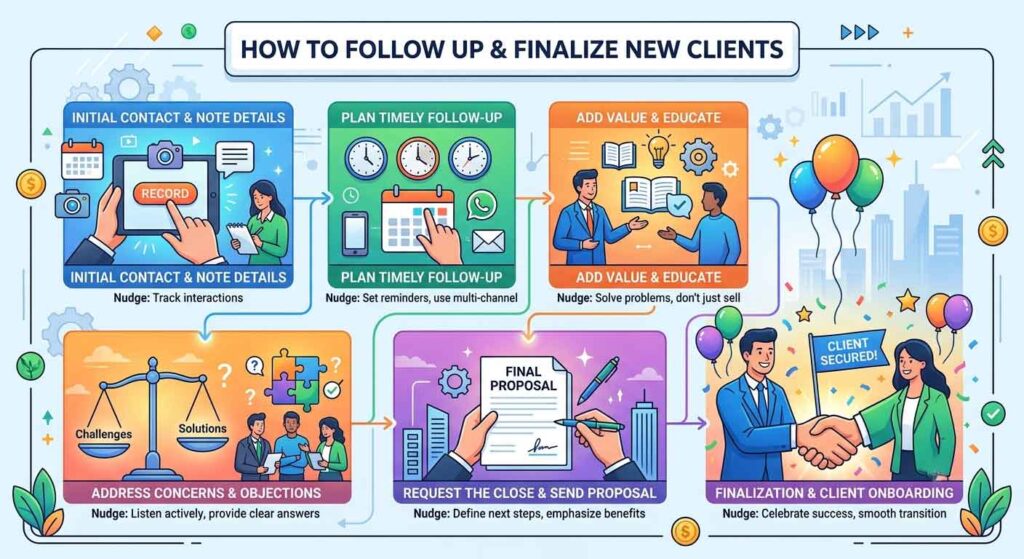
Recommended Follow-Up Process
Step 1: Capture
Record every enquiry immediately.
Step 2: Acknowledge
Confirm receipt and introduce the responsible executive.
Step 3: Qualify
Identify need, fit, authority, budget and timing.
Step 4: Prioritize
Classify as hot, warm, nurture or unqualified.
Step 5: Present
Send only relevant information.
Step 6: Agree Next Action
Fix a specific task and date.
Step 7: Resolve Objections
Understand the real concern before changing terms.
Step 8: Close
Confirm products, price, documents, payment and timeline.
Step 9: Onboard
Guide the client after order confirmation.
Step 10: Review
Record the result and learn from wins and losses.
Frequently Asked Questions
1. How often should a new client be followed up?
The frequency should depend on interest, urgency and the agreed next step. Do not call daily unless the prospect expects an urgent decision.
2. How many times should a lead be contacted?
There is no fixed number. Use a reasonable multi-channel sequence, then pause when there is no response or when the person requests no further contact.
3. Should non-interested leads be deleted?
No. Mark them as unqualified, lost or postponed and record the reason. Archive them according to your data-retention policy.
4. What makes a lead qualified?
A qualified lead has a genuine need, fits your business, has realistic commercial ability, involves a decision-maker and has an identifiable timeline.
5. Should a price list be sent immediately?
A basic list may be sent after initial qualification, but a personalized proposal should follow only after understanding the requirement.
6. Are online business-portal leads fake?
Some may be invalid or low intent, but they should be measured by actual qualification and conversion data rather than assumptions.
7. Should free samples be sent to every enquiry?
No. Verify the prospect, shortlist products, define the evaluation purpose and agree on a follow-up date.
8. Is Excel enough for lead management?
Excel can work for a small team. A CRM is preferable when lead volume, users and follow-up complexity increase.
9. What is the most important column in a follow-up sheet?
The most important operational fields are the current stage, next action and next follow-up date.
10. What should be done after finalizing the client?
Complete documentation, payment, onboarding, dispatch support and post-sale follow-up to encourage repeat business.
Final Thoughts
Client follow-up should not be based on memory, repeated calling or random WhatsApp messages.
A reliable process is:
Capture enquiry → Qualify requirement → Prioritize opportunity → Share relevant proposal → Fix the next action → Handle objections → Confirm commercial terms → Receive commitment → Onboard the client → Build repeat business
The objective is not to follow every lead forever.
The objective is to:
Recognize serious opportunities
Serve them professionally
Stop wasting time on unsuitable leads
Maintain respectful communication
Learn why deals are won or lost
Build long-term customer relationships
Looking for Ayurvedic Franchise or Distribution Opportunities?
Looking to start an Ayurvedic franchise, become a distributor, or launch your own herbal product range?
Elzac Herbal India offers:
Ayurvedic & Herbal Product Range
Franchise & Distribution Opportunities
Third-Party Manufacturing Services
Product Development Support
Marketing Guidance
PAN India Business Opportunities
Whether you are an entrepreneur, retailer, distributor, or healthcare professional, our team can help you explore the right business opportunity in the growing Ayurvedic sector.
Ajay Kamboj is an entrepreneur and business owners associated with many Ayurvedic and Pharmaceutical start-ups. With years of experience in Ayurvedic product marketing, pharmaceutical distribution, franchise development, and client relationship management, he regularly shares practical business insights based on real-world experiences. His articles focus on business growth, entrepreneurship, customer management, and lessons learned from the healthcare and wellness industry.






Leave a Reply Cancel reply
You must be logged in to post a comment.