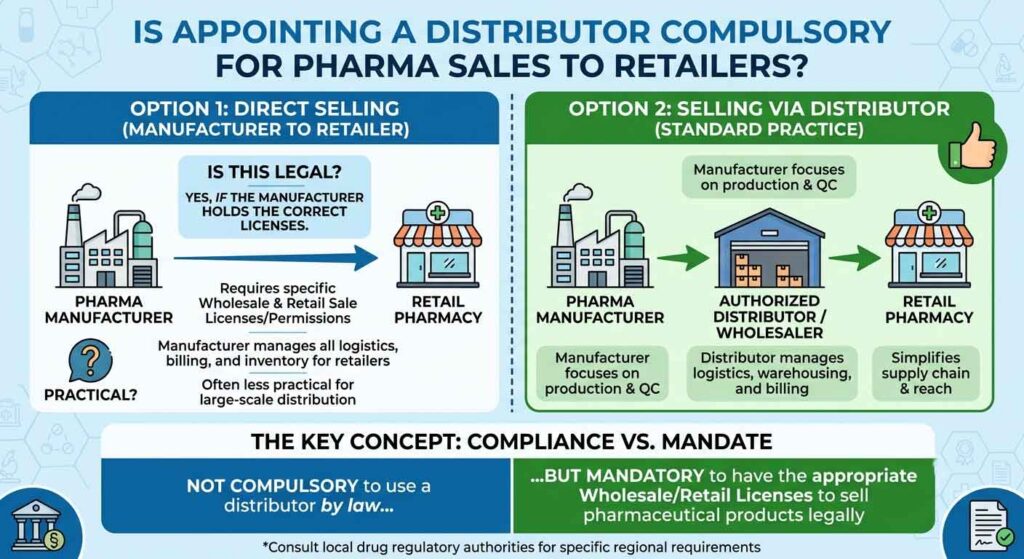
A pharmaceutical marketing company does not necessarily have to appoint a distributor to sell its products to retail chemists.
If the company holds the appropriate wholesale drug licence at the premises from which medicines are received, stored, invoiced and dispatched, it may generally supply products directly to properly licensed retailers.
The company may choose among three distribution models:
Direct supply to retailers
Supply through an appointed distributor
A hybrid model combining both methods
The right model depends on:
Territory size
Number of retailers
Order frequency
Delivery capacity
Credit management
Distributor availability
Product range
Working capital
Sales volume
A common query is:
“I want to start a pharmaceutical marketing company and obtain a wholesale drug licence. Once I receive my products, can I sell them directly to retail chemists using the same licence, or do I need a separate licence? Is appointing a distributor compulsory?”
The practical answer is:
You can generally sell directly to licensed retail chemists using your appropriate wholesale drug licence. You do not need to appoint a distributor merely because your customers are retailers.
However, if you sell medicines directly to patients or consumers, you need the appropriate retail drug-licence arrangement.
Wholesale Licence vs Retail Licence
The distinction is based mainly on who purchases the medicine from you.
Wholesale Drug Licence
A wholesale licence is generally used for selling or distributing medicines to eligible businesses and institutions, such as:
Licensed retail chemists
Licensed wholesalers
Distributors
Stockists
Hospitals
Nursing homes
Dispensaries
Institutional buyers
Government procurement organizations
For common allopathic products, the relevant wholesale licences generally include:
Form 20-B
Form 21-B
Additional licensing applies to Schedule X and other specially controlled products.
Retail Drug Licence
A retail drug licence is used when medicines are sold directly to the final patient or consumer.
Common retail licences include:
Form 20
Form 21
Retail dispensing is also subject to requirements relating to:
Registered pharmacist
Prescription medicines
Schedule records
Storage
Patient supply
Invoicing or cash memos
Simple Example
Wholesale Transaction
Your company sells ten boxes of tablets to a licensed medical store.
This is a wholesale transaction.
Retail Transaction
Your company sells one strip directly to a patient for personal use.
This is a retail transaction.
A wholesale licence does not automatically authorize direct retail dispensing to patients.
Can a Marketing Company Sell Directly to Retail Chemists?
Yes, a properly licensed pharmaceutical marketing or wholesale firm can generally:
Purchase products from manufacturers
Receive stock at its licensed premises
Store products
Raise invoices
Supply licensed retail chemists
Collect payment
Handle expiry returns
Maintain batch-wise records
You do not need to create another company only for distribution.
You also do not need a separate wholesale licence merely because you are supplying retailers instead of distributors.
However, the following conditions should be followed:
Stock should be kept at the licensed premises.
The appropriate product categories should be covered.
Sales should be made to legally eligible buyers.
Invoices should be properly maintained.
Batch and expiry details should be traceable.
Storage conditions should be followed.
A competent person should supervise wholesale operations.
Schedule-specific requirements should be followed.
GST and transport documents should be completed.
Is the Wholesale Drug Licence Premises-Specific?
Yes, drug-sale licensing is linked to the approved premises.
Suppose your company has a wholesale licence at:
Warehouse A, City X
Products can be stocked and dispatched from that approved premises.
If you later open:
Warehouse B, City Y
and begin storing medicines there, you should not assume that Warehouse A’s licence automatically covers Warehouse B.
A separate application or additional licensing arrangement may be required for the new premises.
This is especially important when a company has:
Registered office in one city
Warehouse in another city
Branch office in another state
C&F agent
Multiple stock points
Online order office separate from dispatch location
The registered office may be different from the licensed warehouse, but the actual stock-and-sale location must have the applicable approval.
Is a Distributor Legally Compulsory?
No.
A distributor is a commercial choice, not a universal legal requirement.
You may choose to:
Supply retailers directly
Appoint one distributor
Appoint multiple district distributors
Appoint a super stockist
Use a C&F agent
Use a licensed third-party logistics provider
Combine direct supply with distributors
The Drugs and Cosmetics framework regulate the lawful storage, sale and distribution of medicines. It does not generally force every marketing company to appoint an independent distributor between itself and the retailer.
Direct-to-Retail Distribution Model
Under direct distribution:
Manufacturer → Your marketing company → Retail chemist
Your company handles:
Purchasing
Warehousing
Billing
Order collection
Packing
Dispatch
Delivery
Retailer credit
Payment collection
Returns
Expiry
Complaints
Advantages of Direct Supply to Retailers
1. Greater Commercial Control
You control:
Retailer selection
Net rates
Schemes
Payment terms
Stock allocation
Delivery priority
Product availability
2. Potentially Higher Gross Margin
When no distributor is involved, you may retain the commercial margin that would otherwise be given to the distributor.
However, that amount is not automatically profit.
You must deduct:
Delivery cost
Billing staff
Warehouse staff
Fuel
Vehicle cost
Courier or transport
Bad debts
Collection cost
Returns
Expiry
Software
Small-order handling
3. Direct Retailer Relationship
You receive immediate market information regarding:
Product movement
Competitor rates
Prescriptions
Patient enquiries
Stock shortages
Product complaints
Reorder patterns
4. Better Control Over Product Availability
You can prioritize chemists situated near important:
Doctors
Hospitals
Clinics
Nursing homes
5. Faster Feedback
Retailers may directly tell you:
Which products move
Which pack sizes are preferred
Whether MRP is suitable
Whether packaging is accepted
Whether repeat prescriptions are coming
6. Lower Dependence on One Distributor
The company is not completely dependent on one distributor for:
Market supply
Payment
Order execution
Stock reporting
Disadvantages of Direct Supply
1. Large Number of Small Orders
Retail chemists often place small and frequent orders.
For example:
Three boxes of one product
Five strips of another
One bottle of a syrup
Processing many small invoices increases operating cost.
2. Delivery Responsibility
You must arrange:
Delivery staff
Vehicle
Route planning
Packing
Transport
Proof of delivery
3. Credit Management
Retailers may ask for:
15-day credit
30-day credit
45-day credit
Replacement before payment
Additional schemes
Poor credit control can block working capital.
4. Payment Collection
Your employees may spend considerable time collecting small payments from many retailers.
5. Returns and Expiry
You must directly manage:
Slow-moving stock
Near-expiry stock
Damaged packs
Replacement
Credit notes
Product recalls
6. Wider Territory Becomes Difficult
Direct supply may work well in your home city but become expensive across:
Several districts
Rural areas
Distant towns
An entire state
7. Sales Team Loses Marketing Time
When the same employee handles:
Doctor calls
Chemist orders
Delivery
Collection
Returns
the employee may spend more time in logistics than in market development.
Distributor-Based Model
Under a distributor model:
Manufacturer → Your company or C&F → Distributor → Retail chemist
The distributor normally manages:
Local stock
Chemist orders
Retail supply
Delivery
Invoicing
Retail collections
Credit
Returns
Market servicing
Your marketing team focuses more on:
Doctor promotion
Product demand
Distributor coordination
Sales analysis
New product launches
Territory development
Advantages of Appointing a Distributor
1. Existing Chemist Network
A good distributor may already supply hundreds of retail pharmacies.
This provides faster market access.
2. Faster Delivery
Retailers often expect same-day or next-day delivery.
A local distributor can service small orders more efficiently.
3. Credit and Collection Support
The distributor may:
Extend credit
Collect payments
Follow up with retailers
Manage outstanding balances
Your company deals mainly with one distributor instead of hundreds of chemists.
4. Lower Delivery Cost for the Company
The distributor bears or manages local delivery costs under the agreed commercial structure.
5. Better Order Consolidation
Instead of receiving fifty small retailer orders, your company receives a larger consolidated distributor order.
6. Sales Team Can Focus on Demand Generation
Medical representatives can focus on:
Doctor coverage
Product communication
Prescription support
New customer development
rather than carrying parcels and collecting payments.
7. Local Market Knowledge
A distributor often knows:
Retailer creditworthiness
Important chemists
Hospital purchase patterns
Competitor schemes
Seasonal demand
Local payment practices
Disadvantages of Using a Distributor
1. Distributor Margin
You must provide a commercially workable distributor margin.
2. Reduced Direct Control
The distributor may decide:
Which retailers receive priority
Which products are actively supplied
How quickly orders are delivered
How much stock is kept
3. Dependence on Distributor Interest
A distributor handling many companies may prioritize products that:
Move quickly
Offer better margins
Have strong prescription demand
Provide higher schemes
4. Delayed Market Information
You may not receive immediate information about:
Retail stock-outs
Returns
Retailer objections
Slow-moving products
5. Outstanding Payment Risk
If the distributor receives substantial credit and delays payment, your company’s working capital can be affected.
6. Distributor May Not Develop New Products
Many distributors distribute existing demand but do not create demand.
Your own marketing team must still generate sales.
Hybrid Distribution Model
For many new pharmaceutical companies, the best approach is a hybrid model.
Example:
Direct Supply
Supply directly to:
Major retailers
Hospital pharmacies
Nearby chemists
Key accounts
Your home city
Distributor Supply
Appoint distributors for:
Distant districts
Smaller towns
High-frequency local delivery
Wider state coverage
This provides:
Direct market understanding
Controlled key accounts
Wider reach
Efficient local delivery
Should Retailers’ Licences Be Verified?
Your company should maintain reasonable controls over its customers.
For new retail chemists, collect or verify:
Legal firm name
Drug-licence number
Licensed premises address
GSTIN, where applicable
Contact details
Proprietor or authorized person
Delivery address
Be cautious where:
Delivery address differs from the licensed premises.
The licence has expired or is suspended.
The buyer requests supply without an invoice.
Prescription drugs are requested for an unauthorized location.
Schedule products are ordered without suitable licensing.
Can Products Be Supplied to Hospitals?
A wholesale firm may generally supply eligible hospitals and institutions, subject to:
Buyer’s legal status
Applicable licence or institutional exemption
Product category
Invoice requirements
Storage conditions
Tender terms
Collect appropriate documents before regular supply.
Can You Sell Directly to Doctors?
Supplying medicines commercially to doctors requires caution.
Do not treat every doctor’s clinic as a licensed retail outlet.
A doctor may be permitted to maintain or supply limited medicines under specific legal conditions, but that does not automatically make every clinic eligible to purchase unrestricted wholesale stock for resale.
Before regular commercial supply, verify:
Nature of institution
Applicable licence
Hospital or clinic status
Intended use
Product category
Samples supplied for professional purposes should be managed separately from saleable stock and comply with applicable marketing requirements.
Can You Sell Directly to Patients From the Wholesale Premises?
Not merely under a wholesale licence.
When the company sells medicines directly to the final patient, it enters retail activity.
A proper retail licence and registered pharmacist arrangement may be required.
If the company plans to operate both wholesale and retail from the same premises, it should apply for the combined appropriate licences and meet the applicable premises requirements.
Wholesale-Cum-Retail Premises
A business may operate both retail and wholesale activities from the same approved premises when it holds all applicable licences.
Such a setup may require:
Forms 20 and 21 for retail
Forms 20-B and 21-B for wholesale
Registered pharmacist
Competent-person compliance
Appropriate premises area
Separate records
Suitable storage
State authority approval
Do not begin retail sales merely because a wholesale licence has already been granted.
Does Direct Billing Make the Company Look Small?
No.
Many established companies directly supply:
Hospitals
Institutional customers
Key accounts
Modern trade
Online channels
Large retail chains
Direct billing is a business model, not evidence that the company is small.
The more important questions are:
Is supply reliable?
Are products compliant?
Are invoices correct?
Is the expiry policy clear?
Are prices consistent?
Are complaints handled?
Is delivery timely?
Retailer Margin
Retailer margin should be decided carefully.
Consider:
Product category
Prescription demand
MRP
Price-control status
Distributor margin
Retailer margin
Promotional cost
GST
Freight
Expiry risk
Company profit
Do not print an artificially high MRP merely to show a large discount or margin.
Scheduled medicines must remain within applicable NPPA ceiling-price limits.
For non-scheduled products, pricing is still subject to applicable DPCO monitoring and legal requirements.
Direct Distribution Cost Calculation
Suppose the distributor would receive an 8% margin.
It may appear that direct supply saves the full 8%.
However, calculate the following:
Direct Distribution Expense
Monthly Amount
Delivery employee
₹20,000
Vehicle and fuel
₹15,000
Billing and warehouse staff
₹12,000
Software and stationery
₹3,000
Bad-debt provision
₹5,000
Expiry and return cost
₹5,000
Total
₹60,000
If monthly direct retailer sales are ₹5,00,000:
Direct distribution cost percentage
= ₹60,000 ÷ ₹5,00,000 × 100
= 12%
In this example, an 8% distributor margin may be cheaper than direct supply.
The calculation changes according to:
Territory density
Sales value
Order size
Delivery frequency
Credit recovery
Staff productivity
Distributor Cost Calculation
When using a distributor, include:
Distributor margin
Scheme
Freight
Incentives
Damage support
Expiry support
Credit period
Sales returns
The distributor’s quoted margin is not the only cost.
Questions to Ask Before Choosing Direct Distribution
Ask:
How many chemists will be serviced?
What is the average retailer order value?
How many deliveries will be required daily?
What is the delivery radius?
Who will collect payment?
How much credit will be offered?
Who will handle expiry?
Is software available for batch-wise billing?
Can the sales team manage both marketing and supply?
What will direct distribution cost as a percentage of sales?
Questions to Ask Before Appointing a Distributor
Ask:
Does the distributor hold valid drug licences?
How many retailers are actively serviced?
Which areas are covered?
How many delivery staff are available?
Which competing companies are handled?
What credit is expected?
What margin is expected?
How quickly are new products supplied?
How are returns handled?
Will secondary sales reports be provided?
Who controls retailer schemes?
What happens when the agreement ends?
Marketing and Distribution Are Different Functions
Marketing Creates Demand
Marketing activities may include:
Doctor communication
Product literature
Sales-force activity
Hospital presentation
Digital communication
Product training
Distribution Fulfils Demand
Distribution includes:
Stock
Invoicing
Delivery
Availability
Collection
Returns
A company may perform both functions itself, but each requires different staff and systems.
When Direct Supply Is Better
Direct-to-retail supply may be suitable when:
Territory is compact.
Retailers are concentrated.
Order values are reasonable.
Your warehouse is nearby.
You have delivery staff.
Credit is controlled.
Sales volume supports operating cost.
You want direct key-account relationships.
When a Distributor Is Better
Appointing a distributor may be preferable when:
Territory is wide.
Retail orders are small and frequent.
Same-day delivery is expected.
You lack delivery staff.
You want to focus on doctor promotion.
Local collection is difficult.
Distributor already has strong retailer coverage.
Sales volume is not enough to support your own delivery infrastructure.
When to Use a Hybrid Model
A hybrid model is suitable when:
You directly service major accounts.
Local chemists are supplied directly.
Distant areas are handled by distributors.
Hospitals are billed directly.
Small retailers are serviced through distributors.
Different divisions use different channels.
The policy should be clearly defined to prevent channel conflict.
Avoid Channel Conflict
Conflict may arise when:
Company supplies retailers at a lower rate than the distributor.
Distributor’s territory is not defined.
Direct sales are made inside an exclusive distributor’s area.
Retail schemes differ.
Institutional sales are not excluded from exclusivity.
Online sales undercut local trade.
The agreement should specify:
Direct account policy
Hospital accounts
Government supply
Online sales
Modern trade
Territory
Price structure
Common Mistakes
Avoid:
Believing a distributor is legally compulsory
Selling directly to patients under only a wholesale licence
Stocking medicines at an unlicensed premises
Using another company’s drug licence
Supplying unverified retailers
Hiding the owner’s identity
Offering inconsistent prices
Giving unlimited retailer credit
Ignoring delivery cost
Overloading retailers with stock
Maintaining no batch-wise records
Mixing returned and saleable stock
Appointing a distributor without an agreement
Giving distributor monopoly without performance conditions
Ignoring NPPA pricing
Allowing sales staff to handle uncontrolled cash
Practical Decision Table
Situation
Suitable Model
One compact city
Direct supply may work
One city with many small chemist orders
Local distributor may be efficient
Several districts
District distributors
Entire state
C&F plus distributors or super stockist
Few large hospitals
Direct institutional supply
Strong doctor team but weak logistics
Distributor model
Strong warehouse and delivery team
Direct or hybrid
New company with uncertain sales
Controlled hybrid model
Practical Answer to the Query
If your company has an appropriate wholesale drug licence at its stock-and-sale premises:
You may generally sell medicines directly to properly licensed retailers.
You do not require a separate wholesale licence merely for selling to retailers.
You do not have to appoint an independent distributor.
You need a retail licence if you directly dispense medicines to patients.
Another warehouse or branch that stocks medicines may require its own licence.
Your wholesale firm must maintain proper invoices, batch records, storage and competent-person supervision.
Whether you should appoint a distributor is a commercial decision.
Direct supply provides greater control but requires:
Delivery
Billing
Collection
Credit management
Expiry handling
Retail servicing
A distributor reduces this workload but requires a margin and proper supervision.
Frequently Asked Questions
1. Is a distributor compulsory in pharmaceutical marketing?
No. A company with an appropriate wholesale drug-licence structure may generally supply licensed retailers directly.
2. Can I use my wholesale licence to bill chemists?
Yes, provided the chemists are legally eligible purchasers and the medicines are supplied from the licensed wholesale premises.
3. Do I need another wholesale licence for selling to retailers?
No separate wholesale licence is generally needed for that reason. The same appropriate licence covers wholesale sales from the licensed premises.
4. Can I sell directly to patients under my wholesale licence?
No. Direct sale to patients is retail activity and requires the applicable retail drug-licence arrangement.
5. Can I operate wholesale and retail from the same premises?
Potentially yes, after obtaining both sets of licences and meeting the applicable premises, pharmacist and regulatory requirements.
6. Can I stock medicines at my office if the licence is for another warehouse?
No. Medicines should be stocked only at the premises covered by the applicable licence.
7. Does the distributor need a drug licence?
Yes. A distributor dealing in allopathic medicines should hold appropriate valid wholesale drug licences.
8. Is direct supply more profitable?
Not always. Calculate delivery, staff, credit, returns, expiry and collection costs before comparing it with distributor margin.
9. Should the company owner pretend to be an employee?
No. The owner may perform a management or sales role, but deliberate misrepresentation is unnecessary and unprofessional.
10. Which model is best for a new company?
A hybrid model is often practical: direct supply in the home city and distributors for distant territories.
Final Thoughts
The correct distribution decision is not:
“Must I appoint a distributor?”
The better question is:
“Which model supplies retailers reliably at the lowest controlled cost while protecting product availability, payment and expiry?”
The three workable choices are:
Direct supply Distributor supply Hybrid supply
Direct supply is suitable where your company can efficiently manage:
Stock
Billing
Delivery
Collection
Returns
Retail relationships
A distributor is useful where it can provide:
Wider retailer reach
Faster delivery
Local credit management
Order consolidation
Lower operating burden
The strongest pharmaceutical distribution system is one that provides:
Legal compliance
Product availability
Consistent pricing
Controlled credit
Batch traceability
Fast delivery
Clear return policy
Professional relationships
Looking for Ayurvedic Franchise or Distribution Opportunities?
Looking to start an Ayurvedic franchise, become a distributor, or launch your own herbal product range?
Elzac Herbal India offers:
Ayurvedic & Herbal Product Range
Franchise & Distribution Opportunities
Third-Party Manufacturing Services
Product Development Support
Marketing Guidance
PAN India Business Opportunities
Whether you are an entrepreneur, retailer, distributor, or healthcare professional, our team can help you explore the right business opportunity in the growing Ayurvedic sector.
Ajay Kamboj is an entrepreneur and business owners associated with many Ayurvedic and Pharmaceutical start-ups. With years of experience in Ayurvedic product marketing, pharmaceutical distribution, franchise development, and client relationship management, he regularly shares practical business insights based on real-world experiences. His articles focus on business growth, entrepreneurship, customer management, and lessons learned from the healthcare and wellness industry.





Leave a Reply Cancel reply
You must be logged in to post a comment.