A pharmaceutical Carrying and Forwarding agency, commonly known as a C&F or CFA, stores and dispatches medicines on behalf of a pharmaceutical company.
The pharma company appoints the C&F agent for a defined:
State
Region
Group of districts
Product division
Distribution channel
The C&F agent receives goods from the company’s manufacturing units or central warehouse, stores them safely and dispatches them to authorized:
Distributors
Stockists
Hospitals
Institutional customers
Company branches
Other approved recipients
A common query is:
“I want to start a pharmaceutical C&F business. What licences, premises, investment and distribution arrangements are required? Which location and opportunity would be best?”
The practical answer is:
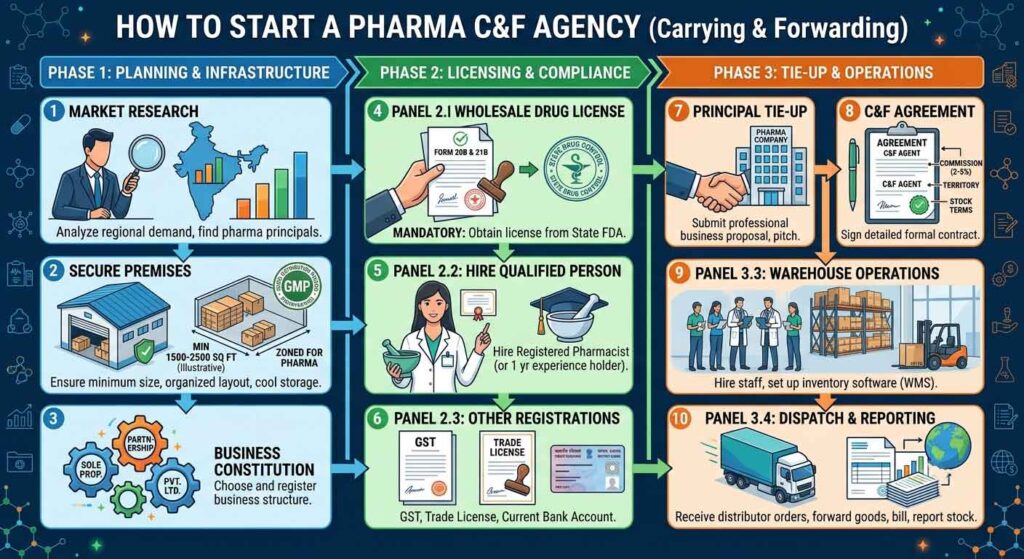
You need a suitable legal entity, GST structure, wholesale drug-licensed warehouse, approved competent person, proper pharmaceutical storage system, warehouse staff, inventory software and a detailed written agreement with the appointing pharmaceutical company.
What Is a Pharmaceutical C&F Agent?
A pharmaceutical C&F agent acts as a regional stock-holding and dispatch service provider for a pharmaceutical company.
Its normal responsibilities may include:
Receiving company stock
Checking quantities and transit damage
Maintaining batch-wise inventory
Storing products under required conditions
Processing company-approved orders
Picking and packing goods
Preparing dispatch documents
Coordinating transport
Maintaining distributor records
Tracking deliveries
Handling returns
Managing near-expiry stock
Supporting recalls
Providing stock and sales reports
The exact role depends on the written agreement.
C&F Agent vs Distributor
These two models should not be confused.
C&F Agent
A genuine C&F agent commonly:
Stores stock belonging to the pharmaceutical company
Dispatches goods according to company instructions
Earns service charges or commission
Does not necessarily purchase the stock
May not bear distributor credit risk
Maintains stock and dispatch records for the principal
Distributor
A distributor generally:
Purchases products from the company or C&F
Owns the purchased stock
Resells products to retailers or sub-distributors
Earns a trading margin
Bears its own credit and market risk
Maintains its own customer network
Super Stockist
A super stockist generally:
Purchases larger quantities
Maintains stock for a large territory
Supplies district distributors
Invests substantial working capital
Earns a trading margin or special distribution margin
C&F-Cum-Super-Stockist
Some companies appoint one entity for both functions.
In this model, the agreement must clearly distinguish:
Company-owned stock
C&F stock handling
Stock purchased by the super stockist
C&F service charges
Trading margins
Billing and GST treatment
Credit risk
Do not use the terms C&F, distributor and super stockist interchangeably.
Is There a Separate C&F Licence?
There is generally no single licence called a:
“Carrying and Forwarding Licence”
Instead, the business requires licences and registrations based on its activities.
These may include:
Business entity registration
GST registration
Wholesale drug licence
Shop and Establishment registration
Local trade registration
Fire-safety approval
Warehousing or building permissions
Labour registrations
E-way bill compliance
Category-specific licences
The pharmaceutical company’s appointment letter does not replace these licences.
Wholesale Drug Licence for a Pharma C&F
If the C&F premises will stock, distribute or offer allopathic medicines for wholesale supply, the relevant wholesale drug-licence structure is generally required.
Common licences include:
Form 20-B
For wholesale sale or distribution of allopathic drugs other than those specified in Schedules C, C(1) and X.
Form 21-B
For wholesale sale or distribution of drugs specified in Schedules C and C(1), excluding Schedule X.
Form 20-G
For wholesale sale or distribution of Schedule X drugs.
Schedule X products require stricter:
Storage
Security
Record keeping
Invoice control
Traceability
A new C&F operator may initially exclude Schedule X products unless there is a clear commercial requirement and suitable compliance system.
Minimum Premises Area
The legal minimum commonly applicable to an ordinary wholesale drug-licensed premises is:
10 square metres
However, this figure is only the licensing floor-area requirement for a small wholesale outlet.
It is not a practical size for a pharmaceutical C&F warehouse handling:
Several hundred products
Multiple batches
Large monthly sales
Returns
Cold-chain products
Promotional materials
Multiple companies
A proper C&F facility may require several thousand square feet depending on:
Number of companies
Product range
Monthly turnover
Carton volume
Cold-chain requirements
Number of distributors
Required buffer stock
Returns and expiry volume
The layout should be accepted by the concerned State Drug Control authority.
Selecting the Right Location
The best C&F location is not automatically the state capital.
Select the location according to:
Access to major highways
Transport availability
Distance from distributor clusters
Courier and cargo connections
Central reach within the territory
Commercial warehouse availability
Reliable electricity
Internet connectivity
Staff availability
Security
Flood and fire risk
Local drug-licensing acceptability
State Capital
A state capital may provide:
Better connectivity
More transporters
Easier access to company officials
Stronger distributor presence
Better staff availability
However, rent and operating costs may be higher.
Central Logistics Hub
A centrally located city may reduce average delivery time across the state.
Strongest Existing Market
A city where you already have:
Distributor relationships
Transport contacts
Staff
Commercial premises
may be more suitable than a theoretically central location.
Choose a place where most district distributors can receive stock within approximately one or two working days.
Premises Requirements
A pharmaceutical C&F warehouse should be:
Independent
Commercially permitted
Easily accessible
Clean
Dry
Secure
Pest controlled
Protected from direct sunlight
Designed for pharmaceutical storage
Recommended Areas
A practical warehouse may contain:
Goods receiving area
Inward inspection area
Saleable stock area
Cold-storage area
Quarantine area
Returned-goods area
Rejected-goods area
Recalled-stock area
Expired-stock area
Packing and dispatch area
Documentation office
Promotional-material area
Loading and unloading area
Staff changing and sanitation facilities
Storage Infrastructure
Storage Racks
Products should be stored on suitable racks or pallets.
Avoid:
Placing cartons directly on the floor
Storing cartons against damp walls
Overloading shelves
Blocking fire exits
Mixing returned stock with saleable stock
Temperature Control
The warehouse should maintain temperatures according to product labels and company requirements.
Provide:
Air conditioning where required
Thermometers or data loggers
Temperature records
Alarm or escalation system
Backup arrangements
Refrigerated Products
For products requiring refrigerated storage, arrange:
Pharmaceutical refrigerator or cold room
Calibrated temperature monitoring
Backup power
Temperature-alarm system
Ice packs and validated cold boxes
Cold-chain dispatch procedure
Excursion investigation
A household refrigerator without monitoring and backup is not suitable for a serious C&F operation.
Humidity Control
Humidity may affect:
Tablets
Capsules
Effervescent products
Paper cartons
Labels
Medical devices
Diagnostic products
Humidity monitoring should be considered according to the product range and local climate.
Power Backup
Provide suitable:
Generator
Inverter
UPS
Automatic changeover
for cold-chain equipment, computers and security systems.
Competent Person
Wholesale drug operations should be supervised by a competent person accepted by the State Licensing Authority.
Depending on the applicable rules, this may be:
A registered pharmacist
A graduate with prescribed experience in dealing with drugs
A person with the prescribed educational qualification and longer practical experience
The competent person should be genuinely employed and available.
Avoid:
Using another firm’s competent person
Showing a person only for inspection
Submitting false experience records
Allowing untrained staff to independently manage drug dispatch
Business Entity Options
A C&F agency may operate as:
Proprietorship
Partnership firm
LLP
Private Limited Company
Proprietorship
Suitable for:
One promoter
Small local operation
Lower setup complexity
The proprietor has personal liability.
Partnership
Suitable where two or more people jointly invest and operate the business.
A detailed partnership deed should define:
Capital
Profit sharing
Duties
Authority
Exit
Dispute resolution
LLP
Provides:
Separate legal identity
Limited liability
Partnership-style management
It can be suitable for a professionally managed regional C&F business.
Private Limited Company
Suitable where the business intends to:
Handle several pharma principals
Expand nationally
Raise outside investment
Establish multiple warehouses
Build a large logistics company
GST Structure for a C&F Agency
GST treatment depends on the exact commercial arrangement.
The agreement and invoicing process must answer:
Who owns the goods?
Who invoices the distributor?
Who receives payment?
Does the C&F supply goods on behalf of the principal?
Does the C&F purchase and resell stock?
Is the C&F only providing warehousing and dispatch services?
Who bears shortages and expiry?
Who generates the e-way bill?
Model 1: Principal-Owned Stock
Under a typical C&F service model:
Stock remains owned by the pharmaceutical company.
The C&F stores and handles the stock.
The company invoices the distributor.
The C&F earns service charges or commission.
The C&F invoices the company for its services.
The GST registration and place-of-business structure of the principal should be professionally reviewed when company-owned stock is maintained in another state.
Model 2: Agent Supplies Goods for Principal
Where the C&F agent receives or supplies goods on behalf of the principal and is authorized to issue invoices or transfer title, principal-agent GST provisions may apply.
This structure requires careful review of:
Agency agreement
Invoice authority
Stock transfer
Tax valuation
Principal-wise records
Input tax credit
State registration
Model 3: Buy-and-Sell Distributor
Where the entity purchases the medicines and resells them:
It is operating as a distributor or super stockist.
It earns trading margin.
It owns the stock after purchase.
Ordinary sale and purchase GST rules apply.
Calling this model “C&F” in conversation does not change its true commercial nature.
GST Registration by State
GST registration is state-specific.
When a pharmaceutical company holds its own stock in a C&F warehouse located in another state, the company may require a suitable GST establishment or registration in that state, depending on the legal and invoicing structure.
The C&F agent will ordinarily require GST registration for its own service income and other taxable activities.
Obtain a written structure note from a Chartered Accountant before signing the agreement.
Documents Required to Start a C&F Agency
Business Documents
Proprietorship declaration, partnership deed, LLP certificate or incorporation certificate
PAN
GST registration
Memorandum and Articles of Association, where applicable
Board resolution or authorization
Bank-account proof
Udyam registration, where suitable
Premises Documents
Ownership deed or lease agreement
Landlord’s NOC
Property proof
Commercial-use proof
Site plan
Key plan
Utility bill
Photographs
Fire-safety documents, where applicable
Drug-Licence Documents
Application form
Government fee receipt
Constitution documents
Competent-person documents
Qualification certificate
Experience certificate
Appointment letter
Identity and address proof
Affidavits and declarations
Storage-equipment details
Refrigerator documents, where applicable
Premises plan
Operational Documents
C&F appointment letter
C&F agreement
Quality or distribution agreement
SOPs
Insurance policies
Staff records
Warehouse records
Transporter agreements
The exact checklist varies by state.
Documents to Obtain From the Pharmaceutical Company
Before accepting the appointment, collect:
Company constitution details
GST certificate
Wholesale or manufacturing licence
Product list
Product-wise manufacturer details
Manufacturing licences
Product permissions
Applicable GMP documentation
Price list
Storage conditions
Recall contact details
Authorized distributor list
Written C&F appointment
Billing and invoicing process
Expiry and return policy
Insurance responsibility
Commission structure
Target stock norms
Due Diligence on the Pharma Company
Do not accept a C&F appointment merely because the company promises large turnover.
Verify:
Legal entity
Registered office
Directors or promoters
Drug licences
Product manufacturers
Product permissions
Market presence
Distributor network
Payment history
Regulatory complaints
Recall history
Financial stability
Existing C&F references
Speak with:
Existing distributors
Existing C&F agents
Transporters
Market contacts
C&F Agreement
A detailed written agreement is essential.
It should address the following matters.
Appointment
Mention:
Legal names
Effective date
Territory
Product division
Exclusive or non-exclusive status
Ownership of Stock
Clarify:
When stock ownership transfers
Whether stock remains company-owned
Who bears transit loss
Who bears warehouse shortage
Who bears expiry loss
Premises
Mention:
Approved warehouse address
Additional premises
Drug-licence numbers
GST details
Restrictions on shifting
Services
Define whether the C&F will handle:
Receipt
Storage
Order processing
Picking
Packing
Dispatch
Invoice printing
Collections
Returns
Promotional material
Distributor support
Remuneration
State whether payment is based on:
Fixed monthly fee
Percentage of sales
Per invoice
Per case
Per line item
Storage volume
Combination of fixed and variable charges
Expenses
Clarify responsibility for:
Rent
Staff
Electricity
Cold storage
Transport
Courier
Packing material
Insurance
Software
Loading and unloading
Pest control
Security
Damages
Credit and Collection
Clearly state:
Who approves credit?
Who collects payment?
Where is payment deposited?
Who bears bad debts?
Can C&F accept cash?
Can C&F issue credit notes?
Inventory Norms
Specify:
Minimum stock
Maximum stock
Reorder level
Slow-moving stock
Near-expiry reporting
Stock-transfer frequency
Expiry and Returns
Clarify:
Minimum shelf life accepted
Near-expiry reporting period
Distributor return period
Expiry reimbursement
Destruction authorization
Freight responsibility
Shortage and Damage
State the procedure for:
Factory shortage
Transit shortage
Warehouse shortage
Damage
Leakage
Theft
Fire
Natural disaster
Insurance
Specify who maintains:
Stock insurance
Fire insurance
Burglary insurance
Fidelity insurance
Transit insurance
Public-liability insurance
Product Recall
Define:
Recall instruction
Distributor communication
Stock blocking
Batch identification
Return collection
Reconciliation
Reporting
Records and Audit
The pharmaceutical company should have the right to inspect:
Warehouse
Stock
Invoices
Returns
Temperature records
Distributor records
Computer data
Termination
Mention:
Notice period
Immediate termination conditions
Stock reconciliation
Pending payments
Return of documents
Transfer of inventory
Confidential information
Final settlement
Quality or Distribution Agreement
A commercial C&F agreement may not provide enough pharmaceutical-quality detail.
A separate distribution-quality agreement should cover:
Storage conditions
Temperature monitoring
FEFO
Batch traceability
Complaints
Recalls
Counterfeit-product prevention
Returned-goods assessment
Product destruction
Change notification
Record retention
Staff training
Self-inspection
Warehouse Staff
A small C&F operation may need:
Warehouse manager
Competent person
Billing executive
Storekeeper
Packing staff
Dispatch coordinator
Accounts executive
Delivery or logistics coordinator
Security personnel
Larger operations may also need:
Quality coordinator
Cold-chain officer
IT support
Claims executive
Distributor-service team
Software Requirements
A pharmaceutical C&F should not depend only on handwritten stock records.
The software should support:
Batch-wise inventory
Expiry tracking
Purchase or stock receipt
Order processing
Invoice printing
GST
E-way bill
Credit notes
Returns
Schemes
Free quantities
Distributor limits
FEFO allocation
Stock ageing
Near-expiry alerts
Recall reports
Principal-wise reporting
The system should also maintain:
User permissions
Audit trail
Backup
Data security
Registers Required
A C&F agency should maintain appropriate records such as:
Goods receipt register
Batch-wise stock register
Dispatch register
Sales or invoice register
Distributor master
Temperature register
Refrigerator-temperature register
Return register
Expiry register
Breakage register
Complaint register
Recall register
Destruction register
Promotional-material register
Transport register
E-way bill register
Debit and credit note register
Inward Stock Procedure
When stock arrives:
Verify the transporter’s documents.
Count the number of packages.
Check seals and physical condition.
Record the arrival time.
Verify invoice or stock-transfer documents.
Check product, batch, expiry and quantity.
Report shortages or damage immediately.
Transfer cold-chain goods without delay.
Enter stock in the software.
Store products in the correct location.
Do not sign “received in good condition” before inspecting the packages.
Dispatch Procedure
A controlled dispatch process should include:
Receive approved distributor order.
Verify distributor licence and credit status.
Prepare picking list.
Pick stock according to FEFO.
Verify batch and expiry.
Complete second-person checking.
Prepare invoice or delivery document.
Generate e-way bill where applicable.
Pack and label cases.
Prepare transporter documents.
Record dispatch.
Send dispatch details to distributor.
Track delivery.
Obtain POD.
FEFO System
FEFO means:
First Expiry, First Out
Stock with the earliest acceptable expiry should generally be dispatched first.
However, the system should also consider:
Minimum remaining shelf life
Customer requirement
Tender conditions
Company instructions
Product stability
Do not dispatch near-expiry stock simply because it appears first in FEFO.
Expiry Management
A strong C&F should issue periodic reports for stock expiring within:
12 months
9 months
6 months
3 months
The agreement should define the reporting intervals.
Early reporting allows the company to:
Transfer stock
Increase legitimate sales focus
Stop further supply
Collect stock before expiry
Avoid distributor disputes
Returned Goods
Returned medicines should be placed in quarantine until authorized assessment.
The C&F should not return them directly to saleable stock without confirming:
Product identity
Batch
Expiry
Storage history
Seal integrity
Return reason
Company authorization
Cold-chain returns require especially careful review.
Product Complaints
When a complaint is received:
Record the product
Record batch and expiry
Record invoice and customer
Preserve the complained sample
Inform the company
Block stock where instructed
Assist investigation
Maintain closure records
A C&F agent should never independently promise that a quality complaint is “minor” without company evaluation.
Recall Procedure
The C&F should be able to identify all distributors that received a particular batch.
The recall process may include:
Receive written recall instruction.
Stop dispatch of the affected batch.
Block the batch in software.
Identify all recipients.
Inform distributors.
Arrange return.
Reconcile dispatched and returned quantity.
Segregate recalled goods.
Submit recall report.
Dispose of goods only under authorization.
Distribution Network
A C&F agent should understand the regional distributor network, but its role is not always to appoint distributors.
Depending on the agreement:
The company may appoint distributors.
The C&F may recommend distributors.
The C&F may collect distributor documents.
The company may approve credit and terms.
The C&F may service only approved accounts.
Do not supply medicines to unauthorized or unlicensed parties merely to increase turnover.
Distributor Documents
Before supply, verify documents such as:
Wholesale drug licence
GST registration
Legal firm name
Billing and delivery address
PAN
Bank details
Contact persons
Credit approval
Company appointment
Licence validity and premises details should be periodically reviewed.
C&F Earnings
There is no universal C&F commission.
Compensation may include:
Fixed monthly remuneration
Percentage of primary sales
Percentage of invoice value
Per-case handling charges
Per-invoice charges
Storage charges
Cold-chain charges
Additional delivery charges
Promotional-material handling charges
The rate depends on:
Monthly turnover
Number of products
Number of invoices
Warehouse size
Staff requirement
Whether billing is done by C&F
Whether collections are handled
Cold-chain requirement
Territory size
Credit risk
Company reputation
Compare the expected income with the full operating cost before accepting the appointment.
C&F Profit Calculation
A basic monthly calculation is:
Total C&F service income
minus:
Rent
Salaries
Electricity
Software
Internet
Security
Insurance
Loading and unloading
Pest control
Cold storage
Stationery
Compliance
Transport expenses not reimbursed
Shortage provision
equals:
Operating profit
A high stated commission may still be unprofitable if:
Turnover is low
Invoice count is high
Cold storage is expensive
The company does not reimburse freight
Staff requirements are heavy
Payments are delayed
Investment Required
There is no single minimum amount.
Investment depends mainly on whether the stock belongs to the pharmaceutical company or is purchased by you.
Principal-Owned Stock Model
Major investment heads include:
Security deposit
Warehouse rent
Racking
Air conditioning
Refrigerator or cold room
Power backup
Computers
Software
Licensing
Staff salaries
Insurance
Working expenses
Working-capital requirement may be comparatively lower because you do not purchase the medicine stock.
Super-Stockist Model
In addition to warehouse investment, you may need substantial funds for:
Product purchase
Distributor credit
GST
Expiry claims
Bad debts
Transport
Stock loss
This requires much higher working capital.
Preparing an Investment Budget
Prepare a table covering:
Investment Head
One-Time or Monthly
Premises deposit
One-time
Warehouse rent
Monthly
Civil work
One-time
Racks and pallets
One-time
Air conditioning
One-time
Refrigerator or cold room
One-time
Generator or backup
One-time
Computers and printers
One-time
Software
One-time and recurring
Drug licence and professional fees
One-time/retention
Salaries
Monthly
Electricity
Monthly
Insurance
Annual
Pest control
Recurring
Loading and transport
Recurring
Working capital
Ongoing
Add a contingency reserve for at least several months of operating expenditure because company turnover may take time to reach the promised level.
Best Opportunities in C&F Business
1. Established Domestic Pharma Companies
Advantages:
Existing distributor network
Regular products
Predictable dispatch
Challenges:
Strict service standards
Competitive appointment process
Lower negotiation power
2. Growing Regional Pharma Companies
Advantages:
Faster growth opportunity
Greater territory
Flexible commercial terms
Challenges:
Sales may be uncertain.
Systems may be less developed.
3. Ayurvedic and Herbal Companies
Opportunities include:
Ayurvedic medicines
Herbal products
Classical products
PCD supplies
The licensing and sale requirements should be checked separately from allopathic medicines.
4. Nutraceutical Companies
These may require:
FSSAI compliance
Food storage controls
Separate licensing review
Do not assume the wholesale drug licence covers food supplements.
5. Medical Devices
Medical-device warehousing and sale follow the applicable Medical Devices Rules and sale-premises requirements.
6. Cold-Chain Specialization
Specialized C&F services may be provided for:
Vaccines
Insulin
Biological products
Temperature-sensitive diagnostics
This requires higher investment and stronger quality systems but may face less ordinary competition.
7. Institutional and Hospital Supply
A C&F may support companies supplying:
Hospitals
Government institutions
Corporate healthcare chains
Tenders
This may involve:
Special packing
Tender rates
Batch documentation
Long credit cycles
Specific delivery schedules
How to Find a Pharma C&F Opportunity
Company Websites
Check whether pharmaceutical companies invite:
C&F agents
State distributors
Super stockists
Logistics partners
Industry Contacts
Use relationships with:
Distributors
Manufacturers
Pharma sales managers
Logistics providers
Industry associations
Pharma Exhibitions
Trade exhibitions can help you meet:
Marketing companies
Manufacturers
Distribution heads
Business-development managers
Professional Proposal
Prepare a C&F profile containing:
Company introduction
Promoter experience
Proposed territory
Warehouse details
Drug licences
GST
Staff
Distributor reach
Transport connectivity
Current principals
Financial capacity
Photographs
References
A professional proposal is more effective than asking only:
“Do you have C&F?”
Questions to Ask the Pharma Company
Before agreeing, ask:
What is the expected monthly turnover?
How many products are active?
How many distributors will be serviced?
Who owns the stock?
Who invoices distributors?
Who approves credit?
Who collects payment?
What is the service charge?
Is there a minimum guaranteed payment?
Who pays rent and staff?
Who pays freight?
Who bears transit loss?
Who bears expiry?
What stock level is expected?
Are cold-chain products included?
How often will stock be supplied?
What reports are required?
What software is used?
What is the termination notice?
How quickly are C&F bills paid?
Warning Signs
Be cautious when a company:
Demands a large security deposit without verification
Promises unrealistic turnover
Refuses to provide licences
Has no written agreement
Does not define stock ownership
Delays existing C&F payments
Pushes short-expiry stock
Has no expiry policy
Has no recall procedure
Requires you to supply unlicensed parties
Does not provide insurance clarity
Frequently changes manufacturers or C&F agents
Asks you to accept unlimited shortage liability
Step-by-Step Procedure
Step 1: Gain Market Understanding
Study:
Pharmaceutical distribution
Wholesaler network
Transport routes
Storage requirements
C&F costing
Step 2: Select Territory
Choose a state or region where you have:
Business contacts
Distributor knowledge
Logistics access
Suitable premises
Step 3: Prepare Business Plan
Estimate:
Warehouse size
Monthly cost
Expected turnover
C&F charges
Staffing
Break-even point
Step 4: Register the Entity
Choose:
Proprietorship
Partnership
LLP
Private Limited Company
Step 5: Select Premises
Obtain a suitable commercial warehouse with:
Road access
Electricity
Security
Expansion space
Storage capability
Step 6: Apply for GST
The structure should match the actual principal-agent and warehousing arrangement.
Step 7: Apply for Wholesale Drug Licence
Arrange:
Premises
Competent person
Storage equipment
Documentation
Inspection
Step 8: Establish Warehouse System
Install:
Racks
Monitoring equipment
Cold storage
Computers
Software
Security
Backup power
Step 9: Prepare SOPs and Registers
Develop procedures for:
Inward receipt
Storage
Dispatch
Returns
Expiry
Complaints
Recalls
Temperature
Documentation
Step 10: Approach Pharma Companies
Submit a professional proposal.
Step 11: Conduct Due Diligence
Verify the company and discuss with existing partners.
Step 12: Sign Agreements
Finalize:
C&F agreement
Quality agreement
GST structure
Payment terms
Stock responsibility
Step 13: Receive Initial Stock
Check:
Quantity
Batch
Expiry
Damage
Storage condition
Step 14: Map Distributors
Load only company-approved and licence-verified distributors.
Step 15: Begin Controlled Dispatch
Use batch-wise software and maintain full documentation.
Step 16: Review Monthly Performance
Review:
Stock accuracy
Dispatch time
Delivery time
Expiry
Damage
Service income
Operating expenses
Company payment
Key Performance Indicators
A pharmaceutical C&F should monitor:
Inventory accuracy
Order-to-dispatch time
On-time dispatch percentage
Distributor fill rate
Expiry percentage
Damage percentage
Return rate
Temperature excursions
Pending PODs
Freight cost
C&F bill payment days
Stock ageing
Recall response time
Common Mistakes
Avoid:
Confusing C&F with distributorship
Taking a warehouse that is too small
Accepting a verbal appointment
Starting without drug licence
Ignoring GST principal-agent provisions
Using an unapproved competent person
Storing products directly on the floor
Mixing returned goods with saleable stock
Failing to monitor temperature
Not taking stock insurance
Accepting unlimited expiry liability
Dispatching to unlicensed parties
Keeping no batch-wise records
Depending on only one employee
Trusting unrealistic turnover promises
Investing heavily before signing the agreement
Practical Answer to the Query
To start a pharmaceutical C&F agency:
Understand whether the proposed role is genuine C&F, distributorship or super-stockist.
Select a commercially suitable territory and logistics location.
Register your business entity.
Obtain GST registration and professional advice on the agency structure.
Select an adequate commercial warehouse.
Obtain wholesale drug licences for the relevant product categories.
Appoint an approved competent person.
Establish temperature-controlled, secure storage.
Install batch-and-expiry inventory software.
Prepare warehouse and recall procedures.
Approach financially and regulatorily reliable pharma companies.
Verify the company before paying security.
Sign detailed commercial and quality agreements.
Receive and reconcile the initial stock.
Dispatch only to approved and licensed customers.
Monitor inventory, expiry, quality and service profitability.
Frequently Asked Questions
1. Is there a separate C&F licence?
There is generally no separate licence called a C&F licence. Licences depend on the activities and products handled.
2. Is a wholesale drug licence required?
Yes, where allopathic medicines are stocked, sold or distributed from the C&F premises.
3. Which drug-licence forms are normally required?
Forms 20-B and 21-B are commonly relevant for wholesale allopathic drug distribution. Form 20-G applies to Schedule X wholesale activity.
4. What is the minimum premises area?
The ordinary legal minimum for wholesale licensing is commonly 10 square metres, but a practical C&F warehouse will normally require much more space.
5. Does a C&F agent purchase stock?
Not necessarily. In a genuine C&F service model, stock commonly remains owned by the pharmaceutical company.
6. Who invoices the distributor?
It depends on the agreement and GST structure. The pharmaceutical company may invoice directly, or the agent may be authorized to issue invoices on its behalf.
7. How does a C&F agent earn?
Earnings may be based on fixed charges, sales percentage, cases handled, invoices processed, storage or a combination.
8. Is the state capital always the best location?
No. The best location is the one offering strong logistics, distributor access, suitable premises and efficient delivery across the agreed territory.
9. Can one C&F handle multiple pharma companies?
Potentially yes, subject to agreements, space, licences, conflict restrictions and operational capacity.
10. What is the biggest C&F risk?
Major risks include vague agreements, delayed service payments, stock shortages, expiry liability, weak principals, poor GST structuring and inadequate warehouse controls.
Final Thoughts
A successful pharmaceutical C&F business is based on:
Licensing + Warehouse control + Accurate inventory + Fast dispatch + Batch traceability + Expiry management + Reliable company relationships
A large distributor network is helpful, but the core responsibility of a C&F agent is professional stock and dispatch management.
The safest approach is to first establish a compliant warehouse and operating system, then accept appointments only from companies with:
Valid licences
Reliable products
Clear payment terms
Proper expiry policy
Realistic sales expectations
Written agreements
Looking for Ayurvedic Franchise or Distribution Opportunities?
Looking to start an Ayurvedic franchise, become a distributor, or launch your own herbal product range?
Elzac Herbal India offers:
Ayurvedic & Herbal Product Range
Franchise & Distribution Opportunities
Third-Party Manufacturing Services
Product Development Support
Marketing Guidance
PAN India Business Opportunities
Whether you are an entrepreneur, retailer, distributor, or healthcare professional, our team can help you explore the right business opportunity in the growing Ayurvedic sector.
Ajay Kamboj is an entrepreneur and business owners associated with many Ayurvedic and Pharmaceutical start-ups. With years of experience in Ayurvedic product marketing, pharmaceutical distribution, franchise development, and client relationship management, he regularly shares practical business insights based on real-world experiences. His articles focus on business growth, entrepreneurship, customer management, and lessons learned from the healthcare and wellness industry.
10 responses to “How to Start a Carrying and Forwarding Agency in the Pharmaceutical Sector”
Could you assist me on setting up a C & F or Wholesale business for pharmaceutical supplies?
I want to start a Pharmaceutical CFA in Bangalore any company is there or any franchise is there to give a Pharma Business in Bangalore to my Pharma CFA.








Could you assist me on setting up a C & F or Wholesale business for pharmaceutical supplies?
I am looking at setting up a business in Kerala.
Hi, i am holding of wholesale license as i can get the products only through stockiest is there any way that i can get the products from C&F
I want to start c&f pharmaceutical busines in puna mah plz if any rag company intrested conf
Hii I want to start a carry and forward business what is the full process and from how much minimum money we can started this business.
NEED A PHARMACEUTICAL C & F PLZ CONTACT
8878666066
I want to start a c&f agency in Kerala. Kindly help with inputs
C&f
In Bangalore i want to open a Pharma CFA any one franchaise or Pharmaceutical company plz contact 8660706895 .
In Kerala I want to open a Pharma CFA any one franchaise or Pharmaceutical company please contact 9747630090.
I want to start a Pharmaceutical CFA in Bangalore any company is there or any franchise is there to give a Pharma Business in Bangalore to my Pharma CFA.