“I want to start a small-scale manufacturing unit related to food or cosmetics, but I do not have a clear idea about the right business area, investment or time required. How should I begin?”
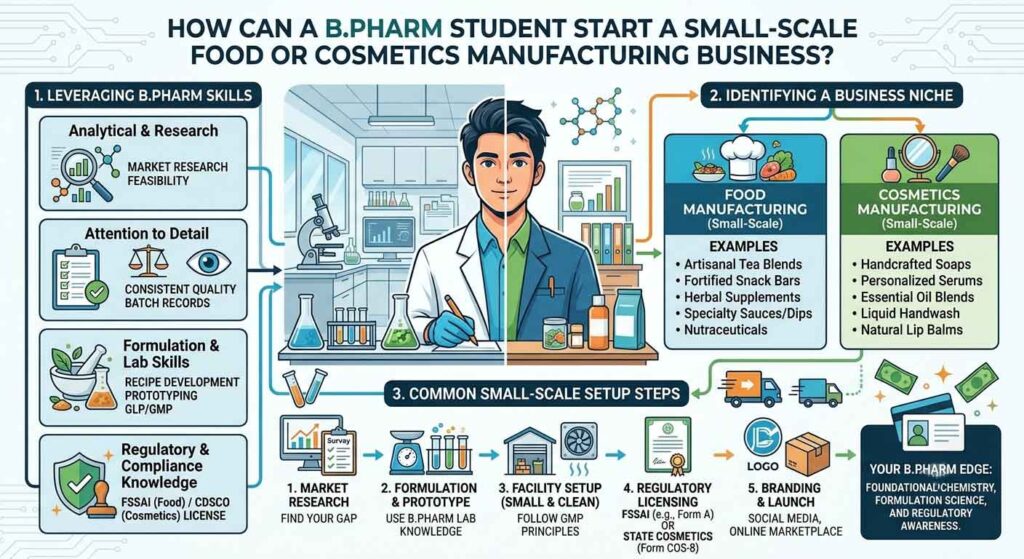
A pharmacy education provides useful knowledge of formulation, quality control, microbiology, chemistry, packaging and regulatory concepts. However, academic knowledge alone is usually not enough to operate a manufacturing business successfully.
A new entrepreneur must also understand:
Production planning
Raw-material sourcing
Vendor management
Licensing
Quality documentation
Packaging
Cost calculation
Distribution
Customer complaints
Staff management
Cash-flow management
For this reason, a B.Pharm student should normally follow a gradual path rather than investing immediately in a complete manufacturing plant.
Quick Answer
The safest path for a B.Pharm student is:
Gain practical experience in a food, cosmetics, Ayurvedic or pharmaceutical company.
Select one product category rather than launching many products.
Test the market through third-party or private-label manufacturing.
Build sales and distribution.
Establish an independent manufacturing unit only after demand becomes stable.
This approach reduces financial risk and provides practical industry exposure.
Can a B.Pharm Graduate Start a Manufacturing Business?
Yes, a B.Pharm graduate can become an entrepreneur and establish a food, cosmetics, Ayurvedic or pharmaceutical business.
However, possessing a B.Pharm degree does not automatically provide permission to manufacture every type of regulated product.
The licences, technical-person requirements, premises standards and approvals depend on:
Product category
Manufacturing activity
Production capacity
State of operation
Ingredients used
Claims made on the label
Applicable regulatory framework
Before investing in premises or machinery, the entrepreneur should confirm the requirements with the relevant licensing authority and an experienced regulatory consultant.
Should a Student Start Immediately After Graduation?
Starting immediately is possible, but starting without practical exposure increases the risk of costly mistakes.
A student may understand formulation theory but may not yet have experience with:
Commercial batch production
Equipment cleaning and maintenance
Batch failures
Raw-material rejection
Stability problems
Packaging leakage
Microbial contamination
Production documentation
Market credit
Distributor expectations
Product returns
Six to twelve months of relevant industry experience can provide valuable practical knowledge. Experience in production, quality assurance, regulatory affairs, purchase or product development is especially useful.
Three Ways to Enter the Business
Option 1: Gain Experience Before Starting
Work in a relevant company after graduation.
Suitable departments include:
Production
Quality assurance
Quality control
Regulatory affairs
Research and development
Purchase
Packaging
Sales and marketing
Advantages
Practical knowledge
Industry contacts
Better supplier understanding
Lower risk of mistakes
Improved knowledge of documentation
Better product-selection decisions
Disadvantage
Business launch is delayed for a few months
Despite the delay, this is often the most valuable preparation for a first-time entrepreneur.
For most students and first-time entrepreneurs, this is the most practical starting model.
Option 3: Establish Your Own Manufacturing Unit
An independent manufacturing unit gives greater control over production, formulation, quality and scheduling.
However, it also requires:
Suitable premises
Machinery
Utilities
Licensing
Technical staff
Quality-control systems
Documentation
Raw-material inventory
Packaging inventory
Working capital
This option is better suited to entrepreneurs who already have practical experience, sufficient capital and confirmed market demand.
Food Manufacturing or Cosmetics: Which Is Better?
Both categories offer opportunities, but the ideal choice depends on your knowledge, capital and target market.
Factor
Food Products
Cosmetics
Regulatory system
FSSAI
Cosmetics Rules and State Licensing Authority
Entry complexity
Low to moderate for simple foods
Moderate
Formulation difficulty
Depends on product
Often requires formulation and stability expertise
Investment
Lower for selected simple products
Usually higher for an independent unit
Testing needs
Food safety and quality testing
Safety, quality, stability and compatibility testing
Market competition
Very high
Very high
Branding importance
High
Extremely high
Suitable for third-party launch
Yes
Yes
Small Food-Business Ideas for Pharmacy Students
A student should preferably begin with a shelf-stable and operationally simple product.
Possible categories include:
Herbal teas
Spice blends
Roasted snacks
Health drink mixes
Traditional food powders
Millet-based products
Dry fruit mixes
Herbal food beverages
Nutrition bars
Ready-to-mix products
Avoid beginning with products that require complex cold chains, short shelf lives or difficult manufacturing controls unless you have adequate technical support.
Health supplements and nutraceutical products may involve additional formulation, ingredient and labelling requirements. Their positioning and claims must be reviewed carefully before launch.
Do not mix several regulated categories at the beginning unless you understand their separate compliance requirements.
Step 2: Conduct Market Research
Study:
Customer demand
Competitor products
MRP
Pack sizes
Ingredients
Reviews
Distribution margins
Online pricing
Minimum order quantities
Speak with retailers, distributors and potential customers before finalising the product.
Step 3: Choose the Business Model
Select one of these:
Third-party manufacturing
Private-label manufacturing
Loan-licence arrangement, where applicable
Independent manufacturing
For a beginner with limited capital, third-party manufacturing is generally the easiest route.
Step 4: Prepare a Business Plan
Your business plan should include:
Product category
Target customer
Initial product range
Estimated production quantity
Manufacturing cost
Packaging cost
Marketing budget
Distributor and retailer margins
Working capital
Break-even estimate
Sales strategy
Do not calculate only manufacturing cost. Include samples, transport, promotional material, damaged stock, returns, online commissions and credit given to buyers.
Step 5: Register the Business
Depending on the scale and ownership structure, the business may operate as:
Proprietorship
Partnership
LLP
Private Limited Company
Other registrations may include:
PAN
Business bank account
GST registration, where applicable
Udyam registration
Trademark application
Local registrations and permissions
The exact registrations depend on the activity, turnover, location and legal structure.
Step 6: Confirm Product-Specific Licensing
For Food Products
Determine the applicable FSSAI registration or licence according to the kind of business, production capacity, turnover and activity.
For Cosmetics
Manufacturing requires compliance with the Cosmetics Rules and approval from the appropriate State Licensing Authority.
For Pharmaceutical Products
Drug manufacturing involves stricter premises, technical-person, product-permission and quality-control requirements.
Do not purchase machinery or finalise premises before confirming the applicable licensing conditions.
Step 7: Select the Premises
The premises should be suitable for the selected activity.
Consider:
Industrial or permitted location
Space for production
Raw-material storage
Finished-goods storage
Packing area
Washing and sanitation
Water quality
Ventilation
Waste disposal
Pest control
Staff movement
Fire safety
Electricity load
A cheap but unsuitable building can cause licensing delays and expensive modifications.
Step 8: Select Machinery
Machinery depends entirely on the product.
A small liquid cosmetic unit may require:
Mixing vessel
Homogeniser
Storage vessel
Filling machine
Capping machine
Labelling machine
Water-treatment system
A dry food unit may require:
Grinder
Sieve
Blender
Roaster
Weighing equipment
Sealing machine
Metal-detection or inspection arrangements, where required
Do not buy oversized machinery before confirming demand.
Step 9: Develop and Test the Product
The product should be evaluated for:
Ingredient quality
Appearance
Colour
Odour
Taste, where applicable
pH
Viscosity
Microbial quality
Stability
Packaging compatibility
Shelf life
Testing requirements differ by product category.
A formula that works in a laboratory may behave differently during commercial-scale production.
Step 10: Finalise Packaging and Labelling
Packaging must protect the product and communicate the required information.
Check:
Product name
Ingredient list
Net quantity
Batch number
Manufacturing date
Expiry or best-before date
MRP
Manufacturer details
Marketer details
Licence number
Directions for use
Storage conditions
Warnings
Customer-care information
Required symbols and declarations
Final artwork should be checked by a qualified regulatory professional before printing.
Step 11: Produce a Pilot Batch
Before investing in large quantities, manufacture a limited commercial or pilot batch where legally and technically possible.
Use it to evaluate:
Customer response
Packaging quality
Product stability
Selling price
Repeat purchase
Retailer interest
Complaints
Transportation damage
The pilot stage can prevent much larger losses later.
Step 12: Build Distribution Before Expanding
Possible sales channels include:
Local retailers
Pharmacies
Cosmetic stores
Supermarkets
Distributors
Salons
Clinics, where appropriate
Your own website
Online marketplaces
Social media
Institutional buyers
Do not launch ten products when you are still learning how to sell the first two.
How Much Investment Is Required?
There is no fixed investment because it depends on product type, capacity, premises, machinery, location and business model.
The following are broad planning estimates only. They do not include purchasing land or a building.
Business Model
Indicative Initial Budget
Approximate Preparation Time
Small third-party/private-label launch
₹2 lakh–₹8 lakh
1–3 months
Basic rented food-processing unit
₹5 lakh–₹25 lakh
3–8 months
Small rented cosmetic unit
₹15 lakh–₹60 lakh
5–12 months
Pharmaceutical manufacturing unit
Usually substantially higher
Often 9–18 months or more
These estimates may change significantly based on machinery, renovation, laboratory arrangements, product category and state-level requirements.
Where Will the Money Be Used?
Your investment may include:
Company registration
Professional and consultancy fees
Premises deposit and rent
Civil modifications
Licensing
Machinery
Water system
Laboratory arrangements
Raw materials
Packaging materials
Product development
Testing
Trademark
Website
Marketing
Salaries
Electricity and utilities
Transport
Working capital
Keep a working-capital reserve instead of spending the entire budget on machinery and interiors.
Recommended Roadmap for a B.Pharm Student
Stage 1: Learn
Duration: Approximately 6–12 months
Work in a relevant company.
Understand production and documentation.
Study one market category.
Build supplier and industry contacts.
Stage 2: Test the Business
Duration: Approximately 3–6 months
Select two or three products.
Use third-party manufacturing.
Build your brand.
Test pricing and customer response.
Develop a small distribution network.
Stage 3: Scale
Duration: After developing consistent sales
Increase repeat orders.
Add related products.
Strengthen distribution.
Improve quality systems.
Evaluate whether your own unit is commercially justified.
Stage 4: Establish Manufacturing
Consider your own unit only when:
Demand is stable.
You understand production.
You have sufficient capital.
You can employ qualified staff.
You have reliable suppliers.
Your projected production volume can support fixed costs.
Common Mistakes to Avoid
Starting without industry exposure
Selecting too many products
Buying machinery before obtaining regulatory guidance
Choosing products only on the basis of low manufacturing cost
Ignoring working capital
Making unsupported health or cosmetic claims
Printing packaging before regulatory review
Giving excessive credit to distributors
Depending on one supplier
Establishing a factory before confirming demand
Final Recommendation
A B.Pharm student should not abandon the idea of entrepreneurship. However, the business should be developed in stages.
The most practical route is:
Industry experience → third-party product launch → market validation → gradual expansion → own manufacturing unit
Starting small does not mean thinking small. It means protecting capital while developing the knowledge and customer base required to build a sustainable company.
Frequently Asked Questions
1. Can a final-year B.Pharm student start a company?
Yes, but product manufacturing and sale must begin only after completing the registrations, licences and technical requirements applicable to that business.
2. Is a B.Pharm degree sufficient for a food manufacturing licence?
The qualification and technical-person requirements depend on the product and activity. Eligibility should be confirmed through FoSCoS and the relevant authority before applying.
3. Is food or cosmetics better for a beginner?
Simple food products may require less machinery, while cosmetics can provide stronger branding and margins but normally require greater formulation, stability and packaging attention.
4. Can I begin without owning a factory?
Yes. Third-party or private-label manufacturing allows you to begin with your own brand without establishing a complete factory.
5. How many products should I launch initially?
Two or three related products are normally easier to manage than a large unrelated range.
6. How much experience should I gain?
Even six to twelve months of relevant practical exposure can improve your understanding significantly. More complex pharmaceutical manufacturing generally requires deeper experience.
7. Should I start with food supplements?
Food supplements can be commercially attractive, but ingredient selection, product classification, claims, labelling and licensing must be reviewed carefully.
8. Can I manufacture cosmetics from home?
Do not assume that household premises are acceptable. The proposed site must meet the applicable local, licensing, hygiene and manufacturing requirements.
9. What is the lowest-risk startup model?
A small third-party-manufactured product range, supported by proper market research and limited inventory, is generally the lowest-risk route.
10. When should I establish my own unit?
Consider an independent unit when repeat sales are sufficient to support rent, salaries, compliance, utilities, maintenance and working capital.
Looking for Ayurvedic Franchise or Distribution Opportunities?
Looking to start an Ayurvedic franchise, become a distributor, or launch your own herbal product range?
Elzac Herbal India offers:
Ayurvedic & Herbal Product Range
Franchise & Distribution Opportunities
Third-Party Manufacturing
Product Development Support
Marketing Guidance
PAN India Business Opportunities
Whether you are an entrepreneur, retailer, distributor, or healthcare professional, our team can help you explore the right business opportunity in the growing Ayurvedic sector.
Ajay Kamboj is an entrepreneur and business owners associated with many Ayurvedic and Pharmaceutical start-ups. With years of experience in Ayurvedic product marketing, pharmaceutical distribution, franchise development, and client relationship management, he regularly shares practical business insights based on real-world experiences. His articles focus on business growth, entrepreneurship, customer management, and lessons learned from the healthcare and wellness industry.




Leave a Reply
You must be logged in to post a comment.