Many BAMS doctors want to move beyond clinical practice and enter the Ayurvedic manufacturing business. This is a natural opportunity because a Bachelor of Ayurvedic Medicine and Surgery already has strong knowledge of Ayurvedic principles, herbs, formulations, classical references, and patient needs.
However, starting an Ayurvedic manufacturing company is not only about knowledge of Ayurveda. It also requires proper licence, premises, machinery, quality-control system, documentation, technical staff, and compliance with applicable rules.
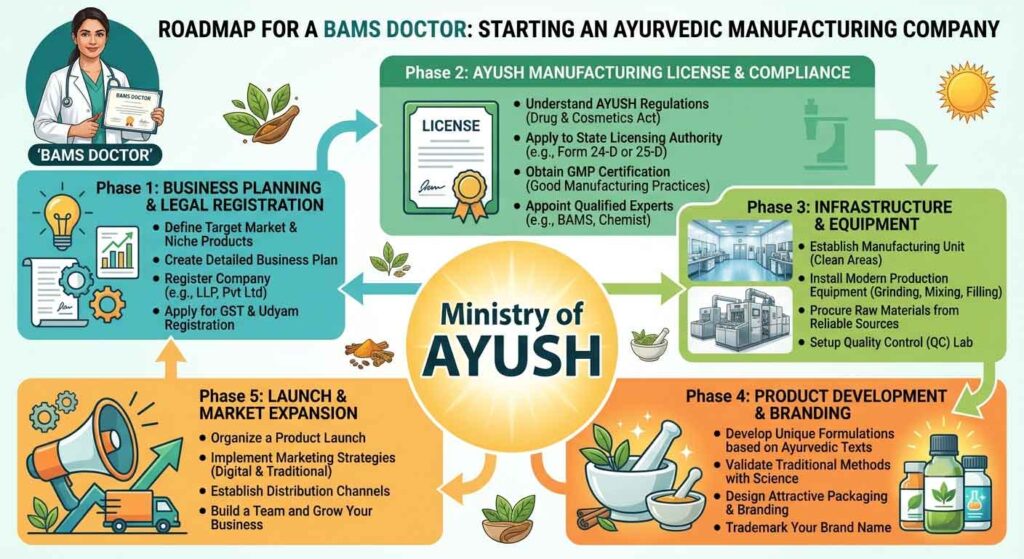
This guide explains how a BAMS doctor can start an Ayurvedic manufacturing company in India.
Can a BAMS Doctor Start an Ayurvedic Manufacturing Company?
Yes, a BAMS doctor can start an Ayurvedic manufacturing company.
In fact, a BAMS doctor has an advantage because Ayurvedic manufacturing requires qualified technical supervision. A BAMS qualification is commonly accepted for the manufacturing technical staff requirement in an Ayurvedic manufacturing unit, subject to approval by the concerned State AYUSH Drug Licensing Authority.
But a BAMS degree alone is not enough to start manufacturing commercially.
You also need:
Ayurvedic manufacturing licence
Schedule T-compliant premises
Required machinery and equipment
Quality-control arrangement
Technical staff
Approved product list
Proper documentation
Inspection and approval from the licensing authority
Why BAMS Doctors Have an Advantage
A BAMS doctor understands Ayurveda from both clinical and classical perspectives.
This helps in:
Selecting the right formulations
Understanding classical Ayurvedic references
Developing proprietary Ayurvedic products
Identifying market-relevant therapeutic segments
Communicating product concepts to doctors and distributors
Maintaining authenticity in Ayurvedic product development
Many successful Ayurvedic brands are built by practitioners who understand real patient problems and practical market demand.
Manufacturing Licence Required
To manufacture Ayurvedic medicines for sale, an Ayurvedic manufacturing licence is required.
The common licence route is:
Application in Form 24-D
Manufacturing licence in Form 25-D
If you do not want to set up your own manufacturing unit and want to manufacture through another licensed facility, you may explore the loan licence route.
For loan licence:
Application is generally made for loan licence
Licence is issued in Form 25-E
The exact procedure, fee, and checklist should be confirmed from your State AYUSH Drug Licensing Authority.
What Is Form 24-D?
Form 24-D is the application form used for applying for a licence to manufacture Ayurvedic, Siddha, or Unani drugs for sale.
The applicant submits Form 24-D along with required documents, fees, technical staff details, premises details, machinery list, and product list.
What Is Form 25-D?
Form 25-D is the manufacturing licence issued by the Licensing Authority for manufacturing Ayurvedic, Siddha, or Unani medicines for sale.
After inspection and verification of requirements, the licensing authority may issue the licence if the premises, staff, documents, and manufacturing arrangements are found satisfactory.
What Is Form 25-E?
Form 25-E is generally related to loan licence manufacturing of Ayurvedic, Siddha, or Unani medicines.
A loan licence is useful when the applicant does not have his or her own manufacturing unit but wants to use the manufacturing facility of an already licensed manufacturer.
For many beginners, loan licence or third-party manufacturing can be easier than immediately establishing a full manufacturing unit.
Technical Staff Required in Ayurvedic Manufacturing
An Ayurvedic manufacturing unit requires competent technical staff for manufacturing and quality control.
A BAMS doctor may commonly fulfill the manufacturing technical person requirement for Ayurvedic manufacturing, subject to approval.
However, the unit also needs quality-control support.
Common technical staff requirements may include:
1. Manufacturing Technical Person
For Ayurvedic manufacturing, this may include a person with BAMS or other recognized Ayurveda-related qualification.
2. Quality-Control Chemist
Quality-control chemist is required for testing and quality-related work.
Common qualification may include:
B.Sc. Chemistry
B.Pharm
B.Pharm Ayurveda
Other qualification accepted by the authority
3. Quality-Control Botanist
A botanist may be required for identification and authentication of herbal raw materials.
Common qualification may include:
B.Sc. Botany
B.Pharm Ayurveda
Bachelor degree in medical science, where accepted
The final technical staff requirement depends on the licensing authority and product category.
Premises Requirement
Ayurvedic manufacturing premises should comply with Schedule T requirements.
Generally, a minimum covered area of around 1200 square feet is considered for setting up an Ayurvedic manufacturing unit, depending on the sections and product categories.
The premises should have proper arrangements for:
Raw material storage
Finished goods storage
Manufacturing area
Packing area
Quality-control area
Machinery room
Washing and cleaning area
Staff facilities
Waste management
Clean water
Electricity
Pest-control and hygiene
If Siddha, Unani, cosmetics, food supplements, or other product categories are added, additional area and separate compliance may be required.
Schedule T Compliance
Schedule T contains Good Manufacturing Practice requirements for Ayurvedic, Siddha, and Unani medicines.
The manufacturing unit should have:
Suitable building
Hygienic conditions
Proper drainage
Washable surfaces
Protection from insects and rodents
Adequate machinery
Quality-control arrangements
Proper storage
Documentation system
Trained staff
Clean water and electricity
Waste-disposal system
Schedule T compliance is one of the most important requirements for obtaining and maintaining an Ayurvedic manufacturing licence.
Documents Required to Start Ayurvedic Manufacturing Company
The exact document list may vary by state, but commonly required documents include:
Application Form 24-D
Prescribed government fee
Constitution of firm or company
Proprietor, partner, or director documents
BAMS qualification documents
Technical staff qualification and appointment documents
Quality-control staff documents
Master site plan
Layout plan
Premises ownership proof or rent agreement
No objection certificate from landlord, if applicable
Power availability certificate
Water availability or water testing details
List of machinery
List of laboratory equipment
List of products to be manufactured
Product formula and references
Project report
Manufacturing process details
Quality-control arrangement
Affidavits and declarations
GST and business registration documents, where applicable
Before filing, take the latest checklist from the concerned State AYUSH licensing office.
Product Selection for a BAMS Doctor
A BAMS doctor should choose products carefully according to knowledge, market demand, classical references, and compliance.
These are company-developed formulations based on Ayurvedic ingredients and principles.
For proprietary products, proper formula documentation, ingredient justification, and product approval requirements should be followed as per the licensing authority.
Machinery Required
Machinery depends on the dosage forms you want to manufacture.
For example:
Liquid Section
Storage tanks
Mixing tanks
Filtration unit
Filling machine
Bottle sealing machine
Labeling machine
Tablet Section
Pulverizer
Mass mixer
Granulator
Dryer
Tablet compression machine
Coating pan, if required
De-dusting machine
Capsule Section
Pulverizer
Blender
Capsule filling machine
Polishing machine
Churna and Powder Section
Grinder
Pulverizer
Sifter
Blender
Packing machine
Oil Section
Heating vessel
Filtration unit
Storage tank
Filling machine
All contact parts should be made from suitable stainless steel or approved material as per manufacturing requirement.
Laboratory and Quality Control
Quality control is essential in Ayurvedic manufacturing.
An Ayurvedic manufacturing unit may establish its own laboratory or use approved testing laboratories where permitted.
Quality-control work may include:
Raw material identification
Herbal authentication
Moisture testing
Ash value
Extractive value
Microbial testing
Heavy metal testing, where applicable
Finished product testing
Stability-related records
Batch-wise documentation
A BAMS doctor should not ignore quality control. Good quality testing protects product reputation and regulatory compliance.
Step-by-Step Procedure for BAMS Doctor
Step 1: Decide Business Model
Choose whether you want:
Own manufacturing unit
Loan licence manufacturing
Third-party manufacturing first
Ayurvedic marketing company first
If investment is limited, third-party manufacturing or loan licence may be practical in the beginning.
Step 2: Choose Product Category
Decide which dosage forms you want to manufacture.
Start with limited sections such as syrup, churna, tablets, capsules, or oils according to budget and market demand.
Step 3: Arrange Premises
Select premises that can comply with Schedule T and local licensing norms.
Make sure the building has sufficient area, clean water, electricity, drainage, and separate sections.
Step 4: Prepare Layout and Project Report
Prepare:
Site plan
Layout plan
Section-wise area plan
Manufacturing flow
Storage plan
Quality-control plan
Project report
Step 5: Arrange Machinery and Equipment
Install machinery according to your selected dosage forms.
Do not purchase unnecessary machines in the beginning. Buy according to product list and licence requirement.
Step 6: Appoint Technical Staff
As a BAMS doctor, you may handle the manufacturing technical role if accepted by the licensing authority.
You still need to arrange quality-control staff such as chemist and botanist as required.
Step 7: Prepare Product List and Formula Details
Prepare a product list with:
Product name
Dosage form
Composition
Classical reference, if applicable
Intended category
Manufacturing process
Label matter
Step 8: Submit Application
Submit Form 24-D along with required documents, fees, and checklist to the State AYUSH Drug Licensing Authority.
Step 9: Inspection by Department
The department will inspect the premises, machinery, staff documents, layout, storage, laboratory, and records.
Step 10: Licence Grant
If requirements are fulfilled, the authority may issue manufacturing licence in Form 25-D.
After licence approval, manufacturing can begin as per approved products and conditions.
A licensed Ayurvedic manufacturer manufactures them
Products are marketed under your brand
You focus on prescription, marketing, distribution, and brand building
This is suitable if you want to test the market before investing in your own plant.
Loan Licence as an Alternative
Loan licence is another option for BAMS doctors who want more formal control than simple third-party manufacturing but do not have their own manufacturing facility.
Under loan licence, you use the facility of an existing licensed manufacturer after obtaining required approval.
This option requires more documentation than normal third-party manufacturing but less investment than setting up a full plant.
Investment Required
Investment depends on:
Premises location
Area
Number of dosage sections
Machinery
Laboratory setup
Product range
Staff
Packaging
Licence and documentation
Working capital
Marketing plan
A small Ayurvedic manufacturing unit may require significant capital. Therefore, beginners should prepare a proper project report before starting.
Common Mistakes to Avoid
BAMS doctors starting manufacturing should avoid these mistakes:
Starting without understanding licence requirements
Selecting too many products in the beginning
Ignoring Schedule T compliance
Not appointing proper quality-control staff
Depending only on clinical knowledge
Ignoring documentation
Making disease-cure claims without legal review
Not testing raw materials properly
Choosing poor-quality packaging
Starting production before licence approval
Underestimating working capital
Final Thoughts
A BAMS doctor can start an Ayurvedic manufacturing company and has a strong technical advantage in this field.
However, Ayurvedic manufacturing is a regulated business. It requires manufacturing licence, Schedule T-compliant premises, machinery, quality-control system, technical staff, documentation, and inspection approval.
If you have sufficient investment and long-term vision, you can start your own manufacturing unit. If you want to begin with lower risk, you can first start with third-party manufacturing or loan licence manufacturing.
The best approach is:
Start with proper compliance, limited products, strong quality control, and a clear marketing plan.
A BAMS degree gives you knowledge. Proper licensing and systems convert that knowledge into a sustainable Ayurvedic business.
Frequently Asked Questions
1. Can a BAMS doctor start an Ayurvedic manufacturing company?
Yes, a BAMS doctor can start an Ayurvedic manufacturing company after fulfilling licensing, premises, technical staff, machinery, and Schedule T requirements.
2. Is BAMS qualification enough for Ayurvedic manufacturing licence?
BAMS may generally fulfill the manufacturing technical staff requirement, subject to approval. However, the unit also requires quality-control staff, premises, machinery, documents, and inspection approval.
3. Which licence is required to manufacture Ayurvedic medicines?
Manufacturing licence for Ayurvedic, Siddha, or Unani medicines is generally issued in Form 25-D after application in Form 24-D.
4. What is Schedule T?
Schedule T contains Good Manufacturing Practice requirements for Ayurvedic, Siddha, and Unani medicines.
5. How much area is required for Ayurvedic manufacturing unit?
A minimum covered area of around 1200 square feet is commonly considered, depending on product sections and state requirements.
6. Does a BAMS doctor need an analytical chemist?
Yes, quality-control staff is required. Depending on state requirements, this may include a chemist and botanist.
7. Can a BAMS doctor start with third-party manufacturing?
Yes. Third-party manufacturing is a practical option for BAMS doctors who want to launch products without immediately setting up their own manufacturing unit.
8. What is better for beginners: own manufacturing or third-party manufacturing?
For beginners with limited investment, third-party manufacturing is easier. Own manufacturing is better when there is sufficient investment, technical team, and long-term production planning.
9. Can a BAMS doctor manufacture proprietary Ayurvedic medicines?
Yes, but proprietary formulations require proper documentation, licenses, ingredient details, approval process, and compliance as per applicable rules.
10. Who inspects Ayurvedic manufacturing premises?
The concerned State AYUSH Drug Licensing Authority or departmental inspection team inspects the premises before issuing the licence.
Looking for Ayurvedic Franchise or Distribution Opportunities?
Looking to start an Ayurvedic franchise, become a distributor, or launch your own herbal product range?
Elzac Herbal India offers:
Ayurvedic & Herbal Product Range
Franchise & Distribution Opportunities
Third-Party Manufacturing Services
Product Development Support
Marketing Guidance
PAN India Business Opportunities
Whether you are an entrepreneur, retailer, distributor, or healthcare professional, our team can help you explore the right business opportunity in the growing Ayurvedic sector.
Ajay Kamboj is an entrepreneur and business owners associated with many Ayurvedic and Pharmaceutical start-ups. With years of experience in Ayurvedic product marketing, pharmaceutical distribution, franchise development, and client relationship management, he regularly shares practical business insights based on real-world experiences. His articles focus on business growth, entrepreneurship, customer management, and lessons learned from the healthcare and wellness industry.







Leave a Reply Cancel reply
You must be logged in to post a comment.