Starting an Ayurvedic manufacturing unit is a good business opportunity for entrepreneurs who want to manufacture classical Ayurvedic medicines, proprietary Ayurvedic medicines, herbal products, pastes, syrups, oils, capsules, tablets, churnas or external applications.
However, Ayurvedic manufacturing is a regulated activity. You cannot start manufacturing Ayurvedic medicines only by taking a small room, machinery and raw material. You need proper premises, section-wise area, machinery, technical staff, quality-control arrangements, documentation and manufacturing licence from the concerned State AYUSH or Drug Licensing Authority. Check : How to start Ayurvedic, Sidha and Unani company in India
This article explains the basic area, machinery, section-wise requirements, budget factors, third-party manufacturing option and research-related points for starting an Ayurvedic manufacturing unit.
Quick Answer
To start an Ayurvedic manufacturing unit, you generally need:
Suitable manufacturing premises
Separate sections for different dosage forms
Minimum covered area as per applicable Schedule T/GMP requirements
Ayurvedic manufacturing licence
Technical staff
Quality-control arrangement
Raw material store
Finished goods store
Packing area
Machinery as per product category
Batch manufacturing records
Testing and stability data, where applicable
Compliance with labelling and packaging rules
For a small startup, it is better to start with one or two dosage-form sections such as churna, capsule, syrup, oil, ointment or paste instead of setting up all sections together.
First Decide Your Product Category
Before planning area and machinery, decide what type of Ayurvedic products you want to manufacture.
Your product category decides the section, machinery, technical requirements and inspection expectations.
Minimum Area Required for Ayurvedic Manufacturing Unit
A commonly followed minimum area for an Ayurvedic manufacturing unit is around 1200 square feet covered area, with separate partitions or cabins for different manufacturing activities.
If Ayurvedic/Siddha and Unani medicines are manufactured in the same premises, additional area may be required.
However, area requirement depends on:
Number of dosage forms
Product category
Machinery layout
State licensing interpretation
GMP requirement
Storage requirement
Quality-control setup
Production capacity
Whether sterile or special products are involved
Do not finalize premises only by reading an online article. Take layout approval guidance from the concerned State AYUSH/Drug Licensing Authority.
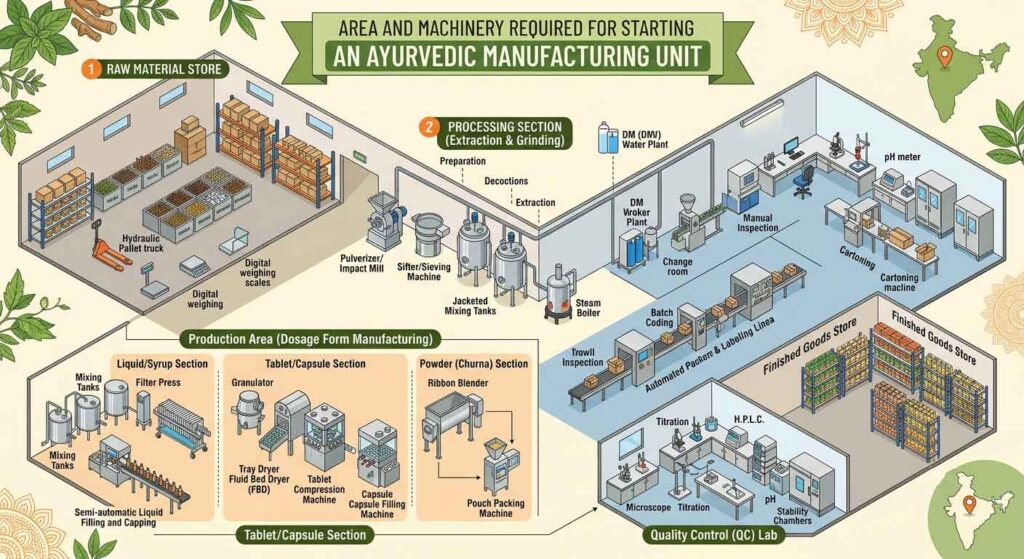
Basic Sections Required in an Ayurvedic Manufacturing Unit
A proper Ayurvedic unit may require the following sections:
1. Raw Material Store
Used for storage of herbs, minerals, excipients and other ingredients.
It should have:
Proper racks
Batch-wise storage
Quarantine area
Approved material area
Rejected material area
Pest-control system
Protection from moisture and sunlight
2. Packing Material Store
Used for storing:
Bottles
Caps
Labels
Cartons
Foils
Tubes
Shippers
Leaflets
Measuring cups
Packing material should be stored safely to avoid mix-up.
3. Manufacturing Area
This is the main production area.
It should be divided dosage-form wise, such as:
Powder/churna section
Capsule section
Tablet/vati section
Syrup section
Oil section
Ointment/paste section
Avaleha section
Asava/arishta section
4. Packing Area
Used for primary and secondary packing.
It should have:
Filling table
Labelling arrangement
Batch coding
Sealing
Final packing
Inspection area
5. Finished Goods Store
Used for storing finished products after production and quality approval.
6. Quality-Control Section
Used for basic testing, sampling and documentation.
Depending on scale, testing may be done in-house or through approved laboratories as permitted.
7. Rejected Goods Area
Separate area should be maintained for rejected raw material, packing material and finished goods.
8. Washing and Cleaning Area
Used for cleaning utensils, containers, vessels and equipment.
9. Office and Documentation Area
Used for maintaining:
Batch records
Purchase records
Sale records
Testing reports
Licence documents
Product approvals
Complaint records
Recall records
10. Utility Area
May include:
Water system
Boiler
Furnace
Bhatti
Air compressor
Electrical panel
Exhaust system
Area Required Section-Wise for Ayurvedic Medicines
The following section-wise area is commonly referred to for Ayurvedic/Siddha dosage forms. Actual requirement must be confirmed with the State Licensing Authority.
The furnace or bhatti section should have proper ventilation, smoke removal, exhaust, fly-proofing and dust protection.
Can Area Be Shared Between Sections?
Some areas and machinery may be shared if allowed by layout, product type and authority inspection.
For example:
Powdering area may be used for different powder-based products.
Furnace area may be used for different heat-related processes.
Liquid packing area may be shared for similar liquid products.
Some vessels and mixers may be used for different products after proper cleaning.
However, sharing should not create cross-contamination, mix-up or quality risk.
Machinery Required for Ayurvedic Manufacturing
Machinery depends on the section and dosage form.
1. Machinery for Anjana/Pisti
Common machinery may include:
Mechanized khalva/kharal
End runner
Ball mill
Sieves
Sifter
2. Machinery for Churna, Nasya, Manjan, Lepa and Kwath Churna
Common machinery may include:
Grinder
Disintegrator
Pulverizer
Powder mixer
Sieve
Shifter
Stainless steel trays
Storage containers
3. Machinery for Pills, Vati, Gutika and Tablets
Common machinery may include:
Ball mill
Mass mixer
Powder mixer
Granulator
Dryer
Tablet compression machine
Pill/vati cutting machine
Stainless steel trays
Storage containers
Coating pan
Polishing pan
Mechanized chattoo for guggulu mixing, where required
4. Machinery for Kupi Pakva, Kshara, Parpati, Lavana, Bhasma, Satva and Sindura
Common machinery may include:
Bhatti
Karahi
Stainless steel vessels
Patila
Flask
Multani mitti or Plaster of Paris
Copper rod
Earthen container
Gajput bhatti
Electrically operated muffle furnace
End runner
Edge runner
Exhaust fan
Wooden or stainless steel spatula
Herbo-mineral or rasaushadhi products require special care, trained personnel and strict testing.
5. Machinery for Kajal
Common machinery may include:
Earthen lamps for kajal collection
Triple roller mill
End runner
Sieves
Stainless steel patila
Exhaust fan
UV lamp in filling/packing area, where required
6. Machinery for Capsules
Common machinery may include:
Capsule filling machine
Air conditioner
Dehumidifier
Hygrometer
Thermometer
Chemical balance
Powder mixer
Sifter
Stainless steel containers
Capsule filling requires humidity control because capsule shells may become brittle or soft in unsuitable conditions.
7. Machinery for Ointment, Marham and Paste
Common machinery may include:
Ointment mixer
Tube filling machine
Crimping machine
End runner or mill, where required
Stainless steel storage containers
Stainless steel patila
Homogenizer, where required
Planetary mixer, where required
For a herbal paste formulation, this section may be important depending on the product category.
8. Machinery for Pak, Avaleha, Khand and Modak
Common machinery may include:
Bhatti section with exhaust fan
Fly-proof manufacturing area
Iron kadahi or stainless steel patila
Stainless steel storage containers
Mixing arrangement
Filling and packing equipment
9. Machinery for Syrup, Panak and Pravahi Kwath
Common machinery may include:
Tincture press
Bhatti section
Exhaust fan
Bottle washing machine
Filter press
Gravity filter
Liquid filling machine
Cap sealing machine
Capping machine
Storage tanks
Transfer pump
10. Machinery for Asava and Arishta
Common machinery may include:
Fermentation tanks
Storage containers
Filter press
Distillation plant, where necessary
Transfer pump
Liquid filling machine
Bottle washing machine
Fermentation area should be carefully planned for hygiene and controlled processing.
11. Machinery for Sura
Common machinery may include:
Distillation plant
Transfer pump
Storage tanks
Filter press
Liquid filling equipment
12. Machinery for Ark
Common machinery may include:
Maceration tank
Distillation plant
Liquid filling tank with tap
Gravity filter
Filter press
Visual inspection box
Filling machine
13. Machinery for Taila and Ghrita
Common machinery may include:
Bhatti
Kadahi
Stainless steel patila
Storage containers
Filtration equipment
Filling tank with tap
Liquid filling machine
Transfer pump
14. Machinery for Eye, Ear and Nasal Preparations
Common machinery may include:
Hot air oven with thermostatic control
Kettle with mixing arrangement
Colloid mill
Ointment mill
Tube filling equipment
Stainless steel mixing tanks
Stainless steel storage tanks
Sintered glass funnel
Seitz filter or filter candle
Liquid filling equipment
Autoclave
Sterilization arrangement
Visual inspection box
Eye products and sterile-type preparations need higher care and should not be started without strong technical support.
Quality-Control Requirement
Quality control is an important part of Ayurvedic manufacturing.
Basic QC may include:
Raw material identification
Organoleptic testing
Foreign matter checking
Moisture content
pH, where applicable
Viscosity, where applicable
Ash values, where applicable
Extractive values, where applicable
Microbial testing
Heavy metal testing
Pesticide residue testing, where applicable
Aflatoxin testing, where applicable
Finished product testing
Stability testing, where applicable
Testing requirements depend on product type, ingredients, claims and licensing authority expectations.
Does Third-Party Manufacturer Provide QC and Stability Testing?
Yes, many third-party Ayurvedic manufacturers provide basic quality-control documents and testing reports.
They may provide:
Certificate of Analysis
Batch manufacturing record
Finished product test report
Microbial test report
Heavy metal test report, where applicable
Stability data, if available or requested
Product specification
Raw material testing documents, where agreed
However, you should confirm these points before placing the order.
Some manufacturers include basic QC in product cost. Some charge extra for special testing, stability study, heavy metal testing, pesticide testing or active-marker analysis.
Always mention testing requirement in your agreement or purchase order.
Budget Required for Ayurvedic Manufacturing Unit
Budget depends on many factors.
Important cost heads include:
Land or rented premises
Civil construction
Flooring and partitions
Electrical work
Water system
Machinery
QC laboratory setup
Storage racks
HVAC or air conditioning, where required
Licence and consultant fees
Technical staff salary
Raw material
Packing material
Trial batches
Testing and stability study
Working capital
Marketing and distribution cost
A single-section unit costs much less than a multi-section unit.
For example, starting only paste/ointment or churna/capsule section may require lower investment than starting tablets, syrups, oils, avaleha, rasaushadhi and eye preparations together.
Documents Required for Ayurvedic Manufacturing Licence
Documents may vary by state, but commonly required documents include:
Application form
Firm or company registration document
PAN card
GST registration
Rent agreement or ownership proof
Site plan and layout plan
List of machinery
List of products
Formula details
Technical staff documents
Manufacturing chemist documents
Analytical chemist documents
Qualification and experience certificates
Water test report
Pollution-control compliance, where applicable
Fire safety compliance, where applicable
Partnership deed or incorporation documents
Affidavit and declaration
Fee receipt
GMP compliance details
Always check the latest checklist from your State AYUSH/Drug Licensing Authority.
Technical Staff Requirement
An Ayurvedic manufacturing unit needs qualified technical persons as per applicable rules.
Technical staff may include:
Manufacturing chemist
Analytical chemist
Quality-control in-charge
Production supervisor
Approved technical person
Qualification requirements may include Ayurveda, Ayurvedic pharmacy, pharmacy, chemistry, botany or other accepted qualifications depending on current rules and product category.
Because recent amendments have updated some technical-person requirements, confirm eligibility before appointing staff.
Common Mistakes to Avoid
Avoid these mistakes:
Buying machinery before licence planning
Taking too small premises
Starting too many sections at once
Ignoring QC and stability testing
Not appointing eligible technical staff
Not checking Schedule T/GMP requirement
Not taking patent advice before formula disclosure
Not preparing layout properly
Ignoring water, drainage and waste management
Not maintaining batch records
Not checking raw material authenticity
Selecting manufacturer only by low rate
Not signing agreement with third-party manufacturer
Making therapeutic claims without approval
Final Thoughts
Starting an Ayurvedic manufacturing unit requires proper planning, investment and regulatory compliance.
A minimum covered area with section-wise partitions is generally required, and machinery depends on the dosage form you want to manufacture.
For beginners, it is better to start with one or two sections, build sales and then expand manufacturing gradually.
Before investing in land, building or machinery, always consult your State AYUSH/Drug Licensing Authority and a qualified Ayurvedic manufacturing consultant.
Frequently Asked Questions
1. How much area is required for Ayurvedic manufacturing unit?
A commonly followed minimum covered area is around 1200 sq. ft. with separate sections, but exact requirement depends on product category and State Licensing Authority approval.
2. Can I start Ayurvedic manufacturing in one section only?
Yes. You can start with one section such as churna, capsule, syrup, oil or ointment/paste, subject to licence approval.
3. Which machinery is required for herbal paste manufacturing?
Common machinery may include paste mixer, stainless steel vessel, end runner or colloid mill, filling machine, sealing machine, balance and packing equipment.
4. Is Ayurvedic manufacturing licence required?
Yes. Manufacturing Ayurvedic medicines for sale requires the applicable manufacturing licence from the concerned authority.
5. Does third-party manufacturer provide QC report?
Many manufacturers provide Certificate of Analysis and basic QC reports. Special testing may cost extra.
6. Is stability testing required for Ayurvedic products?
Stability requirement depends on product type and current rules. Confirm with the manufacturer and State Licensing Authority.
7. Can I patent a herbal formulation?
Patent may be possible if the formulation or process meets patentability criteria. Consult a patent attorney before public disclosure.
8. Can I manufacture patented formulation through third party?
Yes, but use NDA, strong agreement and ownership clauses to protect your formula.
9. Is QC lab compulsory for Ayurvedic unit?
Quality-control arrangement is required. Depending on scale and rules, some tests may be in-house and some may be outsourced to approved labs.
10. Should I start own unit or third-party first?
If budget and technical team are limited, third-party manufacturing is easier. If formula control and long-term manufacturing are important, own unit may be better.
Looking for Ayurvedic Franchise or Distribution Opportunities?
Looking to start an Ayurvedic franchise, become a distributor, or launch your own herbal product range?
Elzac Herbal India offers:
Ayurvedic & Herbal Product Range
Franchise & Distribution Opportunities
Third-Party Manufacturing Services
Product Development Support
Marketing Guidance
PAN India Business Opportunities
Whether you are an entrepreneur, retailer, distributor, or healthcare professional, our team can help you explore the right business opportunity in the growing Ayurvedic sector.
Ajay Kamboj is an entrepreneur and business owners associated with many Ayurvedic and Pharmaceutical start-ups. With years of experience in Ayurvedic product marketing, pharmaceutical distribution, franchise development, and client relationship management, he regularly shares practical business insights based on real-world experiences. His articles focus on business growth, entrepreneurship, customer management, and lessons learned from the healthcare and wellness industry.
2 responses to “Area and Machinery Required for Starting an Ayurvedic Manufacturing Unit”
I want to ask about ayurvedic manufacturing unit
1) In the area of 1200 sq ft what are the important requirements like office ,bathroom,toilet,changing room etc plz tell me








Hi, please provide your contact number?
I want to ask about ayurvedic manufacturing unit
1) In the area of 1200 sq ft what are the important requirements like office ,bathroom,toilet,changing room etc plz tell me