Capsules are one of the most commonly used dosage forms in the pharmaceutical, nutraceutical, Ayurvedic and healthcare industries. They are easy to swallow, convenient to carry, attractive in appearance and useful for filling powders, granules, pellets, liquids, semi-solids and oils.
Many consumers also ask one common question:
“How can we know whether a capsule is vegetarian or non-vegetarian?”
This question is important because most traditional capsules are made from gelatin, which is generally obtained from animal sources. However, vegetarian capsule shells such as HPMC capsules are also widely used today, especially in nutraceuticals, herbal products and vegetarian-friendly formulations.
Quick Answer
A capsule is a small shell used to enclose medicines, supplements or active ingredients. Capsules may be made from animal-source gelatin or vegetarian-source materials such as HPMC, pullulan or starch.
The most common capsule types are:
Hard gelatin capsules
Soft gelatin capsules
Vegetarian capsules
HPMC capsules
Pullulan capsules
Starch-based capsules
In medicines, it is not always possible to identify vegetarian or non-vegetarian capsules only by looking at the packaging, unless the manufacturer clearly mentions “vegetarian capsule,” “HPMC capsule,” “gelatin capsule” or similar information. In food supplements and nutraceuticals, vegetarian or non-vegetarian symbols may help because they follow food labelling rules.
What Is a Capsule?
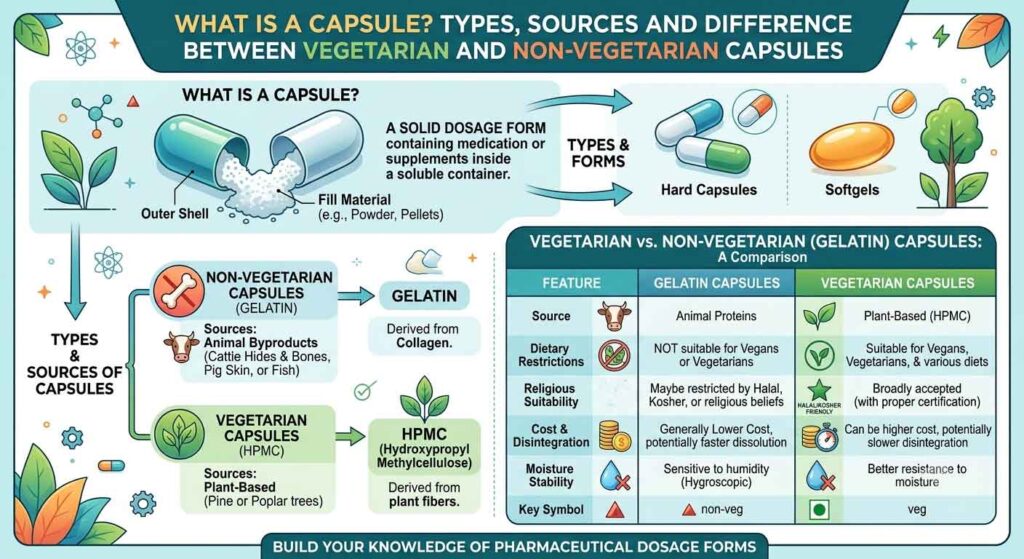
A capsule is a solid dosage form in which medicinal agents, powders, granules, pellets, liquids or semi-solid materials are enclosed inside a small shell.
The shell dissolves or opens after swallowing and releases the contents inside the body.
HPMC capsules are popular because they are plant-derived, stable and suitable for many formulations.
Pullulan Capsules
Pullulan capsules are made from pullulan, a natural polysaccharide produced through fermentation.
They are generally used in premium nutraceutical and dietary supplement products.
Pullulan capsules may provide good oxygen-barrier properties, which can be useful for some sensitive ingredients.
Starch Capsules
Starch-based capsules are another vegetarian option.
They are less common than gelatin and HPMC capsules but may be used in some specific formulations.
Difference Between Gelatin and Vegetarian Capsules
Point
Gelatin Capsules
Vegetarian Capsules
Source
Animal-derived gelatin
Plant-based or non-animal source
Common material
Gelatin
HPMC, pullulan, starch
Vegetarian status
Non-vegetarian
Vegetarian, depending on full formulation
Common use
Pharma and softgel industry
Nutraceuticals, herbal and vegetarian products
Cost
Usually lower
Usually higher
Consumer preference
Widely accepted generally
Preferred by vegetarian consumers
Label clarity
Often not clearly declared on medicines
Often voluntarily declared by brands
Suitable for softgels
Very common
Vegetarian softgel options exist but are more specialized
Are Gelatin Capsules Non-Vegetarian?
Yes, gelatin capsules are generally considered non-vegetarian because gelatin is derived from animal collagen.
The source may include animal skin, bones or connective tissues.
Because of this, consumers who strictly avoid animal-derived ingredients may prefer HPMC or other vegetarian capsules.
Are Softgel Capsules Vegetarian?
Most traditional softgel capsules are made from gelatin and are usually non-vegetarian.
However, vegetarian softgel options also exist, but they are less common and may be costlier.
If a product is a softgel, do not automatically assume it is vegetarian. Check the label or ask the manufacturer.
Are HPMC Capsules Vegetarian?
HPMC capsules are generally considered vegetarian because they are made from cellulose-derived material.
However, to confirm whether the full product is vegetarian, you should also check:
Capsule shell source
Active ingredient source
Excipients
Colour source
Preservatives
Coating material
Manufacturer declaration
A vegetarian capsule shell does not always mean the entire product is vegetarian unless all ingredients are also vegetarian.
How to Differentiate Between Vegetarian and Non-Vegetarian Capsules
1. Check the Label
Look for words such as:
Vegetarian capsule
Veg capsule
HPMC capsule
Cellulose capsule
Pullulan capsule
Gelatin capsule
Soft gelatin capsule
Hard gelatin capsule
If “gelatin” is mentioned, it is generally animal-derived unless a special source is clearly declared.
2. Check Veg or Non-Veg Symbol on Food Supplements
For food supplements and nutraceutical products, the package may carry vegetarian or non-vegetarian symbols as per food labelling rules.
A green symbol generally indicates vegetarian food product.
A brown non-vegetarian symbol indicates non-vegetarian food product.
However, these symbols are mainly food-label symbols and should not be blindly applied to all medicine packs.
3. Ask the Manufacturer
If the label does not clearly mention the capsule source, contact the manufacturer or marketer.
Ask:
“Is the capsule shell gelatin-based or HPMC/vegetarian?”
This is the most reliable way to confirm.
4. Ask the Pharmacist or Doctor
If the capsule is a prescription medicine, ask your doctor or pharmacist before changing or avoiding it.
Do not stop important medicines only because the capsule source is unclear.
5. Check Company Website or Product Brochure
Some companies clearly mention “veg capsule” or “HPMC capsule” in their product brochure, website or catalogue.
6. Do Not Judge by Colour
Capsule colour does not confirm whether it is vegetarian or non-vegetarian.
A green capsule can be gelatin-based, and a transparent capsule can also be gelatin-based.
Colour is used for product identification and branding, not for capsule-source confirmation.
7. Do Not Judge by Hard or Soft Form Alone
Hard capsules can be gelatin or vegetarian.
Softgels are commonly gelatin-based, but vegetarian softgels are also possible.
So, appearance alone is not enough.
Can We Identify Vegetarian Capsules from Medicine Packaging?
In many pharmaceutical medicines, it may not be possible for a consumer to identify the capsule source from packaging unless the company voluntarily declares it.
Medicine labels may mention composition, manufacturer, batch number, expiry, schedule warning and other required details, but the capsule shell source is not always clearly printed.
Therefore, if vegetarian status is important, the safest option is to ask the company, pharmacist or doctor.
Why Most Pharma Capsules Are Gelatin-Based
Gelatin capsules are widely used because:
They are well established
Easy to manufacture
Good mechanical strength
Good filling performance
Suitable for many products
Available in many colours and sizes
Usually cost-effective
Compatible with many formulations
Because of these advantages, gelatin capsules have traditionally dominated the pharmaceutical capsule industry.
Why Demand for Vegetarian Capsules Is Increasing
Demand for vegetarian capsules is increasing because of:
Religious preferences
Vegetarian lifestyle
Vegan lifestyle
Export requirements
Nutraceutical market growth
Herbal product demand
Consumer awareness
Clean-label product trend
Preference for plant-based products
Many Ayurvedic, herbal and nutraceutical companies now prefer vegetarian capsules for better consumer acceptance.
Capsule Sizes
Hard capsules are available in different sizes.
Common capsule sizes include:
000
00
0
1
2
3
4
5
In general, size 000 is the largest and size 5 is the smallest among common capsule sizes.
Approximate Capsule Size Chart
Capsule Size
Approximate Volume
000
1.37 ml
00
0.95 ml
0
0.68 ml
1
0.50 ml
2
0.37 ml
3
0.30 ml
4
0.21 ml
5
0.13 ml
These are approximate values. Actual fill weight depends on powder density, granule size, flow properties and supplier specification.
How to Select Capsule Size
Capsule size selection depends on the volume and density of the powder or granules.
The same capsule size may hold different weights of different powders.
For example:
A heavy mineral powder may fit more weight.
A light herbal powder may fit less weight.
Granules may fill differently from fine powder.
Simple Method for Capsule Size Selection
Weigh the ingredients required for the batch.
Mix the powder properly.
Place the powder in a graduated cylinder.
Note the total volume occupied by the powder.
Divide total volume by number of capsules.
Formula:
Volume per Capsule = Total Powder Volume ÷ Number of Capsules
Then compare the volume per capsule with available capsule sizes.
Example
Suppose total powder volume is 500 ml and you want to fill 1000 capsules.
Volume per capsule:
500 ÷ 1000 = 0.5 ml
A capsule size close to 0.5 ml may be selected, such as size 1, depending on actual filling trial.
Final selection should always be confirmed by trial filling because powder flow and density affect filling.
Important Factors in Capsule Filling
Capsule filling depends on:
Bulk density of powder
Tapped density
Flow property
Moisture content
Particle size
Granule size
Dose weight
Excipients used
Capsule size
Machine type
Locking quality
Stability of ingredients
A formula may look correct on paper but may fail during actual filling if powder flow is poor.
Common Excipients Used in Capsules
Capsules may contain active ingredient plus excipients such as:
Diluent
Binder
Glidant
Lubricant
Disintegrant
Anti-caking agent
Preservative, where required
Colouring agent
Flavouring agent, in some cases
Excipients help improve filling, flow, stability and performance.
Advantages of Capsules Over Tablets
Capsules may offer:
Easier swallowing
Better taste masking
Faster development
Attractive appearance
Suitable for powders and pellets
Less compression stress on ingredients
Useful for herbal extracts
Suitable for small batches
Disadvantages of Capsules
Capsules may also have limitations:
Higher cost than tablets in some cases
Sensitive to moisture
Shell may become brittle or soft
Not suitable for all liquids
Gelatin capsules may not suit vegetarians
Filling weight may vary if powder flow is poor
Larger capsule size may be difficult to swallow
Hard Capsule vs Soft Capsule
Point
Hard Capsule
Soft Capsule
Structure
Two-piece shell
One-piece sealed shell
Parts
Body and cap
No separate body and cap
Fill material
Powder, granules, pellets
Liquid, oil, paste, suspension
Manufacturing
Shell made first, then filled
Shell formed and filled together
Common source
Gelatin or HPMC
Usually gelatin
Use
Medicines, herbal products, probiotics
Oils, fat-soluble vitamins, softgel supplements
Cost
Generally lower
Generally higher
Equipment
Capsule filling machine
Softgel machine required
Vegetarian Capsule vs Non-Vegetarian Capsule
Point
Vegetarian Capsule
Non-Vegetarian Capsule
Main material
HPMC, pullulan, starch
Gelatin
Source
Plant or non-animal source
Animal collagen
Consumer preference
Vegetarians and plant-based consumers
General pharmaceutical use
Common products
Nutraceuticals, herbal capsules
Pharma capsules and softgels
Cost
Usually higher
Usually lower
Identification
May be labelled as veg/HPMC
May be labelled as gelatin
Religious acceptance
Better for many vegetarian users
May not be accepted by strict vegetarians
Should Patients Avoid Gelatin Capsules?
Patients should not stop prescribed medicines without consulting a doctor.
If you are vegetarian and concerned about gelatin capsules, you can ask your doctor or pharmacist for:
Tablet alternative
Syrup alternative
HPMC capsule alternative
Same salt from another brand
Vegetarian supplement option, if suitable
For serious health conditions, treatment should not be stopped only due to capsule-source concern.
What Should Companies Mention on Labels?
For better transparency, companies may voluntarily mention:
Gelatin capsule
Hard gelatin capsule
Soft gelatin capsule
Vegetarian capsule
HPMC capsule
Pullulan capsule
Capsule shell material
Suitable for vegetarians, if properly supported
This helps customers make informed choices and improves trust.
Advice for Ayurvedic and Nutraceutical Companies
If you are manufacturing Ayurvedic, herbal or nutraceutical capsules, vegetarian capsules can improve customer acceptance.
Vegetarian capsules may be useful for:
Ayurvedic products
Herbal extracts
Food supplements
Religious-sensitive markets
Export markets
Premium brands
Vegan or vegetarian positioning
However, cost, stability and compatibility should be checked before finalizing.
Common Myths About Capsules
Myth 1: All Capsules Are Non-Vegetarian
Not true. Many capsules are gelatin-based, but vegetarian capsules are also available.
Myth 2: Green Capsule Means Vegetarian
Not true. Capsule colour does not confirm source.
Myth 3: Softgel Capsules Are Always Vegetarian
Not true. Most softgels are gelatin-based unless clearly declared otherwise.
Myth 4: HPMC Capsule Means Entire Product Is Vegan
Not always. The shell may be vegetarian, but other ingredients may not be vegan.
Myth 5: Medicine Packs Always Tell Capsule Source
Not always. Many medicine packs do not clearly mention capsule shell source.
Final Thoughts
Capsules are widely used dosage forms in the pharmaceutical, Ayurvedic, nutraceutical and healthcare industries.
Capsules may be made from animal-source gelatin or vegetarian materials such as HPMC, pullulan or starch.
Hard gelatin capsules have two parts: body and cap. Soft gelatin capsules are one-piece sealed capsules, commonly used for oils and liquid fills.
To differentiate vegetarian and non-vegetarian capsules, do not rely only on colour, shape or appearance. Check the label, look for HPMC or gelatin declaration, check food supplement symbols where applicable, and contact the manufacturer if needed.
For consumers, the best approach is to ask the doctor, pharmacist or manufacturer before stopping or changing any medicine.
For companies, clear declaration of capsule shell type can improve transparency, trust and customer satisfaction.
Frequently Asked Questions
1. What is a capsule?
A capsule is a small shell used to enclose medicines, supplements or active ingredients for oral use.
2. What are capsules made of?
Capsules may be made from gelatin, HPMC, pullulan, starch or other suitable materials.
3. Are gelatin capsules vegetarian?
No. Gelatin capsules are generally considered non-vegetarian because gelatin is usually obtained from animal collagen.
4. What are vegetarian capsules made of?
Vegetarian capsules are commonly made from HPMC, pullulan, starch or other non-animal materials.
5. What is HPMC capsule?
HPMC capsule is a vegetarian capsule made from hydroxypropyl methylcellulose, a cellulose-derived material.
6. How can I identify vegetarian capsules?
Check whether the label mentions vegetarian capsule, HPMC capsule, cellulose capsule or pullulan capsule. If unclear, ask the manufacturer.
7. Can capsule colour tell whether it is vegetarian?
No. Capsule colour does not confirm whether it is vegetarian or non-vegetarian.
8. Are softgel capsules vegetarian?
Most traditional softgel capsules are gelatin-based and generally non-vegetarian, unless the manufacturer clearly declares a vegetarian softgel.
9. Are food supplement capsules easier to identify?
Yes, food supplements may carry vegetarian or non-vegetarian symbols as per food labelling rules. But always check the full label.
10. Should I stop medicine if it contains gelatin?
Do not stop prescribed medicine without consulting your doctor. Ask for a vegetarian alternative if available.
Looking for Ayurvedic Franchise or Distribution Opportunities?
Looking to start an Ayurvedic franchise, become a distributor, or launch your own herbal product range?
Elzac Herbal India offers:
Ayurvedic & Herbal Product Range
Franchise & Distribution Opportunities
Third-Party Manufacturing Services
Product Development Support
Marketing Guidance
PAN India Business Opportunities
Whether you are an entrepreneur, retailer, distributor, or healthcare professional, our team can help you explore the right business opportunity in the growing Ayurvedic sector.
Ajay Kamboj is an entrepreneur and business owners associated with many Ayurvedic and Pharmaceutical start-ups. With years of experience in Ayurvedic product marketing, pharmaceutical distribution, franchise development, and client relationship management, he regularly shares practical business insights based on real-world experiences. His articles focus on business growth, entrepreneurship, customer management, and lessons learned from the healthcare and wellness industry.







Leave a Reply Cancel reply
You must be logged in to post a comment.