Starting a tablet manufacturing unit requires proper planning of premises, layout, machinery, manpower, quality control, storage, and regulatory compliance. Many new entrepreneurs ask:
“How much area is required to open a tablet manufacturing factory?”
The answer depends on the type of tablet you want to manufacture, whether coating is required, whether you want only one dosage section or multiple sections, and whether the premises can comply with GMP requirements.
For a basic tablet manufacturing section, you should not plan only according to machine size. You must also plan separate areas for material movement, granulation, drying, compression, packing, storage, quality control, personnel movement, and documentation.
Minimum Area for Tablet Manufacturing
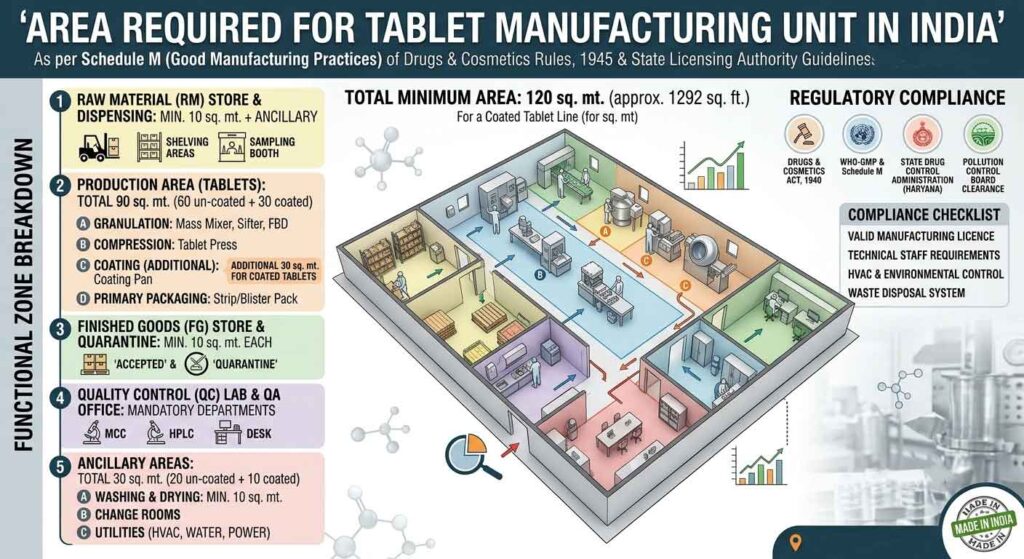
For tablet manufacturing, the area requirement should be planned according to Schedule M and the expectations of the State Drug Licensing Authority.
For uncoated tablets, a minimum area of around:
60 square meters for basic installation + 20 square meters ancillary area
is recommended.
If tablet coating is also required, an additional area of around:
30 square meters for coating section + 10 square meters ancillary area
is recommended.
This means that for a tablet section with coating facility, the basic practical regulatory area may go above 120 square meters when all relevant sections are considered.
However, actual approval depends on layout, product category, machinery, GMP compliance, storage area, QC arrangement, and inspection by the licensing authority.
Tablet Manufacturing Area Should Be Divided into Sections
A tablet production department should not be treated as one open hall.
It should be divided into separate functional sections such as:
Mixing, granulation, and drying section
Tablet compression section
Tablet packing section
Coating section, if applicable
Raw material storage
Packing material storage
In-process material area
Finished goods storage
Quality-control area
Washing and cleaning area
Change room and personnel area
Documentation and record area
This separation helps avoid contamination, mix-ups, dust movement, and process confusion.
Main Sections Required in Tablet Manufacturing Unit
1. Raw Material Store
Raw materials should be stored in a clean, dry, and organized area.
The store should have proper arrangements for:
Quarantine material
Approved material
Rejected material
Temperature and humidity control, where required
Proper labeling
Batch-wise identification
Pest control
Material issue system
2. Dispensing Area
Dispensing is the area where raw materials are weighed before manufacturing.
It should be controlled because wrong weighing can affect the entire batch.
The dispensing area should have:
Weighing balance
Dust-control arrangement
Proper lighting
Material status labels
Cleaning arrangement
Record system
3. Mixing, Granulation and Drying Section
This is one of the main tablet manufacturing areas.
Common activities include:
Sifting
Mixing
Wet granulation or dry granulation
Drying
Milling
Blending
Common machinery may include:
Sifter
Mass mixer
Rapid mixer granulator
Fluid bed dryer
Multimill
Blender
Weighing balance
This section should have sufficient space for machine placement, operator movement, material movement, and cleaning.
4. Compression Section
In this section, granules or blends are compressed into tablets.
Common machinery may include:
Single punch or rotary tablet compression machine
Tablet de-duster
Tablet inspection unit
In-process testing equipment
The compression area should be dust controlled. Tablet machines may be kept in cubicles or separate controlled areas to reduce cross-contamination.
5. In-Process Quality Control Area
During tablet manufacturing, quality checks are performed at different stages.
Common in-process checks include:
Average weight
Weight variation
Hardness
Thickness
Friability
Disintegration
Appearance
Tablet defects
A small in-process testing area may be required near the production section.
6. Coating Section
If you manufacture coated tablets, a separate coating area is required.
This may include:
Coating pan
Auto coater
Solution preparation tank
Exhaust system
Air-conditioning and dehumidification, where required
Coating involves dust, fumes, moisture, and solvent-related risks depending on the process. Therefore, it should be separated and properly ventilated.
7. Packing Section
Tablet packing may involve:
Strip packing
Blister packing
Alu-alu packing
Bottle packing
Labeling
Cartoning
Batch coding
Packing material should be reconciled properly because printed material carries batch number, expiry date, MRP, and product identity.
8. Finished Goods Store
After quality approval, finished products should be transferred to finished goods storage.
Finished goods should be stored batch-wise with proper status labels.
Separate space should be available for:
Approved goods
Hold goods
Rejected goods
Returned goods, where applicable
9. Quality Control Laboratory
A tablet manufacturing unit needs a quality-control arrangement.
The company may establish its own laboratory or use approved outside testing arrangements where permitted.
A QC lab may require equipment for:
Assay testing
Dissolution
Disintegration
Hardness
Friability
Weight variation
Microbial testing, where applicable
Raw material testing
Finished product testing
10. Ancillary Areas
Ancillary areas are also important.
These may include:
Change room
Washing area
Equipment cleaning area
Toilets away from production areas
Utility area
Maintenance area
Documentation room
Rejected material area
Waste material area
A layout without ancillary areas may face objections during inspection.
Practical Area Planning for Tablet Manufacturing
Although minimum recommendations exist, practical area should be planned according to business scale.
For a small tablet manufacturing unit, the practical covered area may often be higher than the minimum because you also need space for storage, QC, packing, office, documentation, and movement.
A practical planning approach may be:
Basic Uncoated Tablet Section
Manufacturing area
Compression area
Packing area
Raw material store
Packing material store
Finished goods store
QC arrangement
Ancillary area
Tablet Section with Coating
In addition to the above, you need:
Coating room
Coating solution preparation area
Exhaust and ventilation system
Humidity-control arrangement, where required
Multi-Product or Larger Unit
If you manufacture multiple product categories or high-volume batches, you will need more space for:
Separate product sections
Dedicated storage
Larger packing line
Separate quarantine areas
Expanded QC laboratory
More staff facilities
Future expansion
Where Should the Land Be Located?
The location of a pharmaceutical manufacturing unit should be selected carefully.
It is better to choose land or premises in:
Approved industrial area
Pharma industrial zone
Area permitted for manufacturing activity
Location with road connectivity
Location with electricity and water availability
Area with proper drainage and waste-disposal arrangement
Place where pollution control and local approvals can be obtained
Location accessible for workers and transport
Should the Factory Be Near a Village?
A factory may be located near a village only if the land use is legally permitted for industrial or manufacturing activity.
Before choosing village-side land, check:
Land use conversion
Industrial permission
Local body NOC
Pollution control requirement
Electricity load availability
Water source
Drainage and waste disposal
Road access
Distance from residential population
Fire safety norms
Labour availability
Do not select agricultural or residential land without proper conversion and permission.
Should the Factory Be Near a Highway?
Near-highway location can be good for logistics because it helps in transportation of raw materials and finished goods.
Advantages include:
Better transport access
Easier dispatch
Easier staff movement
Better supplier connectivity
But check:
Industrial permission
Service road access
Dust and pollution exposure
Local development rules
Parking and loading-unloading space
Safety from traffic and contamination
The premises should be protected from dust, smoke, waterlogging, and contamination.
Should the Factory Be Near a River?
It is usually better to avoid riverbank or flood-prone areas.
If land is near a river, check:
Flood risk
Environmental restrictions
Pollution control requirements
Waterlogging possibility
Waste-water disposal rules
Soil stability
Local authority permissions
A pharma manufacturing unit should not be placed where there is risk of flooding, contamination, or environmental objection.
Important Site Selection Checklist
Before finalizing land or premises, check:
Is industrial activity permitted?
Is drug manufacturing allowed at this location?
Is the building suitable for GMP layout?
Is there enough area for future expansion?
Is clean water available?
Is sufficient electricity load available?
Is drainage proper?
Is the area free from flooding?
Is pollution control approval possible?
Is the premises protected from dust and pests?
Is road access suitable for transport vehicles?
Is there enough space for loading and unloading?
Is fire safety approval possible?
Is the building strong and washable?
Can separate sections be created?
Basic Machinery Required for Tablet Manufacturing
Machinery depends on product type and scale, but commonly includes:
Sifter
Multimill
Mass mixer
Rapid mixer granulator
Fluid bed dryer or tray dryer
Blender
Tablet compression machine
Tablet de-duster
Tablet inspection unit
Coating pan or auto coater, if required
Strip or blister packing machine
Batch coding machine
Weighing balances
Dust collector
Air handling or exhaust system, where required
For modern GMP compliance, machinery layout should support cleaning, maintenance, and prevention of cross-contamination.
Documents Required for Tablet Manufacturing Licence
The exact document list varies by state, but commonly required documents include:
Application form
Government fee
Constitution of firm or company
Premises ownership proof or rent agreement
Site plan and layout plan
List of machinery
List of laboratory equipment
Technical staff documents
Manufacturing chemist details
Analytical chemist details
Product list
Water testing report, where applicable
Power availability certificate
Pollution control documents, where applicable
Project report
GMP compliance undertaking
Affidavits and declarations
Inspection report
Always collect the latest checklist from the State Drug Licensing Authority before starting construction.
Common Mistakes to Avoid
New entrepreneurs often make these mistakes:
Planning only 30 sq. meters for tablet manufacturing
Not making separate compression and granulation areas
Ignoring coating area requirement
Forgetting ancillary areas
Not planning raw material and finished goods storage
Taking residential or agricultural land without permission
Ignoring pollution control and local approvals
Buying machinery before layout approval
Not planning air handling, dust control, and exhaust
Not leaving space for future expansion
Starting construction without consulting regulatory experts
These mistakes can delay licence approval and increase project cost.
Final Thoughts
For a tablet manufacturing unit, area planning should be done according to product type, machinery, Schedule M requirements, GMP layout, and licensing authority expectations.
For uncoated tablets, plan at least the recommended tablet section area along with ancillary and storage areas. If coating is required, additional coating area is necessary.
The best location is usually an approved industrial area with good road access, electricity, water, drainage, and permission for pharmaceutical manufacturing.
Do not plan a pharma factory only according to minimum machine space. Plan it according to compliance, workflow, hygiene, expansion, and inspection requirements.
1. How much area is required for tablet manufacturing unit?
For uncoated tablet manufacturing, around 60 square meters basic area plus 20 square meters ancillary area is recommended for the tablet section. Additional areas are required for storage, QC, office, washing, and other activities.
2. Is 30 square meters enough for tablet manufacturing?
Thirty square meters may be mentioned for some other dosage sections, but for a tablet manufacturing section, it is not sufficient as a complete practical setup. Tablet manufacturing requires separate areas for granulation, compression, packing, and coating where applicable.
3. How much extra area is required for coating section?
For tablet coating, an additional area of around 30 square meters basic installation plus 10 square meters ancillary area is recommended.
4. Can I start tablet manufacturing near a village?
You can consider village-side land only if industrial use and pharmaceutical manufacturing are legally permitted. Land conversion, local approval, electricity, water, drainage, and pollution control requirements must be checked.
5. Is highway-side land good for tablet manufacturing factory?
Highway-side land can be useful for transport and logistics, but it must have industrial permission and protection from dust, pollution, and traffic-related contamination.
6. Can I start tablet manufacturing near a river?
River-side or flood-prone land should generally be avoided unless environmental, flood safety, and local approvals are clearly available.
7. Which sections are required in tablet manufacturing?
Main sections include raw material store, dispensing, mixing/granulation/drying, compression, coating if required, packing, finished goods store, QC, washing, and ancillary areas.
8. Is separate area required for penicillin tablets?
Yes, penicillin and non-penicillin products require separation to avoid cross-contamination. Product category must be discussed with the licensing authority.
9. Should I buy machinery before licence approval?
It is better to finalize layout and confirm regulatory requirements before purchasing machinery. Wrong machinery placement can create inspection problems.
10. Who approves tablet manufacturing premises?
The concerned State Drug Licensing Authority inspects and approves the premises before issuing the manufacturing licence.
Looking for Ayurvedic Franchise or Distribution Opportunities?
Looking to start an Ayurvedic franchise, become a distributor, or launch your own herbal product range?
Elzac Herbal India offers:
Ayurvedic & Herbal Product Range
Franchise & Distribution Opportunities
Third-Party Manufacturing
Product Development Support
Marketing Guidance
PAN India Business Opportunities
Whether you are an entrepreneur, retailer, distributor, or healthcare professional, our team can help you explore the right business opportunity in the growing Ayurvedic sector.
Ajay Kamboj is an entrepreneur and business owners associated with many Ayurvedic and Pharmaceutical start-ups. With years of experience in Ayurvedic product marketing, pharmaceutical distribution, franchise development, and client relationship management, he regularly shares practical business insights based on real-world experiences. His articles focus on business growth, entrepreneurship, customer management, and lessons learned from the healthcare and wellness industry.





Leave a Reply Cancel reply
You must be logged in to post a comment.