Starting a pharmaceutical manufacturing company requires much more than obtaining a manufacturing licence. The real secrets lie in understanding how to sell, what to manufacture, and how to build a sustainable business model.
Many entrepreneurs focus only on machinery and factory setup. However, successful pharmaceutical manufacturers first understand the market, build industry experience, and create a clear strategy before investing crores of rupees.
If you are planning to start your own pharma manufacturing company, this guide will help you understand what to do—and what mistakes to avoid.
Query
Hello Sir, I am from NIPER. I want to start my own pharmaceutical manufacturing company. Please guide me from the beginning. What should I do and what should I avoid?
Starting a pharmaceutical manufacturing company is a dream for many pharmacy graduates and healthcare professionals. But before discussing licences and machinery, there are two important questions every entrepreneur should answer honestly.
The Two Secrets of Starting a Pharma Manufacturing Company
1. Do You Know How and Where to Sell?
Manufacturing is only one part of the business.
You may produce excellent products, but if you cannot sell them, your factory will struggle to survive.
Before investing, ask yourself:
Who will buy your products?
Will you target doctors?
Will you work through distributors?
Will you enter PCD/franchise marketing?
Will you manufacture for third parties?
Will you focus on exports?
A clear sales strategy should come before factory construction.
2. Do You Know What and How to Manufacture?
The second question is equally important.
Do you understand:
Regulatory requirements?
Manufacturing processes?
Quality systems?
Product development?
Stability requirements?
Documentation procedures?
If the answer is yes, you can move to the next stage.
If not, gaining practical exposure before investing can save you from expensive mistakes.
Theory and the Real Market Are Different
Many pharmacy graduates believe academic knowledge alone is enough.
Unfortunately, the pharmaceutical market operates differently.
Theory teaches you how medicines work. The market teaches you how businesses survive.
In the pharmaceutical industry, patients are the end users, but they are not always your direct customers.
Your actual customers may include:
Doctors
Distributors
Stockists
Retail chemists
Hospitals
Franchise partners
Institutional buyers
Understanding their expectations is essential.
Is Experience Necessary Before Starting?
One common question is:
“Experience will come only by doing. Why should I work for someone else?”
While entrepreneurship involves learning by doing, pharmaceutical manufacturing requires significant investment.
You may spend lakhs—or even crores—on:
Factory setup
Machinery
Regulatory approvals
Staff salaries
Inventory
Marketing
Therefore, gaining two to three years of industry experience can provide valuable insights with comparatively lower risk.
Experience Helps You Understand
Market realities
Product selection
Regulatory inspections
Vendor management
Distribution channels
Payment cycles
Customer expectations
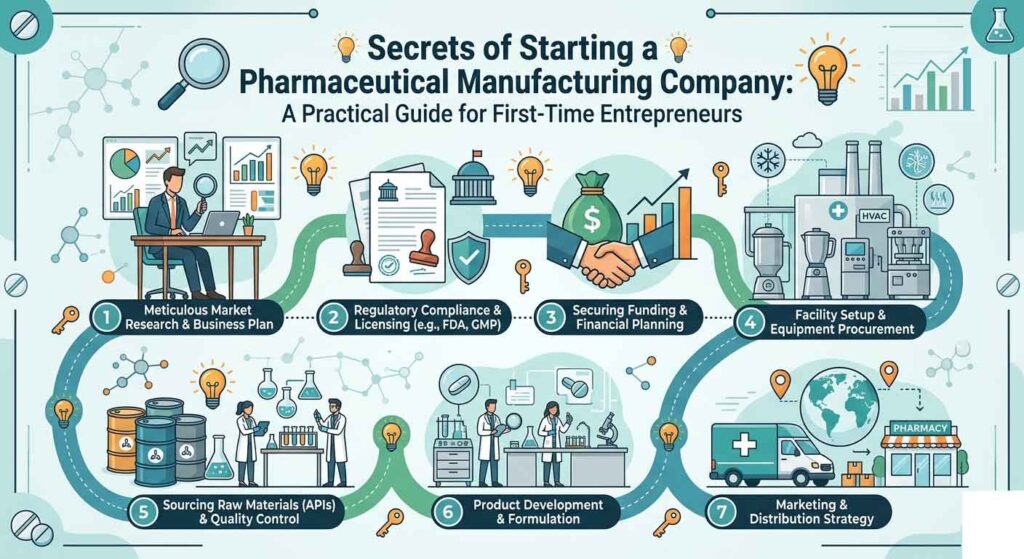
Step-by-Step Process to Start a Pharma Manufacturing Company
Step 1: Arrange Investment
Manufacturing requires substantial capital.
Prepare a realistic estimate covering:
Land and building
Machinery
Working capital
Licences
Initial marketing expenses
Avoid underestimating costs.
Step 2: Decide What You Want to Manufacture
Select your dosage forms carefully.
Examples include:
Tablets
Capsules
Syrups
Ointments
Dry syrups
Injectables
Nutraceuticals
Many entrepreneurs begin with a single dosage form and expand later.
Example
A common strategy is:
Start with solid dosage forms such as tablets and capsules, then gradually diversify.
Step 3: Finalize Company Name and Product Portfolio
Choose:
Company name
Brand names
Product categories
Molecules to manufacture
Your product selection should be based on market demand rather than personal preference.
Step 4: Select the Factory Location
You may choose:
Owned premises
Rented premises
The building should comply with regulatory requirements regarding:
Layout
Workflow
Cleanliness
Utilities
Storage
Location should also support logistics and future expansion.
Step 5: Construct the Facility According to Regulatory Norms
The factory must comply with pharmaceutical Good Manufacturing Practices (GMP).
Depending on dosage forms, requirements may include:
Air Handling Units (AHU)
HVAC systems
Air-conditioning
Epoxy flooring
Proper drainage
Segregated production areas
Quality Control laboratory
Quality Assurance area
Warehouse facilities
Regulatory compliance should be incorporated during design rather than corrected later.
Step 6: Purchase Machinery
Machinery depends on the dosage forms being manufactured.
For tablet and capsule facilities, common equipment includes:
Tablets
Rapid Mixer Granulator
Fluid Bed Dryer
Multi Mill
Compression Machine
Coating Machine
Capsules
Capsule Filling Machine
Capsule Polishing Machine
Packaging
Blister Packing Machine
Alu-Alu Packing Machine
Cartoning Equipment
Utilities
Air Compressor
Water Treatment System
Generator
Chillers
Purchase machinery from reliable vendors with service support.
Step 7: Recruit Technical and Non-Technical Staff
A manufacturing unit cannot function without competent personnel.
Typical teams include:
Technical Staff
Manufacturing Chemist
Analytical Chemist
Quality Assurance personnel
Quality Control staff
Operational Staff
Machine operators
Helpers
Warehouse personnel
Administrative staff
For obtaining manufacturing licences, the qualifications and approvals of technical staff are critical.
Step 8: Apply for Manufacturing Licence
After completing infrastructure and staffing requirements:
Prepare documentation
Submit applications
Facilitate inspections
Respond to regulatory observations
Only after receiving approval can commercial manufacturing begin.
Step 9: Obtain Supporting Registrations
In addition to manufacturing approval, you may require:
Wholesale drug licence
GST registration
Company registration
Trademark registration
These registrations help in invoicing, protecting brands, and conducting business smoothly.
Step 10: Build Your Marketing and Distribution Network
A factory without customers becomes a liability.
Develop:
PCD franchise networks,
Distribution channels,
Institutional supply relationships,
Third-party manufacturing clients,
Export opportunities.
Marketing should begin before production starts.
Common Mistakes to Avoid
Many first-time entrepreneurs fail because they focus only on manufacturing.
Avoid these mistakes:
❌ Starting without market understanding.
❌ Over-investing in machinery.
❌ Selecting products without demand analysis.
❌ Ignoring working capital requirements.
❌ Underestimating regulatory compliance.
❌ Hiring inexperienced teams.
❌ Delaying marketing efforts.
Should You Start Manufacturing Immediately?
There is no universal answer.
If you already possess:
Strong industry exposure
Reliable mentors
Marketing networks
Financial capacity
then manufacturing may be a suitable next step.
However, if you lack practical exposure:
Working in the pharmaceutical industry for two to three years can provide invaluable learning while reducing business risk.
Learning with a salary is often safer than learning after investing crores.
Final Thoughts
Starting a pharmaceutical manufacturing company is not just about obtaining licences and purchasing machines.
The true secrets are:
Understanding the market
Building experience
Choosing the right products
Planning finances carefully
Ensuring regulatory compliance
Developing strong marketing channels
Manufacturing expertise can be acquired.
Marketing strategies can evolve.
But thoughtful planning before investment often determines long-term success.
Frequently Asked Questions
Can a fresher start a pharmaceutical manufacturing company?
Yes, but practical industry experience can significantly improve your chances of success.
How much investment is required?
Investment depends on dosage forms, scale of operations, location, and machinery requirements.
Which dosage form is best for beginners?
Many entrepreneurs begin with tablets and capsules because of comparatively lower complexity.
Is marketing more important than manufacturing?
Both are important, but products cannot generate revenue without effective marketing and distribution.
Can I manufacture and market my own brands?
Yes. Many manufacturers market products under their own brands while also undertaking third-party manufacturing.
Should I work before starting my own company?
If possible, gaining two to three years of hands-on experience can help you avoid costly mistakes and build valuable industry connections.
Partner with Elzac Herbal India
Looking to start an Ayurvedic franchise, become a distributor, or launch your own herbal product range?
Elzac Herbal India offers:
Ayurvedic & Herbal Product Range
Franchise & Distribution Opportunities
Third-Party Manufacturing Services
Product Development Support
Marketing Guidance
PAN India Business Opportunities
Whether you are an entrepreneur, retailer, distributor, or healthcare professional, our team can help you explore the right business opportunity in the growing Ayurvedic sector.
Ajay Kamboj is an entrepreneur and business owners associated with many Ayurvedic and Pharmaceutical start-ups. With years of experience in Ayurvedic product marketing, pharmaceutical distribution, franchise development, and client relationship management, he regularly shares practical business insights based on real-world experiences. His articles focus on business growth, entrepreneurship, customer management, and lessons learned from the healthcare and wellness industry.








Leave a Reply Cancel reply
You must be logged in to post a comment.