A Bachelor of Pharmacy (B.Pharm) opens the door to a wide range of career opportunities in India’s rapidly growing pharmaceutical and healthcare industry.
While many graduates choose traditional jobs in pharmaceutical companies, others dream of starting their own pharma business, marketing company, manufacturing unit, or franchise venture.
If you are wondering “What should I do after B.Pharm?” or “Which career path is best for starting my own business in the future?”, this guide will help you make an informed decision.
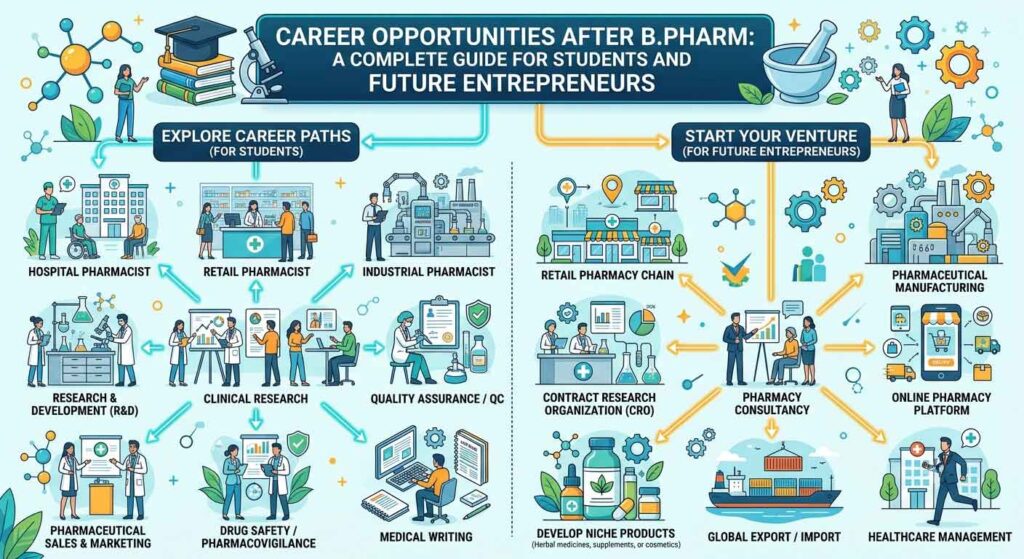
Career Options After B.Pharm
A B.Pharm degree allows you to work in several departments of the pharmaceutical industry.
Some of the most popular career options include:
Quality Assurance (QA)
Quality Control (QC)
Production
Research & Development (R&D)
Regulatory Affairs
Pharmaceutical Sales & Marketing
Medical Representative
Product Management
Pharmacovigilance
Clinical Research
Hospital Pharmacy
Retail Pharmacy
Third-Party Manufacturing
Pharmaceutical Entrepreneurship
Each department offers different learning opportunities depending on your long-term career goals.
If Your Goal Is to Start Your Own Pharma Business
Many pharmacy students eventually want to become entrepreneurs instead of working throughout their careers.
If that is your dream, remember one important principle:
Before becoming a successful business owner, become a skilled professional.
The knowledge and experience you gain during your first few years of employment can save you from costly mistakes when you start your own company.
Your job is not only a source of income—it is also your practical business education.
Which Department Should You Choose?
The answer depends on your interests and future plans.
Quality Assurance (QA)
QA teaches you:
Good Manufacturing Practices (GMP)
Documentation
SOP preparation
Validation
Quality systems
Regulatory compliance
This is an excellent department for understanding how pharmaceutical companies maintain product quality.
Quality Control (QC)
QC helps you understand:
Laboratory testing
Analytical instruments
Product specifications
Stability studies
Testing procedures
This role is ideal if you enjoy laboratory work and analytical thinking.
Production
Production provides practical knowledge about:
Manufacturing processes
Batch planning
Equipment
Productivity
Inventory handling
It is particularly useful if you plan to establish a manufacturing unit in the future.
Regulatory Affairs
If your long-term goal is entrepreneurship, Regulatory Affairs is one of the most valuable departments to learn.
It helps you understand:
Drug regulations
Product approvals
Documentation
Licensing requirements
Compliance standards
Product registration
This knowledge becomes extremely valuable when starting a pharmaceutical company.
Sales & Marketing
Many successful pharma entrepreneurs have a sales background.
Sales teaches you:
Doctor interactions
Distributor management
Product promotion
Customer psychology
Negotiation
Market analysis
If you plan to build a pharma marketing company or franchise business, sales experience can be a major advantage.
Should You Join a Small Company or a Large Company?
Both options have advantages.
Small Company
Advantages
Learn multiple departments
Broader exposure
Faster practical learning
Greater responsibilities
Limitations
Lower salary
Limited career growth
Fewer structured training programs
Large Pharmaceutical Company
Advantages
Better salary
Professional training
Strong systems
Better long-term career growth
Exposure to advanced technologies
Limitations
Limited exposure outside your department
More specialized roles
For many aspiring entrepreneurs, beginning in a small company can provide wider business exposure, while later moving to a larger company can strengthen technical and managerial skills.
API Company or Formulation Company?
This is another common question among pharmacy graduates.
API Companies
You will learn:
Active Pharmaceutical Ingredient manufacturing
Chemical processes
Raw material management
Industrial production
Suitable for those interested in bulk drug manufacturing.
Formulation Companies
You will learn:
Tablet manufacturing
Capsules
Syrups
Ointments
Injections
Packaging
Branding
Finished pharmaceutical products
If your long-term goal is to start a pharma marketing company, franchise business, or third-party manufacturing business, experience in a formulation company is generally more relevant, as it provides exposure to finished products, packaging, branding, and distribution.
How Much Experience Should You Gain Before Starting a Business?
There is no fixed rule.
However, many successful entrepreneurs spend 3–5 years working in the pharmaceutical industry before launching their own business.
During this period, focus on learning rather than simply earning.
Develop knowledge about:
Manufacturing
Product costing
Regulatory compliance
Marketing
Distribution
Finance
Inventory management
Customer service
These skills will prove invaluable when running your own company.
How Much Investment Is Required?
The investment depends on the business model you choose.
Each model requires a different level of investment.
Many entrepreneurs begin with a pharma marketing company using third-party manufacturing, as it generally requires lower capital than setting up a manufacturing plant.
Essential Skills Every Future Pharma Entrepreneur Should Develop
In addition to technical knowledge, focus on developing:
Leadership
Communication
Sales skills
Financial management
Digital marketing
Negotiation
Decision-making
Problem-solving
Successful businesses are built on both technical expertise and strong management skills.
Final Thoughts
A B.Pharm degree offers far more opportunities than many students realize.
Whether you choose Quality Assurance, Regulatory Affairs, Production, Sales, or Research, every department provides valuable learning experiences.
If entrepreneurship is your long-term goal, invest your early career in gaining practical knowledge, understanding the pharmaceutical industry, and building professional relationships.
The more you learn today, the stronger your business foundation will be tomorrow.
Frequently Asked Questions (FAQs)
Is B.Pharm a good career choice?
Yes. B.Pharm graduates can work in pharmaceutical manufacturing, quality assurance, regulatory affairs, sales, research, hospitals, retail pharmacy, and healthcare businesses. It also provides an excellent foundation for entrepreneurship.
Which department is best after B.Pharm?
The best department depends on your career goals. Regulatory Affairs, QA, Production, and Sales each offer unique advantages. For future entrepreneurs, gaining exposure to regulatory processes and business operations can be especially valuable.
Should I work before starting my own pharma company?
Yes. Practical industry experience helps you understand manufacturing, regulations, marketing, and customer needs, making it easier to build a successful business.
How many years of experience should I gain?
Many entrepreneurs benefit from gaining 3–5 years of relevant industry experience before launching their own pharmaceutical business.
Can I start a pharma company immediately after B.Pharm?
It is possible, but having industry experience often reduces risk and improves your understanding of the pharmaceutical business ecosystem.
Which is better for future entrepreneurs: API or formulation?
Both offer valuable experience, but for students planning to start a pharma marketing company or franchise business, formulation experience is generally more relevant because it covers finished products, packaging, branding, and distribution.
Partner with Elzac Herbal India
Looking to start an Ayurvedic franchise, become a distributor, or launch your own herbal product range?
Elzac Herbal India offers:
Ayurvedic & Herbal Product Range
Franchise & Distribution Opportunities
Third-Party Manufacturing Services
Product Development Support
Marketing Guidance
PAN India Business Opportunities
Whether you are an entrepreneur, retailer, distributor, or healthcare professional, our team can help you explore the right business opportunity in the growing Ayurvedic sector.
Ajay Kamboj is an entrepreneur and business owners associated with many Ayurvedic and Pharmaceutical start-ups. With years of experience in Ayurvedic product marketing, pharmaceutical distribution, franchise development, and client relationship management, he regularly shares practical business insights based on real-world experiences. His articles focus on business growth, entrepreneurship, customer management, and lessons learned from the healthcare and wellness industry.





Leave a Reply
You must be logged in to post a comment.