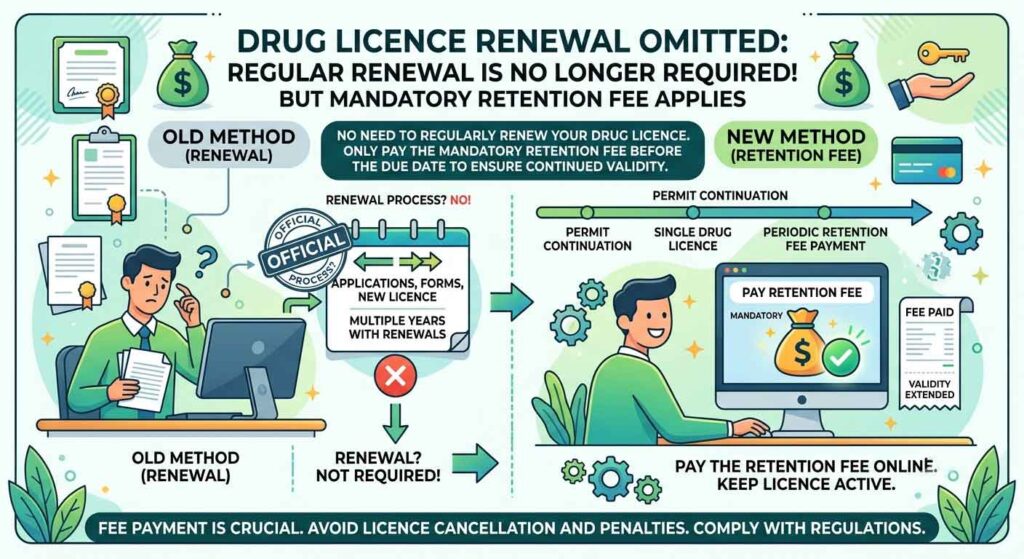
Earlier, pharmaceutical businesses had to renew their drug licences after a fixed period. This renewal process was often time-consuming because the licence holder had to complete formalities similar to a fresh licence application.
After amendment in the Drugs and Cosmetics Rules, the renewal requirement for many pharmaceutical licences was omitted. Now, instead of regular renewal, licence holders are required to deposit a licence retention fee before the expiry of every succeeding five-year period from the date of issue of the licence.
This change is commonly known as perpetual licensing.
However, this does not mean that the licence holder can ignore compliance. The licence remains valid only if it is not suspended or cancelled and the licence retention fee is deposited on time.
What Does “Renewal Omitted” Mean?
“Renewal omitted” means that a licence holder is not required to apply for regular renewal again and again, provided the licence remains valid and the required retention fee is deposited within the prescribed time.
In simple words:
Old system: Apply for renewal before expiry. New system: Licence continues, but retention fee must be paid every five years.
This has reduced paperwork for retail, wholesale, manufacturing, loan licence, and certain other licence holders.
Is Drug Licence Renewal Completely Removed?
Regular renewal has been omitted for many categories, but the licence holder must still:
Deposit licence retention fee on time
Maintain all licence conditions
Follow Drugs and Cosmetics Act and Rules
Maintain premises, staff, storage, and records
Allow inspection by drug authorities
Avoid violations that may lead to suspension or cancellation
So, the licence continues, but compliance responsibility continues also.
What Is Licence Retention Fee?
Licence retention fee is the fee paid by a licence holder to keep the licence valid for the next five-year period.
It is not exactly a renewal application, but it is a mandatory payment.
If the licence retention fee is not paid on time, the licence holder may face penalty and cancellation.
What Happens If Retention Fee Is Not Paid on Time?
If the licence holder fails to deposit the licence retention fee before the due date:
The licence holder must pay the retention fee.
A late fee is also payable.
The late fee is calculated at 2% of the licence fee for every month or part of the month.
This late payment facility is available up to six months.
If payment is not made within this period, the licence is deemed to have been cancelled.
Therefore, every licence holder should maintain a proper reminder system for retention fee payment.
Which Licences Are Affected?
The amendment is relevant for several categories of pharmaceutical licences, including many retail, wholesale, manufacturing, loan licence, testing, cosmetic, and related licence forms.
The exact applicability depends on the licence form, product category, and current rules.
Effect on Retail and Wholesale Drug Licences
For retail and wholesale licences, the major benefit is that regular renewal application is not required in the earlier manner.
However, the premises can be inspected by the Drug Inspector to verify compliance with licence conditions and the provisions of the Drugs and Cosmetics Act and Rules.
This means retailers and wholesalers must continue to maintain:
Proper premises
Required storage conditions
Refrigerator, if applicable
Qualified person or registered pharmacist, as applicable
Purchase and sale records
Invoices and bills
Schedule drug records, where required
Valid licence display
Compliance with sale conditions
Effect on Manufacturing and Loan Licences
Manufacturing and loan licence holders also get relief from repeated renewal procedures.
However, manufacturing units remain under strict compliance requirements.
Before grant of licence and during continued operation, the premises may be inspected to verify whether the manufacturing unit complies with the licence conditions and applicable rules.
Manufacturers must maintain:
Approved premises
Required machinery
Qualified technical staff
Quality control arrangements
Batch manufacturing records
Testing records
Raw material records
Finished goods records
GMP compliance
Proper storage and dispatch system
Perpetual validity does not reduce the responsibility of the manufacturer. In fact, regular compliance becomes even more important.
Inspection Requirement After Renewal Omission
One important effect of this amendment is increased importance of inspection.
For retail and wholesale premises, inspection may be conducted to verify compliance with licence conditions.
For manufacturing and loan licence premises, inspection may be conducted jointly by inspectors appointed by Central and State authorities, depending on the licence category.
The purpose of inspection is to ensure that the licence holder continues to follow the Act, Rules, and licence conditions.
Benefits of Renewal Omission
The omission of regular renewal has several benefits for the pharmaceutical sector.
1. Less Paperwork
Earlier, renewal required repeated documentation. Now the process is simpler because retention fee payment keeps the licence valid, subject to compliance.
2. Time Saving
Licence holders do not have to spend unnecessary time in repeated renewal procedures.
3. Reduced Workload for Drug Department
Drug authorities can focus more on inspection, compliance verification, and quality enforcement instead of routine renewal processing.
4. Better Transparency
A retention fee-based system is easier to track and manage compared to repeated renewal applications.
5. Focus on Compliance
Since licences continue perpetually, authorities can focus more on whether the licence holder is actually complying with the law.
Important Precautions for Licence Holders
Even though renewal has been omitted, licence holders should not become careless.
You should:
Note the five-year retention fee due date
Pay retention fee before the due date
Maintain all required records
Keep premises compliant
Keep technical staff details updated
Inform authorities about changes, where required
Maintain proper storage conditions
Prepare for inspection at any time
Avoid selling or manufacturing outside licence conditions
Does Perpetual Licence Mean Lifetime Licence Without Compliance?
No.
The word “perpetual” does not mean permanent licence without responsibility.
A licence may still be:
Suspended
Cancelled
Deemed cancelled for non-payment of retention fee
Affected by change in constitution
Affected by change in premises
Affected by serious non-compliance
Therefore, licence holders must treat retention fee and compliance as essential legal obligations.
Special Note for Ayurvedic, Cosmetic, and Homoeopathic Products
Different categories may have different rules, forms, portals, and compliance requirements.
For example:
Ayurvedic, Siddha, and Unani drug manufacturing has its own licensing provisions.
Cosmetic manufacturing is now governed under the Cosmetics Rules, 2020.
Homoeopathic manufacturing has separate provisions under the Drugs Rules.
Manufacturing and loan licence requirements differ from retail and wholesale requirements.
Before taking action, always verify the exact requirement with the State Licensing Authority, CDSCO portal, or a qualified regulatory consultant.
Effect of Renewal Omission on the Pharmaceutical Sector
The renewal omission system has changed the way pharmaceutical licences are maintained.
Its major effects are:
Licence holders get relief from repeated renewal formalities.
Drug department workload is reduced.
Compliance monitoring becomes more inspection-based.
Premises may be checked at regular intervals.
Manufacturers are encouraged to maintain proper GMP standards.
Quality standards may improve through periodic inspection.
Licence holders must maintain discipline because non-compliance can still lead to action.
This is a positive change for genuine businesses that maintain proper standards.
Final Thoughts
The omission of regular drug licence renewal has made licence maintenance easier for pharmaceutical businesses. But it has not removed compliance obligations.
Now, licence holders should focus on two important responsibilities:
Pay retention fee on time. Maintain full compliance at all times.
If you hold a retail, wholesale, manufacturing, loan, cosmetic, Ayurvedic, or related licence, you should carefully check your licence conditions and retention fee due dates.
A licence may continue perpetually, but only when the licence holder follows the law.
Frequently Asked Questions
1. Is drug licence renewal required now?
For many pharmaceutical licences, regular renewal has been omitted. However, licence retention fee must be paid every succeeding five years, unless the licence is suspended or cancelled.
2. What is licence retention fee?
Licence retention fee is the fee required to keep the licence valid for the next five-year period.
3. What happens if retention fee is not paid?
If the fee is not paid on time, late fee applies. If it remains unpaid beyond the permitted period, the licence may be deemed cancelled.
4. Does perpetual licence mean no inspection?
No. Inspection can still be conducted to verify compliance with licence conditions and applicable rules.
5. Does this apply to retail and wholesale licences?
Yes, many retail and wholesale drug licence forms are covered under the retention fee system, but the exact applicability should be checked according to the licence form.
6. Does this apply to manufacturing licences?
Yes, many manufacturing and loan licence categories follow the retention fee system, but manufacturing units remain subject to strict compliance and inspection requirements.
7. Is the same rule applicable to cosmetics?
Cosmetic licences are now governed under the Cosmetics Rules, 2020. Many cosmetic licences also follow a perpetual validity and retention fee system, but the applicable forms and rules are different.
8. Can a licence still be cancelled?
Yes. A licence can still be suspended, cancelled, or deemed cancelled for non-compliance, non-payment of retention fee, or violation of licence conditions.
Looking for Ayurvedic Franchise or Distribution Opportunities?
Looking to start an Ayurvedic franchise, become a distributor, or launch your own herbal product range?
Elzac Herbal India offers:
Ayurvedic & Herbal Product Range
Franchise & Distribution Opportunities
Third-Party Manufacturing Services
Product Development Support
Marketing Guidance
PAN India Business Opportunities
Whether you are an entrepreneur, retailer, distributor, or healthcare professional, our team can help you explore the right business opportunity in the growing Ayurvedic sector.
Ajay Kamboj is an entrepreneur and business owners associated with many Ayurvedic and Pharmaceutical start-ups. With years of experience in Ayurvedic product marketing, pharmaceutical distribution, franchise development, and client relationship management, he regularly shares practical business insights based on real-world experiences. His articles focus on business growth, entrepreneurship, customer management, and lessons learned from the healthcare and wellness industry.





Leave a Reply
You must be logged in to post a comment.