Pain relief spray is a popular product category in India. It is commonly used for muscle pain, joint pain, sprain, stiffness, back pain, sports injury, and general body pain.
Many entrepreneurs want to launch a pain relief spray because it has demand in both prescription and over-the-counter markets. However, before launching such a product, one important question must be answered:
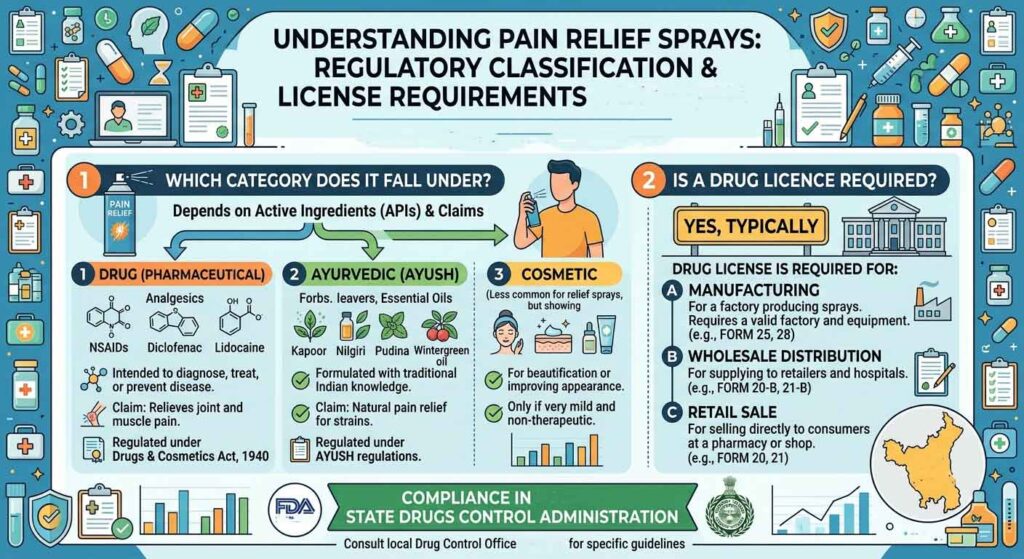
What category does a pain relief spray fall under, and is a drug licence required?
The answer depends on the product’s ingredients, formulation, intended use, manufacturing process, and claims made on the label or advertisement.
How Is Pain Relief Spray Classified?
A pain relief spray may fall under different categories depending on its composition.
Cosmetic, only in very limited non-therapeutic cases
Medical product requiring additional approval, if it is a new formulation
The most important factor is the claim.
If the product claims pain relief, treatment of inflammation, relief from sprain, muscle pain, arthritis pain, or similar therapeutic action, it is generally treated as a drug or medicinal product rather than a simple cosmetic.
If the Spray Contains Pharmaceutical Ingredients
If the pain relief spray contains pharmaceutical active ingredients, it will generally be considered an allopathic drug product.
Examples may include ingredients such as:
Diclofenac
Methyl salicylate
Menthol
Camphor
Capsaicin
Linseed oil with pharmacological claim
Other topical analgesic or anti-inflammatory ingredients
If you want to market, stock, sell, or distribute the product, you may also need the required sale licence, such as wholesale drug licence, depending on your business model.
If the Spray Is Ayurvedic or Herbal
If the formulation is based on Ayurvedic herbs, herbal extracts, classical Ayurvedic ingredients, or traditional pain-relief oils, it may fall under Ayurvedic proprietary medicine or Ayurvedic medicine category.
The formulation should comply with applicable AYUSH rules.
Labeling should be as per Ayurvedic drug requirements.
Ingredient list should be properly declared.
Claims should be supported and legally acceptable.
You should avoid exaggerated disease-cure claims.
If you do not have your own Ayurvedic manufacturing licence, you can explore third-party manufacturing or loan licence manufacturing through a licensed Ayurvedic manufacturer.
Is Pain Relief Spray a Cosmetic?
Usually, no.
A cosmetic is mainly intended for cleansing, beautifying, improving appearance, fragrance, or skin/hair care without therapeutic claims.
A pain relief spray generally makes a therapeutic claim, such as relief from pain, inflammation, sprain, stiffness, or muscular discomfort. Because of this, it is normally treated as a medicinal product rather than a cosmetic.
If a product is promoted as a cosmetic but claims treatment or relief of medical conditions, it may create regulatory risk.
Is a Drug Licence Required for Pain Relief Spray?
In most practical cases, yes.
If the product is an allopathic pain relief spray, it should be manufactured under a valid pharmaceutical manufacturing licence.
If it is an Ayurvedic or herbal pain relief spray, it should be manufactured under a valid Ayurvedic manufacturing licence.
If you are only marketing the product and not manufacturing it yourself, then you should get it manufactured by a properly licensed third-party manufacturer.
For sale, stocking, and distribution, you should also check whether a wholesale drug licence or other sale permission is required in your state and according to the product category.
Manufacturing Licence vs Marketing Licence
Many beginners confuse manufacturing and marketing.
Manufacturing Licence
Required when you manufacture the product yourself.
The manufacturer must have:
Approved premises
Valid manufacturing licence
Technical staff
Machinery
Quality-control system
Batch records
Label approval, where applicable
Product permission, where required
Marketing or Distribution
If you do not manufacture but want to market the product under your brand, you can get it manufactured from a licensed third-party manufacturer.
You may still need:
GST registration
Wholesale drug licence, where applicable
Brand/trademark
Agreement with manufacturer
Product documentation
Proper invoices
Compliant label and claims
How Long Does It Take to Obtain a Manufacturing Licence?
The time required depends on:
State licensing authority
Type of product
Premises readiness
Machinery installation
Technical staff availability
Documentation completion
Inspection schedule
Product approval requirement
Whether formulation is already approved or new
A simple manufacturing licence may take a few months if all documents, premises, machinery, and inspection requirements are complete.
If the formulation is new, contains new ingredients, has novel claims, or requires special approval, the process may take longer.
Should You Manufacture Yourself or Use Third-Party Manufacturing?
For most new entrepreneurs, third-party manufacturing is the better first option.
Third-Party Manufacturing Advantages
Lower investment
Faster launch
No need to set up factory
Licensed manufacturer handles production
Less operational burden
Easier to test market demand
More focus on branding and sales
Own Manufacturing Advantages
More control over production
Better confidentiality if managed properly
Long-term cost control at scale
Better control over process and quality
Practical Suggestion
If you are launching your first pain relief spray, begin with a licensed third-party manufacturer. Once the product establishes market demand, you can consider loan licence or own manufacturing setup.
How to Protect Your Unique Formulation
If you have developed a special formula with a scientist or technical partner, you should protect it before sharing it widely.
Possible protection methods include:
1. Patent Protection
If the formulation is new, inventive, and industrially applicable, you may consult a patent attorney and file a patent application.
2. Non-Disclosure Agreement
Before sharing formula details with manufacturers, sign a proper NDA.
3. Manufacturing Agreement
Your agreement with the manufacturer should include confidentiality, non-compete, non-supply, and non-disclosure clauses.
4. Trade Secret Protection
If you do not want to disclose the full formula publicly through patent filing, you may protect it as a trade secret through strong internal control and contracts.
5. Limited Formula Disclosure
Where possible, disclose only the details necessary for manufacturing and regulatory compliance.
6. Trademark Protection
Register your brand name and logo. Even if the formula cannot be fully protected, your brand identity can be protected.
Important Point About Patent
Patent is not automatically available for every formulation.
To be patentable, the product or process should generally be:
New
Non-obvious
Industrially applicable
If the formulation is only a simple mixture of known ingredients without inventive step, patent protection may be difficult.
Therefore, take professional patent advice before depending only on patent protection.
Step-by-Step Plan to Launch Pain Relief Spray in India
Step 1: Finalize the Formula
Prepare complete formula details including:
Ingredients
Quantity
Function of each ingredient
Solvent or base
Propellant, if aerosol
Fragrance, if any
Preservatives, if any
Manufacturing process
Step 2: Determine Product Category
Ask a regulatory consultant or manufacturer to classify the product as:
Allopathic drug
Ayurvedic drug
Herbal proprietary medicine
Cosmetic
New drug product
OTC medicine
Step 3: Check Regulatory Approval Requirement
Find out whether the formulation is already permitted or whether new approval is required.
Step 4: Decide Manufacturing Route
Choose between:
Own manufacturing licence
Loan licence
Third-party manufacturing
Contract manufacturing
Step 5: Select Licensed Manufacturer
Choose a manufacturer with experience in sprays and external preparations.
Check:
Valid licence
Product approval
Spray manufacturing facility
Filling and packing capability
Quality-control system
Batch size
Delivery timeline
Confidentiality policy
Step 6: Protect Your Formula
Before sharing technical information, sign:
NDA
Manufacturing agreement
Non-supply clause
Confidentiality clause
Intellectual property clause
Step 7: Prepare Label and Claims Carefully
Your label should avoid exaggerated or unsupported claims.
For example, instead of writing:
“Cures arthritis permanently”
Use safer claim language such as:
“Helps provide temporary relief from muscular pain and stiffness”
Final claim wording should be checked by a regulatory professional.
Step 8: Apply for Licence or Use Licensed Manufacturer
If you manufacture yourself, apply for the applicable manufacturing licence.
If using third-party manufacturing, confirm that the manufacturer can legally manufacture that specific product category.
Step 9: Get Product Tested
Before launch, ensure quality testing and stability checks.
Testing may include:
Appearance
Spray pattern
Fill volume
Assay, if applicable
Microbial limits
Stability
Leakage
Container compatibility
Safety-related tests
Step 10: Start Marketing
Once product is manufactured legally and documentation is complete, start marketing through:
Distributors
Retail pharmacies
Doctors
Physiotherapists
Sports shops, where permitted
Online channels, if compliant
Franchise partners
B2B pharma networks
Documents You May Need
Depending on category and business model, documents may include:
Formula details
Ingredient specifications
COA of raw materials
Manufacturing licence copy
Product permission copy, where applicable
GST registration
Brand trademark application
Manufacturing agreement
NDA
Label artwork
Stability data
Finished product COA
Batch manufacturing record
Invoice and supply documents
Common Mistakes to Avoid
Avoid these mistakes when launching pain relief spray:
Calling the product cosmetic while claiming pain relief
Starting manufacturing without checking licence requirement
Sharing full formula without NDA
Depending only on verbal agreement with manufacturer
Making exaggerated disease-cure claims
Not checking whether the manufacturer has approval for spray products
Ignoring stability and packaging compatibility
Launching without trademark search
Not checking aerosol/flammability and transport requirements, if applicable
Assuming herbal products need no licence
Final Answer
A pain relief spray will generally fall under drug or Ayurvedic medicinal product category depending on its ingredients and claims.
If it contains pharmaceutical active ingredients, it should be manufactured under a pharmaceutical drug manufacturing licence.
If it is herbal or Ayurvedic, it should be manufactured under an Ayurvedic manufacturing licence.
For beginners, third-party manufacturing from a licensed manufacturer is usually the best starting option. To protect a unique formula, use patent advice, NDA, manufacturing agreement, confidentiality clauses, and trademark protection.
Before launching, first confirm product classification and licensing requirements with a qualified regulatory expert or the concerned licensing authority.
Frequently Asked Questions
1. Is pain relief spray a drug or cosmetic?
A pain relief spray is usually treated as a drug or medicinal product if it claims relief from pain, inflammation, sprain, stiffness, or muscular discomfort. It is generally not a cosmetic.
2. Does pain relief spray require drug licence?
Yes, in most cases it requires manufacturing under a valid drug or Ayurvedic manufacturing licence, depending on the formulation.
3. Can I market pain relief spray without manufacturing licence?
You may market the product if it is manufactured by a properly licensed manufacturer, but you should check whether sale or wholesale licence is required for your business model.
4. Can herbal pain relief spray be sold without licence?
No. Herbal or Ayurvedic medicinal products manufactured for sale should be made under proper Ayurvedic manufacturing licence or licensed manufacturing arrangement.
5. How can I protect my pain relief spray formula?
You can use patent filing where eligible, NDA, manufacturing agreement, confidentiality clauses, non-supply clauses, trade secret protection, and trademark registration.
6. Is patent the only way to stop manufacturer from copying formula?
No. Patent may help if the formula is patentable, but NDA, contract clauses, trade secret control, and carefully selecting a trustworthy manufacturer are also important.
7. Should I start with third-party manufacturing?
For most new entrepreneurs, third-party manufacturing is practical because it requires lower investment and allows faster market testing.
8. What if my formula is new in India?
If the formulation is new or contains new ingredients or claims, regulatory approval and safety data may be required before manufacturing and sale.
9. Can I import a formula from the USA and manufacture in India?
Yes, but the formulation must comply with Indian regulations. You may need regulatory review, product approval, and manufacturing through an appropriately licensed Indian manufacturer.
10. Can I sell pain relief spray online?
Online sale depends on product category, licensing, labeling, and applicable e-commerce medicine rules. Check with a regulatory professional before online launch.
Looking for Ayurvedic Franchise or Distribution Opportunities?
Looking to start an Ayurvedic franchise, become a distributor, or launch your own herbal product range?
Elzac Herbal India offers:
Ayurvedic & Herbal Product Range
Franchise & Distribution Opportunities
Third-Party Manufacturing
Product Development Support
Marketing Guidance
PAN India Business Opportunities
Whether you are an entrepreneur, retailer, distributor, or healthcare professional, our team can help you explore the right business opportunity in the growing Ayurvedic sector.
Ajay Kamboj is an entrepreneur and business owners associated with many Ayurvedic and Pharmaceutical start-ups. With years of experience in Ayurvedic product marketing, pharmaceutical distribution, franchise development, and client relationship management, he regularly shares practical business insights based on real-world experiences. His articles focus on business growth, entrepreneurship, customer management, and lessons learned from the healthcare and wellness industry.



Leave a Reply
You must be logged in to post a comment.