Retailer margin is one of the most common points of confusion in pharma marketing, PCD business and direct supply to chemists.
Many companies assume retailer margin is calculated directly on MRP. Some retailers claim that they must receive a fixed percentage according to law. Some people calculate margin before GST, while others calculate it after GST.
A common query is:
“I am giving 20% margin to retailers, but one retailer said confidently that according to rule, retailer margin must be 23.8%. He threatened to complain to the Drug Inspector because I am giving him 20% of MRP. Please guide me about the legal rule. I am giving direct supply to retailers.”
The answer is:
There is no universal rule that every retailer must always receive 23.8% margin on every medicine. Retailer margin depends on product category, price-control status, company policy, trade practice and commercial agreement.
However, for price-controlled scheduled formulations under DPCO, retailer margin is considered as per DPCO formula while fixing ceiling price or retail price.
Short Answer
Retailer margin can be understood in two ways:
Commercial retailer margin offered by company or distributor
DPCO margin considered for price-controlled medicines
For non-price-controlled products, retailer margin is usually a commercial matter between supplier and retailer, subject to MRP, invoicing, tax and trade terms.
For scheduled formulations under DPCO, the pricing formula allows 16% margin to retailer on Price to Retailer while fixing ceiling price.
This 16% on PTR is not the same as 16% on MRP.
What Is Retailer Margin?
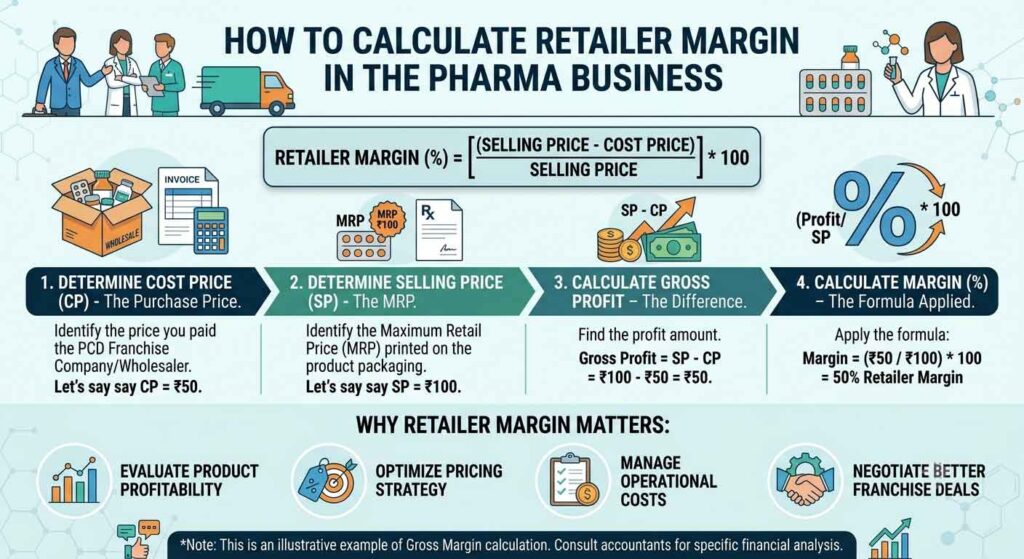
Retailer margin is the earning of the retail chemist between the price at which he purchases the product and the price at which he sells it to the customer.
Simple formula:
Retailer Margin = Selling Price – Purchase Price
If the retailer sells at MRP, then:
Retailer Margin = MRP – PTR
Where:
MRP = Maximum Retail Price
PTR = Price to Retailer
What Is PTR?
PTR means Price to Retailer.
It is the price at which a retailer purchases the product from stockist, distributor, wholesaler or company.
PTR may be shown before GST or inclusive of GST depending on the price list and invoice format.
Always check whether your calculation is before GST or after GST.
What Is MRP?
MRP means Maximum Retail Price.
This is the maximum price printed on the pack at which the product can be sold to the final consumer.
For medicines, MRP is generally printed as inclusive of all taxes.
A retailer cannot sell above MRP.
Is Retailer Margin Fixed by Law?
There is no single fixed legal margin like 23.8% for all medicines in every situation.
For many non-scheduled medicines, margin is commercially negotiated.
What Does DPCO Say About Retailer Margin?
Under the Drugs Prices Control Order, for scheduled formulations, government fixes ceiling prices.
While calculating ceiling price, DPCO allows retailer margin as a percentage of Price to Retailer.
The important point is:
DPCO retailer margin is calculated on PTR, not directly on MRP.
This is why people get confused.
Why 16% on PTR Is Different From 16% on MRP
Suppose PTR is ₹100.
If retailer margin is 16% on PTR, then margin is ₹16.
So price before tax becomes:
₹100 + ₹16 = ₹116
Here retailer earns ₹16 on purchase price of ₹100.
But if someone says retailer margin is 16% on MRP of ₹116, then:
16% of ₹116 = ₹18.56
That is different.
So margin percentage changes depending on whether it is calculated on PTR or MRP.
Why Retailer Claims 23.8% Margin
Sometimes retailers or trade persons quote margins differently because they calculate margin from different bases.
For example:
Margin on PTR
Margin on MRP
Mark-up on purchase price
Discount on MRP
Margin before GST
Margin after GST
Scheme-adjusted margin
This creates confusion.
A retailer may say he wants 23.8%, but you should ask:
23.8% on what?
On MRP?
On PTR?
Before GST?
After GST?
Is it union practice or legal requirement?
Is the product under DPCO?
Is it written in any official price list?
Without this clarity, the claim has no proper meaning.
Is 20% Retailer Margin Wrong?
Not necessarily.
If you are giving 20% margin on MRP and your product is not violating DPCO, GST, invoice or MRP rules, then it is generally a commercial matter.
In many pharma products, retailer margin may vary from around 16% to 25% or more depending on product category and trade practice.
Some products give lower margin but high demand.
Some products give higher margin but lower demand.
There is no single margin that applies to all products.
Can a Retailer Threaten Complaint to Drug Inspector for Margin?
A retailer may complain about many issues, but margin dispute alone is generally a commercial issue unless it involves violation of law.
Drug authorities may check matters such as:
Valid drug licence
Purchase invoice
Sale invoice
Stock records
Batch number
Expiry date
Sale of prescription medicines
Sale of Schedule H/H1/X medicines
Storage conditions
Samples and quality issues
Sale above MRP
Price-control violation
Price list availability
Record maintenance
They do not normally decide ordinary commercial margin disputes between supplier and retailer.
However, if you are violating DPCO, selling above permissible price, maintaining wrong records, selling without licence or issuing improper invoices, then regulatory action may arise.
Important: Direct Supply to Retailer
If you are supplying directly to retailers, ensure that your business has proper wholesale drug licence support.
You should maintain:
Purchase bills
Sale invoices
Batch number
Expiry details
GST invoice
Product price list
Drug licence details
Supplier licence details
Proper stock records
Return and expiry records
Direct supply should not be done casually without licensing and documentation.
If MRP is ₹100 and you want to give 20% margin on MRP:
PTR = MRP – 20%
PTR = ₹100 – ₹20 = ₹80
Retailer buys at ₹80 and sells up to ₹100.
Retailer gross margin = ₹20.
Example: Retailer Wants 20% Mark-Up on Purchase Price
If retailer wants 20% mark-up on PTR and MRP is ₹100, then:
PTR = MRP / 1.20
PTR = ₹100 / 1.20 = ₹83.33
Retailer buys at ₹83.33 and sells at ₹100.
Retailer earns ₹16.67.
This is 20% mark-up on PTR but only 16.67% margin on MRP.
GST Confusion in Retailer Margin
GST creates another confusion.
MRP is inclusive of GST, but invoice price may show taxable value plus GST.
If GST is 5%, then MRP ₹100 includes GST.
Taxable value before GST is approximately:
₹100 / 1.05 = ₹95.24
GST is:
₹4.76
So, when calculating margin, clarify whether you are calculating:
On MRP inclusive of GST
On taxable value before GST
On PTR before GST
On invoice value including GST
For correct accounting, always calculate from invoice and GST structure.
Practical Formula for PTR From MRP
If you want to give retailer margin on MRP:
PTR = MRP × (100 – Margin %) / 100
Example for 20% margin:
PTR = ₹100 × 80 / 100 = ₹80
Example for 25% margin:
PTR = ₹100 × 75 / 100 = ₹75
This is simple trade calculation.
Practical Formula for MRP From PTR
If you know PTR and want to calculate MRP with margin on MRP:
MRP = PTR / (1 – Margin %)
Example:
PTR = ₹80 Retailer margin = 20%
MRP = ₹80 / 0.80 = ₹100
What Margin Should Be Given to Retailers?
Retailer margin depends on business model.
Common practical ranges may be:
Branded prescription products: often lower to moderate
PCD products: moderate to higher
Generic products: often higher
Nutraceutical products: flexible
Ayurvedic products: flexible
OTC products: category-dependent
DPCO products: price-control structure must be checked
You should decide margin after calculating:
Product cost
MRP
PTR
PTS
GST
Stockist margin
Retailer margin
Scheme
Expiry risk
Credit risk
Competition
DPCO status
Market demand
Do not fix margin only because one retailer demands it.
Retailer Margin vs Stockist Margin
In pharma trade, both retailer and stockist need margin.
Typical distribution chain:
Company → Stockist → Retailer → Customer
Stockist margin and retailer margin must be calculated carefully.
If you supply directly to retailer, you may not need separate stockist margin, but you must still maintain proper wholesale licence, billing and supply records.
What If Retailer Refuses to Work Below Certain Margin?
This is a commercial decision.
Retailer may refuse to stock your product if the margin is not attractive.
You can decide whether to:
Increase margin
Offer scheme
Improve demand through prescription
Provide better service
Focus on other retailers
Improve product movement
Reduce MRP if needed
Promote different products
But do not increase margin blindly if it destroys your profitability.
Can Chemist Association Fix Margin?
Some local chemist associations may follow trade practices or recommended margins.
But internal association practice is not automatically a legal rule.
If the market in your area follows a certain standard, you may need to consider it commercially.
However, the retailer should not misrepresent commercial practice as a statutory rule unless there is a specific applicable legal provision.
What Should You Tell the Retailer?
You can professionally say:
“Our margin and PTR are calculated as per company price list, invoice and applicable pricing rules. If the product is under DPCO, we follow the notified price. For non-DPCO products, retailer margin is a commercial term and not a fixed 23.8% statutory rule. We are ready to discuss commercially, but all supplies will be through proper invoice and compliance.”
Do not argue aggressively. Keep documentation ready.
Documents You Should Maintain
For safe business, keep:
Valid drug licence
GST registration
Purchase invoices
Sale invoices
Product price list
Manufacturer price list
Batch-wise stock
Expiry records
Return records
Credit notes
Scheme record
DPCO price check, where applicable
Schedule H/H1 record, where applicable
Good records protect you during inspection.
Common Mistakes in Retailer Margin Calculation
Avoid these mistakes:
Calculating margin without GST clarity
Confusing margin on MRP with mark-up on PTR
Assuming every retailer must get 23.8%
Ignoring DPCO price control
Selling above MRP
Not issuing proper invoice
Supplying without valid licence
Ignoring Schedule H/H1 rules
Not maintaining batch records
Giving excessive margin without profit calculation
Accepting threats without checking law
Final Answer to the Query
If you are giving 20% margin to retailer, it is not automatically illegal.
There is no general rule that every retailer must receive exactly 23.8% margin on all medicines.
For DPCO scheduled formulations, retailer margin is considered as per DPCO formula while fixing ceiling price, and it is calculated on Price to Retailer.
For non-scheduled products, margin is generally a commercial matter between supplier and retailer, subject to MRP, invoice, GST and applicable law.
A Drug Inspector may check licence, invoice, stock records, expiry, quality, schedule-drug compliance and MRP-related issues. But a normal commercial margin dispute is not usually a Drug Inspector matter unless it involves violation of drug law or price-control rules.
The safest approach is to maintain proper documents, check DPCO status product-wise, issue correct invoices and calculate margins clearly.
Frequently Asked Questions
1. Is retailer margin fixed at 23.8% by law?
No. There is no universal rule that every retailer must get 23.8% margin on all medicines.
2. What is the retailer margin under DPCO?
For scheduled formulations under DPCO, 16% margin to retailer on Price to Retailer is allowed while fixing ceiling price or retail price.
3. Is 16% on PTR the same as 16% on MRP?
No. Margin percentage changes depending on whether it is calculated on PTR or MRP.
4. Can I give only 20% retailer margin?
Yes, if your pricing, MRP, invoice and regulatory compliance are proper. Margin is generally commercial unless specific price-control rules apply.
5. Can a retailer complain to Drug Inspector only because margin is low?
He may complain, but low margin alone is normally a commercial issue. Drug authorities focus on licence, records, quality, prescription rules, MRP and price-control compliance.
6. Can retailer sell above MRP?
No. Retailer cannot sell above the printed MRP or applicable price list.
7. Should GST be included in margin calculation?
MRP is inclusive of GST, but invoice value may be before GST plus GST. Always clarify whether your margin calculation is before or after GST.
8. What is PTR?
PTR means Price to Retailer. It is the price at which retailer purchases the product.
9. What records should I maintain for direct supply to retailers?
Maintain drug licence, GST invoices, purchase bills, sale bills, batch number, expiry, price list and stock records.
Looking for Ayurvedic Franchise or Distribution Opportunities?
Looking to start an Ayurvedic franchise, become a distributor, or launch your own herbal product range?
Elzac Herbal India offers:
Ayurvedic & Herbal Product Range
Franchise & Distribution Opportunities
Third-Party Manufacturing Services
Product Development Support
Marketing Guidance
PAN India Business Opportunities
Whether you are an entrepreneur, retailer, distributor, or healthcare professional, our team can help you explore the right business opportunity in the growing Ayurvedic sector.
Ajay Kamboj is an entrepreneur and business owners associated with many Ayurvedic and Pharmaceutical start-ups. With years of experience in Ayurvedic product marketing, pharmaceutical distribution, franchise development, and client relationship management, he regularly shares practical business insights based on real-world experiences. His articles focus on business growth, entrepreneurship, customer management, and lessons learned from the healthcare and wellness industry.


Leave a Reply
You must be logged in to post a comment.