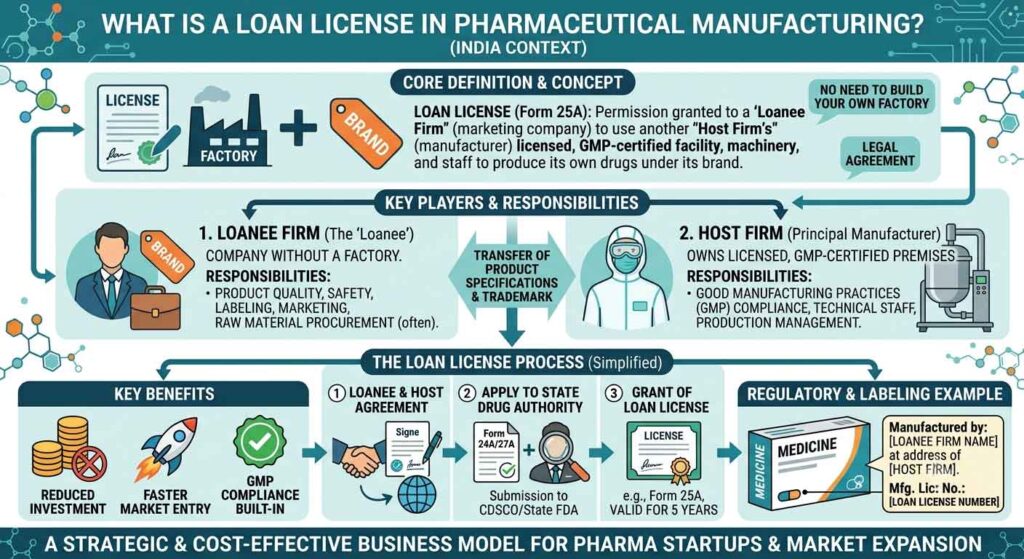
Loan license is a common term used in the pharmaceutical manufacturing business. Many pharma marketing companies want to manufacture their own brand products but do not have their own manufacturing unit. In such cases, they may use another licensed manufacturer’s facility under a loan license arrangement, subject to approval from the licensing authority.
In simple words:
Loan license means getting permission to manufacture your products by using the manufacturing facilities of another licensed pharmaceutical manufacturer.
It is like using another company’s approved manufacturing premises, machinery, equipment, technical staff and testing facilities to manufacture products under your own name or brand, after obtaining the required permission from the licensing authority.
What Is Loan License?
A loan license is a license granted to an applicant who wants to manufacture drugs by using the manufacturing facilities of an existing licensed manufacturer.
The applicant does not set up a full manufacturing unit of his own. Instead, he uses the facility of another manufacturer that already has:
Approved premises
Manufacturing license
Machinery
Equipment
Technical staff
Quality control facilities
Testing arrangement
Manufacturing capacity
The licensing authority checks whether the manufacturing unit has adequate capacity, equipment, staff and testing facilities to manufacture products on behalf of the loan license applicant.
Simple Example of Loan License
Suppose ABC Pharma wants to manufacture tablets under its own brand name but does not own a tablet manufacturing plant.
XYZ Pharmaceuticals already has a licensed tablet manufacturing unit.
ABC Pharma may apply for loan license approval to manufacture its products at XYZ Pharmaceuticals’ premises.
After approval, ABC Pharma can get its products manufactured at XYZ’s facility under the loan license arrangement.
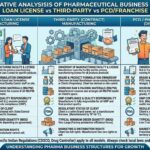
Loan License vs Third-Party Manufacturing
Many people confuse loan license with third-party manufacturing. Both involve using another manufacturer’s facility, but they are not exactly the same.
Point
Loan License
Third-Party Manufacturing
Licensing involvement
Applicant obtains specific loan license approval
Marketing company usually gets products manufactured by licensed manufacturer
Regulatory responsibility
Higher involvement of loan license holder
Manufacturer usually handles manufacturing compliance
For beginners, third-party manufacturing is generally easier. Loan license is more suitable for companies that want more involvement in manufacturing and regulatory control.
Why Companies Choose Loan License
Companies choose loan license because it allows them to manufacture products without investing heavily in their own plant.
Benefits include:
No need to set up full manufacturing unit
Lower investment than own factory
Use of existing licensed facility
Faster manufacturing start compared to own plant
Better control than simple third-party manufacturing
Ability to manufacture own brands
Access to approved machinery and technical staff
Useful for expanding product range
Who Can Apply for Loan License?
A pharma company, marketing company or business entity may apply for loan license if it wants to manufacture drugs by using another licensed manufacturer’s premises.
The exact eligibility depends on:
Type of drug
Dosage form
Manufacturing section
State licensing rules
Existing manufacturer’s license
Product category
Required technical staff
Premises approval
Testing arrangement
Always confirm requirements from the State Drug Control Department or a qualified regulatory consultant before applying.
Basic Conditions for Loan License
Before granting loan license, the licensing authority may check whether:
The manufacturing premises are already licensed.
The manufacturing unit has required machinery.
The unit has enough production capacity.
The unit has qualified technical staff.
Testing facilities are available.
Quality control arrangements are adequate.
Product category is permitted.
Manufacturing and storage areas are suitable.
Documentation system is proper.
Products can be manufactured as per required standards.
The authority may inspect the premises before approval.
Documents Required for Loan License
The exact document list may vary from state to state and according to product category. Common documents may include:
1. Covering Letter
A covering letter mentioning:
Applicant company name
Address of applicant
Manufacturing unit name
Manufacturing premises address
Product category
Purpose of application
2. Application Form
Application should be submitted in the prescribed form and format as required by the licensing authority.
The exact form depends on product category and type of license.
3. Government Fee Receipt
Prescribed government fee should be paid and receipt attached with the application.
4. Constitution of Firm or Company
Documents may include:
Proprietorship declaration
Partnership deed
LLP agreement
Memorandum and Articles of Association
Company incorporation certificate
Board resolution, where applicable
5. Manufacturing License Copy of the Unit
Copy of the existing manufacturing license of the manufacturing unit where products will be manufactured.
6. Consent Letter from Manufacturer
The existing manufacturer should provide consent or agreement allowing the applicant to use its manufacturing facilities.
7. Agreement Between Parties
A written agreement should define:
Manufacturing responsibility
Product list
Quality responsibility
Testing responsibility
Batch release
Documentation
Rejection handling
Recall procedure
Payment terms
Confidentiality
Liability
Termination terms
8. Identity and Address Proof
Identity and address proof of:
Proprietor
Partners
Directors
Authorized signatories
9. Technical Staff Details
Details of technical staff such as:
Manufacturing chemist
Analytical chemist
Quality control personnel
Approved technical persons
Documents may include qualification certificates, experience certificates and approval records, where applicable.
10. List of Machinery
A detailed list of machinery available in the manufacturing unit for the proposed dosage form.
11. Laboratory Equipment List
List of testing instruments and laboratory equipment available for quality control.
12. Site Master File
Site Master File may be required to describe the facility, quality system, manufacturing area, personnel, equipment and procedures.
13. Plant Layout
Blueprint or layout of premises showing:
Manufacturing area
Packing area
Raw material store
Finished goods store
Quality control laboratory
Change rooms
Utility area
Equipment placement
Material and personnel movement
14. HVAC Layout, Where Applicable
For certain dosage forms, HVAC design and layout may be required.
15. Product List
List of products proposed to be manufactured under loan license.
This may include:
Product name
Composition
Dosage form
Strength
Pack size
Product category
16. Water Analysis Report
Water analysis report may be required, especially for liquid, oral, sterile or other water-dependent manufacturing processes.
17. Quality Control Documents
Documents may include:
SOP list
Testing procedure
Specification
Batch manufacturing record format
Batch packing record format
Stability data, where applicable
Validation documents, where applicable
Step-by-Step Procedure for Loan License
Step 1: Select a Licensed Manufacturer
Choose a manufacturer who has approval for the required dosage form.
For example:
Tablets
Capsules
Syrups
Dry syrups
Ointments
Injections
Eye drops
Ayurvedic products, where applicable
Nutraceuticals, under separate applicable rules
Do not choose a manufacturer only because of low rates. Check quality, compliance and capacity.
Step 2: Verify Manufacturer’s License
Check whether the manufacturer has a valid license for the proposed section and product category.
Also verify:
GMP status
Product permission
Quality control facility
Technical staff
Capacity
Past reputation
Complaint handling system
Step 3: Finalize Agreement
Prepare a written agreement between applicant and manufacturer.
The agreement should clearly define responsibilities of both parties.
Step 4: Prepare Product List
Prepare a list of products you want to manufacture.
Do not include doubtful, banned or unapproved combinations.
Check regulatory status before applying.
Step 5: Prepare Documents
Collect all documents required by the licensing authority.
This may include company documents, technical staff details, manufacturing license copy, layout, machinery list, QC details and product list.
Step 6: Submit Application
Submit the application with prescribed fee to the concerned licensing authority.
Step 7: Inspection by Authority
The licensing authority may inspect the manufacturing premises to verify:
Capacity
Equipment
Staff
Facility
Testing arrangement
Storage condition
Documentation
Compliance status
Step 8: Approval and Grant of License
If the authority is satisfied, loan license may be granted for approved products and sections.
Step 9: Start Manufacturing
After approval, manufacturing can start according to license conditions, quality standards and documentation requirements.
Responsibilities of Loan License Holder
The loan license holder should ensure:
Products are manufactured as per approved standards.
Proper documentation is maintained.
Labels and artworks are compliant.
Batch records are available.
COA is issued for each batch.
Quality complaints are handled properly.
Defective batches are investigated.
Product recall procedure is available.
Regulatory requirements are followed.
Loan license holder should not treat the arrangement as only commercial purchase. It involves regulatory responsibility.
Responsibilities of Manufacturer
The manufacturer should ensure:
Manufacturing is done in approved premises.
Proper machinery and equipment are used.
Qualified staff supervises production.
Testing is carried out properly.
Batch records are maintained.
Products meet quality specifications.
Storage conditions are maintained.
Licensing conditions are followed.
Advantages of Loan License
Loan license has several advantages:
Lower investment than own manufacturing unit
Faster entry into manufacturing
Better control than normal third-party manufacturing
Use of approved manufacturing infrastructure
Ability to manufacture own brands
Useful for companies planning future manufacturing
No need to immediately purchase land and machinery
Disadvantages of Loan License
Loan license also has challenges:
More documentation than third-party manufacturing
Regulatory approval required
Dependence on another manufacturer’s facility
Need for clear agreement
Inspection and compliance responsibility
More complex than simple marketing model
May require technical understanding
Not ideal for very small beginners
Is Loan License Suitable for Beginners?
For most beginners, third-party manufacturing is easier than loan license.
Loan license may be suitable if:
You have regulatory knowledge.
You want more control over manufacturing.
You have a stable product plan.
You have sufficient documentation support.
You are working with a reliable manufacturer.
You plan to grow into manufacturing later.
If you are only starting a small pharma marketing company, third-party manufacturing may be simpler.
Loan License for Ayurvedic Products
Ayurvedic manufacturing is regulated separately under applicable AYUSH provisions and state licensing requirements.
If you want loan license or similar manufacturing arrangement for Ayurvedic products, consult the State AYUSH Licensing Authority.
Requirements may differ from allopathic pharmaceutical products.
Loan License for Nutraceutical Products
Nutraceuticals and food supplements usually fall under FSSAI-related compliance, not standard drug manufacturing license, unless the product is legally categorized otherwise.
For nutraceutical products, check:
FSSAI license category
Product approval requirements
Ingredient permissions
Labeling rules
Claims regulations
Manufacturing compliance
Do not assume that pharma loan license rules automatically apply to nutraceuticals.
Loan License vs Own Manufacturing Unit
Point
Loan License
Own Manufacturing Unit
Investment
Lower
Higher
Premises ownership
Not required
Required
Machinery
Manufacturer’s machinery used
Own machinery
Staff
Manufacturer’s approved staff used
Own staff required
Control
Moderate to high
Full control
Compliance burden
Shared/defined
Full responsibility
Setup time
Faster
Longer
Suitable for
Growing companies
Established companies
Loan License vs PCD Franchise
Loan license and PCD franchise are completely different.
PCD franchise is a marketing and distribution model.
Loan license is a manufacturing permission model.
In PCD franchise, you sell or market products.
In loan license, you manufacture products using another licensed facility after approval.
Common Mistakes to Avoid
Avoid these mistakes:
Confusing loan license with third-party manufacturing
Starting without regulatory consultation
Selecting manufacturer only on low cost
Not signing written agreement
Not checking manufacturing license
Not checking product permission
Ignoring quality responsibility
Not collecting batch records and COA
Not defining recall responsibility
Not checking label compliance
Applying without complete documents
Final Thoughts
Loan license is a useful option for pharma companies that want to manufacture their own products without setting up a complete manufacturing unit.
It allows the applicant to use another licensed manufacturer’s facility after obtaining approval from the licensing authority.
However, loan license involves more documentation, more regulatory responsibility and more technical involvement than simple third-party manufacturing.
For beginners, third-party manufacturing is often easier. For companies that want more manufacturing control and are ready for compliance responsibility, loan license can be a practical option.
Before applying, always consult the State Drug Control Department or a qualified regulatory consultant because requirements may vary according to dosage form, product category and state.
Frequently Asked Questions
1. What is loan license in pharma?
Loan license is permission granted to an applicant to manufacture drugs by using the manufacturing facilities of another licensed manufacturer.
2. Is loan license same as third-party manufacturing?
No. Third-party manufacturing is simpler commercial outsourcing, while loan license involves specific licensing approval and more regulatory responsibility.
3. Who grants loan license?
Loan license is granted by the concerned licensing authority, usually through the State Drug Control Department, depending on product category.
4. Can I manufacture my own brand under loan license?
Yes, subject to approval, you can manufacture your own brand products using another licensed manufacturer’s facility.
5. Is loan license suitable for beginners?
For most beginners, third-party manufacturing is easier. Loan license is more suitable for companies with regulatory understanding and stable business plans.
6. What documents are required for loan license?
Common documents include application form, fee receipt, company documents, manufacturer license copy, consent letter, agreement, technical staff details, machinery list, layout, product list and quality documents.
7. Is inspection required for loan license?
The licensing authority may inspect the manufacturing premises before granting approval.
8. Who is responsible for quality under loan license?
Both parties have responsibilities as defined by law and agreement. The manufacturer handles manufacturing operations, while the loan license holder must ensure compliance and product quality oversight.
9. Can Ayurvedic products be manufactured under loan license?
Ayurvedic products follow applicable AYUSH licensing requirements. Consult the State AYUSH Licensing Authority for exact procedure.
10. What is better: loan license or third-party manufacturing?
For beginners, third-party manufacturing is usually better. For companies wanting more control and regulatory involvement, loan license may be suitable.
Partner with Elzac Herbal India
Looking to start an Ayurvedic franchise, become a distributor, or launch your own herbal product range?
Elzac Herbal India offers:
Ayurvedic & Herbal Product Range
Franchise & Distribution Opportunities
Third-Party Manufacturing Services
Product Development Support
Marketing Guidance
PAN India Business Opportunities
Whether you are an entrepreneur, retailer, distributor, or healthcare professional, our team can help you explore the right business opportunity in the growing Ayurvedic sector.
Ajay Kamboj is an entrepreneur and business owners associated with many Ayurvedic and Pharmaceutical start-ups. With years of experience in Ayurvedic product marketing, pharmaceutical distribution, franchise development, and client relationship management, he regularly shares practical business insights based on real-world experiences. His articles focus on business growth, entrepreneurship, customer management, and lessons learned from the healthcare and wellness industry.
One response to “What Is Loan License in Pharmaceutical Manufacturing?”

Need loan licensing