Veterinary supplements are widely marketed for cattle, buffaloes, poultry, pets and other animals.
Common products include:
Liquid calcium supplements
Mineral mixtures
Vitamin supplements
Liver-support feed supplements
Digestive feed supplements
Electrolyte powders
Amino-acid supplements
Milk-production support products
Poultry feed additives
Pet nutritional supplements
A common query is:
“I want to start a marketing company for veterinary supplements such as liquid calcium. The product does not contain any active pharmaceutical ingredient. Do I need FSSAI registration? My expected income will be less than ₹2 lakh. Do I need GST registration at the beginning?”
The practical answer is:
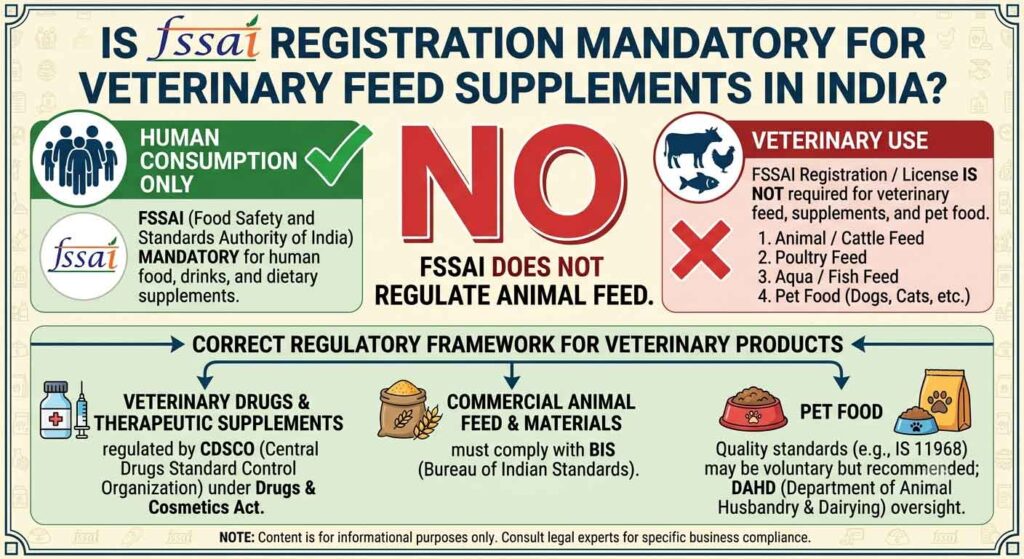
An ordinary veterinary feed supplement intended exclusively for animals generally does not require FSSAI registration merely because it is nutritional. FSSAI primarily regulates food intended for human consumption and excludes animal feed from the definition of food.
However, another licence, approval, standard or registration may apply depending on:
Product composition
Intended animal species
Product claims
State of manufacture
State of sale
Whether the product is feed or medicine
Manufacturing activity
Packaging and labelling
Business turnover and interstate supply
Therefore, product classification must be completed before manufacturing or marketing.
FSSAI Applies to Human Food, Not Ordinary Animal Feed
FSSAI regulates food products intended for human consumption, including:
Human food
Beverages
Food ingredients
Health supplements
Nutraceuticals
Functional foods
Certain dietary products
The Food Safety and Standards Act specifically excludes animal feed from its definition of food.
Therefore, a product intended only for feeding animals should not normally be registered as a human nutraceutical through FSSAI.
For example:
Human Calcium Supplement
A calcium tablet or syrup intended for people may fall under:
Food or nutraceutical regulation, or
Drug regulation,
depending on its composition, claims and regulatory classification.
Veterinary Calcium Supplement
A liquid calcium supplement intended only for cattle or buffaloes is not automatically an FSSAI-regulated human food product.
Its classification may instead be considered under:
Animal feed or feed-supplement requirements
Applicable state feed-control requirements
BIS standards, where relevant
Veterinary drug requirements if therapeutic claims are made
General business, packaging and taxation laws
Is the Absence of an API Enough to Avoid a Licence?
No.
The absence of an API does not by itself determine whether a product is regulated.
API means Active Pharmaceutical Ingredient, but regulatory classification depends on more than whether a recognised pharmaceutical API is present.
Authorities may examine:
Ingredients
Concentrations
Dosage
Product name
Intended purpose
Claims
Label instructions
Promotional literature
Website description
Veterinary recommendation
Route of administration
A product containing only minerals, vitamins or herbs may still create regulatory concerns if it is advertised as treating or curing a disease.
Veterinary Feed Supplement vs Veterinary Medicine
This distinction is extremely important.
Veterinary Feed Supplement
A feed supplement is generally positioned to add nutritional substances to an animal’s normal feed or diet.
Examples of appropriate supportive positioning may include:
Provides calcium and phosphorus
Helps meet nutritional mineral requirements
Supports normal bone health
Supports nutritional requirements during lactation
Provides vitamins and trace minerals
Supports normal growth and productivity
It should not be promoted as a guaranteed treatment for disease unless it is properly licensed as a veterinary medicinal product.
Veterinary Medicine
A product may be treated as a veterinary drug when it is intended or represented to:
Diagnose disease
Prevent disease
Treat disease
Cure disease
Control infection
Alter a pathological condition through medicinal action
Examples of drug-style claims include:
Treats milk fever
Cures hypocalcaemia
Prevents mastitis
Treats infertility
Cures liver disease
Controls bacterial infection
Treats diarrhoea
Works as an antibiotic
A product carrying such claims may require veterinary-drug manufacturing permission, even if the marketer describes it as a supplement.
Example: Liquid Calcium Veterinary Supplement
Consider a liquid product containing:
Calcium
Phosphorus
Vitamin D3
Vitamin B12
Magnesium
Trace minerals
It may potentially be positioned as an animal feed supplement when it is intended to supplement normal nutrition.
Suitable supportive descriptions may include:
Liquid calcium and mineral feed supplement
For cattle and buffaloes
Supports normal calcium and phosphorus intake
Supports bone development and lactation nutrition
To be mixed with feed or administered as directed by a veterinarian
The following claims may change the regulatory risk:
Treatment for milk fever
Prevents postpartum paralysis
Cures calcium deficiency
Guaranteed increase in milk yield
Treats infertility
Works as a veterinary medicine
The complete label and promotional matter should be reviewed before launch.
Does a Marketing Company Need FSSAI Registration?
A company marketing only veterinary feed supplements generally should not obtain FSSAI merely to display an FSSAI number on an animal product.
Using an FSSAI licence number on a product outside the FSSAI framework may mislead buyers into believing that the product has been approved as human food.
Instead, determine:
Who will manufacture the product?
Under which legal category is it manufactured?
Which standards apply?
What claims will appear on the label?
Which authority regulates it in the manufacturing state?
Are there state-specific animal-feed requirements?
Do not apply for an unrelated licence only because customers or distributors ask for “some certificate.”
Is There One Central Licence for All Veterinary Feed Supplements?
India does not have a simple single-window national FSSAI-style licence that applies uniformly to every veterinary feed supplement.
Requirements may differ according to:
Cattle feed
Mineral mixture
Poultry feed
Pet food
Aquaculture feed
Feed additive
Medicated feed
Herbal veterinary product
Veterinary medicine
State-level rules and product-specific standards may also apply.
Therefore, the manufacturer should obtain written classification guidance from the relevant authority before starting production.
BIS Standards and Veterinary Feed Products
Bureau of Indian Standards specifications exist for various animal-feed and mineral products.
Depending on the product, relevant standards may cover areas such as:
Compounded cattle feed
Mineral mixtures
Poultry feed
Ingredient quality
Nutrient content
Contaminant limits
Sampling and testing
Whether BIS certification is mandatory or voluntary must be checked for the exact product and any applicable Quality Control Order or state requirement.
Do not print:
BIS Standard Mark
ISI mark
BIS licence number
unless the manufacturer is legally authorised to use it.
State Animal Feed Requirements
Some states may have:
Cattle-feed control orders
Animal-feed quality requirements
Registration systems
Manufacturing permissions
Local animal-husbandry requirements
Agriculture-department supervision
A business planning pan-India supply should not assume that the practice followed in one state will automatically be accepted everywhere.
Confirm requirements in:
Manufacturing state
Main marketing state
States where stock will be stored
States with specific feed-control rules
When Is a Veterinary Drug Licence Required?
A veterinary drug manufacturing licence may be required when the product legally qualifies as a drug for animals.
This may apply to products such as:
Veterinary antibiotics
Antiparasitic drugs
Hormonal preparations
Veterinary analgesics
Anti-inflammatory preparations
Veterinary injections
Medicinal boluses
Therapeutic oral liquids
Medicated powders
Certain disease-treatment herbal products
The product should then be manufactured by a unit holding appropriate permission for:
Veterinary dosage form
Exact composition
Manufacturing premises
Product category
A general feed-supplement unit should not manufacture veterinary medicines without the appropriate licence.
What About Herbal Veterinary Supplements?
A herbal product does not automatically become exempt from regulation.
Its classification depends on:
Ingredients
Source of ingredients
Intended use
Claims
Dosage
Manufacturing process
Applicable regulatory category
A herbal feed supplement with nutritional or general wellness positioning may be treated differently from a product claiming to treat a defined animal disease.
Avoid assuming:
“It contains only herbs, so no licence is required.”
Veterinary Supplement Labelling Checklist
A properly prepared veterinary feed-supplement label may need information such as:
Product name
Clear product category
“For animal use only”
Target animal species
Complete composition
Quantity of each ingredient
Net quantity
Directions for use
Recommended feeding level
Storage conditions
Batch number
Manufacturing date
Best-before or expiry date
Manufacturer’s name and address
Marketer’s name and address
Customer-care details
MRP
Applicable registration or licence details
Precautions
Veterinary-consultation statement, where appropriate
The exact label should be reviewed according to the applicable product category.
Important Claims to Avoid
Unless supported by the appropriate veterinary-drug permission, avoid claims such as:
Cures milk fever
Treats infertility
Prevents mastitis
Cures retained placenta
Treats liver disease
Controls bacterial infection
Guaranteed milk increase
Replaces veterinary treatment
No side effects
100% guaranteed results
Doctor-recommended, without evidence and permission
Even the product name can create a medicinal claim.
For example, names containing words such as:
Cure
Treatment
Anti-infection
Mastitis
Fever
Fertility cure
may create a different regulatory impression from a neutral nutritional brand name.
Registrations Commonly Considered for a Veterinary Supplement Marketing Company
Depending on business structure, you may need:
Proprietorship, partnership, LLP or company registration
PAN
Current bank account
GST registration, where applicable
Local shop and establishment registration
Trademark application
Legal Metrology compliance
Warehouse or trade permissions
State-specific animal-feed registration
Import Export Code if exporting or importing
Not every registration applies to every business.
Is GST Based on Income or Turnover?
GST registration is not determined by the proprietor’s personal income.
It is based primarily on factors such as:
Aggregate business turnover
Nature of supply
State of registration
Interstate transactions
E-commerce activity
Compulsory-registration categories
For GST purposes, turnover generally refers to the total value of applicable business supplies, not profit.
Example:
Sales: ₹30 lakh Business expenses: ₹28 lakh Profit: ₹2 lakh
GST turnover is not treated as only ₹2 lakh merely because that is the profit.
GST Threshold for Goods
For suppliers dealing in goods, the general threshold commonly applied in many states is ₹40 lakh of aggregate annual turnover.
A lower threshold may apply in certain states or situations.
The threshold should not be quoted as universally ₹40 lakh without checking:
State
Nature of product
Nature of supply
Business model
Applicable notification
Is GST Required for Interstate Supply?
Interstate transactions can trigger additional GST considerations.
The old statement that GST is always mandatory for every interstate transaction, without exception, is too broad because GST law contains different exemptions and conditions for different categories.
However, a goods business planning regular interstate supply should obtain professional GST advice before starting.
A GST registration may also be commercially necessary because:
E-commerce platforms may impose documentation requirements.
Should a Startup Take GST Voluntarily?
Even when turnover is below the threshold, voluntary registration may be considered when:
Selling to distributors
Selling across states
Supplying registered businesses
Claiming input tax credit
Selling through certain online channels
Building a national distribution network
But voluntary registration also creates ongoing obligations, including:
Tax invoices
Return filing
Record maintenance
Tax payment
Reconciliation
Take GST registration after discussing the business model with a qualified GST professional.
Example for a Small Veterinary Supplement Startup
Suppose you want to market liquid calcium for cattle.
Your proposed structure may be:
Register a proprietorship or company.
Select a compliant product category.
Choose a suitable manufacturer.
Obtain the manufacturer’s legal and quality documents.
Conduct a trademark search.
Prepare compliant label matter.
Confirm state animal-feed requirements.
Determine GST applicability.
Sign a manufacturing agreement.
Start with limited quantity.
Supply through invoices.
Maintain complaint and batch records.
Do not manufacture or print packaging until product classification is confirmed.
Can a Feed Supplement Be Sold Through Veterinary Doctors?
Yes, veterinary feed supplements may be promoted through appropriate veterinary and animal-husbandry channels.
Potential buyers include:
Veterinary doctors
Dairy farmers
Poultry farms
Feed dealers
Veterinary pharmacies
Cattle-feed distributors
Dairy cooperatives
Animal-husbandry businesses
Promotional information should remain consistent with the product’s legal category.
Do not ask veterinarians or distributors to use medicinal claims that are absent from the approved label.
Can the Same Product Be Used for Multiple Animal Species?
Only when the composition and directions are suitable for the relevant species.
A product for cattle should not automatically be promoted for:
Poultry
Dogs
Cats
Horses
Fish
Goats
Animal species differ in:
Nutritional requirements
Tolerance
Metabolism
Dose
Toxicity risks
The label should clearly identify intended species and feeding directions.
Practical Answer to the Query
For a veterinary liquid calcium feed supplement:
FSSAI registration is generally not required merely because the product contains nutrients, since ordinary animal feed is outside the definition of food under the FSS Act.
The absence of an API does not automatically make the product licence-free.
Check whether it is a feed supplement, mineral mixture, feed additive or veterinary medicine.
Avoid therapeutic disease-treatment claims unless the product is licensed accordingly.
Verify BIS and state-specific animal-feed requirements.
Get the product manufactured by a suitable and legally compliant manufacturer.
Obtain complete composition, specifications and batch-wise COA.
Determine GST on the basis of aggregate turnover and business activity, not personal income.
Your expected personal income of less than ₹2 lakh is not the deciding factor for GST.
Before launch, obtain written advice on the exact composition, label, claims, manufacturing state and proposed sales route.
Frequently Asked Questions
1. Is FSSAI compulsory for veterinary feed supplements?
Generally, ordinary animal feed is excluded from the definition of food under the FSS Act. Therefore, FSSAI is not normally the relevant registration merely because the product is a feed supplement.
2. Does a liquid calcium supplement need a veterinary drug licence?
It depends on its composition, intended use and claims. A nutritional feed supplement may differ from a product claiming to treat hypocalcaemia or milk fever.
3. Does “no API” mean no licence is required?
No. Regulatory classification depends on the complete product, claims and intended use, not only the presence of an API.
4. Can an FSSAI number be printed on veterinary supplements?
Do not print an FSSAI number unless the product and business genuinely fall within the applicable FSSAI framework.
5. Is BIS certification required?
Relevant BIS standards may apply to certain feed or mineral products. Whether certification is mandatory must be checked for the exact product and applicable government orders.
6. Can I market veterinary supplements through third-party manufacturing?
Yes. Select a suitable manufacturer, verify its documents, sign an agreement and ensure the product is legally classified and properly labelled.
7. Is GST based on profit?
No. GST applicability is generally based on aggregate turnover and other statutory conditions, not net profit or personal income.
8. What is the common GST threshold for goods?
₹40 lakh is a commonly applicable threshold for suppliers of goods in many states, but lower thresholds and compulsory-registration cases may apply.
9. Is GST compulsory for interstate veterinary-supplement sales?
Interstate supply can affect registration requirements. The exact structure and applicable exemptions should be checked with a GST professional before starting.
10. What should be written on a veterinary supplement label?
The label should clearly state the product category, composition, target species, directions, batch details, dates, net quantity, manufacturer, marketer, storage and applicable cautions.
Final Thoughts
Veterinary supplements should not be treated as completely unregulated products.
The correct approach is:
Classify the product → Verify ingredients and claims → Check state and product-specific rules → Select a compliant manufacturer → Prepare the label → Determine GST → Start marketing
For a liquid calcium feed supplement, FSSAI will not ordinarily be the correct licence simply because calcium is also used in human nutrition.
At the same time, calling the product a feed supplement cannot be used to avoid veterinary-drug requirements when its actual claims and intended use are therapeutic.
The safest strategy is to keep the formulation nutritional, use responsible claims and obtain written regulatory guidance before launching the brand.
Looking for Ayurvedic Franchise or Distribution Opportunities?
Looking to start an Ayurvedic franchise, become a distributor, or launch your own herbal product range?
Elzac Herbal India offers:
Ayurvedic & Herbal Product Range
Franchise & Distribution Opportunities
Third-Party Manufacturing Services
Product Development Support
Marketing Guidance
PAN India Business Opportunities
Whether you are an entrepreneur, retailer, distributor, or healthcare professional, our team can help you explore the right business opportunity in the growing Ayurvedic sector.
Ajay Kamboj is an entrepreneur and business owners associated with many Ayurvedic and Pharmaceutical start-ups. With years of experience in Ayurvedic product marketing, pharmaceutical distribution, franchise development, and client relationship management, he regularly shares practical business insights based on real-world experiences. His articles focus on business growth, entrepreneurship, customer management, and lessons learned from the healthcare and wellness industry.



Leave a Reply Cancel reply
You must be logged in to post a comment.